Technical Knowledge
Timing Control of Concrete Spreader & Power Trowel Machine Collaboration
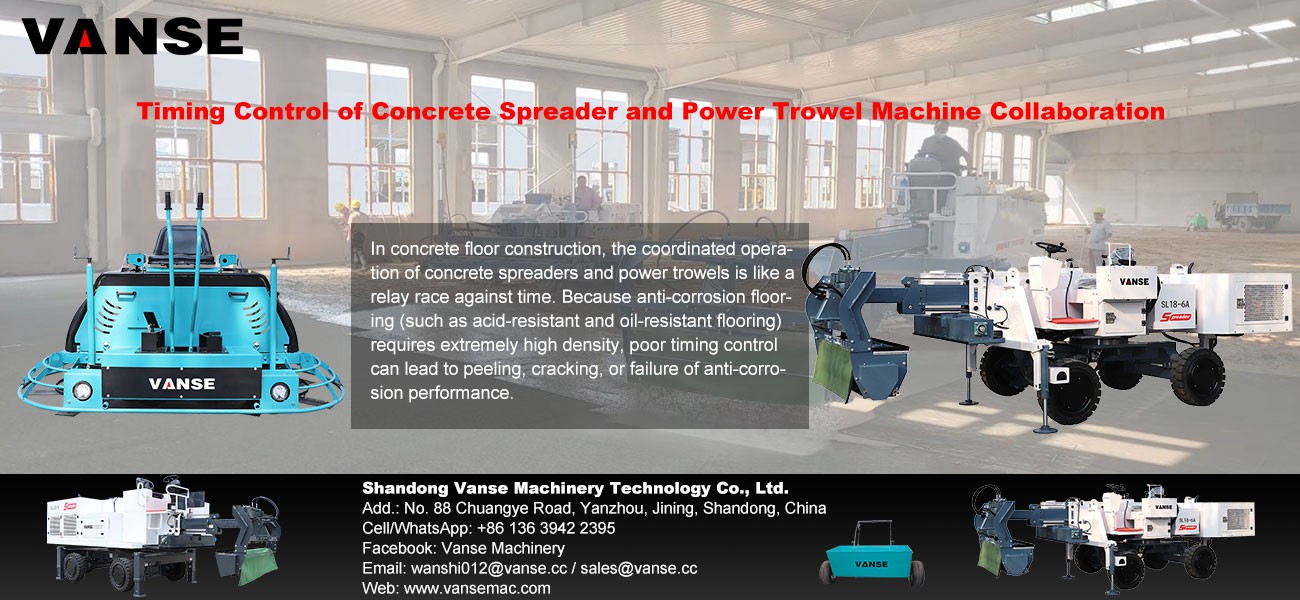
In concrete floor construction, the coordinated operation of concrete spreaders and power trowels is like a relay race against time. Because anti-corrosion flooring (such as acid-resistant and oil-resistant flooring) requires extremely high density, poor timing control can lead to peeling, cracking, or failure of anti-corrosion performance.
The following are the key timing points and collaborative logic in the standard construction process:
1. Key Timeline and Collaborative Process
Phase 1: Concrete Spreader Arrival (Initial Setting Stage)
Judgment Criteria: After concrete paving and leveling, when construction workers step on the concrete surface, the footprint depth is approximately 3mm-5mm.
Collaborative Operation:
At this point, most of the moisture on the concrete surface has evaporated, but it can still moisten the aggregate.
The spreader begins spreading the first layer of material (usually 2/3 of the total).
Note: Spreading material on a surface with standing water is strictly prohibited, as it will dilute the thickness of the anti-corrosion coating.
Phase Two: Initial Grouting (Following Material Spreading)
Judgment Criteria: After material spreading, wait for the aggregate to absorb moisture from the concrete and darken (approximately 5-15 minutes).
Coordinated Operation:
The power trowel, equipped with a "disc," performs the initial grouting.
Objective: Through the kneading action of the disc, the anti-corrosion aggregate is pressed into the concrete surface, integrating it with the base grout.
Phase Three: Secondary Material Application and Fine Leveling
Timing: Immediately after the initial slurry application.
Coo rdinated Operation:
The material application machine applies the remaining 1/3 of the material (to reinforce areas unevenly applied in the first round).
The power trowel then applies the slurry again in a crisscrossing pattern.
Phase 4: Mechanical Finishing (Before Final Setting)
Judgment Criteria: The concrete begins to harden; footprints are barely visible when stepped on.
Coordinated Operation:
The power trowel removes its disc and uses a blade for finishing.
Key to Corrosion Prevention: 3-4 repeated finishing passes are required. As the concrete hardens, continuously increase the blade angle until a mirror-like surface is achieved.
2. Impact of Construction Environment on Joints (Dynamic Adjustment)
Construction joints are not fixed; the coordination speed of the spreading machine and the power trowel must be adjusted according to environmental changes.
| Environmental factors | Impact on timing | Coordinated Adjustment Strategies |
| High temperature/strong wind | Concrete dehydrates extremely quickly, shortening the window period. | The spreading machine should closely follow the leveling machine, and the number of power trowels should be increased to operate synchronously. |
| Low temperature/high humidity | Slow setting; premature construction may bury materials. | Extend the waiting time to prevent aggregate from settling to the bottom of the concrete. |
| Indoor/underfloor heating | The bottom heats up quickly, causing a skin to form on the surface. | The power trowel should apply slurry as early as possible to prevent "false drying" that can lead to hollow areas. |
3. Special Control Points for Anti-corrosion Flooring
For special functional flooring such as acid-resistant and oil-resistant flooring, extra attention needs to be paid during collaborative construction:
Prioritize Density: The power trowel should apply 1-2 more passes than for ordinary flooring to seal all micropores and prevent acid/oil penetration.
Joint Treatment: When the spreader is moving, ensure that the overlap area between two applications is approximately 10cm. The power trowel should then focus on strengthening the grinding at the overlap area.
Finished Product Protection: After the final pass, a curing agent or anti-corrosion sealant should typically be sprayed within 4-6 hours.
Construction Recommendations
If your construction area is large (over 1000㎡ per day), we recommend using a combined operation mode of laser leveling machine + automatic material spreader + ride-on power trowel to ensure that the corrosion resistance of the entire floor is at a consistent level.
Is your current construction environment indoors or outdoors? Depending on the ventilation conditions, I can provide you with detailed parameters for controlling the material spread thickness.
Note: The parameters provided in this document are for reference only and are not mandatory. Due to differences in technical characteristics between different brands and models of laser levelers, please consult the manufacturer for a suitable solution before actual operation. This reference document assumes no responsibility for any issues arising from failure to follow the manufacturer's instructions.
Thanks to All the Friends Who Support and Trust Shandong Vanse Machinery Technology Co., Ltd.
If you want to know more about Shandong Vanse Machinery Technology Co., Ltd. or have any questions, please feel free to contact us:
Our Factory
Shandong Vanse Machinery Technology Co., Ltd.








Share this article

About the Author: Shandong Vanse Machinery Technology Co., Ltd.
Shandong Vanse Machinery Technology Co., Ltd. is a high-tech manufacturer specializing in concrete construction machinery, including laser screeds and related equipment. The company integrates R&D, production, and global sales, with products exported to over 60 countries and widely used in infrastructure projects worldwide.
Previous Post
Next Post
Related Articles
You Might Also Like
How to improve construction efficiency of large-area floor concrete laser leveling machine leveling construction method?
– Before construction, plan the order of concrete pouring and leveling according to factors such as the size, shape and entrance and exit locations of the site. For example, for a large rectangular floor, you can adopt a construction sequence that gradually advances from one end to the other, or use block construction, skip-bin construction and other methods. This can avoid confusion and cross-operation during the construction process and improve construction efficiency. – At the same time, it is necessary to coordinate the links of concrete supply, distribution and leveling. Ensure that concrete can be supplied continuously and the distribution speed matches the working speed of the leveling machine. For example, when the concrete supply is sufficient, arrange a suitable number of distribution equipment (such as concrete distributor or loader) in front of each laser leveling machine so that the distribution can keep up with the progress of the leveling machine in time and reduce the waiting time of the leveling machine. – Strengthen communication and collaboration between construction teams. Operators, quality inspectors and concrete suppliers should maintain close contact and communicate construction progress and problems in a timely manner through communication tools such as walkie-talkies. For example, when there is a short delay in the supply of concrete, the leveling machine operator can adjust the working speed in advance or pause at a suitable position, waiting for the concrete supply to resume before continuing the construction quickly. – Make overall arrangements for construction equipment. In the process of concrete pouring and leveling, a variety of equipment is involved, such as concrete mixers, concrete spreaders, laser levelers, etc. Reasonable arrangement of the entry and exit time of these equipment, as well as the conversion and coordination between equipment, can effectively reduce the idle time of equipment and improve the overall utilization rate of equipment. For example, when a laser leveling machine completes the leveling work of an area, another concrete spreader can quickly enter the area to spread the next layer of concrete, achieving seamless connection. – Choose a high-performance concrete laser leveling machine. Advanced leveling machines have higher working efficiency. For example, some large laser leveling machines have a leveling head width of up to 3-5 meters and a working speed of up to 20-30 square meters per minute. Compared with traditional small equipment, they can complete large-area leveling work in a short time. – Regularly maintain and service the leveler to ensure that the equipment is in the best working condition. Check and replace worn parts such as scrapers, vibrators, etc. to ensure the working accuracy and stability of the equipment. For example, regularly clean the laser receiver and transmitter of the leveler so that it can accurately receive and transmit laser signals to improve the accuracy and speed of leveling. – Provide professional training for leveler operators to improve their operating proficiency and skill level. Operators should be familiar with the various functions and operating methods of the leveler and be able to quickly adjust the working parameters of the equipment according to different construction conditions (such as concrete slump, site slope, etc.). For example, skilled operators can accurately control the scraper height and vibration frequency of the leveler according to the changes in the laser signal, while ensuring the construction quality and improving work efficiency. – Cultivate the safety awareness and emergency handling capabilities of operators. During the construction process, they can promptly discover and handle equipment failures, safety hazards and other problems to avoid construction delays caused by these problems. For example, when a leveler has a minor fault, the operator can quickly determine the cause of the fault and perform simple repairs or take temporary measures to restore the equipment to normal operation as soon as possible. – Use a high-precision laser control system to achieve automatic leveling. The laser transmitter emits a stable laser plane, and the laser receiver of the leveler can receive the laser signal in real time and transmit the signal to the control system. The control system automatically adjusts the working parts of the leveler to make the leveling work more accurate and efficient. Compared with the traditional manual leveling method, it greatly saves time and manpower. – Combined with laser scanning technology, the site can be quickly scanned before construction to obtain the terrain data of the site. Based on these data, the construction plan can be planned in advance, such as determining the thickness of the concrete and the working route of the leveler, so as to improve the construction efficiency. For example, in the construction of sites with complex terrain, the terrain data obtained by laser scanning can enable the construction team to make targeted construction preparations and avoid repeated adjustments during the construction process. – Use auxiliary equipment such as concrete spreading machines to improve the efficiency and uniformity of concrete spreading. The spreading machine can quickly and evenly distribute concrete in the site, providing good working conditions for the laser leveling machine. Compared with the traditional manual spreading method, it is not only faster, but also can ensure the consistency of the thickness of the spreading material, and reduce the adjustment time of the leveling machine during the work process. – Equipped with an intelligent monitoring system to monitor the construction process in real time. Through the sensors and cameras installed on the equipment, the monitoring system can obtain information such as construction progress, equipment status, construction quality, etc., and transmit this information to the control center or the manager's mobile device. In this way, managers can find problems in time and make adjustments to ensure efficient construction.Laser leveling machine manufacturers will fully popularize the misunderstandings of using equipment for you
Before using the laser leveling machine, you should read the instruction manual carefully, which can effectively reduce the occurrence of misunderstandings. Secondly, you cannot use it only according to your own wishes. Incorrect use will seriously affect the working efficiency of the equipment, so we need to understand the use of the equipment in detail. The following laser leveling machine manufacturers share with you what misunderstandings exist when using the equipment. ✸ It is better to have more oil than less: We know that a small amount of laser leveling oil will cause insufficient oil supply and poor lubrication, leading to mechanical accidents. Therefore, when refueling, you should not "prefer to add more" for fear of insufficient oil. In fact, too much oil will not only increase the power consumption of the crankshaft due to increased rotational resistance, but also the oil is prone to bubbles, emulsification and leakage, resulting in poor lubrication. ✸ If the lubricating oil turns black, it means that the lubricating oil has deteriorated: Modern lubricating oils are added with appropriate amounts of various additives to improve their lubricating properties. It is normal for the lubricating oil of internal combustion machinery with detergent dispersants to turn black shortly after use. It cannot be easily replaced because the "oil has deteriorated". Lubricating oil with additives often makes the bearing surface turn black during use, which is also a normal phenomenon. Therefore, when we determine whether the lubricating oil has deteriorated, we cannot judge it by sight alone, but conduct a comprehensive analysis. When conditions permit, the oil should be tested and tested to ensure that the oil is changed according to quality. ✸ Oil with high viscosity is more beneficial to the engine than oil with low viscosity. If the viscosity grade of lubricating oil is too high, the pumping performance of the oil pump will be poor, the flow rate will be reduced, and its lubricity, washing and heat dissipation will deteriorate, which will easily cause semi-dry friction of the machine parts, causing failures such as burning and shaft seizure. ✸ Change the oil according to the oil grade required by the laser leveler: The oil grade specified in the laser leveler manual is for general working conditions. In the practice of machine oil change and maintenance, the actual use conditions must also be considered. If the actual use conditions are more stringent than the specified use conditions, a higher grade oil should be selected (through testing) or the oil change cycle should be shortened appropriately. ✸ Using high-viscosity engine oil can solve the problems of engine powerlessness and oil leakage: The engine powerlessness, oil consumption and oil leakage are external characteristics of the deterioration of the engine's technical condition. The basis for "using high-viscosity engine oil to solve the above problems" is insufficient. On the contrary, it will increase the starting resistance of the engine, deteriorate the lubrication performance, and aggravate the wear of the parts. The knowledge about the misunderstandings shared by the laser leveler manufacturer for you is explained here. It is recommended that you do not use it according to the methods in the article when using it. Such misunderstandings will seriously affect the working efficiency of the equipment. Thank you for your continued attention and support.What are the applicable scenarios for concrete laser leveling machines?
Concrete laser leveling machines are suitable for a variety of scenarios. The following are some common applicable scenarios: 1. Floor construction: Concrete laser leveling machine can be used for various floor construction, such as industrial plants, commercial plazas, parking lots, airport runways, etc. 2. Road construction: Concrete laser leveling machine can be used for the construction of urban roads, highways, bridges and other roads. 3. Bridge construction: Concrete laser leveling machine can be used for bridge construction, such as bridge decks, piers, etc. 4. Airport construction: Concrete laser leveling machine can be used for the construction of airport runways. 5. Others: Concrete laser leveling machines can also be used for construction in underground parking lots, subway platforms, squares and other places. In general, concrete laser leveling machines are suitable for large-area floor construction, such as large industrial plants, workshops, Automated three-dimensional warehouses, clean factories such as electronic appliances, food materials, medicine, etc., large warehouse supermarkets, logistics centers, convention and exhibition centers, etc., as well as outdoor floors such as docks, container yards, freight yards, squares, residential floors, municipal roads, etc. In addition, the concrete laser leveling machine is also suitable for the construction of various roads and bridges. The above information is for reference only. If necessary, you can consult us.