Technical Knowledge
Application of Spreaders in Anti-corrosion Concrete Flooring (e.g., Acid-resistant, Oil-resistant)
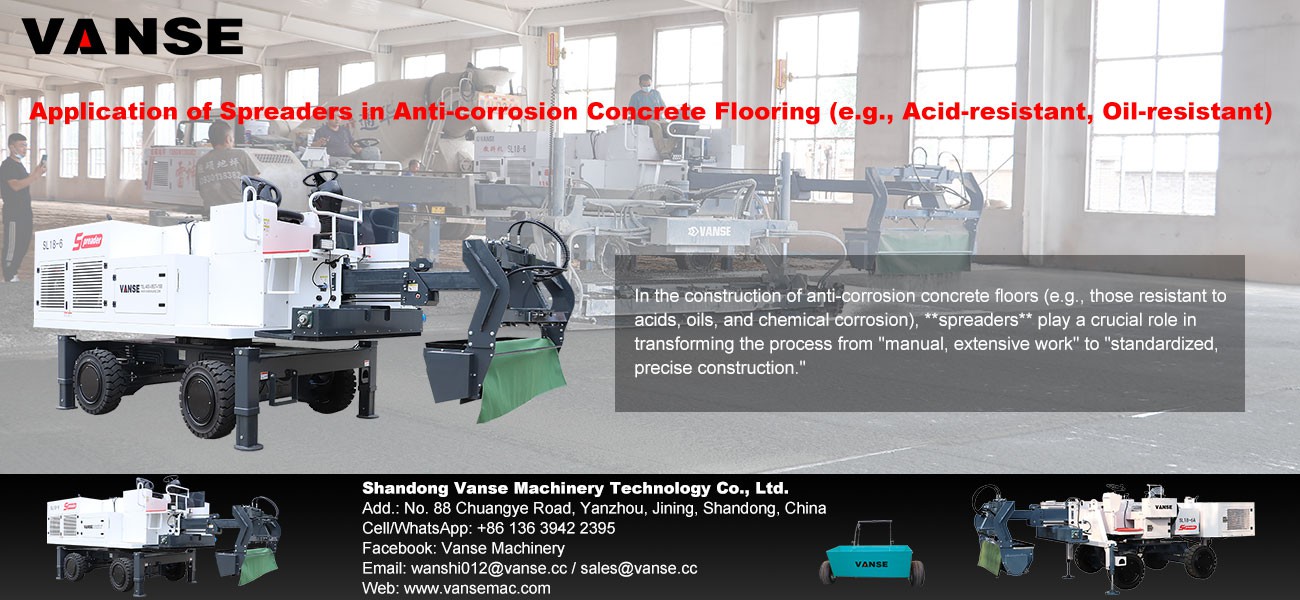
In the construction of anti-corrosion concrete floors (e.g., those resistant to acids, oils, and chemical corrosion), **spreaders** play a crucial role in transforming the process from "manual, extensive work" to "standardized, precise construction."
Unlike ordinary wear-resistant floors, anti-corrosion floors have stringent requirements for the uniformity and density of material distribution. The following is an analysis of the specific applications of spreaders in this field:
1. Core Functions of Spreader in Anti-corrosion Flooring
When constructing anti-corrosion concrete floors (typically involving hardeners, aggregates, or special resin mortars), spreaders primarily address the following three major challenges:
Precise Quantity Control: Anti-corrosion materials (such as quartz sand, corundum, or alloy aggregates) are generally more expensive than ordinary materials. Spreaders can precisely control the amount spread per square meter within an error range (e.g., 5 kg/m²), avoiding localized areas that are too thin (easily corroded) or too thick (easily cracked) due to manual spreading.
Physical Density: Spreaders are typically used in conjunction with laser leveling machines to uniformly spread the material over a large area during the initial setting phase of the concrete. This uniformity ensures a tight bond between the anti-corrosion surface layer and the base concrete, reducing porosity and thus improving the floor's impermeability-a key factor in anti-corrosion.
Synchronized Progress: The construction window for anti-corrosion flooring is extremely short. The high efficiency of spreaders ensures that, during large-area construction, the material is pressed into the surface in the optimal hydration state of the concrete.
2. Application Scenarios for Different Environments
A. Oil-resistant Flooring (Factories, Hangars, Garages)
This type of flooring requires extremely high sealing properties.
Application: Use a spreader to evenly distribute non-metallic hardened aggregate.
Effect: The resulting dense layer effectively prevents engine oil and cutting fluid from seeping into the concrete through capillaries, avoiding a loose or crumbling base layer.
B. Acid and Alkali Corrosion Resistant Flooring (Chemical Plants, Laboratories, Food Processing Plants)
Although concrete itself is not resistant to strong acids, modern processes often involve applying a vinyl ester mortar or epoxy anti-corrosion mortar to the surface.
Application: When laying anti-corrosion aggregate layers over large areas, the spreader ensures a consistent distribution density of the corrosion-resistant filler.
Effect: Eliminates "weak points and gaps" left by manual operation, preventing acidic media from "drilling" through sparsely distributed areas and corroding the reinforcing steel.
3. Comparison of construction process flow
| Links | Manual material application | Automatic spreading machine application |
| Uniformity | Relies on experience, easily resulting in uneven application and weak areas. | Uniform height, fully automated control. |
| Denseness | Secondary leveling is difficult. | Instant bonding with the substrate after application, minimizing air bubbles. |
| Corrosion resistance life | Due to localized weaknesses, premature pitting corrosion is likely. | Uniform coating thickness, extending overall lifespan by over 30%. |
| Material loss | Loss rate is approximately 10%-15%. | Loss rate controlled below 3%. |
4. Key Technical Considerations
Timing: In anti-corrosion flooring construction, spreading the aggregate too early will cause it to settle to the bottom, negating its anti-corrosion protective effect; spreading it too late will prevent it from forming a cohesive whole with the concrete, leading to peeling later.
Overlapping Area Treatment: The spreader's path should have slight overlap to ensure that the anti-corrosion performance at the joints is not compromised.
Multiple Process Coordination: After spreading, a power trowel must be used for multiple finishing processes to further improve the surface layer's wear resistance and impermeability through mechanical pressure.
Summary
When pursuing high-performance corrosion protection, the material spreader is not only a tool for improving efficiency but also a physical line of defense for quality control. Through its uniform physical structure, it provides the most stable carrier for chemical corrosion-resistant materials.
Are you planning a specific factory flooring project? If you have specific corrosion protection requirements (such as resistance to 5% sulfuric acid or deep grease penetration), I can provide you with more targeted material proportioning suggestions or construction plan guidance.
Note: The parameters provided in this document are for reference only and are not mandatory. Due to differences in technical characteristics between different brands and models of laser levelers, please consult the manufacturer for a suitable solution before actual operation. This reference document assumes no responsibility for any issues arising from failure to follow the manufacturer's instructions.
Thanks to All the Friends Who Support and Trust Shandong Vanse Machinery Technology Co., Ltd.
If you want to know more about Shandong Vanse Machinery Technology Co., Ltd. or have any questions, please feel free to contact us:
Our Factory
Shandong Vanse Machinery Technology Co., Ltd.








Share this article

About the Author: Shandong Vanse Machinery Technology Co., Ltd.
Shandong Vanse Machinery Technology Co., Ltd. is a high-tech manufacturer specializing in concrete construction machinery, including laser screeds and related equipment. The company integrates R&D, production, and global sales, with products exported to over 60 countries and widely used in infrastructure projects worldwide.
Previous Post
Next Post
Related Articles
You Might Also Like
What details do you need to pay attention to when using a concrete laser leveling machine to deal with special ground conditions?
When using a concrete laser leveling to deal with special ground conditions, you need to pay attention to the following details: 1. For situations where construction efficiency is high, it is necessary to ensure that the later cutting work is carried out in a timely manner. Usually, each laser paving and leveling machine needs to be equipped with 7-8 seam cutting machines to meet the requirements. 2. The laser leveling machine should not travel too fast during leveling operations to ensure the leveling effect and quality. 3. Before concrete leveling, preliminary leveling work is required to ensure that the concrete surface after initial leveling is higher than the established elevation. 4. When dealing with special ground conditions, you can consider using mulching film covering and maintenance methods, and covering the seams with non-woven fabric to protect the surface. 5. When installing the laser transmitter, special attention needs to be paid to avoiding obstacles to avoid affecting the laser emission and leveling effects. 6. During the construction process, the steel mesh may experience horizontal displacement due to the alkaline side pressure. In order to effectively control the horizontal displacement of the steel mesh sheets, isolation benches can be placed between adjacent steel mesh sheets, and these benches can be used interchangeably. Please note that the above are just some basic considerations and specific details may vary depending on ground conditions and construction requirements. When dealing with special ground conditions, it is recommended to evaluate based on the actual situation and seek professional advice.Concrete laser leveling machine manufacturers how to grasp the initiative
At present, the laser leveling machine industry after years of development, has become increasingly mature, and now the industry is also undergoing major changes, such as the use of the Internet and the development of electricity, the current laser leveling machine business environment is taking place Of the changes, a profound impact on all the laser leveling machine business behavior. Mobile Internet completely broke the information barriers, allowing users to access information anytime, anywhere. Sellers and buyers of information asymmetry gradually disappear, therefore, the original by the information asymmetry to make money business will face death. At the same time, the user is no longer easily fooled, "buyers do not sell fine" argument is being rewritten. "Who has mastered the big data, who will master the big future." Today there are many laser leveling machine companies have seen the "big data" brought about by the opportunity. For example, under the support of large data, in addition to a specific laser leveling machine brand can be based on statistical data to implement product improvement, service enhancement, order follow-up, but also can be associated with similar brands to achieve interactive marketing The Prior to the laser leveling machine industry's interactive marketing is dependent on the Union, are organized by the enterprise, not necessarily with the needs of consumers fit. Now through the intuitive presentation of large data, you can find the user's choice of brand relevance, the higher the proportion of the brand can take the initiative to jointly provide users with preferential marketing or service interaction, so as to truly meet the needs of consumers.How to evaluate the flatness of concrete pavement through quality inspection?
The quality inspection of the flatness of concrete pavement is the core link in evaluating the construction effect, and the application of Concrete Laser Leveling Machine can not only improve the construction accuracy, but also provide data support for the inspection through its supporting digital functions. The following is an analysis from the aspects of inspection indicators, methods, equipment and data application, focusing on the relevant role of laser leveling machine in inspection: Standard Flatness tolerance Detection tool Applicable scenarios China GB 50666-2011 ≤3mm/3m (measured with a 3m ruler) 3m ruler, feeler gauge Municipal roads and highway surface US ASTM E1155 ≤2mm/m (measured by laser profiler) Laser profiler, inertial profiler Airport runway, industrial floor European Union EN 13036-1 International Roughness Index (IRI) ≤2.5m/km Laser flatness meter Expressways, urban trunk roads – The flatness error of the road surface constructed by laser leveling machine can usually be controlled within ±2mm/3m, which is better than the ±5mm/3m of traditional technology, and the international flatness index (IRI) can be as low as 1.5-2.0m/km, meeting the requirements of high-grade road surface. 🎨1. Traditional detection method: combination of manual and mechanical – 3m ruler method: – Operation: Place the 3m ruler perpendicular to the driving direction on the road surface, and use a feeler gauge to measure the maximum gap between the ruler and the road surface, measuring 2 places × 10 feet every 200m. – Limitations: Only reflects local flatness, cannot cover the entire section, and is greatly affected by human operation. – Laser leveling machine association: During construction, the real-time elevation data of the leveling machine can be used to predict the key areas of ruler detection (such as equipment joints and corner filling areas) and make corrections in advance. – Continuous Smoothness Tester Method: – Equipment: A trailer-type instrument with a sensor, which continuously measures at a speed of 5km/h, and calculates the standard deviation (σ) to evaluate the smoothness (the smaller the σ, the better the smoothness). – Data Comparison: The σ value of the road section constructed by the laser leveling machine is usually ≤1.2mm, while the σ value of the traditional process is ≥1.8mm, which is a significant difference. – Laser Profiler: – Principle: The laser transmitter emits multiple laser beams (such as 16), scans the longitudinal profile of the road surface, generates 3D elevation data, and calculates IRI, σ and other indicators (as shown in Figure 1). – Detection efficiency: 5-10km can be detected per hour, the data sampling interval is ≤10cm, and the accuracy is ±1mm. – Laser leveling machine data linkage: – The per square meter elevation data recorded during the leveling machine construction (stored in the equipment control system) can be directly imported into the detection software and compared with the measured data. The area with an error of more than ±3mm is automatically marked as "needing re-inspection". – For example: After a laser leveling machine was used for construction in an industrial plant, two elevation deviations (+5mm and -4mm) were found through the profiler detection. The construction record of the leveling machine was traced back to confirm that it was caused by the temporary occlusion of the sensor when the equipment turned, and it was repaired in time to meet the standard. – Inertial navigation flatness inspection vehicle: – Application scenarios: Suitable for long-distance inspections such as highways, integrating laser sensors and inertial navigation systems, driving at a speed of 60-80km/h, and generating real-time flatness cloud maps of the entire road section. – Pre-control value of laser leveling machine: Before construction, the inspection vehicle scans the old road surface and imports the data into the automatic leveling system of the laser leveling machine to achieve "feedforward control" – that is, adjust the leveling beam height in advance according to the deformation characteristics of the old road to reduce the impact of differential settlement in the later stage. – Linkage between laser transmitter and receiver: When the leveling machine is operating, the receiver continuously receives laser signals and updates the leveling beam height ≥10 times per second. If the local elevation deviation is detected to exceed ±4mm (preset threshold), the equipment automatically sounds and lights an alarm and stops moving, prompting the operator to check the concrete slump or foreign matter in the base. Case: During the construction of an airport runway, the receiver detected that the elevation of a continuous 3-meter area was 5mm lower. After the shutdown, it was found that there was loose backfill soil in the base that was not compacted. After timely rework, large-scale rectification was avoided in the later stage. – Intelligent construction report: Some high-end laser levelers (such as a German brand) can generate flatness process control reports, including: – Average elevation and maximum deviation value of each construction zone; – Correlation analysis between leveler travel speed and elevation fluctuation (as shown in Figure 2, the deviation rate increases by 20% when the speed is greater than 1.2m/min); – Comparison of concrete consumption with design value (flatness is more stable when the error is ≤±2%). – Preliminary detection of base layer flatness: Before construction, use the empty machine scanning function of the laser leveler (without paving concrete), drive at a speed of 0.5m/s, collect base layer surface data through the leveling beam sensor, generate a base layer flatness chromatogram (the red area indicates a deviation of >8mm), and guide base layer repair (as shown in Figure 3). – Data comparison: After the base layer flatness σ dropped from 5.0mm to 2.0mm, the surface layer flatness σ dropped from 2.5mm to 1.8mm, indicating that the base layer treatment has a significant impact on the final effect. – Use BIM+GIS technology to integrate test data, mark unqualified areas (such as sections with IRI>3.0m/km) in the 3D model, associate the construction trajectory of the laser screed machine, and analyze the causes of errors (such as vibration leakage in the overlapping area at the equipment handover). – Example: A municipal road inspection found that the IRI of a continuous 100m section was 3.2m/km. Tracing the screed machine data found that the slump in this area changed suddenly during construction (from 140mm to 180mm), resulting in the failure to adjust the screed machine speed in time and local accumulation of concrete. – Local repair: For areas with deviation ≤5mm, use a handheld laser leveler (small equipment, paving width 1-2m) with fine stone concrete for repair, and use built-in sensors to ensure that the elevation after repair is consistent with the original road surface. – Large area rework: If the deviation is greater than 8mm or IRI is greater than 4.0m/km, the original road surface needs to be milled and removed, and the laser leveler is used again for paving to avoid the "patch effect" caused by manual leveling. Advantages Dimensions Traditional technology Laser leveling machine technology Data traceability No data record of the construction process Traceable 10+ parameters including elevation per square meter, speed, slump, etc. Detection efficiency Manual sampling coverage ≤ 20% Process detection coverage is 100%, and finished product detection efficiency is increased by 3 times Error prediction capability Post-testing is the main method Real-time warning during construction, reducing the rate of defective products by more than 80% Cost-effectiveness Corrective cost accounts for 5-10% Corrective cost accounts for ≤2% The coordinate system of the testing instrument must be consistent with the positioning system of the laser leveling machine (such as GPS or total station) to avoid data distortion due to coordinate deviation. Testing should be avoided in high temperature (>35℃) or strong wind (>5 level) weather. At this time, the concrete surface evaporates too quickly and plastic cracks are easily generated, affecting the flatness test results. Technicians operating laser leveling machines need to master basic detection principles (such as IRI calculation logic) so that they can actively adjust parameters to match the detection standards during construction. The inspection and evaluation of the flatness of concrete pavement needs to run through the whole process of "pre-construction base pre-control – dynamic monitoring during construction – comprehensive inspection after construction", and the laser leveling machine has become the core link between construction and inspection through digital construction data and high-precision control capabilities. It is recommended to give priority to the use of advanced equipment such as laser profilers for full-section inspection, and make full use of the process data of the leveling machine for error tracing, to achieve the closed-loop management of "inspection-analysis-rectification", and ultimately ensure that the road surface flatness meets the design requirements and extends the service life. Click the below to jump immediately!!! ARMOUR JOINT LASER LEVELING MACHINE LIGHT TOWER POWER TROWEL SLIPFORM MACHINE STEEL FIBER TOPPING SPREADER TRACKED MINI DUMPER