Insight blog
Global Market Guide to Four-Wheel Concrete Laser Screeds
Global Market Guide to Four-Wheel Concrete Laser Screeds
Quick Answer

A four-wheel concrete laser screed is a self-propelled concrete leveling machine that uses laser receivers, hydraulic controls, and a vibrating screed head to place, strike off, level, and compact large concrete slabs with high flatness and reduced labor. It is most suitable for warehouses, factories, logistics parks, airport aprons, port yards, retail buildings, and infrastructure slabs where production speed and floor tolerances matter.
For the Global market, buyers should first match the machine to slab area, reinforcement density, concrete mix, required flatness, jobsite access, local fuel rules, and service availability. Large contractors commonly compare established manufacturers such as Somero, Ligchine, Shandong Vanse Machinery, Shantui, SANY, and local concrete-equipment dealers with documented spare-parts capability.
Qualified international suppliers, including Chinese manufacturers with CE, ISO 9001, relevant local certifications, practical export experience, and strong pre-sales and after-sales support, can be a cost-effective option. The best choice is not simply the lowest purchase price: it is the machine with a suitable screed width, reliable laser-control components, available parts, trained technicians, and predictable operating cost in the buyer’s region.
What Is a Four-Wheel Concrete Laser Screed?

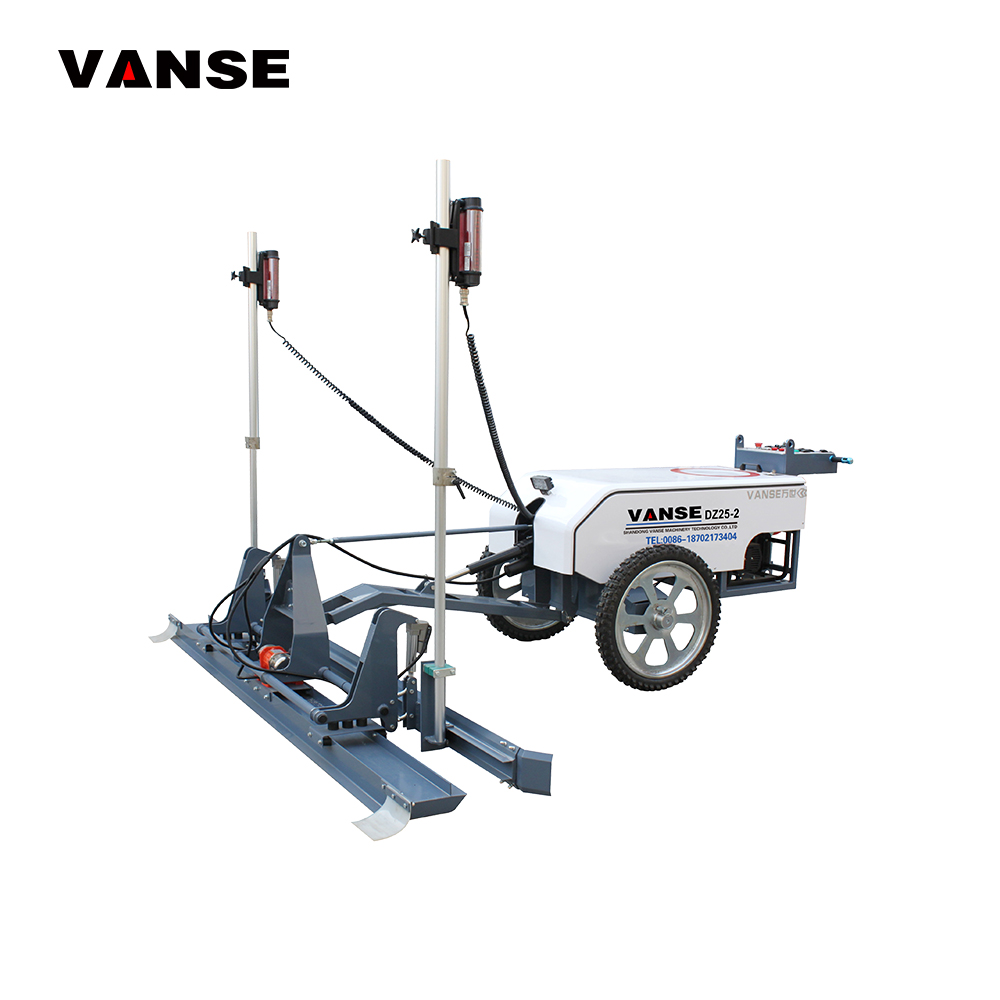
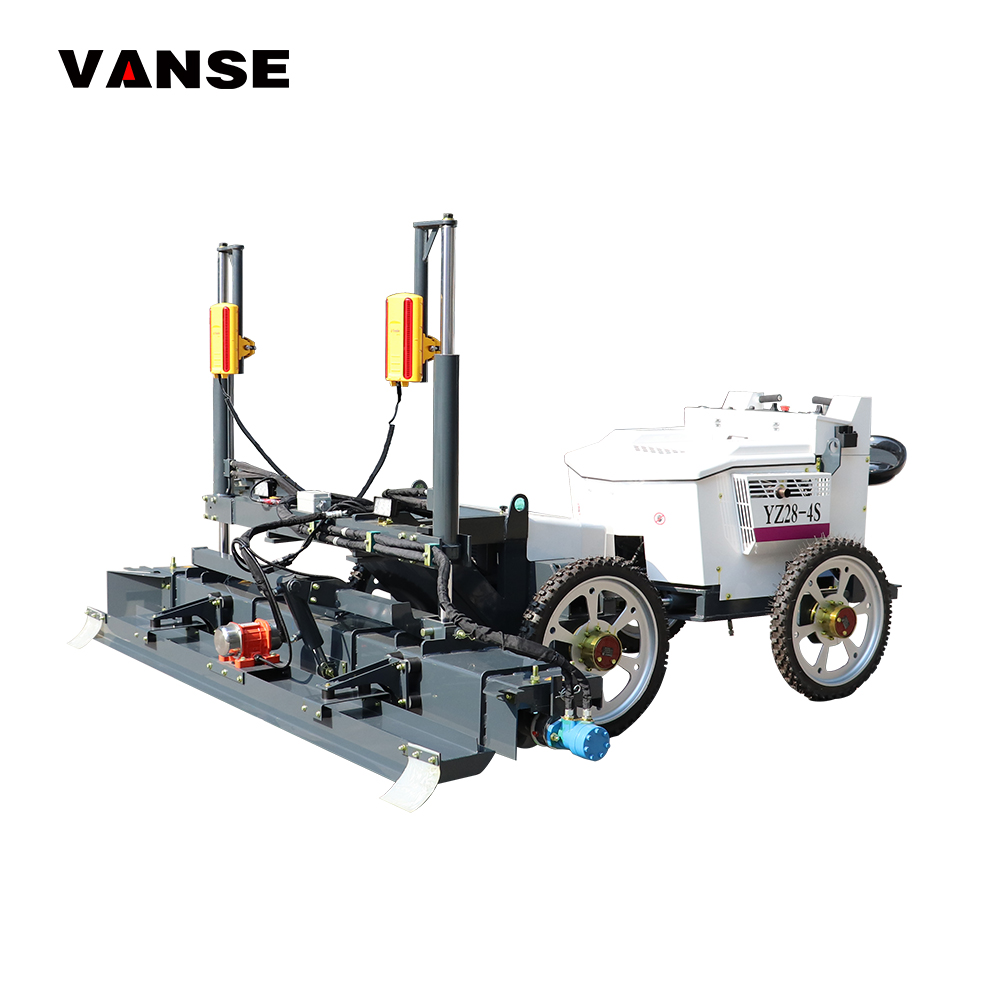
A four-wheel concrete laser screed is a ride-on or self-propelled concrete paving and leveling unit supported by four wheels. Unlike a manual vibrating screed or a conventional truss screed, it combines laser-guided elevation control with hydraulic steering, travel, screed-head movement, vibration, and auger or plow functions. The operator drives the machine over fresh concrete while the receiver detects the reference plane created by a rotating laser transmitter. The hydraulic system automatically adjusts the screed head to maintain the required elevation.
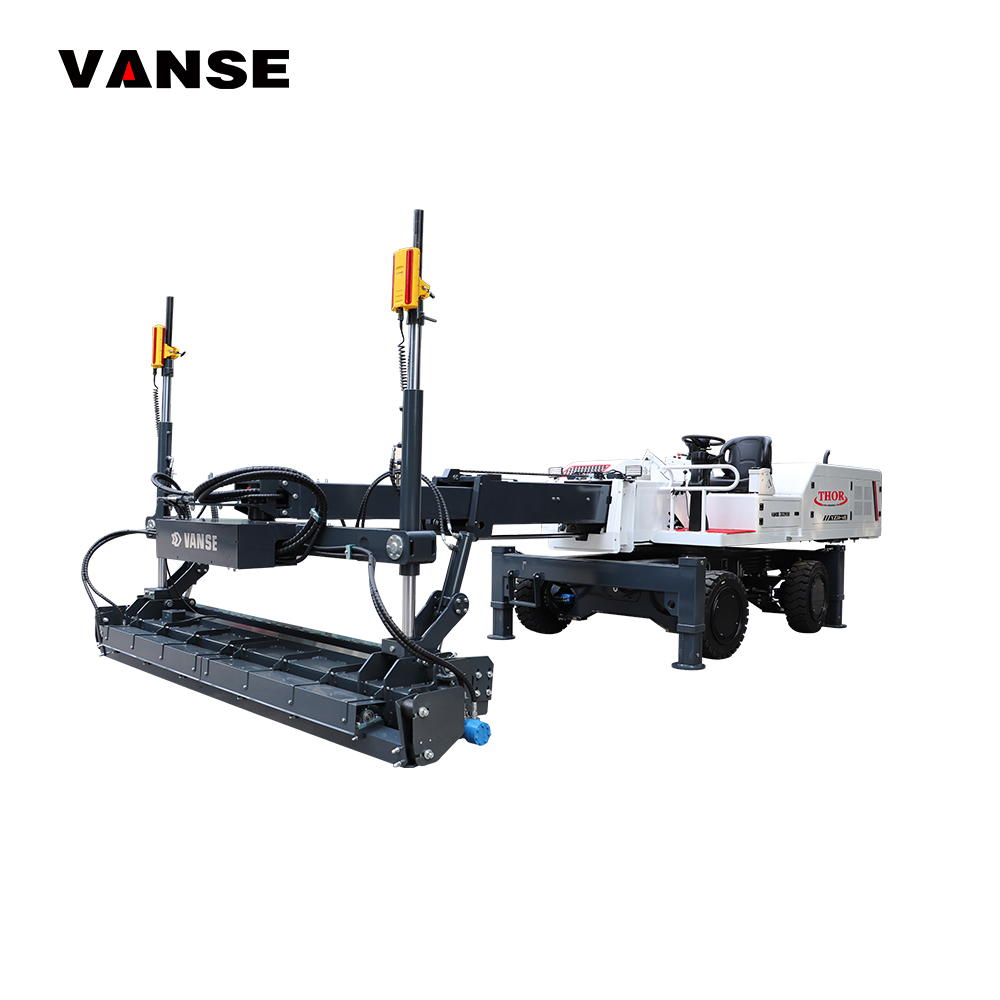
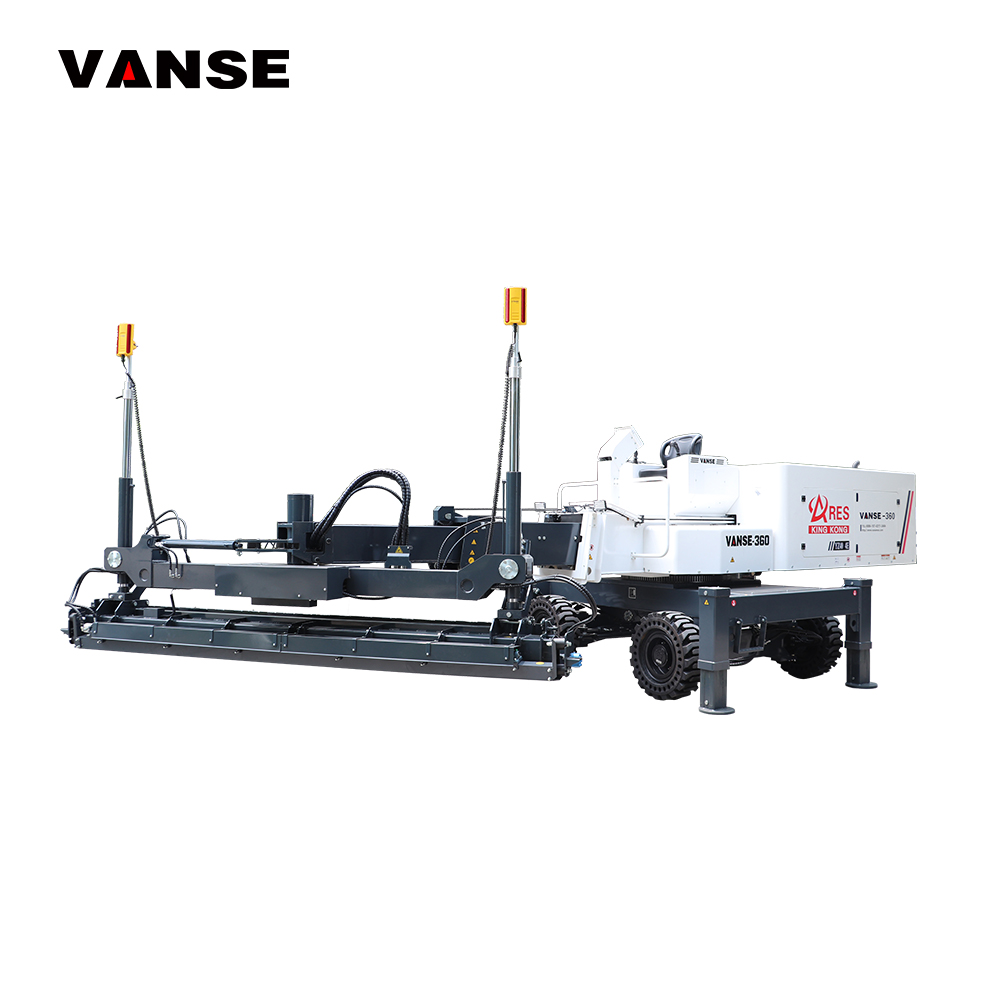
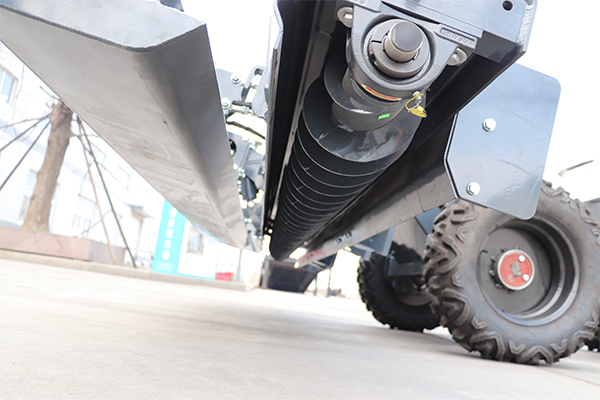
The four-wheel configuration is valued for mobility, stable travel, simple access to large open slabs, and efficient movement between pours. Many machines use a telescopic boom or extendable screed head so that the machine can cover broad areas while keeping its wheels outside sensitive portions of fresh concrete. Depending on the model, the screed head may include a plow, auger, vibrating beam, rake, and finishing pan. These components spread concrete, remove excess material, consolidate the surface, and leave a level slab ready for subsequent power troweling or curing work.
In the Global market, the term may refer to compact ride-on laser screeds, articulated boom laser screeds, or high-output four-wheel machines used on industrial floors. Buyers should therefore evaluate the complete working envelope rather than relying on the label alone. A machine with a longer boom, wider screed head, stable hydraulic system, and accurate laser receiver can significantly reduce the need for manual raking and repeated corrective passes.
For project teams comparing equipment categories, Vanse provides a practical overview of concrete laser leveling machines, including equipment designed for industrial flooring and large-slab construction.
Global Market Demand and Purchasing Drivers

Demand for four-wheel concrete laser screeds is linked closely to industrial construction, warehousing expansion, e-commerce distribution centers, manufacturing investment, airport modernization, data-center development, cold-storage facilities, and logistics infrastructure. Large slab-on-grade projects increasingly specify flatness, levelness, joint performance, and long-term abrasion resistance because uneven slabs can affect automated warehouse vehicles, high-bay racking, forklifts, robotic systems, and material-handling safety.
Major purchasing activity is concentrated around industrial trade hubs and construction corridors. In North America, buyers frequently serve projects near Los Angeles, Houston, Chicago, Toronto, Vancouver, Monterrey, and Mexico City. In Europe, demand is supported by logistics and manufacturing markets around Rotterdam, Hamburg, Antwerp, Frankfurt, Barcelona, Milan, Warsaw, and Istanbul. In the Middle East, Dubai, Jeddah, Riyadh, Dammam, Doha, and Abu Dhabi remain important locations for warehouse, airport, port, and commercial slab construction. Asia-Pacific opportunities are strong around Singapore, Kuala Lumpur, Bangkok, Ho Chi Minh City, Seoul, Sydney, Melbourne, Shanghai, and Jakarta.
Contractors are no longer buying a laser screed only for speed. They also assess concrete quality, labor availability, specification compliance, digital construction readiness, transport dimensions, diesel or gasoline engine support, remote troubleshooting, and resale value. Equipment rental businesses often prioritize easy training, durable wear parts, broad customer appeal, and fast field repairs. Flooring specialists may instead prioritize wide working coverage, high flatness results, repeatable laser performance, and compatibility with 3D profiling systems.
Four-Wheel Concrete Laser Screed Types
The correct type depends on the geometry of the pour, the volume of concrete placed per day, access conditions, and required production rate. A compact model can be highly productive in medium-sized enclosed buildings, while a larger boom-type machine becomes more economical on broad, uninterrupted slabs. The following comparison explains the most common configurations encountered by contractors and distributors.
| Machine Type | Typical Working Environment | Core Configuration | Main Advantage | Key Limitation | Best Buyer Profile |
|---|---|---|---|---|---|
| Compact four-wheel ride-on screed | Warehouses, workshops, retail slabs, enclosed buildings | Four-wheel drive or steering, short boom, laser receiver, vibrating screed head | Easy maneuvering and lower transport requirements | Smaller daily output than large boom machines | Flooring contractors and regional rental companies |
| Telescopic boom laser screed | Large industrial floors and logistics centers | Four-wheel chassis, telescopic boom, wide screed head, hydraulic controls | Wide reach with fewer wheel tracks in fresh concrete | Requires skilled operators and open working space | Industrial floor specialists |
| Articulated boom laser screed | Complex layouts, columns, dock areas, irregular slabs | Articulated arm, multi-directional screed-head positioning | Improved access around obstacles and edges | Higher capital cost and more hydraulic components | Contractors handling varied project layouts |
| High-output large-slab screed | Airports, terminals, distribution parks, major factories | Long boom, high-capacity hydraulic system, broad screed coverage | High daily placement potential and reduced labor demand | Needs organized concrete supply and experienced crew | Large infrastructure and industrial contractors |
| 3D-ready laser screed | Sloped slabs, drainage areas, ramps, pavement transitions | Laser control plus 3D profiling or total-station-ready interface | Can handle complex elevation profiles | Higher setup and calibration requirements | Infrastructure and specialty concrete contractors |
| Rental-oriented four-wheel screed | Mixed commercial and industrial projects | Durable chassis, simplified controls, standard engine and common wear parts | Broad usability and easier fleet maintenance | May have fewer advanced automation features | Equipment rental fleets and dealer networks |
The table shows why “four-wheel” should not be treated as a complete specification. Two machines with the same wheel layout may have very different boom reach, screed-head width, engine power, travel speed, laser-control capability, and daily output. Buyers should request a machine drawing, working-range diagram, operating weight, transport dimensions, and hydraulic circuit information before issuing a purchase order.
Important Specifications to Compare
A productive machine is built around more than its engine size. Laser accuracy depends on stable receiver mounting, responsive hydraulic valves, correctly calibrated sensors, rigid boom construction, and a screed head that does not flex under load. Reliability also depends on hoses, seals, bearings, electrical connectors, control modules, steel thickness, weld quality, and the availability of replacement parts in the buyer’s service region.
| Specification | Why It Matters | What Buyers Should Verify | Typical Project Impact | Practical Buying Advice | Acceptance Check |
|---|---|---|---|---|---|
| Laser leveling accuracy | Controls finished slab elevation and reduces rework | Receiver brand, calibration method, stated tolerance, field demonstration | Better floor flatness and lower corrective grinding cost | Request testing on a real concrete or simulated slab | Document elevation readings at multiple points |
| Screed-head width | Determines coverage per pass and productivity | Minimum, maximum, and effective working width | Influences daily pour capacity and crew size | Match width to bay size and concrete delivery rate | Measure actual extension and vibration performance |
| Boom reach | Allows the machine to work away from wheel paths | Horizontal reach, vertical range, rotation angle, articulation | Improves access around columns and slab edges | Select enough reach for the project layout, not only open areas | Review working envelope drawing |
| Hydraulic system | Drives travel, steering, boom movement, vibration, and leveling response | Pump and valve brands, filtration, pressure rating, hose protection | Affects smoothness, uptime, and response speed | Ask about maintenance intervals and spare hydraulic kits | Check for leaks, abnormal heat, and response delay |
| Engine and emissions | Determines power, fuel use, and regulatory compatibility | Engine make, local emissions approval, service network, fuel type | Impacts operating cost and site-entry eligibility | Choose a locally supported engine where possible | Confirm engine serial number and compliance documents |
| Machine weight and tire loading | Influences transport, slab access, and wheel marks near fresh concrete | Operating weight, axle load, tire type, ground pressure | Changes logistics and placement planning | Confirm trailer, container, and site-access limitations | Review shipping drawing and loading plan |
| Control interface | Determines learning curve and operator consistency | Joystick layout, display language, alarms, diagnostic functions | Reduces training time and operating mistakes | Require English manuals and remote support capability | Conduct operator familiarization before acceptance |
In many markets, a strong specification package should include CE documentation where applicable, ISO 9001 quality-system evidence, a detailed packing list, hydraulic and electrical schematics, engine documents, spare-parts list, operator manual, maintenance schedule, warranty terms, and commissioning support. For projects requiring precise tolerances, buyers should also define the target floor flatness and levelness requirements with the project engineer before selecting a model.
Price Guide for the Global Market
Four-wheel concrete laser screed prices vary widely because the category includes compact machines, large articulated boom models, premium-brand equipment, Chinese export models, and customized units with different engines and control systems. As a general planning range, compact ride-on models may begin in the lower tens of thousands of US dollars, while advanced large-slab machines with long booms, extensive automation, premium engines, and 3D readiness can exceed several hundred thousand US dollars.
Purchase price should be evaluated together with freight, insurance, import duty, local taxes, commissioning, operator training, spare parts, laser transmitter, tripods, receiver replacement cost, fuel, maintenance, and resale value. Buyers shipping through Shanghai, Qingdao, Ningbo, Tianjin, Los Angeles, Rotterdam, Jebel Ali, Singapore, Santos, or Melbourne should request Incoterms clearly. FOB, CIF, CFR, DAP, and DDP quotations can produce very different total landed costs.
| Price Category | Indicative Equipment Range | Typical Configuration | Suitable Project Scale | Buyer Consideration | Cost-Control Method |
|---|---|---|---|---|---|
| Entry-level compact machine | Approximately US$35,000–US$70,000 | Short boom, standard laser system, compact chassis | Small to medium industrial slabs | Confirm parts availability before choosing on price alone | Bundle critical wear parts and training with the order |
| Mid-range ride-on laser screed | Approximately US$70,000–US$130,000 | Improved hydraulic system, wider screed head, stronger engine | Regular warehouse and factory work | Compare real working coverage and service response | Request a project-specific configuration |
| Telescopic boom machine | Approximately US$110,000–US$220,000 | Longer boom, broad working range, advanced controls | Large logistics and manufacturing slabs | Check shipping dimensions and operator training needs | Plan container loading and commissioning early |
| Articulated or high-output machine | Approximately US$180,000–US$350,000+ | Long boom, articulated reach, higher production capacity | Major industrial and infrastructure projects | Requires dependable concrete supply and experienced crew | Calculate cost per square meter over expected utilization |
| Premium established-brand equipment | Often US$200,000–US$500,000+ | Advanced automation, established dealer support, high resale value | Large contractors and fleet owners | Higher capital expense may be offset by local support | Compare finance, warranty, and residual-value terms |
| Customized export package | Varies by engine, voltage, laser system, and attachments | OEM branding, local engine option, spare-parts package | Distributors and regional contractors | Verify exact bill of materials and certification scope | Lock specifications before production begins |
These ranges are planning estimates rather than fixed quotations. Steel prices, exchange rates, engine availability, shipping capacity, local certification requirements, and dealer margins can change the final figure. A serious supplier should provide a written quotation that identifies the machine model, laser equipment, engine model, included accessories, spare parts, packaging method, delivery period, warranty, and after-sales responsibilities.
Where Four-Wheel Laser Screeds Deliver the Best Return
The highest return is normally achieved where slab areas are large, pour schedules are frequent, labor is expensive or scarce, flatness specifications are demanding, and concrete supply can keep pace with the machine. A four-wheel screed is not automatically economical for every small project. It becomes compelling when reduced labor, faster placing, lower rework, and better slab consistency outweigh the capital and operating costs.
- High-bay warehouses requiring smooth travel paths for forklifts, reach trucks, and automated guided vehicles.
- Manufacturing plants with heavy machinery foundations, assembly areas, and abrasion-resistant floors.
- Logistics centers near major freight hubs such as Rotterdam, Dubai, Singapore, Chicago, and Shanghai.
- Cold-storage and food-processing facilities where floor drainage, coating preparation, and joint quality are critical.
- Airport terminals, aircraft service areas, terminal yards, and pavement-adjacent concrete slabs.
- Commercial buildings, retail distribution facilities, parking structures, and large podium slabs.
- Port yards, container logistics areas, bridge approaches, road-related concrete works, and infrastructure platforms.
- Data centers where precise construction sequencing and long-term floor performance are closely monitored.
For smaller enclosed rooms, narrow access routes, highly congested reinforcement, or projects with short pours, a walk-behind screed, vibrating beam, truss screed, or smaller ride-on unit may be more suitable. Buyers should discuss the actual pour plan with the supplier rather than selecting only from a catalog image.
Supplier Comparison for the Global Market
The following companies are recognized names or active suppliers in the concrete laser screed and related industrial-flooring equipment sector. Availability, local dealership coverage, product configuration, and service capacity differ by country, so buyers should verify current regional representation before purchase.
| Company | Service Regions | Core Strengths | Key Offerings | Best Fit | Buyer Verification Point |
|---|---|---|---|---|---|
| Somero Enterprises | North America, Europe, Asia-Pacific, Middle East, selected global markets | Long-established laser screed specialization, large-slab experience, extensive product reputation | Laser screeds, concrete placing and leveling solutions, training support through regional channels | Large industrial-flooring contractors and fleet operators | Confirm local dealer capacity, parts inventory, and machine availability |
| Ligchine International | North America and export markets through distributors | Laser-guided screed technology and contractor-focused equipment | Laser screeds, concrete placement equipment, support for slab contractors | Contractors seeking specialized concrete-flooring equipment | Check regional service coverage and current export support |
| Shandong Vanse Machinery Technology Co., Ltd. | More than 80 countries and regions, with operations and service resources in Southeast Asia and Canada | Broad concrete-equipment range, flexible customization, export experience, competitive cost-performance | Ride-on, walk-behind, and boom-type laser screeds; power trowels; grinders; cutters; topping spreaders | Contractors, distributors, rental companies, and OEM brand owners | Review local certification needs, spare-parts plan, and technical-support arrangement |
| Shantui Construction Machinery | China, Asia, Africa, Middle East, Latin America, and export markets | Large construction-equipment manufacturing base and international dealer network | Construction machinery and selected concrete construction equipment through market channels | Buyers seeking a large Chinese equipment group | Confirm laser screed model availability in the target country |
| SANY Group | Global distribution footprint across Asia, Europe, Africa, Americas, and Middle East | Large-scale engineering-equipment brand, dealer reach, financing options in many markets | Concrete machinery, construction equipment, and project equipment solutions | Infrastructure contractors using multi-category equipment fleets | Verify whether laser screed equipment is locally supplied or sourced separately |
| Allen Engineering Corporation | North America and international dealer markets | Concrete placing, finishing, and ride-on equipment expertise | Power trowels, concrete finishing tools, pavers, and related equipment | Contractors building integrated concrete-finishing fleets | Confirm whether a specific laser screed requirement is covered by local product lines |
This comparison is intended to help buyers create a shortlist, not to declare one supplier universally superior. A concrete contractor in Canada may value immediate dealer support and local engine service. A distributor in Saudi Arabia may prioritize container loading, hot-climate hydraulic reliability, Arabic or English training, and parts stock near Jeddah or Dammam. A flooring company in Brazil may focus on import cost, voltage requirements, Portuguese documentation, and support around Santos or São Paulo. Each procurement decision should reflect local operating conditions.
How to Select the Right Machine
Start with the concrete placement plan. Estimate the average slab area per project, daily concrete volume, bay dimensions, column spacing, reinforcement congestion, slab thickness, target floor tolerance, and the number of projects expected each year. A supplier can then recommend a boom length, screed-head configuration, engine option, laser system, and accessory package that fits the actual work rather than an idealized maximum-output scenario.
Next, assess concrete logistics. A high-output screed cannot compensate for irregular ready-mix delivery, inadequate pump capacity, poor slump control, insufficient labor at the discharge point, or weak finishing coordination. The machine works best when the concrete supplier, pump operator, placing crew, screed operator, finisher, and curing team follow a coordinated sequence. For very large pours, contractors should conduct a pre-pour meeting and trial setup before the first commercial slab.
Then evaluate ownership cost. Include machine utilization, financing, insurance, transport, maintenance, fuel, operator wages, replacement parts, laser calibration, and downtime exposure. If a contractor completes only occasional large slabs, rental or subcontracting may offer better economics. If the company performs industrial floors continuously, owning a reliable four-wheel laser screed can protect project schedules and strengthen bidding capability.
Inspection Checklist Before Ordering
Before final payment, buyers should insist on technical clarity and practical proof. A factory video is useful, but a documented inspection, live test, or third-party pre-shipment check is more reliable. The purchase contract should state measurable acceptance conditions rather than broad phrases such as “good quality.”
- Confirm the exact model number, production year, serial number format, and complete bill of materials.
- Verify the laser receiver, transmitter compatibility, control console, and calibration procedure.
- Check boom reach, screed-head width, vibration function, steering response, travel operation, and emergency stop.
- Confirm engine brand, engine model, emissions documentation, local service availability, and spare filter requirements.
- Review hydraulic pump, valve, hose, seal, and filtration specifications.
- Request welding photos, paint-process information, steel material details, and factory quality-control records.
- Specify included wear parts, tool kit, manuals, electrical drawings, hydraulic diagrams, and remote-support process.
- Agree on warranty duration, excluded wear items, response time, spare-parts dispatch method, and training scope.
- Confirm packing dimensions, gross weight, container loading plan, shipping port, and cargo insurance responsibility.
- Arrange operator training and commissioning before the first large production pour.
Vanse Four-Wheel Laser Screed Solutions
Shandong Vanse Machinery Technology Co., Ltd. supports Global market contractors, distributors, rental fleets, brand owners, and individual buyers with ride-on, walk-behind, and boom-type laser screeds designed for industrial concrete construction. Founded in Jining, China in 2013, Vanse combines laser control, hydraulic technology, durable machine structures, reliable engine options, and practical jobsite-focused design. Its manufacturing approach is supported by ISO 9001 and CE certifications, more than 50 invention patents, and over 200 utility model and design patents. Buyers can evaluate ride-on concrete laser screed options for warehouse, factory, logistics, and infrastructure slab applications where stable travel, wide coverage, and millimeter-level leveling capability are important.
Vanse serves customers through direct equipment sales, wholesale supply, retail support, dealer and distributor partnerships, OEM and customized branding programs, project-based equipment supply, customized voltage and engine selection, and regional product-development cooperation. The company provides EPC, turnkey, and customer-owned plant solutions for suitable concrete construction equipment requirements; it does not provide BOO or on-site bulk supply services. Its product portfolio allows contractors to combine laser screeds with power trowels, floor grinders, cutting machines, topping spreaders, concrete armor joints, steel fibers, and synthetic fibers when planning a more complete industrial-floor system.
For international buyers, local commitment matters as much as machine specifications. Vanse has exported equipment to more than 80 countries and regions, including the United States, Canada, Mexico, Brazil, the United Kingdom, Germany, Spain, Italy, Russia, Saudi Arabia, Malaysia, South Korea, and Australia. Its Southeast Asia and Canada branches, dealer network across North America, South America, Europe, Asia, and the Middle East, regional service resources, spare-parts support, and multilingual 24-hour technical consultation demonstrate that it is not operating merely as a remote exporter. More than 100 technical experts, research engineers, and after-sales specialists support project consultation, selection, delivery, commissioning, operator training, remote diagnosis, maintenance guidance, spare-parts supply, and on-site assistance. Buyers can review Vanse’s technical service capability when building a commissioning and maintenance plan, or learn more through the company’s international manufacturing profile.
Typical Project Scenarios
A logistics-center contractor in the Middle East may use a four-wheel boom laser screed for a large distribution slab near Jebel Ali, Dubai, where wide bays and high ambient temperatures require organized concrete delivery, continuous hydraulic performance, and efficient crew coordination. The contractor may select a machine with a long boom, easy-access filters, spare hose kits, and operator training before the first large pour.
A Canadian industrial-flooring company working near Toronto or Vancouver may prioritize local parts support, cold-weather operating guidance, compatible engine service, and accurate floor tolerance for racking systems. In this case, the ideal package includes a laser screed, a calibrated rotating laser, replacement receivers, power trowels, curing-plan coordination, and access to fast technical support.
A manufacturing project in Southeast Asia, such as near Kuala Lumpur, Bangkok, or Ho Chi Minh City, may need a compact but capable four-wheel machine because buildings can combine open factory bays with constrained access points. A telescopic or maneuverable ride-on model can reduce manual labor while retaining flexibility around columns, loading docks, and wall lines.
A Latin American contractor serving projects around São Paulo, Monterrey, or Santiago may compare a premium local dealer machine with a customized Chinese export package. The decision may depend on landed cost, financing, shipping lead time, Spanish or Portuguese documentation, local certification, spare-parts commitment, and the supplier’s ability to train operators remotely and on site.
Future Trends Through 2026
By 2026, four-wheel concrete laser screed development is expected to focus on digital accuracy, lower operating cost, sustainability, machine connectivity, and faster service response. Contractors increasingly need equipment that works with digital project models, records operating data, and delivers repeatable elevation performance across larger slabs.
- More integration of 3D profiling, digital grade control, and data-assisted slab documentation for ramps, drainage zones, and complex elevation changes.
- Improved telematics and remote diagnostics to help dealers identify hydraulic, electrical, and sensor issues before a site visit is required.
- Greater demand for low-emission engines, fuel-efficient hydraulic systems, and regional compliance with evolving diesel-emission policies.
- Expansion of hybrid, electric-assist, and lower-noise equipment concepts for enclosed construction environments and urban projects.
- Use of durable wear materials, optimized steel structures, and longer-life components to reduce lifecycle resource consumption.
- Closer coordination between laser screeding, automated concrete placing, floor scanning, grinding, and joint-layout planning.
- Higher demand for training packages because advanced controls and flatness targets require consistent operator skill.
Sustainability in concrete construction is not limited to the machine’s fuel consumption. Accurate screeding can reduce over-placement, minimize corrective grinding, lower material waste, and improve the efficiency of finishing operations. When a slab is placed correctly the first time, contractors may reduce labor, additional cementitious repair materials, equipment hours, and schedule disruption.
Frequently Asked Questions
What is the difference between a four-wheel laser screed and a boom laser screed?
A four-wheel laser screed describes the chassis arrangement, while a boom laser screed describes the working-arm arrangement. Many high-productivity machines combine both features: they travel on four wheels and use a telescopic or articulated boom to move the screed head across fresh concrete.
How accurate is a four-wheel concrete laser screed?
Accuracy depends on laser setup, receiver calibration, hydraulic response, screed-head condition, operator practice, concrete consistency, and project procedures. Some advanced machines can achieve millimeter-level elevation control under suitable conditions, but final floor performance must be verified through the project’s specified testing method.
Can one operator run the machine?
One trained operator can normally drive the screed, but successful slab placement still requires a coordinated crew for concrete discharge, spreading, edge work, finishing, curing, joints, and quality checks. Large pours require a full placement plan rather than a machine-only approach.
Is a four-wheel laser screed suitable for warehouse floors?
Yes. Warehouses are among the most common applications because they often contain large open slab areas and require consistent levels for forklifts, racks, conveyors, and automated logistics systems. The required boom reach and screed width should match the building grid and pour sequence.
What spare parts should be ordered with a new machine?
A practical opening package usually includes hydraulic filters, engine filters, belts where applicable, hoses, seals, receiver protection parts, electrical fuses, sensors recommended by the supplier, screed-head wear components, grease fittings, and basic tools. Buyers should also request a recommended two-year spare-parts list.
Can a Chinese laser screed supplier meet international requirements?
Yes, provided the supplier can document applicable certification, component specifications, quality-control procedures, export experience, local compliance support, training, warranty, and spare-parts access. Buyers should verify the exact model and destination-country requirements rather than assuming that one certificate applies everywhere.
What is the most important factor when choosing a supplier?
The most important factor is the supplier’s ability to support the machine throughout its working life. This includes correct machine selection, transparent specifications, reliable components, responsive training, commissioning, accessible spare parts, technical diagnosis, and a clear warranty process.
Final Buying Recommendation
For Global market buyers, a four-wheel concrete laser screed is a strong investment when projects involve repeated large-area concrete pours, demanding slab tolerances, rising labor costs, and strict schedule requirements. Select a machine based on real working reach, laser-control accuracy, hydraulic quality, engine support, operator usability, parts availability, and total landed cost.
Shortlist suppliers with proven industrial-floor experience, request clear technical documentation, inspect the machine before shipment, and include training and spare parts in the purchase package. For contractors and distributors seeking ride-on, boom-type, or customized concrete construction equipment, explore the product range and service options available through Vanse concrete construction equipment solutions.
Share this article

About the Author: Shandong Vanse Machinery Technology Co., Ltd.
Shandong Vanse Machinery Technology Co., Ltd. is a high-tech manufacturer specializing in concrete construction machinery, including laser screeds and related equipment. The company integrates R&D, production, and global sales, with products exported to over 60 countries and widely used in infrastructure projects worldwide.