Technical Knowledge
Jointing Process between Manual Trowel and Mechanical Troweling in Edge Areas
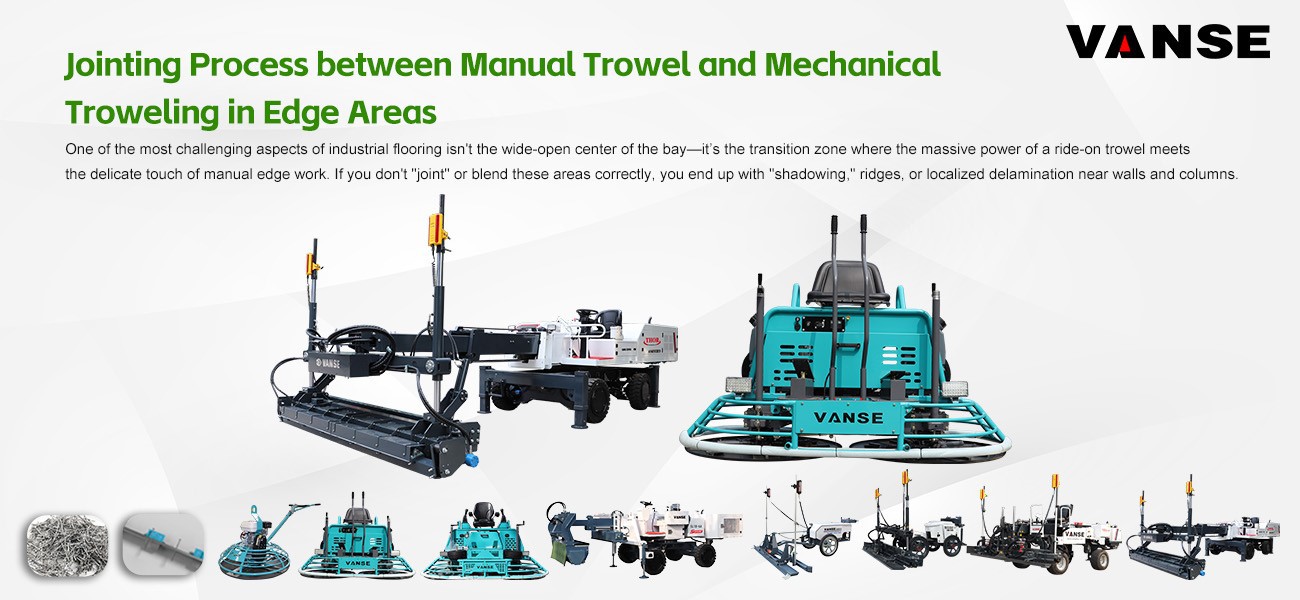
One of the most challenging aspects of industrial flooring isn't the wide-open center of the bay-it’s the transition zone where the massive power of a ride-on trowel meets the delicate touch of manual edge work. If you don't "joint" or blend these areas correctly, you end up with "shadowing," ridges, or localized delamination near walls and columns.
To achieve a seamless, professional finish that passes high-spec inspections, you need a workflow that bridges the gap between manual precision and mechanical force. Here is the pro’s guide to mastering the edge transition using the Vanse professional fleet.
1. Precision Placement: The "Zero-Spill" Edge
The transition starts before the concrete is even poured. If you have "mounds" of concrete near the formwork, the manual crew has to work twice as hard to get it flat.
The Vanse Workflow: Use a Vanse Concrete Distributor to place an even ribbon of material along the edges. For tight corners or indoor pillars where a truck can't reach, the Vanse Mini Dumper is the perfect "last-mile" tool. It allows you to dump concrete with surgical precision right up to the edge, reducing the manual labor needed to "pull" the concrete into place.
2. The Leveling Baseline: Getting Close to the Form
If the edge isn't level, the power trowel will "hop" when it hits the transition, creating a visible ridge.
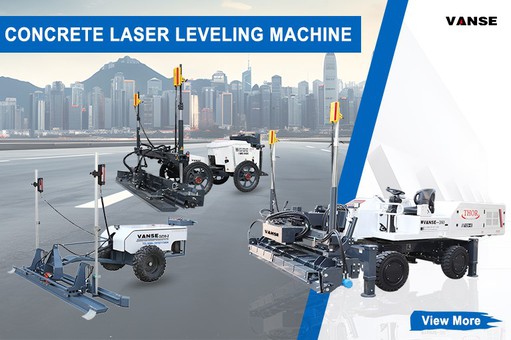
The Vanse Workflow: A Vanse Concrete Laser Leveling Machine (like the agile YZ25-4) is designed to get incredibly close to the formwork. The high-frequency vibration consolidates the edges just as effectively as the center. This creates a uniform "baseline" flatness, so the manual crew only has to focus on the final 15cm of finish rather than trying to fix the level.
3. Integrated Hardening: Don't Forget the Boundaries
A common failure point is the "soft edge"-where the center of the floor is hard as iron but the edges are dusty because the dry-shake wasn't applied correctly.
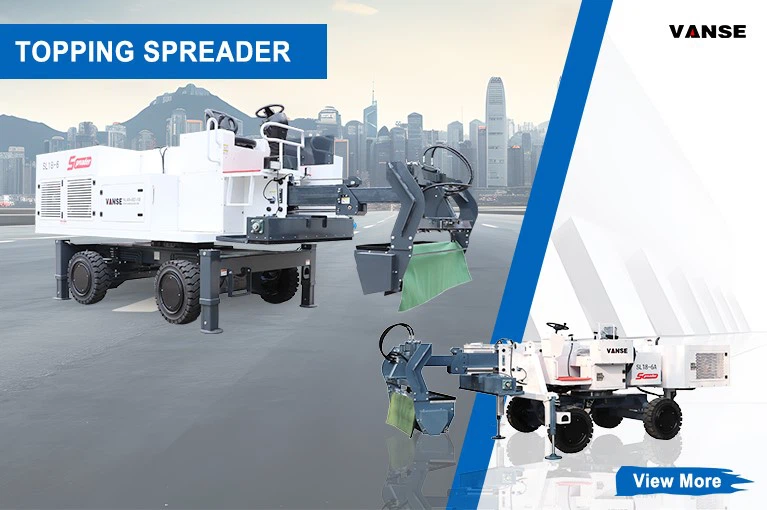
The Vanse Workflow: The Vanse Automatic Topping Spreader ensures that your wear-resistant hardener is applied uniformly right up to the boundary lines. This means the manual troweling in the edge area will have the same material density as the mechanically troweled center.
4. The "Seamless Blend" Troweling Technique
This is the critical "jointing" phase. The goal is to make it impossible to tell where the manual work ends and the machine work begins.
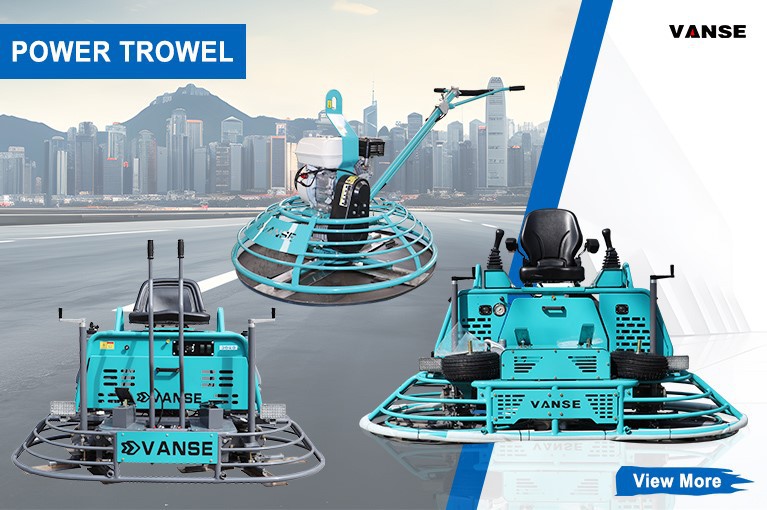
The Strategy: As the manual crew finishes the edges with hand floats, the Power Trowel operator (using a machine like the Vanse VS836 walk-behind or the VS1046H ride-on) must overlap the manual work by at least 15-20cm.
Vanse Edge-Friendly Tech: Vanse power trowels feature precision pitch control and balanced rotor designs. This allows the operator to "feather" the edge of the trowel pass, slowly decreasing the blade angle as they approach the manual work to create a perfectly flat, blended transition without "digging" into the fresh edge.
5. Final Stress Relief: The Clean Cut
Once the transition is blended, the edge area is under a lot of stress during the drying phase.
The Vanse Workflow: Use a Vanse Concrete Cutting Machine (Floor Saw) to execute the contraction joints near walls and columns. A stable, high-speed cut ensures that any shrinkage stress is relieved exactly where you want it, preventing "random cracks" from ruining your beautiful edge work.
Comparison: Manual vs. Mechanical Transition
| Stage | Manual Edge Focus | Vanse Mechanical Support |
| Placement | Pulling concrete by hand. | Mini Dumper / Distributor precision. |
| Leveling | Manual leveling (variable). | Laser Leveling Machine (±1mm accuracy). |
| Hardening | Hand-throwing (uneven). | Automatic Topping Spreader (uniform). |
| Finishing | Hand troweling (lower density). | High-Torque Power Trowel (dense/burnished). |
| Jointing | Hand-tooling joints. | Concrete Cutting Machine (clean/straight). |
Final Word
The quality of a floor is judged by its weakest point-which is usually the edges. By utilizing a complete "system" from Vanse Machinery (www.vansemac.com), you ensure that your edges aren't just an afterthought. They become a seamless extension of the superflat floor you’ve worked so hard to create.
Tired of "shadowed" edges? Visit Vanse today to see how our fleet can perfect your next project from center to boundary.
Note: The parameters provided in this document are for reference only and are not mandatory. Due to differences in technical characteristics between different brands and models of laser levelers, please consult the manufacturer for a suitable solution before actual operation. This reference document assumes no responsibility for any issues arising from failure to follow the manufacturer's instructions.
Thanks to All the Friends Who Support and Trust Shandong Vanse Machinery Technology Co., Ltd.
If you want to know more about Shandong Vanse Machinery Technology Co., Ltd. or have any questions, please feel free to contact us:
Our Factory
Shandong Vanse Machinery Technology Co., Ltd.
Share this article

About the Author: Shandong Vanse Machinery Technology Co., Ltd.
Shandong Vanse Machinery Technology Co., Ltd. is a high-tech manufacturer specializing in concrete construction machinery, including laser screeds and related equipment. The company integrates R&D, production, and global sales, with products exported to over 60 countries and widely used in infrastructure projects worldwide.
Previous Post
Next Post
Related Articles
You Might Also Like
How Do The Laser Transmitter And Receiver Of A Concrete Laser leveling Work?
How the laser transmitter and receiver of a concrete laser leveling machine work Concrete laser leveling machine, as an important equipment in modern building construction, has been widely used in the construction industry with its efficient and accurate ground leveling capabilities. In this machine, the laser transmitter and receiver play a vital role, working together to ensure the flatness and accuracy of the concrete surface to predetermined standards. This article will discuss in detail the working principle of the laser transmitter and receiver of the concrete laser leveling, including its principle, signal transmission and processing, precise positioning and calibration, etc., and also discuss the impact of environmental factors on the equipment and the maintenance and upkeep of the equipment. Key points, and finally a summary and outlook on technology applications and development trends. 1. Principle of laser transmitter The laser transmitter is one of the core components of the concrete laser leveling. Its main function is to emit a stable, high-precision laser beam. These laser beams provide the leveling with a reliable reference, allowing the machine to precisely control the concrete paving and leveling process. The working principle of a laser transmitter is based on the physical process of laser generation. With specific optical components and excitation sources, laser transmitters are able to produce a high-quality laser beam. This laser beam has extremely high directivity and monochromaticity, allowing it to maintain stable characteristics during propagation. At the same time, laser transmitters are usually equipped with angle and height adjustment devices so that users can adjust the direction and projection range of the laser beam according to actual needs. In the application of concrete laser leveling machine, the laser transmitter is placed on a stable platform to ensure the stability of the laser beam. By adjusting the angle and height of the emitter, precise control of the laser beam can be achieved to meet different construction needs. 2. Working principle of the receiver The laser receiver is another key component of the concrete laser leveling machine. It is responsible for receiving the laser beam emitted by the laser transmitter and converting it into a processable electrical signal. These electrical signals are then used to control the operation of the leveling, ensuring a smooth surface on the concrete. The working principle of the laser receiver is based on the principle of photoelectric conversion. When the laser beam irradiates the photoelectric element on the receiver, the photoelectric element will generate a photocurrent. The size of this photocurrent is proportional to the intensity of the laser beam, so the photocurrent can be measured. size to determine the intensity of the laser beam. At the same time, the receiver can also focus and filter the laser light through the built-in optical system to improve the receiving sensitivity and anti-interference ability. During the operation of the concrete laser leveling, the laser receiver needs to be kept within the irradiation range of the laser beam at all times. When the receiver receives the laser beam, it converts the optical signals into electrical signals and transmits these signals to the leveler's control system. The control system calculates the actual height and position information of the concrete surface based on the received signals, and adjusts the working parameters of the leveling machine accordingly, such as the height and vibration frequency of the blade, to achieve accurate leveling effects. 3. Signal transmission and processing Signal transmission and processing between the laser transmitter and receiver are the key to achieving high-precision operation of the leveler. In concrete laser leveling machines, signal transmission mainly relies on transmission media such as electrical or optical fiber. These media transmit the electrical signals converted by the laser receiver to the leveler's control system. After the control system receives the signal, it processes and analyzes it. This process usually includes signal amplification, filtering, conversion and calculation steps. Through signal processing, the control system can accurately obtain the height and position information of the concrete surface and compare it with the preset leveling standards. Based on the comparison results, the control system will adjust the working parameters of the leveling machine to achieve the desired leveling effect. 4. Precise positioning and calibration The precise positioning and calibration of the laser leveler is an important part of ensuring construction quality. The leveler requires initial calibration before work to ensure precise alignment between the laser transmitter and receiver. Initial calibration involves adjusting parameters such as the height and angle of the transmitter, and the position and sensitivity of the receiver. During the construction process, the leveling machine also needs to be calibrated in real time to deal with possible errors and changes. Real-time calibration is usually achieved by comparing the difference between the received laser signal and a preset value. When the difference exceeds the allowable range, the leveler will automatically adjust the working parameters to eliminate the error. In addition, the laser leveling machine is equipped with high-precision sensors and control systems to achieve more accurate positioning and calibration. These sensors can monitor the position and status of the leveling machine in real time and provide accurate data support for the control system. 5. Impact of environmental factors on Environmental factors have a non-negligible impact on the performance of the laser transmitter and receiver of the concrete laser leveling. First, changes in temperature can cause changes in the performance of laser transmitters and receivers. Such as the stability of the laser beam, the sensitivity of the photoelectric components, etc. In a high-temperature environment, the equipment may overheat, affecting its normal operation; while in a low-temperature environment, the performance of some components may be degraded due to low temperatures. In addition, humidity and dust are also important factors affecting the performance of laser transmitters and receivers. A high-humidity environment may cause condensation inside the device, affecting the normal operation of electronic components; and the accumulation of dust may block the receiving surface of the photoelectric component and reduce the receiving sensitivity. Therefore, when using a concrete laser leveling, it is necessary to fully consider the impact of environmental factors on the performance of the equipment and take appropriate measures for protection and maintenance. For example, in high-temperature environments, heat dissipation measures can be taken, such as installing fans or radiators; in environments with high humidity, the equipment can be dehumidified regularly; at the same time, regular cleaning of the surface and interior of the equipment is also necessary. 6. Maintenance and Maintenance Points The maintenance and upkeep of the concrete laser leveling machine is the key to ensuring its long-term stable operation. For laser transmitters and receivers, the following are key maintenance and care points: First, regularly check the optical components of the laser transmitter and receiver to ensure that their surfaces are clean and dust-free. Any dirt or scratches may affect the transmission and reception quality of the laser beam. Special cleaning cloths and detergents should be used for cleaning, and harsh chemical solvents should be avoided. Secondly, keep the mechanical parts of the transmitter and receiver in good condition, regularly check whether the fasteners are loose, and lubricate the moving parts to ensure their normal operation and extend their service life. At the same time, pay attention to waterproofing and moisture-proofing to avoid using the device in humid or harsh environments to avoid damaging electronic components. In addition, regular calibration of the equipment is necessary. Since the equipment may be affected by various factors during use, resulting in changes in the signal shift of the laser beam or the receiving sensitivity, regular calibration can ensure the accuracy and stability of the equipment. Finally, equipment that is not used for a long time should be properly stored. The device should be placed in a dry, ventilated environment away from direct sunlight and high temperatures. At the same time, the equipment should be powered on regularly to ensure the normal operation of its circuits and components. 7. Technology Application and Development The application of warm concrete laser leveling machines in the construction industry has become more and more widespread, and its characteristics of high precision and high efficiency have been widely recognized. With the continuous development of science and technology, the performance of laser transmitters and receivers are also constantly improving, providing more reliable technical support for the work of the leveling machine. In the future, with the continuous advancement of laser technology and the improvement of intelligence level, concrete laser leveling machines are expected to achieve higher precision and wider applications. For example, by optimizing the design of the laser transmitter and receiver, the stability and anti-interference ability of the laser beam are improved; by introducing more advanced control systems and sensors, more precise positioning and calibration can be achieved; at the same time, the Internet of Things and Big data technology enables remote monitoring and intelligent maintenance of equipment, improving equipment efficiency and reliability. In addition, with the continuous improvement of environmental awareness, the application of concrete laser leveling machines in green construction will also receive more attention. By optimizing equipment design and construction technology, energy consumption and waste emissions are reduced to achieve green and environmentally friendly building construction. 8. Summary and Outlook The laser transmitter and receiver of the concrete laser leveler are key components to achieve high-precision leveling. They provide reliable reference and control signals for the leveling machine by emitting and receiving laser beams. During use, you need to pay attention to the impact of environmental factors on equipment performance, and take appropriate measures for protection and maintenance. Looking to the future, with the continuous advancement of science and technology and the continuous expansion of application fields, concrete laser levelings are expected to achieve higher precision, wider applications and more environmentally friendly construction methods. At the same time, we also need to continue to pay attention to the development of new technologies and new materials, promote technological innovation and industrial upgrading of concrete laser leveling machines, and make greater contributions to the sustainable development of the construction industry. In short, the laser transmitter and receiver of the concrete laser leveling are the key links to ensure construction accuracy and efficiency. By in-depth understanding of its working principle and maintenance points, we can better utilize this advanced technology, improve the quality and efficiency of construction, and promote the sustainable development of the construction industry.What is the difference between a concrete laser leveling and a polisher?
Concrete laser levelings and polishers are two different types of mechanical equipment with different functions and application fields. Here are their main differences: ✔How it works The concrete laser leveling machine uses laser measurement technology to emit a laser beam through a laser transmitter. The laser receiver receives the reflected laser signal and calculates the distance and direction of the leveling machine's movement, thereby accurately controlling the leveling machine's traveling route and direction. height to achieve the purpose of leveling the concrete surface. A concrete grinder is a mechanical device that uses an electrically driven grinding wheel or grinding wheel for grinding. The grinding wheel rotates under the drive of the motor and grinds the concrete surface smooth through a manual or automatic control system. ✔Application areas Concrete laser leveling machines are mainly used for leveling operations in large-area concrete projects, such as highways, bridges, parking lots, etc. It has the advantages of high precision, high efficiency, automation, etc., and can complete the leveling work of a large number of concrete surfaces in a short time. Concrete grinders are mainly used for grinding on construction sites and small-area concrete projects. It can grind various concrete surfaces, such as floors, walls, columns, etc. ✔How to operate Concrete laser levelings usually use automated control systems that can be operated via a computer or remote control. The operator only needs to set relevant parameters and routes, and the leveling machine can automatically perform leveling operations. The concrete grinder requires manual control by the operator, and the depth and uniformity of grinding can be controlled by adjusting the height and angle of the grinding wheel. Operators need to have certain skills and experience to achieve good grinding results. ✔Processing quality Due to the use of laser measurement technology, the concrete laser leveling machine can complete large-area leveling operations in a short time and can achieve high precision and flatness. It can control the flatness error of the concrete surface within a small range and improve the quality and service life of the concrete surface. The processing quality of a concrete grinder mainly depends on the skill and experience of the operator. If the operator has rich experience and high skill level, he can achieve better smoothing results. However, if the operator's technical level is not high or unskilled, it may lead to uneven grinding depth or excessive grinding, affecting the processing quality and service life. ✔Processing efficiency The processing efficiency of concrete laser leveling machines is usually high. It can achieve automated control and high-precision measurement to complete the leveling operations of a large number of concrete surfaces in a short time. At the same time, due to the use of laser measurement technology, it can avoid errors and delays in traditional measurement methods. The processing efficiency of concrete grinders is relatively low. It requires operators to manually control the height and angle of the grinding wheel, as well as the grinding time and speed, which requires more time and manpower to complete large-area concrete projects. ✔Maintenance and care Maintenance and maintenance of a concrete laser leveling is relatively simple. It requires regular inspection of the cleanliness and accuracy of the laser transmitter and receiver, as well as routine lubrication and maintenance of the machine. At the same time, regular cleaning and maintenance of the machine is also required to maintain the normal operation and service life of the machine. The maintenance and upkeep of concrete polishers is relatively complicated. It requires regular inspection of the working status of the grinding wheel and motor, and regular lubrication and maintenance of the machine. At the same time, the grinding wheel also needs to be replaced and adjusted to ensure the normal operation and service life of the machine. In summary, although concrete laser levelings and polishers are both used for concrete surface treatment, there are certain differences in their working principles, application fields, operating methods, processing quality, processing efficiency, and maintenance. difference. When choosing to use, you need to choose the appropriate machinery according to the actual situationCORRECT USE OF LASER LEVELING MACHINE
CORRECT USE OF LASER LEVELING MACHINE The laser leveling machine is an indispensable equipment in the construction industry. It is inseparable from the construction of large highways. To ensure the smooth progress of the construction and the smoothness of the road surface, it is necessary to master the correct use of the laser leveling machine. Secondly, read the instruction manual of the equipment before use, because in this way you can get familiar with the internal structure of the equipment as soon as possible, so as to achieve correct operation. The following laser leveling machine manufacturers will take you to understand the correct use of the laser leveling machine. The knowledge shared by laser leveling machine manufacturers for you basically comes to an end here. If you have the intention to understand the equipment, you can contact us by phone, or log in to our official website and leave us a message. We will see it later. Thank you for your reading.