Technical Knowledge
Superflat floor construction technology
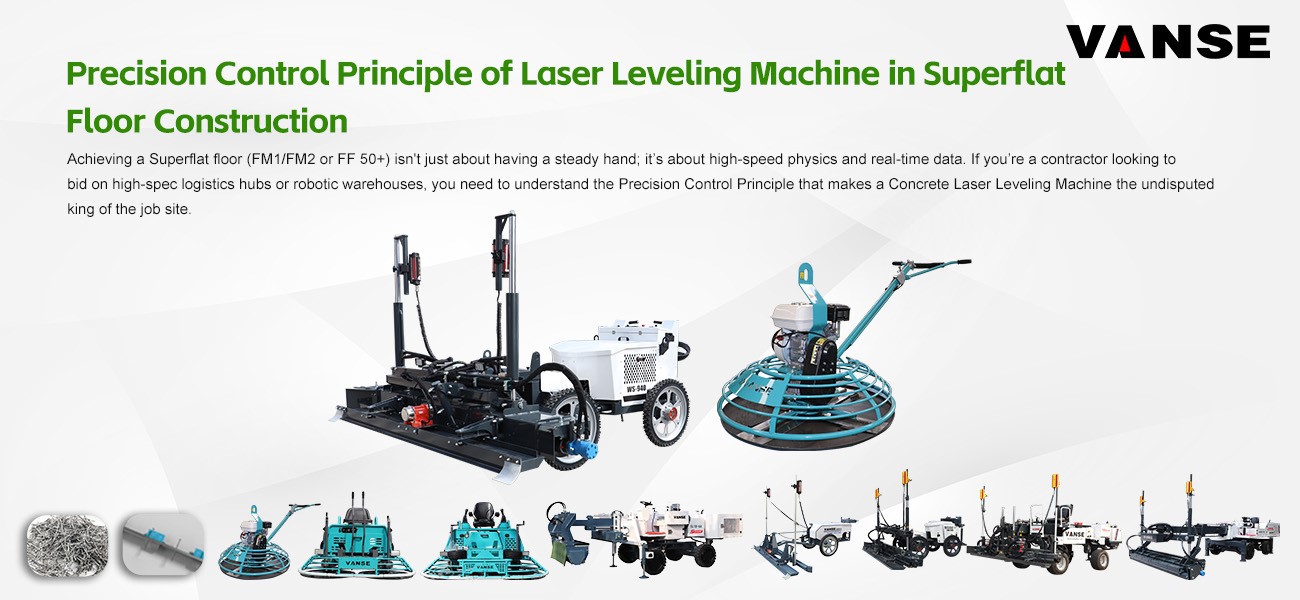
In the era of automated logistics and high-reach VNA (Very Narrow Aisle) warehouses, "flat" isn't just an aesthetic choice-it’s a functional requirement. Superflat floor construction technology is designed to meet extreme tolerances, typically measured as FF (Floor Flatness) and FL (Floor Levelness) numbers (e.g., FF 50+ or FM1 standards).
If you are a contractor looking to master this high-spec field, you don't just need workers; you need a synchronized ecosystem of precision machinery. Here is the ultimate professional workflow for Superflat success, featuring the specialized lineup from Vanse Machinery.
Phase 1: Controlled Placement & Material Handling
Superflat precision begins before the leveling starts. If your concrete distribution is uneven, you create "slump variations" that lead to dips later.
The Strategy: Use a Vanse Concrete Distributor to discharge the mix in uniform ribbons. To get material into tight strips or multi-level bays without the heavy footprint of a truck, the Vanse Mini Dumper (available in electric or gasoline) is the perfect "last-mile" tool. It allows your crew to place concrete with surgical precision, reducing the manual "shoveling" that often leads to inconsistencies.
Phase 2: High-Precision Leveling (The Core)
This is where the Superflat status is won or lost. Traditional manual leveling simply cannot hit FM1/FM2 numbers consistently.
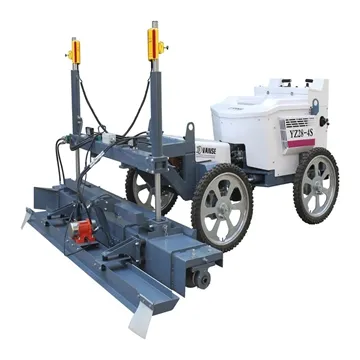
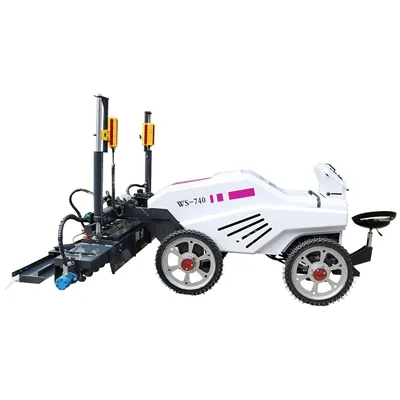
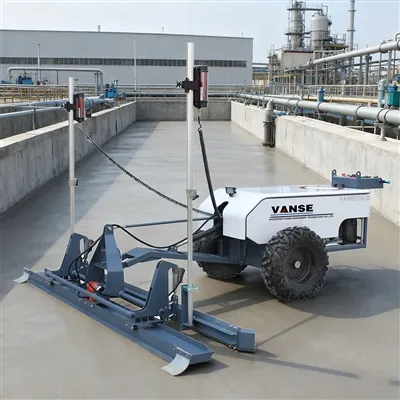
The Vanse Edge: The Vanse YZ30-4E Telescopic Boomed Laser leveling is the industry standard for large-scale precision. Its 6-meter telescopic boom allows the leveling head to strike off the concrete while the machine remains stationary, eliminating the "tire track" issues that ruin FL scores. For smaller projects, the agile Vanse YZ25-4 offers the same high-frequency vibration and laser-controlled precision in a compact frame, ensuring every square meter is consolidated from the bottom up.
Phase 3: Uniform Surface Hardening
VNA floors must be incredibly wear-resistant. However, manual "dry-shake" broadcasting is notoriously uneven, which can lead to color variations and localized "dusting."
The Strategy: Transition to a Vanse Automatic Topping Spreader. By mechanically applying the wear-resistant hardener immediately behind the laser leveling, you ensure a perfectly uniform grams-per-square-meter application. This creates a monolithic bond with the base slab, preserving the flatness achieved by the laser leveling machine while adding iron-clad durability.
Phase 4: Densification & The Mirror Finish
Once the concrete begins to set, you need to "seal" it. In Superflat flooring, this isn't just for looks; it’s about surface density.
The Vanse Edge: A machine like the Vanse Ride-on Power Trowel, provides the heavy compaction needed to "burnish" the floor. Its precision pitch control allows the operator to make micro-adjustments to the blades, smoothing out any remaining micro-imperfections to create a mirror-like finish that meets the highest FF (Flatness) requirements.
Phase 5: Precision Stress Relief (The Joints)
Even the perfect slab will fail if the joints are ragged. In VNA lanes, joint integrity is critical for forklift wheel health.
The Strategy: Use a Vanse Concrete Cutting Machine (Floor Saw) for early-entry or standard contraction joints. Its stable chassis and high-speed blade ensure clean, straight cuts that won't spall or lift, protecting the floor’s long-term FF/FL integrity.
Why Global Buyers are Investing in the "Vanse Workflow"
When you visit www.vansemac.com, you’re not just looking for a "smoothing tool"; you’re looking for a guaranteed result. Here is why international contractors are making the switch:
Labor Savings: A full Vanse fleet can turn a 12-man manual crew into a high-output 5-man team, often paying for itself in labor savings within 6-12 months.
Reduced Rework: Avoid the nightmare of "grinding" a floor that failed its F-number test. Vanse machines are designed to hit the spec the first time.
Reliability: By using world-class components (Honda, Rexroth, Danfoss), Vanse ensures your fleet stays on the job site, not in the repair shop.
Final Thought
Superflat floor construction is the "Formula 1" of the concrete world. You wouldn't take a family sedan to a race track-so don't take "standard" equipment to a Superflat job site. Equip your team with the precision of Vanse (www.vansemac.com) and transform every pour into a high-performance asset.
Ready to upgrade? Check out the full range of Superflat solutions at Vanse Machinery and see how we can help you set a new standard in your market.
Note: The parameters provided in this document are for reference only and are not mandatory. Due to differences in technical characteristics between different brands and models of laser levelers, please consult the manufacturer for a suitable solution before actual operation. This reference document assumes no responsibility for any issues arising from failure to follow the manufacturer's instructions.
Thanks to All the Friends Who Support and Trust Shandong Vanse Machinery Technology Co., Ltd.
If you want to know more about Shandong Vanse Machinery Technology Co., Ltd. or have any questions, please feel free to contact us:
Our Factory
Shandong Vanse Machinery Technology Co., Ltd.








Share this article

About the Author: Shandong Vanse Machinery Technology Co., Ltd.
Shandong Vanse Machinery Technology Co., Ltd. is a high-tech manufacturer specializing in concrete construction machinery, including laser screeds and related equipment. The company integrates R&D, production, and global sales, with products exported to over 60 countries and widely used in infrastructure projects worldwide.
Previous Post
Next Post
Related Articles
You Might Also Like
Vanse Laser Leveling Machine – Strive To Create High-End Ultra-Flat Ground
Vanse Laser Leveling Machine – Strive To Create High-End Ultra-Flat Ground With the continuous advancement of science and technology, in the construction of modern building floors, more and more things are not manually operated, but replaced by more efficient machines. For example, the laser leveling machine produced by our VANSE Machinery is a Such a machine is an excellent product to replace labor. The concrete floor poured out by VANSE Concrete Laser Leveling Machine is smooth, compact and time-saving. It can more than double the efficiency of manual laying and pouring the ground, but it greatly saves manpower. The solidity is three times that of artificial paving, making the cement floor more solid and dense. Therefore, this machine is regarded as the first choice for ground paving by many construction teams. Today, VANSE Machinery will summarize the construction advantages of concrete laser leveling machines. The biggest feature of our concrete laser leveling machines is to save labor and improve efficiency. Let's take a look at the specific and more detailed aspects: 1. High construction quality The laser leveling machine can level the ground, which can significantly improve the flatness of the ground. For the ground constructed by the laser leveling machine and the traditional method, 22 points are detected (one point every 5mx4m), and the average flatness is 1.3mm and 4.1mm respectively. Laser leveling The leveling quality of equipment such as leveling machines is more than three times higher than that of traditional methods. The laser leveling machine can realize large-scale construction, reduce a large number of construction joints, reduce the slump of concrete, and ensure the strength of concrete, so that the ground has good integrity and is not prone to cracks. 2. Fast construction speed Using laser leveling machine and other equipment to construct large concrete slabs can improve the work efficiency by 3 times compared with the traditional beam vibrator method, save 30%, and can complete 3,000 square meters per day on average. It is especially suitable for concrete surfaces with simple shapes and large surface areas. construction. 3. Reduce the amount of side formwork support and dismantling Based on the statistics of 20,000 square meters of concrete pavement, the traditional method needs to dismantle 5800m of side formwork, but with advanced equipment such as laser leveling machine, the dismantling is only 2500m, reducing the support modulus by more than 74% 4. High degree of automation and low labor intensity The use of laser leveling machines and other equipment turns heavy manual labor into mechanical paving, vibrating, leveling, slurry extraction, and surface plastering, reducing the number of operators by 30% and reducing labor intensity. 5. High economic benefit The application of laser leveling machine and other equipment saves the cost of 2-3 yuan/㎡ compared with the traditional process, with fewer seams and lower maintenance costs in the later period, so that the economic benefits are significantly improved. Advanced equipment such as laser leveling machines are especially suitable for projects such as docks, storage yards, expressways, airports, large squares, parking lots, and municipal roads that have relatively simple shapes, large amounts of action, and high construction quality requirements. Now our laser leveling machine is very mature. Customers who have bought it have used it for a period of time. During the return visit, our sales staff all said that it has been used very well. We are honored and very happy. The user's feedback that the concrete laser leveling machine is easy to use comes from their own heartfelt words. Only after using a good product can they have the most personal experience. VANSE laser leveling machine – strive to create high-end ultra-flat ground!What Fuel-Saving Measures Should Be Taken When Operating A Concrete Laser Leveling?
Nowadays, the amount of work is increasing. When operating the concrete laser leveling, you will feel that the fuel consumption of the machine is a bit high. This is because the workload itself is relatively large, and the construction time is also relatively long, so the fuel consumption is It is also a relatively common phenomenon, but in order to further save costs, we still need to take some measures, which can actually reasonably reduce the fuel consumption of concrete laser leveling machines. 1. Be proficient in the operation method of concrete laser leveling machine In order to reduce the unnecessary increase in fuel consumption in the concrete laser leveling machine, you must first understand the basic operations of the concrete laser leveling machine and master the correct operations of loading, walking, turning, leveling, slope repair and other operations. If the foundation is not good, it will increase the fuel consumption of the concrete laser leveling machine. I would like to remind novices who have just entered the industry to listen to the advice of the master and master the leveling operation. 2. Reduce unnecessary idling If you want to save fuel, you need to reduce the necessary idling speed of the engine. You should know that when the concrete laser leveling is idling, it is also using a hydraulic pump to circulate hydraulic oil. The longer the idling time, the more fuel is wasted. In fact, the correct way to save fuel is to try not to idle the concrete laser leveler during standby and rest periods. This is one of the secrets to saving fuel. 3. Reduce engine speed When performing excavation operations, when the engine speed is at a higher speed, the operating speed is fast, but the fuel consumption is high. When operating at non-full throttle, appropriately reduce the engine speed. Although the operating speed is reduced, fuel consumption can be reduced. Improve fuel efficiency. 4. Walking without full throttle When walking with the engine not at full throttle, everyone should know that the higher the engine speed, the faster the walking speed, and the higher the fuel consumption. Reducing the engine speed during operation can improve fuel consumption efficiency while walking.Differentiated considerations for the selection of concrete laser leveling machine in indoor and outdoor projects
There are significant differences in the selection considerations of concrete laser leveling machine for indoor and outdoor projects, mainly due to the differences in engineering environments, concrete properties, technical requirements, and the quality goals of the final products. The following will elaborate on this differentiated consideration in detail from multiple dimensions: Interior engineering: Greater emphasis is placed on precision, efficiency, flexibility and environmental protection. The ground, as the final finish or the foundation for supporting precision equipment, has extremely high requirements for flatness and levelness. Outdoor engineering: More emphasis is placed on equipment power, passability, anti-interference ability and adaptability to the base layer. In the face of harsh environments, large aggregate concrete and complex base conditions, the stability and "brute force" of the equipment are the key. Dimension of consideration Dimension of consideration Interior engineering Outdoor engineering 1. Ground accuracy requirements Extremely high Relatively low The flatness (FF/FL) requirement is high, and it is often necessary to meet the super-flat floor standard (such as FF≥50, FL≥35). Most of them are road surfaces, storage yards, squares, etc., and the requirement for flatness is lower than that for indoor areas. It is used in warehouses, logistics centers, precision manufacturing workshops, etc., directly affecting the operational efficiency of equipment and the stability of shelves. The allowable error range is larger, but it is necessary to ensure that the drainage slope meets the design requirements. 2. Device type preference First choice: Wheeled concrete laser leveling machine First choice: Wheeled (large tire) laser leveling machine • Advantages: Low grounding specific pressure, which will not cause damage to the base layer or the already laid steel mesh. It walks smoothly with low vibration and has the highest leveling accuracy. It turns flexibly and is suitable for areas with complex shapes. • Advantages: Good mobility and fast transfer speed; It has a high ground clearance, strong passability and can adapt to uneven base surfaces. Tires have better tolerance for rough substrates. 3. Grassroots conditions and passability Good conditions The conditions are complex and changeable. The base layer is usually compacted and leveled, with a smooth and solid surface. The base layer may be compacted soil base or crushed stone layer, which may be uneven and soft. There may be obstacles such as columns and walls in the space, which requires the equipment to be mobile and flexible. There may be slopes and potholes, so the equipment is required to have good passability and strong driving force. 4. Concrete properties The slump is small Large slump and large aggregate Most of them are fine aggregate concrete with small aggregate particle size and low slump (dry-hard concrete), which is convenient for laser leveling machines to complete compaction and leveling in one go. Coarse aggregate concrete is often used, and the aggregate particle size is large. The slump may be relatively high, and the requirements for the disturbance and subsidence control capabilities of the leveling are different. 5. Laser system High precision and multi-adaptability Strong anti-interference ability A laser system must be used and the accuracy of the receiver is required to be high. Both laser systems and GPS systems can be used. In multi-storey buildings, the deflection of floor slabs needs to be taken into account. Sometimes, multi-point laser or GPS systems are required to simulate the preset camp. GPS has obvious advantages in large outdoor areas, with no problem of visual obstruction and no need to frequently move base stations. The laser system needs to take into account the influence of strong outdoor light and strong wind on the stability of the laser signal. 6. Power system Mainly electric or electric + hydraulic Mainly high-power diesel engines • Electric: Zero emissions, low noise, highly suitable for construction in confined Spaces, meeting indoor environmental protection requirements. • Diesel engine: It offers powerful traction and vibration power, capable of handling large-aggregate concrete and complex substrates. The power demand is relatively low. The requirements for emissions and noise are relatively lenient. 7. Environmental Protection and Working Environment Demanding The requirements are lenient It must be low-noise and have zero emissions to avoid polluting the indoor air. It has relatively low requirements for noise and emissions. The size of the equipment should take into account the size restrictions of construction elevators and door openings. The working environment is harsh (sun exposure, rain, and dust), which requires the equipment to have a high protection level and a sturdy and durable structure. 8. Construction efficiency and area High efficiency, medium and small area Continuous operation over an extremely large area The daily construction area is large, but the individual operation surface is usually smaller than the outdoor area. It is commonly seen in airports, highways and large squares, with a huge single pouring area. Efficiency is reflected in the rapid leveling with high precision, reducing subsequent manual repairs. Efficiency is reflected in the continuous and uninterrupted large-scale paving and leveling capabilities. Step 1: Clarify the project attributes (indoor/outdoor) If it is an interior project Precision requirement: Does it meet the standard of super-flat floor? Yes -> Give priority to high-precision tracked types. Space limitations: Are there any obstacles such as columns or walls? Is the size of the door opening restricted? Yes -> Choose small-sized or equipment with column anti-blocking function, such as Vanse YZ30-4E Environmental protection requirements: Is it a sealed or clean environment? Yes -> Electric power must be chosen. Concrete type: Is it fine aggregate low slump concrete? Yes -> Suitable for all types of levelings. If it is an outdoor project Area and terrain: Is the area large (> 10,000 square meters) and the terrain open? Yes -> Give priority to wheeled +GPS systems. Base conditions: Is the base soft and uneven? It is -> Choose wheeled equipment with large tires, high ground clearance and strong driving force. Concrete type: Is it aggregate concrete? Yes -> Choose equipment with powerful vibration power. Slope control: Are there any complex requirements for the drainage slope? Yes -> The GPS system has more advantages in three-dimensional slope control (Vanse YZ30-4E/WS940C supports 3D system construction). In conclusion, choosing a concrete laser leveling machine for indoor and outdoor projects is essentially a trade-off between "precision" and "robustness". The core of interior selection is to find a "meticulous artist" who can carve out an extremely smooth floor within a small space in a clean environment. Wheeled, electric/diesel, and high-precision laser are its labels. The core of outdoor selection is to find a "strong warrior" that can overcome wind, rain and rough terrain, and efficiently complete the paving task in the vast expanse of the world. Wheeled and diesel power are its weapons. Correct selection not only ensures construction quality but also greatly enhances construction efficiency, reduces labor costs and safety risks. Therefore, before purchasing or leasing equipment, it is essential to conduct a comprehensive assessment based on the specific characteristics of the project. Note: The parameters provided in this document are for reference only and are not mandatory. Due to differences in technical characteristics between different brands and models of laser levelers, please consult the manufacturer for a suitable solution before actual operation. This reference document assumes no responsibility for any issues arising from failure to follow the manufacturer's instructions.