Technical Knowledge
How to avoid concrete surface delamination
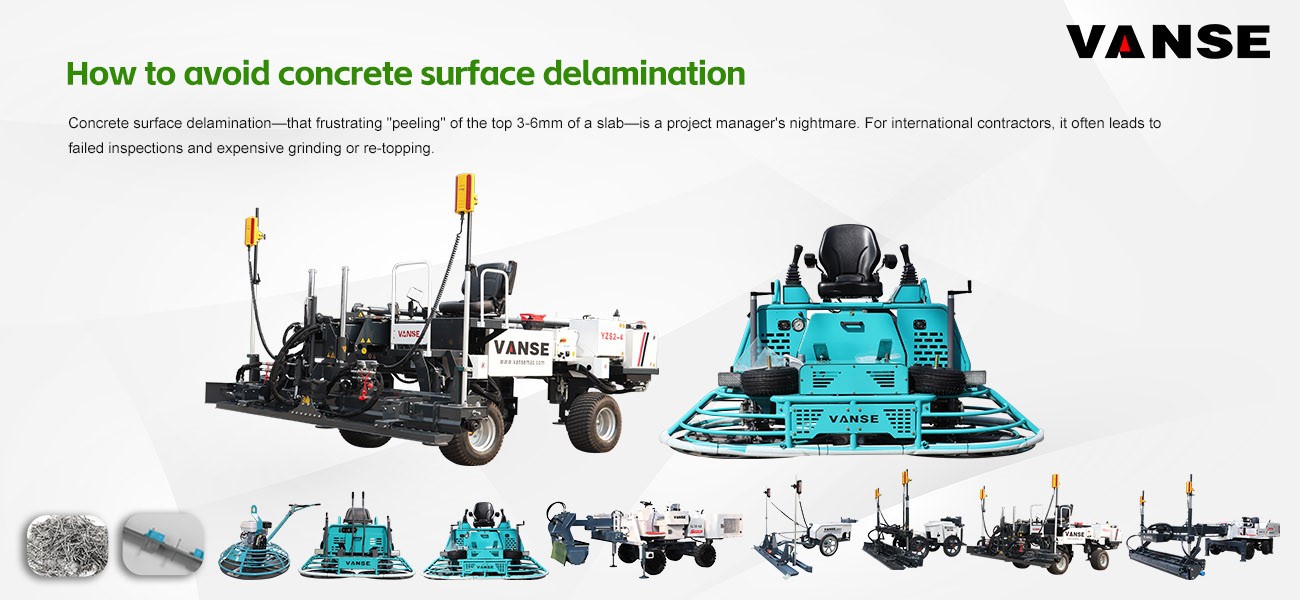
Concrete surface delamination-that frustrating "peeling" of the top 3-6mm of a slab-is a project manager's nightmare. For international contractors, it often leads to failed inspections and expensive grinding or re-topping.
In the industry, we know the main culprit: trapped bleed water or air. If you seal the surface too early, you create a hollow "blister" that eventually snaps off. To avoid this, you need a workflow that prioritizes timing and uniform compaction.
Here is how to eliminate delamination risks using a professional-grade fleet from Vanse Machinery.
1. Uniform Placement: The "Foundation" of Prevention
Delamination often starts with inconsistent concrete placement. If one part of the bay is thicker or wetter than the next, the bleed water will rise at different rates.
The Vanse Workflow: Instead of dumping large, uneven piles that create "wet spots," use a Vanse Concrete Distributor to ensure an even ribbon of material.
2. Consolidated Leveling: Eliminating Air Pockets
If the slab isn't consolidated from the bottom up, air pockets can migrate to the surface during finishing, leading to "blisters."
The Vanse Workflow: A Vanse Concrete Laser Leveling Machine (like the YZ28-4S or the telescopic YZ30-4E) doesn't just "scrape" the top; it uses high-frequency vibration (up to 4000rpm) to liquefy and consolidate the entire depth of the slab in one pass. This forces out excess air and ensures the bleed water rises naturally and evenly across the entire floor.
3. Integrated Hardening: Bonding the "Skin"
Many delamination issues occur because manual dry-shake hardener is applied unevenly, preventing a proper bond with the base slab.
The Vanse Workflow: Use the Vanse Automatic Topping Spreader. By mechanically applying the hardener immediately after the laser leveling pass, you ensure the material integrates perfectly with the wet paste. This creates a monolithic bond that won't "peel" under heavy forklift traffic.
4. Master the Timing: The Power Trowel Rule
The most common cause of delamination is premature troweling. If you start "burning" the floor while bleed water is still rising, you are guaranteed to have peeling issues.
The Vanse Workflow: When you use a high-performance Vanse VS1046 Ride-on Power Trowel, you have the torque and weight to wait for the "Goldilocks" window. Because Vanse machines are so efficient, you don't have to rush the first pass. You can wait for the bleed water to fully evaporate, then use the precision pitch control to densify the surface without trapping moisture underneath.
5. Stress Relief: Precision Joint Cutting
Sometimes "peeling" happens near the edges of joints due to localized stress or "spalling."
The Vanse Workflow: As soon as the floor is hard enough to walk on, use a Vanse Concrete Cutting Machine (Floor Saw). A clean, straight cut ensures that the slab can "breathe" and move during the curing process, preventing the edges from lifting or delaminating during the critical first 48 hours.
Comparison: Why Pro Equipment Prevents Failures
| Technical Cause of Peeling | Prevention Strategy | Vanse Advantage |
| Inconsistent Placement | Controlled, even distribution. | Concrete Distributor & Mini Dumper |
| Trapped Air/Water | Bottom-up consolidation. | High-Frequency Laser Leveling Machine |
| Poor Hardener Bond | Mechanical, even application. | Automatic Topping Spreader |
| Premature Sealing | High-torque finishing at the right time. | VS836 / VS1046 Power Trowel |
| Edge Stress | Early, clean joint execution. | Stable Concrete Cutting Machine |
Final Thought
Avoiding delamination is all about respecting the concrete's timeline. You can't force the water to stop rising, but you can use equipment that works with the material. By combining the placement precision of the Mini Dumper, the leveling power of the Laser leveling, and the finishing torque of the Power Trowel, you ensure a floor that is as durable as it is flat.
Don't risk your reputation on a "peeling" floor. Explore the full professional lineup at www.vansemac.com and build it right the first time.
Note: The parameters provided in this document are for reference only and are not mandatory. Due to differences in technical characteristics between different brands and models of laser levelers, please consult the manufacturer for a suitable solution before actual operation. This reference document assumes no responsibility for any issues arising from failure to follow the manufacturer's instructions.
Thanks to All the Friends Who Support and Trust Shandong Vanse Machinery Technology Co., Ltd.
If you want to know more about Shandong Vanse Machinery Technology Co., Ltd. or have any questions, please feel free to contact us:
Our Factory
Shandong Vanse Machinery Technology Co., Ltd.








Share this article

About the Author: Shandong Vanse Machinery Technology Co., Ltd.
Shandong Vanse Machinery Technology Co., Ltd. is a high-tech manufacturer specializing in concrete construction machinery, including laser screeds and related equipment. The company integrates R&D, production, and global sales, with products exported to over 60 countries and widely used in infrastructure projects worldwide.
Previous Post
Next Post
Related Articles
You Might Also Like
Door-To-Door Service Concrete Floor Laser Leveling Machine
The concrete laser leveler is a device that uses the laser emitted by the transmitter as the reference plane and controls the leveling head in real time through the laser receiver on the laser leveler to achieve high-precision and rapid leveling of concrete. Laser leveling machines are developed based on the increasing demand for ground quality such as strength, flatness, and levelness in modern industrial plants, large shopping malls, warehouses, and other large-area cement concrete floors. With the development of laser technology and electronic technology and the requirements of modern industrial floors, the international engineering field has begun to use laser pavers in the construction of concrete floors since the 1980s, achieving precision leveling of concrete floors. automation. Concrete floor laser leveling machine: Indoor floor ①Underground garages, general industrial plants, workshops, and automated three-dimensional warehouses; ②Clean factories for electronic appliances, food materials, medicine, etc.; ③Large-scale warehouse supermarkets, logistics centers, convention and exhibition centers, etc. Outdoor floor ① Terminals, container yards, cargo yards; ②Airport runways, aprons, parking lots; ③Plazas, residential floors, municipal roads, etc. Wanshi concrete floor laser leveling machine–hand-held two-wheel cement floor laser leveling machine–four-wheeled steel mesh cement laser leveling machine–gasoline laser leveling machine–cement floor laser leveling machine–small laser Leveling machine–car laser leveling machineConcrete Laser Levelings Machine User Manual And Operating Guide
♢ • ♢ • ♢ • ☆ Equipment Overview ☆ • ♢ • ♢ • ♢ The concrete laser leveling machine is an efficient and accurate ground leveling equipment that is widely used in various construction projects. It combines modern laser technology and mechanical engineering technology, captures the signal from the laser transmitter through the laser receiver, controls the scraper height of the leveling machine, and realizes automatic leveling of newly poured concrete, greatly improving work efficiency and leveling quality. . This equipment is suitable for large-area, high-precision concrete ground construction, such as commercial complexes, parking lots, warehouses and other places. ♢ • ♢ • ♢ • ☆ Equipment composition ☆ • ♢ • ♢ • ♢ The concrete laser leveling machine mainly consists of the following parts: 1. Main machine: including core components such as engine, traveling system, leveling system, control system, etc., it is the main working mechanism of the leveling machine. 2. Laser transmitter: used to emit laser signals to provide a reference plane for the leveling machine. 3. Laser receiver: installed on the leveling machine, used to capture laser signals and convert them into mechanical control signals. 4. Water source and water spray system: Provide an appropriate amount of moisture to the concrete during the leveling process to ensure that the concrete surface is flat and smooth. 5. Accessories: including various to ols, measuring tools, etc., used to assist the use and maintenance of the leveling machine ♢ • ♢ • ♢ • ☆ Safety Instructions ☆ • ♢ • ♢ • ♢ When operating a concrete laser leveling, the following safety regulations must be strictly observed: 1. Operators must receive professional training, be familiar with the equipment structure and operating points, and must obtain operating qualifications before taking up their posts. 2. Before starting the equipment, you must check whe ther all components are intact and whether the fasteners are firm and reliable to ensure that the equipment is in good working condition. 3. During operation, overloading, overspeeding, and over-range use are strictly prohibited to avoid equipment damage due to overload. 4. At the construction site, obvious safety war ning signs must be set up to ensure that non-workers stay away from the work area. 5. When the equipment has a fault or abnormality, it should be stopped immediately for inspection and the fault can be eliminated before continued use. 6. Operators must wear complete safety protective equipment, such as hard hats, protective glasses, gloves, etc., to ensure personal safety. ♢ • ♢ • ♢ • ☆ Preparation ☆ • ♢ • ♢ • ♢ Before operating the concrete laser leveling machine, you need to make the following preparations: 1. Check whether the appearance of the equipment is intact and whether there is any obvious damage or deformation. 2. Check whether the engine oil, water tank water level, etc. are within the specified range to ensure that the equipment lubrication and cooling systems are working properly. 3. Check whether each connection part is fastened reliably to prevent the equipment from loosening or falling off during work. 4. Check whether the laser transmitter and receiver are installed correctly to ensure that the laser signal can be transmitted and received normally. 5. According to the conditions of the construction site, reasonably arrange the position of the laser transmitter to ensure that the leveler can receive stable laser signals. 6. Prepare the water source and water spray system to ensure that the concrete surface can be fully moistened during the leveling process. ♢ • ♢ • ♢ • ☆ Operational procedures ☆ • ♢ • ♢ • ♢ The operation process of the concrete laser leveling is as follows: 1. Start the engine, preheat the equipment, and check whether each system is working properly. 2. Set the parameters of the laser transmitter according to the construction drawings and site conditions to ensure that the laser signal emitted meets the leveling requirements. 3. Connect the laser receiver to the leveling machine to ensure stable and reliable signal transmission. 4. Adjust the height and angle of the scraper of the leveling machine to maintain an appropriate distance and angle from the laser signal. 5. Turn on the water spray system to provide the appropriate amount of moisture to the concrete surface. 6. Start the leveling operation. According to the construction progress and the initial setting time of the concrete, reasonably control the walking speed of the leveling machine and the lifting frequency of the scraper. 7. During the leveling process, always observe the flatness and wetness of the concrete surface, and adjust the scraper height and water spray volume in a timely manner. 8. After the leveling operation is completed, turn off the engine and water spray system, and disconnect the laser receiver from the leveling machine. 9. Clean the equipment surface and construction site to ensure that the equipment is tidy and the environment is clean. ♢ • ♢ • ♢ • ☆ Care and Maintenance ☆ • ♢ • ♢ • ♢ In order to ensure the long-term stable operation of the concrete laser leveling machine, regular maintenance and upkeep work must be performed, including: 1. Regularly replace the engine oil and clean the oil filter to ensure that the engine lubrication system is clean and effective. 2. Check whether the cooling system components such as water tanks and water pipes are leaking or blocked, and keep the cooling system unimpeded. 3. Check the wear of scrapers, running wheels and other wearing parts, and replace damaged parts in time to ensure stable equipment performance. 4. Clean dust, oil and other debris on the surface and inside of the equipment to keep the equipment clean and tidy. 5. Regularly check the working status of key components such as electrical systems, laser transmitters and receivers to ensure their normal operation. 6. In accordance with the requirements of the equipment instruction manual, conduct regular comprehensive inspections and maintenance of the equipment to ensure long-term stable operation of the equipment. ♢ • ♢ • ♢ • ☆ Troubleshooting ☆ • ♢ • ♢ • ♢ During use, the concrete laser leveling may encounter some malfunctions or abnormal situations. To solve these problems, we can take the following measures to eliminate them: 1. Difficulty starting the engine: Check whether the battery power is sufficient, whether the starter motor is working normally, whether the fuel supply is smooth, etc. If there is any problem, replace the battery, start the motor or clean the fuel system in time. 2. Poor leveling effect: Check whether the laser transmitter and receiver are installed correctly and whether the signal is stable and reliable; check whether the height and angle of the scraper are adjusted appropriately; check whether the concrete surface is even and moist. If there is any problem, adjust or replace relevant parts in time. 3. The equipment is running abnormally: check whether the running wheels are seriously worn, whether the bearings are damaged, whether the transmission chain is loose, etc. If there is any problem, replace the running wheel, bearing or adjust the transmission chain in time. 4. The laser signal is unstable: Check whether the laser transmitter and receiver are interfered, whether the reflective surface is clean, whether the lens is damaged, etc. If there is any problem, promptly eliminate the interference, clean the reflective surface or replace the lens. 5. Electrical system failure: Check whether the cables are damaged, whether the wiring is loose, whether the components are damaged, etc. If there is a problem, repair the cable, tighten the wiring or replace the components in time. When troubleshooting, operators should strictly follow the requirements of the equipment instruction manual and are strictly prohibited from dismantling or repairing the equipment at will. If you encounter a fault that cannot be solved, you should contact professional maintenance personnel in time to handle it. ♢ • ♢ • ♢ • ☆ Transportation and Storage ☆ • ♢ • ♢ • ♢ When transporting and storing the concrete laser leveling, you need to pay attention to the following points: 1. Before transportation, make sure the device is turned off and disconnect the power supply and cables to prevent accidental startup during transportation. 2. During transportation, the equipment should be fixed and protected to prevent the equipment from being collided or damaged during transportation. 3. After arriving at the destination, the equipment should be fully inspected to ensure that the equipment has not been damaged or deformed during transportation. 4. When storing equipment, you should choose a dry, ventilated, and dark place to prevent the equipment from moisture, rust, or other damage. 5. During the storage period, the equipment should be maintained and maintained regularly to ensure that the equipment can work normally the next time it is used. In short, the warm concrete laser leveling machine is an efficient and accurate ground leveling equipment, but during use it needs to strictly abide by safety regulations, make preparations, follow operating procedures, perform regular maintenance and troubleshooting, and troubleshoot in a timely manner , and take necessary protective measures during transportation and storage. Only in this way can the long-term stable operation and service life of the equipment be ensured.Automatic levelling concrete floor laser leveling machine for sale
1. Concrete laser leveling machines are more and more used in building floors. The laser measurement and control system on the leveling machine is used to control the leveling machine in real time. There is no need to pull up the control line and control the ground level without supporting side formwork. In the absence of interference, the overall height of the paved ground remains unaffected no matter where the leveling moves. But how to use the concrete laser leveling machine to level the ground, here is a detailed explanation for you: 2. One operator assists the manipulator to install and debug the machine, and the main operator installs the transmitter and the handheld receiver. Check whether the position of the launch tube is safe; measure the initial height of concrete paving (above 2mm); ≥10MM); measure the height of the concrete after leveling (the range cannot be lower than -2MM and cannot exceed 3MM) Key points: concrete edges and manual scraping concrete surfaces; when the machine is cool, clean the machine. Check the battery level of the handheld receiver. 3. When the two concrete leveling machines cannot be operated, they should level the concrete together with the pavers; when following the machine, they should follow the command of the main machine crew to scrape and fill the position of the scraper. (The concrete material should not be lower than the edge of the scraper, and should not be 35MM higher than the edge of the scraper); 4. 2-4 paving workers must obey the command of the operator; initially level the concrete.