Technical Knowledge
What scenarios are the super flat floors suitable for?

Super flat flooring is a high-precision, high-flatness floor treatment method that is suitable for various commercial places, industrial plants, airports and other places that require long-term use and maintenance. The following are the scenarios where super flat floors are suitable for use:
▶Commercial places
Commercial places are one of the places where super flat floors are most commonly used, including shopping malls, department stores, supermarkets, restaurants, coffee shops, etc. In these locations, ultra-flat floors can provide a high level of surface flatness and wear resistance, improving customers’ shopping experience and comfort while reducing maintenance costs and time.
▶Industrial plant
Industrial plants are another place that requires high-precision floor treatment, including manufacturing workshops, warehouses, laboratories, etc. In these places, ultra-flat floors can provide better ground support and wear resistance, reduce damage to the ground by machines and vehicles, and at the same time improve work efficiency and safety.
▶Airport
Airports are another place that requires high-precision floor treatment, including runways, aprons, terminals, etc. In these locations, ultra-flat floors can provide better surface flatness and wear resistance, improving the operational efficiency and safety of aircraft and vehicles while reducing maintenance costs and time.
▶Hospital
The hospital is a place that requires a high degree of cleanliness and hygiene, and super-flat floors can meet these requirements to a certain extent. For example, in areas such as operating rooms and wards, ultra-flat floors can provide better surface flatness and dust-freeness, reducing the risk of bacterial growth and infection while improving patient comfort and satisfaction.
▶School
The school is a place that requires a high degree of safety and maintenance, and super-flat floors can meet these requirements to a certain extent. For example, in areas such as classrooms and libraries, ultra-flat floors can provide better surface flatness and wear resistance, reducing the risk of slips and falls while improving students' learning efficiency and comfort.
In general, super flat floors are suitable for various places that require long-term use and maintenance, including commercial places, industrial plants, airports, hospitals, schools, etc. In these places, super-flat floors can provide high levels of surface smoothness, wear resistance, waterproofness, anti-slip, pressure resistance, dust-freeness and aesthetics, improving work efficiency, safety and comfort. , while reducing maintenance costs and time.
Thanks to All the Friends Who Support and Trust Shandong Vanse Machinery Technology Co., Ltd.
If you want to know more about Shandong Vanse Machinery Technology Co., Ltd. or have any questions, please feel free to contact us:
Our Factory
Shandong Vanse Machinery Technology Co., Ltd.
Share this article

About the Author: Shandong Vanse Machinery Technology Co., Ltd.
Shandong Vanse Machinery Technology Co., Ltd. is a high-tech manufacturer specializing in concrete construction machinery, including laser screeds and related equipment. The company integrates R&D, production, and global sales, with products exported to over 60 countries and widely used in infrastructure projects worldwide.
Previous Post
Next Post
Related Articles
You Might Also Like
Are Shandong Vanse’s walk-behind laser leveling low-maintenance?
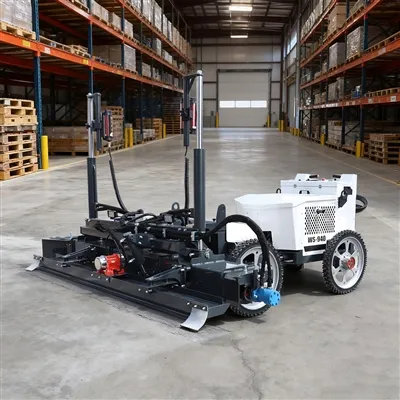
The later maintenance cost of Shandong Vanse's walk-behind laser leveling is relatively low, which is clearly reflected in multiple dimensions such as equipment design, quality of core components, maintenance convenience, after-sales service policies, and actual construction feedback. Specifically, it can be summarized as follows in combination with the details of the manual and actual market applications: The innovative structure simplifies the maintenance process. This equipment adopts a front and rear hood tilting design, which is an industry-first design that can quickly expose the internal key components (such as the generator and hydraulic system), and maintenance can be completed without disassembling a large number of peripheral components. Compared with the complex process of disassembling the body of traditional models, it not only saves more than 30% of maintenance time, but also avoids component damage caused by improper disassembly, indirectly reducing maintenance costs. Meanwhile, the body adopts a lightweight design, with the entire machine weighing only 325-350kg. When moving to another location, there is no need for large hoisting equipment, reducing the wear and tear on the tires and chassis during transportation. Moreover, the walking system is independently driven by two wheels. When a single wheel malfunctions, the entire machine does not need to be shut down for maintenance, reducing downtime losses. The service life of vulnerable parts is optimized and the replacement cycle is clearly marked. The manual clearly indicates the maintenance and replacement cycle of core components. Most vulnerable parts have a longer service life, reducing the cost of frequent replacement. Long-term durable components: The replacement cycle of the rubber shock absorber is 500,000 square meters of construction area, and the replacement cycle of the scraper connection shaft is 200,000 square meters, far exceeding similar models in the industry (usually requiring replacement for 200,000 to 300,000 square meters). Regular maintenance parts: The balance shaft bracket and the wheel axle head only need to be greased every 50 hours and do not need to be replaced frequently. The fixing bolts of the vibrator should be inspected once every 100 hours. They only need to be tightened and do not require regular replacement. Controllable consumable costs: The air filter should be cleaned every 70 hours and the gasoline filter every 100 hours. After cleaning, they can be reused without the need to frequently purchase new parts. The core components of the equipment (such as generators, laser systems, and drive parts) all adopt imported brands from Germany, the United States, and Japan, for example The generator is equipped with Jialing, Japanese YITENG (TY3600DC-2) or SAWAFUJI (SH6500EX) . It features stable power and a low failure rate. The manual indicates that the first oil change cycle for a new machine is 20 hours, and then it should be changed every 100 hours. The oil grade is clearly specified (10-30 gasoline oil for the south and 15-40 for the north). Avoid engine damage caused by improper oil compatibility.The laser control system adopts microcomputer scanning technology. The working diameter of the laser emitter reaches 300m and it has a protection level of IP66. It operates stably in an environment ranging from -10 to 60℃, with very few signal failures. Compared with domestic laser systems, it can reduce the frequency of debugging and maintenance by more than 50%. The durability of high-quality components directly reduces the probability of core system failures. According to market feedback, during continuous construction (such as 8 hours of operation per day), this equipment has no major failures on average within 1,000 hours and only requires regular maintenance, which is far superior to the performance of some domestic models that need repair within 500 to 800 hours. The maintenance process is standardized to reduce labor costs. The manual details a hierarchical maintenance list of "daily – every 50 hours – every 100 hours", and the operation is simple and easy to execute: Every day, only the cable connectors and laser communication interfaces (waterproof + loose) need to be inspected, and the oil of the lifting frame joint head needs to be added. One person can complete this in 30 minutes. Every 50 hours, maintenance items (such as adding grease to the balance shaft bracket and inspecting the distribution box) can be carried out by the construction team themselves without the need for professional maintenance personnel, thus saving on-site service fees (usually the cost of a single on-site maintenance is 300 to 500 yuan). The after-sales service policy reduces additional expenses. The manufacturer provides worry-free services throughout the entire life cycle. Core benefits include: Free regular maintenance: Every winter, we organize the "Winter Warmth Delivery Campaign", offering free inspections of the laser system, hydraulic pipelines, and electrical circuits for customers. We promptly identify potential issues (such as laser receiver calibration and aging of sealing parts) to prevent minor malfunctions from escalating into major repairs (for instance, if the laser receiver is not calibrated in time, it may lead to ground flatness errors, with subsequent rework costs exceeding 10 yuan per square meter). Overseas/Off-site service support: When the equipment is exported or construction is carried out in other places, the manufacturer can send engineers to the site for commissioning. The commissioning and training costs are already included in the purchase cost of the machine and no additional fees are required. Component supply guarantee: Vulnerable parts (such as puncture-resistant tires and vibration plate bolts) can be quickly allocated through dealers, with transparent unit prices (for example, the unit price of a tire is about 200 yuan per piece), which is 20%-30% lower than that of third-party repair shops. From the perspective of engineering application, the low maintenance cost of this equipment is also reflected in the indirect savings of later ground maintenance expenses: Laser leveling technology enables large-scale integral paving, reducing construction joints (traditional techniques leave joints every 6-8 meters, while this equipment can be seamless within 25 meters). The probability of ground cracking is reduced by 60%, and the later repair cost (typically 50-100 yuan for repairing a 1-meter crack) is significantly decreased. The construction accuracy meets the German standard (flatness error ≤1.3mm), and there is no need for post-construction grinding and leveling (traditional processes require additional grinding, with a cost of about 2 yuan per square meter). Considering the maintenance cost of the equipment itself, the overall cost is saved by 2-3 yuan per square meter compared to traditional processes. Taking the construction of a 10,000 square meter factory building as an example, the comprehensive cost can be saved by 20,000 to 30,000 yuan. Shandong Vanse walk-behind laser leveling machine achieves controllable later maintenance costs through "high-durability components + simplified maintenance design + free after-sales support" The cost of regular maintenance (including consumables) is approximately 5 to 8 yuan per hour (calculated based on oil changes and filter cleaning every 100 hours). In the absence of major malfunctions, the construction and maintenance cost per 10,000 square meters is approximately 200 to 300 yuan, which is much lower than the industry average of 500 to 800 yuan per 10,000 square meters. It is particularly suitable for long-term use in medium and small-sized construction sites (such as factories and underground garages), balancing economy and reliability. Note: The parameters provided in this document are for reference only and are not mandatory. Due to differences in technical characteristics between different brands and models of laser levelers, please consult the manufacturer for a suitable solution before actual operation. This reference document assumes no responsibility for any issues arising from failure to follow the manufacturer's instructions.Technical tips for leveling the power trowel chassis and calibrating the blade height consistency
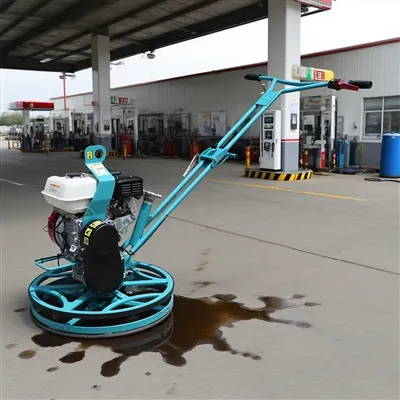
The construction quality of a power trowel (also known as a finishing machine) is 70% about leveling and 30% about operation. The flatness of the chassis and the blade is the key to determining whether the concrete surface ultimately achieves a mirror-like smoothness, without ripples or flaws. The following are detailed technical tips for leveling the base of a power trowel and calibrating the consistency of the blade height, combining the experience of experienced masters with scientific methods. One benchmark: Take the chassis as the sole benchmark. All blade adjustments must be based on a already leveled chassis. Three unifications: uniform blade height, uniform inclination Angle, and uniform wear degree. The chassis serves as the installation platform for the blade. If the chassis itself is uneven, the consistency of the blade is out of the question. First choice: A large and flat platform (such as a calibrated granite platform, a thick tempered glass tabletop or a new thick steel plate). Second choice: On a very flat ground, use a known uniform thickness pad (such as a feeler gauge). Essential items: feeler gauge, tape measure, marker pen. Cleaning and preparation Thoroughly clean the chassis and remove all cement slurry and hard lumps. Check the chassis for any obvious deformation caused by the collision. If there is severe deformation, it needs to be corrected or replaced first. Place the power trowel on the platform and ensure that the contact surface between the chassis and the platform is clean and free of debris. Preliminary "Four-point measurement Method" Consider the chassis as a clock face and measure the gap between the edge of the chassis and the surface of the platform at the four positions of 12 o 'clock, 3 o 'clock, 6 o 'clock and 9 o 'clock. Use a feeler gauge to measure and record the gap values at four points. Preliminary judgment: If the gap values at the four points differ by more than 1-2 millimeters, it indicates that the chassis is uneven and needs to be adjusted. The chassis of most power trowels is connected to the main unit through three or four adjustable pull rods. Identify the high and low points: Based on the measurement data, determine which corner has the smallest clearance (the highest point of the chassis) and which has the largest clearance (the lowest point of the chassis). To raise a certain Angle, loosen (counterclockwise) the lock nut of the pull rod corresponding to that Angle, then shorten the length of the pull rod (turn the pull rod body clockwise), and finally tighten the lock nut. To lower a certain Angle, loosen the lock nut, then extend the length of the pull rod (turn it counterclockwise), and finally lock it. The mnemonic: "High pines are short, low pines are long." (For the angles that need to be adjusted After each adjustment, gently rotate the chassis (to prevent scratching the platform) and conduct the four-point measurement again. Repeat steps 3 and 4 until the difference in gap values among the four points is controlled within 1 millimeter. At this point, it can be considered that the chassis has been leveled. The calibration of the blade can only be carried out on the basis of ensuring that the chassis is absolutely flat. A ruler (preferably a high-precision steel ruler) or a dedicated blade height gauge. Tape measure, marker pen, wrench. Installation and cleaning Install a set of blades of consistent newness and oldness onto the blade seat. It is strictly prohibited to mix new and old blades! Make sure that all the blade fixing bolts and blade seats are clean, the threads are undamaged and can be tightened in place. Place the power trowel with the chassis adjusted on a flat ground. Place a fixed reference point (such as a thin gasket or directly using the joints of floor tiles) on the ground beneath the chassis and within the rotation trajectory of the blade. Stand a ruler vertically beside the reference point and measure the distance from one of the knife tips to the ground, recording it as the reference height H. It is extremely important: Manually and slowly rotate the base of the trotter so that the same position of the next blade (for example, the outermost end of both blades) rotates directly above the reference point. Measure the distance from the tip of the knife to the ground again with a ruler. Compare it with the reference height H and record the difference. For example: Blade 1 is H, blade 2 is H-1.5mm, and Blade 3 is H+1.0mm. Measure all the blades in sequence. The height of the blade is adjusted by the regulating bolt on the blade seat to change its inclination Angle. Adjustment principle If the measured value of a certain blade is low, it needs to be raised. The method is: tighten the adjusting bolt below the blade seat, or loosen the adjusting bolt above to lift the leading edge of the blade (the side close to the rotation direction). If the measured value of a certain blade is too high, it needs to be reduced. The method is: Loosen the adjusting bolt below the blade seat or tighten the adjusting bolt above it to lower the leading edge of the blade. Mnemonic: "High tight, low loose, the leading edge as the standard." (For the leading edge of the blade that needs to be adjusted After adjusting each blade, it is necessary to rotate and measure once again, as adjusting one blade may slightly affect the height of adjacent blades. Repeat steps 3 and 4 until the difference between the measured height of all blades at the reference point and the reference height H is controlled within ±1 millimeter. Final inspection: Rotate the chassis quickly and listen to the sound with your ears. When the highly uniform blades are idling, the wind sound is a uniform "buzz". Inconsistent ones will have a periodic noise of "puff puff". The sequence is crucial: the chassis must be leveled first, and then the blades calibrated. Reversing the order is in vain. Tools are the guarantee: Having an absolutely flat calibration platform is half the battle. Data-driven operation: Trust feeler gauges and rulers, not rely on the naked eye. Each adjustment should be measured and recorded. Complete set replacement: The blades must be replaced as a complete set to maintain the same wear condition. Regular inspection: A quick inspection should be carried out before starting work every day and after replacing the blade. A full set of calibration should be carried out every 50 to 100 hours of operation or after a collision. Safety first: All operations must be carried out when the machine is completely powered off and the engine is turned off. Through the above strict and meticulous process, your power trowel machine will be in the best working condition, capable of easily creating a mirror-like smooth and high-quality concrete surface, effectively avoiding problems such as ripples, scratches and excessive cutting, thereby enhancing construction efficiency and professional image. Note: The parameters provided in this document are for reference only and are not mandatory. Due to differences in technical characteristics between different brands and models of laser levelers, please consult the manufacturer for a suitable solution before actual operation. This reference document assumes no responsibility for any issues arising from failure to follow the manufacturer's instructions.Power trowel VS manual polishing—Which saves more cost?
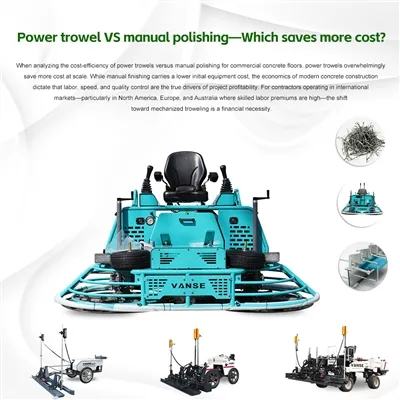
When analyzing the cost-efficiency of power trowels versus manual polishing for commercial concrete floors, power trowels overwhelmingly save more cost at scale. While manual finishing carries a lower initial equipment cost, the economics of modern concrete construction dictate that labor, speed, and quality control are the true drivers of project profitability. For contractors operating in international markets-particularly in North America, Europe, and Australia where skilled labor premiums are high-the shift toward mechanized troweling is a financial necessity. Here is a breakdown of where the actual costs and savings lie: Manual Polishing: Finishing a large commercial slab by hand requires a massive crew of skilled laborers working simultaneously to beat the concrete's curing clock. The hourly wages, overtime, and sheer number of personnel required make manual finishing financially unsustainable for anything larger than a residential driveway or tight edge-work. Power Trowels: A single operator on a ride-on power trowel can finish exponentially more square meters per hour than an entire manual crew. By drastically reducing the headcount required on the slab, contractors immediately slash their largest operational expense. The labor savings generated from just a few large-scale logistics or warehouse pours typically cover the entire initial purchase price of the machine. Manual Polishing: Manual work is slow and highly vulnerable to environmental factors. If the concrete sets faster than the crew can work, it leads to cold joints or poor surface finishing. This slows down the entire construction schedule. Power Trowels: Mechanized equipment allows for massive daily pour volumes. Faster surface finishing means the concrete contractor completes the job sooner, reducing on-site overhead costs and allowing the general contractor to advance the build schedule. Faster turnaround directly translates to higher annual revenue capacity for the contracting business. Manual Polishing: Human application is inconsistent. Achieving the strict Floor Flatness (FF) and Floor Levelness (FL) metrics demanded by modern automated warehouses is virtually impossible by hand. Failing to meet these specifications results in the hidden, catastrophic costs of remedial grinding, surface leveling, or even slab rejection. Furthermore, manual pressure cannot achieve the deep surface compaction needed to prevent future dusting and wear. Power Trowels: The mechanical weight and high-speed blade rotation of a power trowel compress the concrete matrix aggressively. This brings the cement paste to the top and drives the aggregate down, creating a dense, highly wear-resistant "burnished" finish. This precision guarantees that the high FF/FL numbers established during the laser leveling process are maintained, eliminating the cost of expensive post-pour corrections. Manual polishing only wins on Day 1 regarding Capital Expenditure (CapEx). However, when factoring in the total lifecycle cost of a commercial pour, power trowels deliver a massive cost advantage. They insulate contractors from labor shortages, eliminate the risk of specification failures, and drive the high-efficiency output necessary to compete in the global construction market. Note: The parameters provided in this document are for reference only and are not mandatory. Due to differences in technical characteristics between different brands and models of laser levelers, please consult the manufacturer for a suitable solution before actual operation. This reference document assumes no responsibility for any issues arising from failure to follow the manufacturer's instructions.