Technical Knowledge
What floor materials are suitable for metal power trowels?

1. Concrete floor
– Newly poured concrete: Metal trowels are hard and strong, and are very suitable for rough and fine grinding of newly poured concrete floors. After the initial setting of concrete, the use of metal trowels can effectively compact the concrete surface, eliminate pores and tiny cracks on the surface, and make the floor smoother. For example, when building the floor of a large industrial plant, the use of metal trowels can quickly handle large areas of newly poured concrete, improve construction efficiency and floor quality.
– Old concrete repair: For the repair of old concrete floors, such as floor wear and sanding, metal trowels can grind and trim the damaged parts. It can remove the loose layer on the surface and provide a good bonding foundation for subsequent repair materials (such as epoxy floor paint, concrete repair mortar, etc.).
2. Cement mortar floor
– Floor leveling layer: In interior decoration, cement mortar is often used for floor leveling. Metal trowels can be used for smoothing after the cement mortar has initially set, so that the surface of the leveling layer is flat, which is convenient for the subsequent laying of floor tiles, wooden floors and other floor materials. Its hardness can ensure that it will not be excessively worn due to the sand particles in the cement mortar during the smoothing process, and at the same time it can effectively compact the cement mortar.
– Decorative cement mortar floor: For some cases where colored cement mortar is used as a decorative floor, metal trowels can make the floor achieve a better finish and enhance the decorative effect. For example, in some retro-style buildings, using metal trowels to smooth the colored cement mortar floor can show delicate texture and luster.
3. Terrazzo floor
– Rough grinding stage: There are multiple stages in the production process of terrazzo floor, such as rough grinding, fine grinding and polishing. In the rough grinding stage, metal trowels can be used to remove excess stone and cement slurry on the surface of terrazzo, so that the stone is evenly exposed, laying the foundation for subsequent fine grinding and polishing. Since the terrazzo floor contains hard stones, the high hardness of the metal trowel can withstand the friction of the stones and will not be easily damaged.
– Surface defect repair: During the use of the terrazzo floor, if there are surface scratches, pits and other defects, the metal trowel can be used to polish and repair these local areas. Through proper polishing, the damaged area can be restored to the level with the surrounding ground, and then polished to restore the original beauty of the ground.
4. Emery wear-resistant floor
– Forming trowel: The emery wear-resistant floor is formed after the emery wear-resistant material is spread in the initial setting stage of concrete. The metal trowel plays a key role in this process. It can fully combine the emery wear-resistant material with the concrete surface, compact and smooth it. Because the emery itself has a high hardness, the metal trowel can cooperate with it to form a hard and wear-resistant surface on the ground, which is widely used in industrial workshops, warehouses and other places.
– Post-maintenance: In the post-maintenance of diamond abrasive wear-resistant floors, metal polishing sheets can be used to regularly polish and clean the floors to remove surface dirt and slight wear marks, thereby extending the service life of the floors.
Thanks to All the Friends Who Support and Trust Shandong Vanse Machinery Technology Co., Ltd.
If you want to know more about Shandong Vanse Machinery Technology Co., Ltd. or have any questions, please feel free to contact us:
Our Factory
Shandong Vanse Machinery Technology Co., Ltd.








Share this article

About the Author: Shandong Vanse Machinery Technology Co., Ltd.
Shandong Vanse Machinery Technology Co., Ltd. is a high-tech manufacturer specializing in concrete construction machinery, including laser screeds and related equipment. The company integrates R&D, production, and global sales, with products exported to over 60 countries and widely used in infrastructure projects worldwide.
Previous Post
Next Post
Related Articles
You Might Also Like
Industry Standards And Specification Requirements For Concrete Laser Leveling Machines
Industry standards and specification requirements for concrete laser leveling machines 1. Introduction With the rapid development of the construction industry and the continuous progress of technological innovation, the importance and role of concrete laser leveling machines as key equipment in modern building construction have become increasingly prominent. In order to ensure the stable performance, safe operation and convenient maintenance of concrete laser leveling machines, the industry has formulated a series of industry standards and regulatory requirements. This article aims to deeply discuss the industry standards and specification requirements for concrete laser leveling machines and provide clear guidance and reference for relevant practitioners. 2. Industry background and current situation As a high-precision and high-efficiency ground leveling equipment, concrete laser leveling machine is widely used in infrastructure construction fields such as roads, bridges, airports, and squares. With the continuous innovation of technology and the continuous expansion of application fields, the concrete laser leveling machine industry shows the following characteristics: ※Equipment technology continues to be upgraded, making performance more stable and reliable. ※Application fields continue to expand and market demand continues to grow. ※Competition in the industry is becoming increasingly fierce, and the requirements for product quality and service are constantly increasing. In this context, it is particularly important to formulate and implement industry standards and regulatory requirements. They not only help improve the overall quality of concrete laser leveling machines and ensure construction safety, but also promote the healthy development of the industry and enhance international competitiveness. 3. Overview of industry standards The industry standards for concrete laser levelings mainly include the following aspects: ※Technical performance standards: Specifies the technical performance indicators of concrete laser levelings, such as flatness, accuracy, efficiency, etc., to ensure that the equipment can meet the needs of different projects. ※Safety standards: stipulate the safety performance of equipment, including electrical safety, mechanical safety, operational safety, etc., to ensure the life safety of construction personnel and the stable operation of equipment. ※Environmental standards: Limit environmental indicators such as noise, vibration, and exhaust emissions of equipment to reduce environmental pollution. ※Repair and maintenance standards: Specify maintenance requirements and troubleshooting methods for equipment to ensure long-term stable operation of the equipment. 4. Analysis of specification requirements The specification requirements for concrete laser levelinging machines mainly include the following aspects: ※Design and manufacturing requirements: The equipment is required to be reasonably designed, well manufactured, and comply with relevant technical specifications and standards. At the same time, the equipment is required to be easy to maintain and operate, and can meet the needs of different projects. ※Performance requirements: Clearly define the performance of the equipment, such as flatness, accuracy, efficiency, etc. The equipment is required to complete the leveling task within the specified time and achieve the specified leveling effect. ※Safety requirements: Equipment is required to strictly abide by safety regulations during design, manufacturing, and use to ensure the safety of operators. At the same time, the equi pment is required to have complete safety protection measures and fault alarm functions. ※Environmental protection requir ements: Environmental protection indicators such as noise, vibration, and exhaust emissions of equipment are required to comply with relevant standards and regulations to reduce the impact on the environment. 5. Design and manufacturing requirements The design and manufacture of concrete laser leveling machines should comply with the following requirements: ※Structural rationality: The equip ment structure should be reasonably designed, with uniform stress, to reduce stress concentration, so as to improve the stability and durability of the equipment. ※Material selection: High-quality materials that meet standards should be selected to ensure the strength and stiffness of the equipment. At the same time, the corrosion resistance and wear resistance of the material should be considered to adapt to different construction environments. ※Processing technology: Adopt advanced processing technology and equipment to ensure the manufacturing accuracy and surface quality of the equipment. Special treatment is performed on key components, such as heat treatment, spraying, etc., to improve their service life and performance. ※Inspection and testing: Strict inspection and testing should be carried out during the equipment manufacturing process to ensure that various performance indicators of the equipment meet standard requirements. At the same time, long-term durability tests are conducted on the equipment to evaluate its performance in actual use. 6. Performance testing and evaluation The performance testing and evaluation of concrete laser leveling machines is a key link to ensure stable and reliable performance of the equipment. During the test process, the performance indicators such as flatness, accuracy, efficiency and so on of the equipment should be comprehensively tested. At the same time, the actual construction environment is simulated and long-term continuous operation tests are conducted on the equipment to evaluate its stability and reliability in actual use. In addition, the ease of operation and subsequent maintenance of the equipment should also be evaluated to meet the user's needs. 7. Operation and maintenance specifications In order to ensure the safe use and long-term stable operation of the concrete laser leveling, detailed operation and maintenance specifications should be formulated. The operating specifications should include operating steps and precautions such as starting, stopping, running, and adjusting the equipment. At the same time, clear requirements are placed on the quality and skills of operators to ensure that they can operate the equipment skillfully and accurately. Maintenance specifications should include daily inspection, maintenance, and repair of equipment. Operators are required to perform regular maintenance on the equipment, discover and deal with hidden faults in a timely manner, and ensure the long-term stable operation of the equipment. 8. Safe use and warnings The safe use of warm concrete laser levelings is a top priority. During use, safety regulations should be strictly followed to ensure the safety of operators. The equipment should be equipped with complete safety protection measures, such as emergency stop buttons, protective devices, etc. At the same time, warning signs and operating procedures instructions are set up in conspicuous locations on the equipment to remind operators to pay attention to safety matters and operating procedures. In addition, regular safety training and education are provided to operators to improve their safety awareness and operating skills and ensure the safe use of equipment. 9. Training and Certification To ensure the safe and efficient use of concrete laser levelings, operator training and certification are crucial. Manufacturers or relevant industry associations should provide specialized training courses, covering the basic principles of equipment, operating procedures, safety regulations, maintenance and other aspects. After the training, the sample operators should pass theoretical examinations and practical assessments. Conduct a comprehensive assessment. Only certified operators can work to ensure the safe and efficient operation of the equipment. 10. Market Supervision and Regulation In order to ensure the healthy development of the concrete laser leveling machine industry, government departments should strengthen market supervision and supervision. Develop strict industry standards and regulations and impose penalties on products and companies that do not meet the standards. At the same time, we will strengthen the random inspection and evaluation of equipment quality to ensure that the concrete laser leveling machines sold on the market meet relevant standards and requirements. In addition, enterprises should be encouraged to increase investment in research and development, promote technological innovation and industrial upgrading, and improve the competitiveness and international influence of the entire industry. 11. Future Outlook With the continuous advancement of science and technology and the continuous expansion of application fields, the concrete laser leveling machine industry will face more development opportunities and challenges. In the future, the industry will develop in the direction of intelligence, efficiency, and environmental protection. The application of intelligent technology will improve the automation and ease of operation of the equipment; efficient design will further improve the leveling efficiency and quality of the equipment; environmental protection requirements will prompt the equipment to pay more attention to environmental protection and sustainability during the manufacturing and use processes. develop. At the same time, with the continuous advancement of global infrastructure construction and the increasingly frequent international trade, the concrete laser leveling machine industry will face a broader market space and a more intense competitive environment. Therefore, relevant enterprises should continuously improve their own strength and innovation capabilities to adapt to market changes and demand development. Summarize Through a comprehensive discussion of the industry standards and regulatory requirements for mixed soil laser leveling machines, we can see that the industry has achieved remarkable results in technological innovation, market expansion, and safe use. However, in the face of future development opportunities and challenges, it is still necessary to strengthen industry supervision and market supervision, promote technological innovation and industrial upgrading, and improve the competitiveness and international influence of the entire industry. At the same time, relevant practitioners should continue to improve their own quality and capabilities to adapt to market changes and demand development. Only in this way can the concrete laser leveling machine industry usher in a better future.Can concrete polishing machines replace power trowels for achieving mirror-finish super flat floors?
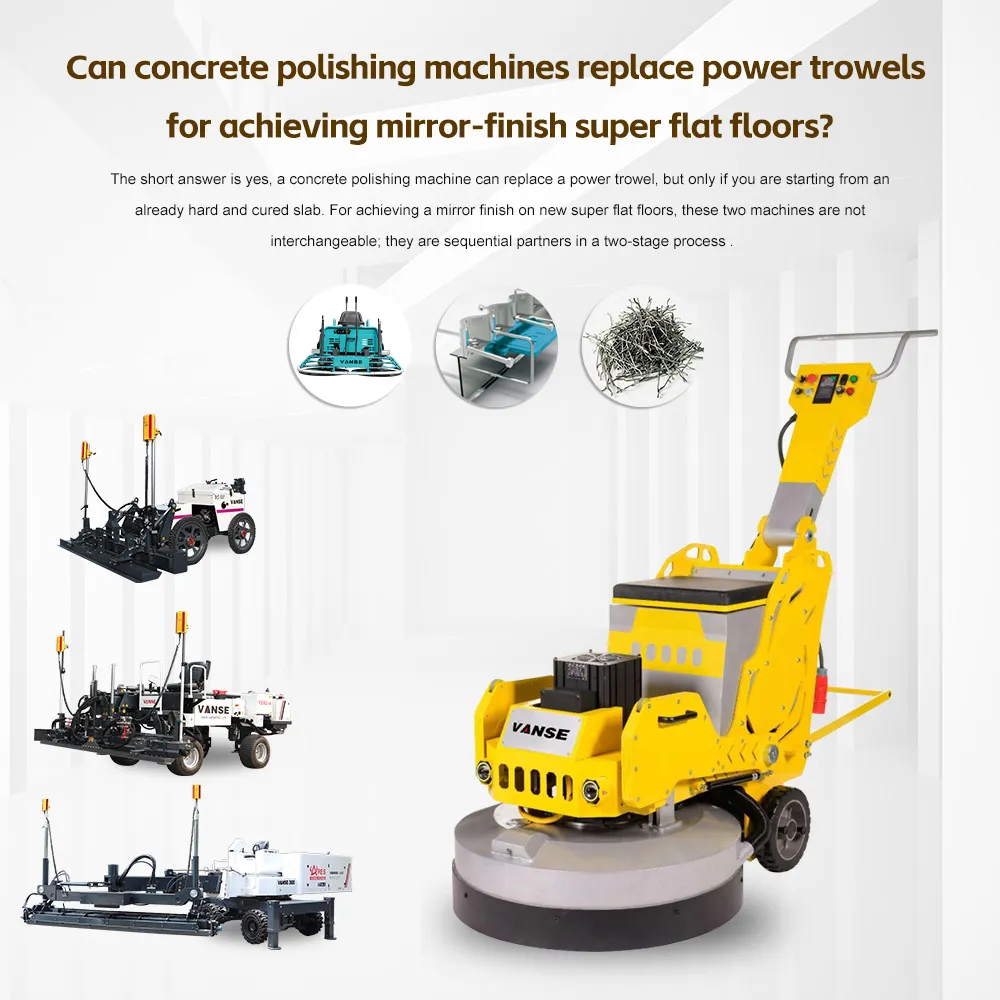
The short answer is yes, a concrete polishing machine can replace a power trowel, but only if you are starting from an already hard and cured slab. For achieving a mirror finish on new super flat floors, these two machines are not interchangeable; they are sequential partners in a two-stage process . To understand why, you have to look at when in the concrete's life cycle each machine operates. A power trowel works on wet, setting concrete, while a polishing machine works on hard, cured concrete. Feature Power Trowel (Finishing Stage) Concrete Polisher (Hardening Stage) When to Use During the concrete's initial set (while still plastic/hardening) . After the concrete has fully cured (typically 28+ days) . How it Works Uses steel blades to float, compact, and "burnish" the surface paste, creating a temporary mechanical shine . Uses abrasive diamond pads to physically grind down the surface, exposing the aggregate and creating a permanent structural shine . Result Creates the initial dense, smooth surface required before any polishing can happen. This is the foundation. Removes the top layer to achieve the final desired gloss level (from satin to mirror). This is the final art. Goal Densification & Profile Creation. To prepare a flat, cured slab ready for polishing. Aesthetics & Durability. To reveal the aggregate and create a long-lasting, high-gloss finish . Think of it like building a piece of fine furniture. You cannot start with a rough log and immediately apply varnish. You need a plane to make it flat first. The power trowel's job is to create a perfectly flat and dense foundation. As we discussed in your previous question about operation time, the trowel burnishes the surface. If you try to use a polishing machine on a floor that hasn't been properly power-troweled, the slab will be too rough and uneven. The polisher would have to remove far too much material to achieve flatness, which is inefficient and costly . Once the concrete is cured, the polishing machine takes over. You attach diamond abrasive pads (starting coarse and moving to very fine, like 3,000 grit) . This process physically cuts the surface, revealing the inner beauty of the stone and creating a shine that is part of the material itself, not just a surface effect . Technically, yes, a power trowel can be converted into a high-speed polishing machine, but this is for the polishing phase only. The Conversion: You can buy a conversion kit (planetary grinding heads) that attaches to the bottom of a power trowel, allowing it to hold diamond polishing pads . The Advantage: This is incredibly fast. A converted ride-on power trowel can polish over 10,000 square feet a day, making it ideal for massive warehouses . The Trade-off: A converted trowel is less precise than a dedicated planetary grinder and cannot get close to walls or into corners. You would still need a smaller, walk-behind grinder for the edges . Regardless of which machine you use for polishing, you must apply a chemical hardener called a densifier (usually lithium silicate) after the initial grinding passes . This chemical reacts with the concrete to make it rock-hard, allowing it to accept a high-gloss polish. Without it, the surface will remain chalky and dull. In short: Use the power trowel to build the perfect canvas. Then, bring in the polisher to create the artwork. If you are planning a project, knowing the desired final gloss level (e.g., matte, satin, or high-gloss mirror) will help determine exactly which grit progression you need for the polishing phase. Let me know if you'd like more details on that. Contact us NOW Note: The parameters provided in this document are for reference only and are not mandatory. Due to differences in technical characteristics between different brands and models of laser levelers, please consult the manufacturer for a suitable solution before actual operation. This reference document assumes no responsibility for any issues arising from failure to follow the manufacturer's instructions.Detailed explanation of concrete laser leveling machine pouring leveling construction and leveling control matters
Detailed explanation of concrete laser leveling machine pouring leveling construction and leveling control matters 1. Preparation 1.1 After the base layer is processed, the equipment of the laser paver is debugged, and the fixed reference level point is drawn according to the original level point; the non-woven fabric is laid, the side formwork is supported, the laser transmitter is erected, and the ground level is introduced according to the original level point. Laser leveling machine. 1.2 Conveying concrete Commercial concrete is used, and the commercial concrete is transported to the entrance and exit of the garage by tank truck, and then transported to the construction site by a three-wheel dump truck. 1.3 Standard calibration Use a hand-held laser receiver to check the elevation of the floor, introduce the elevation into the laser paver, and adjust the reference point (±0.00) on the leveling machine. 2. Concrete paving Pouring steps: (1) After the formwork is supported, the warehouse should be cleaned one day in advance before pouring concrete, rinsed and soaked with water. When pouring is approaching, drain the open water and sweep the cement slurry or interface agent. At this time, no obvious water accumulation is strictly prohibited. If there is, it must be resolutely removed before paving concrete. (2) After the concrete is put down, it should be preliminarily leveled, and the leveling height should be 3 cm thicker than the elevation. Then level it with a laser paver. The corners that cannot be leveled can be leveled with a gasoline leveler or manually. (3) When the warehouse near the wall is being poured, after the leveling machine walks over, it must be scraped with a scraper in time. and so on. (4) For areas where concrete mixer trucks cannot be driven to the site, tractors should be used to transfer concrete. After the pouring is completed, the floor finishing construction begins when the concrete is initially set. (5) When the warehouse near the wall is being poured, it must be leveled with a scraper in time after the leveling machine has passed by. and so on. (6) For areas where concrete mixer trucks cannot be driven to the site, tractors should be used to transfer concrete. After the pouring is completed, the floor finishing construction begins when the concrete is initially set. 3. During construction, the laser signal received by the receiver of the laser paver (frequency of 10 times per second) automatically adjusts the elevation in real time to ensure that the construction elevation is always at the set standard. Because the laser transmitter is fixed after being set up, it can ensure that the construction of a large area of ground does not produce cumulative errors. 4. During the construction, the operator uses a hand-held laser receiver to detect the ground after the machine is constructed, and again ensures that the flatness error is within the controllable range. If there is anything you don't understand, you can consult us, and we will continue to answer for you.