Technical Knowledge
The cleaning four steps of laser leveling machine
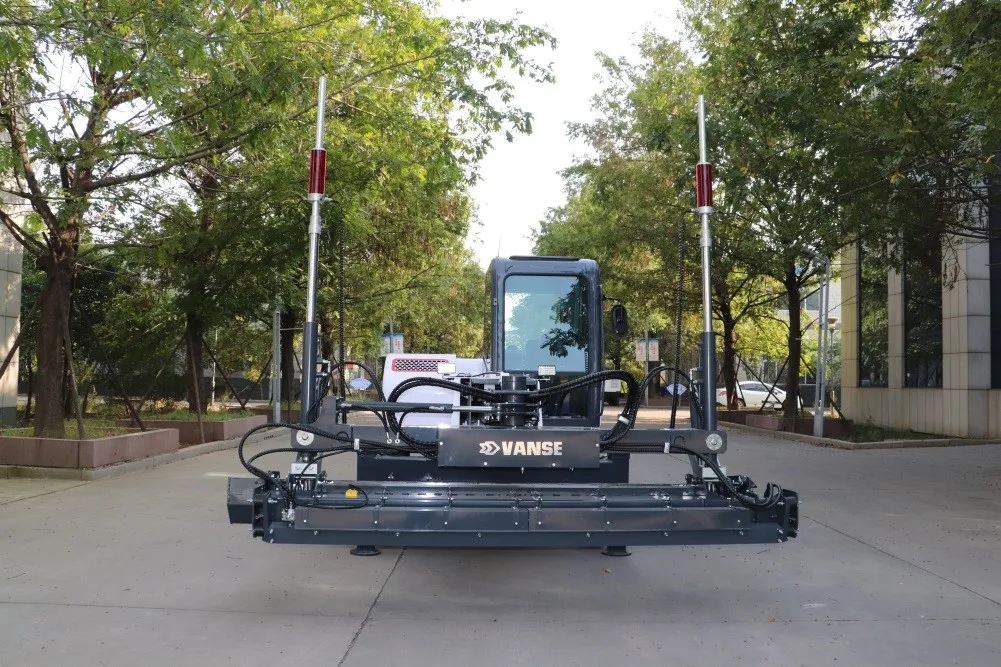
With the addition of concrete laser leveling machines in the construction industry and road construction industries, there has been a qualitative leap in both quality and speed, and it has also saved a lot of costs for users. However, in the face of high-frequency use, users cannot ignore the cleaning of the equipment. This step must not be sloppy. Let's take a look at how to clean the leveling in a few steps!
1
The liquid crystal surface on the laser leveling machine body also needs to be cleaned. You can use organic resin or lens cleaning cloth to wipe off the dirt. If there is too much dirt, it can be removed with a lens cleaning solution.
2
After the laser leveling machine is constructed, there will be a lot of dust and mud. First of all, the dust on the laser leveling machine should be wiped clean, and the dirt and oil stains should be wiped clean with tissue paper or cotton cloth.
3
If the laser signal is lost during the construction of the laser leveling machine, the machine needs to be restarted, and the interval should be more than ten seconds.
4
If there are too many stains, you can use a soft cloth to soak in water diluted with a neutral detergent, wring it out and clean it. The best laser leveling machine manufacturers remind you not to use volatile oil, thinner, gasoline, etc. Chemical cleaning wipe.
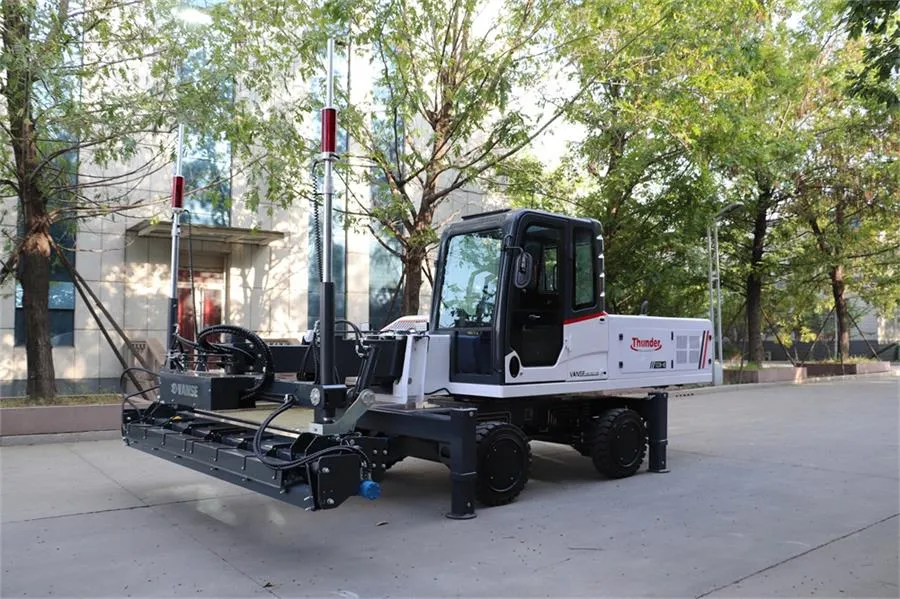
The laser leveling machine uses a scraper to take away the raised concrete and initially level it to reach the elevation required by the design. The hydraulically driven vibrating motor vibrates at a frequency of 4000 times per minute, driving the entire vibrating plate to vibrate the concrete together. The leveling of the laser paver does not need to pull the control line, nor does it need the side formwork to control the ground elevation, but is controlled by the laser measurement and control system on the laser leveling machine in real time. As long as the laser transmitter is not disturbed, no matter where the laser leveling machine moves Wherever it is, it can be ensured that the overall elevation of the paved ground will not be affected.
The concrete ground laser leveling machine is to spread the mixed concrete along the subgrade according to the given thickness, width and road type requirements, and then complete the construction of paving the concrete road surface through the operation procedures of vibrating, leveling and troweling. mechanical. The working device of the concrete floor laser leveling machine generally consists of a distributor, a scraper, a vibrator (including a vibrator and a vibrator), a leveling machine, a trowel and other devices. At the same time, it also requires the organic cooperation of the frame, walking mechanism, manipulation control system and other auxiliary mechanisms. Some models integrate all the devices into one, and some are divided into two or more independent stand-alone machines.

|

|

|

|
Thanks to All the Friends Who Support and Trust Shandong Vanse Machinery Technology Co., Ltd.
If you want to know more about Shandong Vanse Machinery Technology Co., Ltd. or have any questions, please feel free to contact us:
Our Factory
Shandong Vanse Machinery Technology Co., Ltd.








Share this article

About the Author: Shandong Vanse Machinery Technology Co., Ltd.
Shandong Vanse Machinery Technology Co., Ltd. is a high-tech manufacturer specializing in concrete construction machinery, including laser screeds and related equipment. The company integrates R&D, production, and global sales, with products exported to over 60 countries and widely used in infrastructure projects worldwide.
Previous Post
Next Post
Related Articles
You Might Also Like
With the advent of laser leveling machines, are you still using the old vibrating leveler to vibrate the beam?
With the advent of laser leveling machines, are you still using the old vibrating leveler to vibrate the beam? When it comes to construction, everyone knows that only with a short construction period and high quality can we save costs, improve efficiency and increase profits. If you want to save costs quickly during construction, construction tools are a very important choice. An efficient, convenient and fast tool will make construction work more effective with half the effort! On the contrary, choosing inappropriate tools will extend the construction period, increase costs, and reduce profits. Take the floor construction under construction as an example! The flatness of the floor is more difficult to grasp. Leveling is usually done manually. Even if you use an old-fashioned floor machine, the effect and cost are not particularly ideal. The emergence of a laser leveling machine has greatly solved many problems that arise during construction. During the construction process, it can solve the problems of hollowing, shelling, cracking, and uneven ground after general construction. It can make the final effect exceed Party A's floor quality requirements, reduce costs, and Improved work efficiency. Many industries require factories, as well as shopping malls, large warehouses and other construction sites that require large areas of ground, to have much higher standards. Attention has been greatly increased to the strength, flatness and level of the ground quality. It is difficult to meet the requirements using old-fashioned flooring methods, and labor costs will increase exponentially. The construction principle of the laser leveler is very simple and clear. It can perform several construction processes such as leveling and vibration at the same time, further ensuring the quality of the construction and completely saving labor costs. The advantage of construction is that the construction speed is fast and the quality is high, ensuring that the overall integrity of the ground is good and cracks are not prone to occur. The amount of support and disassembly is reduced compared with the traditional method. Moreover, the reduction in the number of workers ensures an increase in final profits.What impact does poor laser signal reception stability of a concrete laser screed have on construction?
The poor stability of laser signal reception in concrete laser levelings is a serious construction quality issue. It can trigger a series of negative chain reactions like a "domino effect". The following are the specific impacts it has on construction, ranging from direct effects to long-term consequences: Manifestation: The ground shows "wavy" undulations, local depressions or protrusions. The reason is that the receiver signal is intermittent or fluctuating, causing the lifting cylinder of the leveling machine to constantly perform incorrect correction actions, and the scraper cannot maintain a constant height. Performance: It is impossible to achieve the absolute level of the design (such as high-standard warehouses) or precise slope (such as ground with drainage requirements). Reason: The laser emitter establishes an accurate reference plane. An unstable receiver means that the leveling has lost this reliable reference and is unable to spread the concrete to the designed height Performance: Frequent shutdowns are required to inspect the laser transmitter, receiver or circuit. The reason is that in order to ensure quality, the operator has to stop the construction for investigation once any abnormality is found in the process of flattening the head, which seriously slows down the progress. Performance: More experienced workers are needed for manual remediation. The reason is that for uneven ground, a large number of workers need to use handheld trowels to "make up" in the later stage. This is not only time-consuming and labor-intensive, but also the accuracy of manual leveling is far lower than that of machines. Manifestation: Inaccurate control of concrete usage. Reason: Uncontrolled elevation may lead to local concrete being too thick (wasting materials) or too thin (requiring replenishment and affecting strength). Manifestation: Irregular cracks appear on the ground after use. The reason is that poor flatness leads to uneven thickness of the concrete surface layer in subsequent pouring. Under the action of load and shrinkage, stress concentration is prone to occur at the junction of thin and thick layers, thus causing cracking. Symptoms: Dust, sand and aggregates appear on the ground too early. The reason is that high places are prone to wear and tear, while low places are likely to accumulate dirt and get damaged. At the same time, subsequent hardeners or sealants are also difficult to apply evenly, further reducing the overall durability of the ground. Performance: High-standard industrial floors (such as VNA ultra-flat warehouses), epoxy floors, PVC roll material laying, etc. cannot be carried out or the cost has increased sharply. The reason is that these processes have extremely high requirements for the flatness of the base layer (such as FF/FL values). If the base is uneven, either construction cannot be carried out or a huge cost needs to be spent on grinding or self-leveling to level it. Performance: Difficult installation of high-rack shelves and questionable stability; Automated equipment such as automatic guided vehicles (AGVs) and stackers operate unstably, have poor precision and a high failure rate. Reason: These devices are extremely sensitive to the flatness of the ground. Even the slightest unevenness can cause the devices to shift, vibrate or stop rotating. After understanding the impact, it is also necessary to know the root cause of the problem in order to solve it in a targeted manner Problems with the laser emitter itself: insufficient battery power, self-accuracy drift, or displacement or vibration caused by human or equipment collision. Receiver and sensor issues: Receiver damage, photosensitive element blocked by dirt, poor contact of signal lines. Environmental interference Obstruction: Construction workers, equipment, and building materials temporarily blocked the laser beam. Vibration: Heavy equipment is in operation nearby, or the tripod of the transmitter is not stable, causing the transmitter to shake. Temperature and air flow: In extreme environments, heat waves can cause changes in air density, leading to slight refraction of laser beams (" mirage "effect), which affects the stability of long-distance signals. Operational issue: When the transmitter is set up at a height that exceeds its effective range, or when the ground has a significant slope, the Angle between the laser line and the receiver is too large, resulting in poor signal reception. Conclusion The stability of laser signal reception is the "lifeline" of concrete laser leveling machine construction. Once a problem occurs, it is by no means just a minor issue of "a slightly uneven ground", but will have a serious impact on the project from multiple dimensions such as quality, efficiency, cost and safety. Before and during construction, ensuring the stability and reliability of the laser system must be regarded as a core task for inspection and management. Note: The parameters provided in this document are for reference only and are not mandatory. Due to differences in technical characteristics between different brands and models of laser levelers, please consult the manufacturer for a suitable solution before actual operation. This reference document assumes no responsibility for any issues arising from failure to follow the manufacturer's instructions.How to optimize laser leveling technology to improve efficiency while considering construction costs?
In the field of construction, cost control and efficiency improvement are key factors for project success. As an advanced construction process, laser leveling technology has been widely used in the leveling of concrete floors. However, how to further optimize laser leveling technology to improve efficiency while considering construction costs is a question worthy of in-depth discussion. The following is a detailed analysis of this issue. Introduction With the rapid development of the construction industry, construction costs and efficiency have become the focus of project managers. Laser leveling technology has been widely used in construction with its high efficiency and high precision, but it is also accompanied by certain cost investment. How to improve efficiency and reduce costs by optimizing technology while ensuring construction quality is a challenge facing the current construction industry. 1. Technical Overview Laser leveling technology uses the horizontal laser beam emitted by the laser transmitter as a reference and uses automated equipment to accurately level the concrete surface. The core advantage of this technology lies in its high efficiency and high precision, but it also requires corresponding equipment and technical support, which increases the construction cost to a certain extent. 2. Balance between cost and efficiency On the premise of considering the construction cost, optimizing laser leveling technology to improve efficiency requires balancing the following aspects: – **Equipment investment and maintenance cost**: Select appropriate laser leveling equipment and formulate a reasonable maintenance plan to extend the service life of the equipment and reduce long-term costs. – **Labor cost**: Reduce manual operation by increasing the degree of automation, but at the same time, it is necessary to ensure that the operator has the necessary skills and knowledge to avoid cost increases caused by improper operation. – **Construction materials**: Optimize concrete mix ratio and pouring process to reduce material waste and improve material utilization. – **Construction time**: By optimizing the construction process and increasing the construction speed, shorten the construction cycle and reduce time costs. 3. Technical optimization strategy In order to improve the efficiency of laser leveling technology while considering the cost, the following optimization strategies can be adopted: – **Equipment selection and configuration**: Select appropriate laser leveling equipment according to the construction scale and needs to avoid over-investment. – **Equipment sharing and leasing**: For equipment that is not frequently used, consider sharing or leasing to reduce the cost of equipment acquisition. – **Operator training**: Strengthen operator training, improve their professional skills, and reduce construction delays and cost increases caused by improper operation. – **Construction process optimization**: Through refined management, optimize the construction process, reduce unnecessary construction links, and increase construction speed. – **Technology innovation and R&D**: Invest in technological innovation and R&D to develop more efficient and lower-cost laser leveling technology. 4. Construction process optimization In the construction process, the application of laser leveling technology can be optimized in the following ways to improve efficiency: – **Preliminary planning**: Carry out detailed planning before construction, including construction plan design, material budget and construction schedule. – **Construction preparation**: Ensure that the construction site is fully prepared, including site leveling, equipment commissioning, etc. – **Construction monitoring**: Implement real-time monitoring during the construction process to ensure the normal operation and construction quality of the laser leveling equipment. – **Post-evaluation**: Conduct effect evaluation after the construction is completed, summarize experience and lessons, and provide reference for subsequent construction. 5. Cost control measures While optimizing laser leveling technology, effective cost control measures need to be taken: – **Budget management**: Develop a detailed budget plan and strictly control cost expenditures. – **Supply chain management**: Optimize the supply chain and reduce material procurement costs. – **Risk management**: Identify and evaluate possible risks during the construction process and develop corresponding risk response measures. 6. Technological innovation and development trends Technological innovation is the key to improving the efficiency of laser leveling technology and reducing costs. Future development trends may include: – **Intelligent technology**: Integrate more intelligent sensors and control systems to improve the automation level of the leveling machine. – **Multifunctional equipment**: Develop laser leveling equipment that can complete multiple construction tasks at the same time. – **Environmentally friendly materials and processes**: Research and use more environmentally friendly concrete materials and construction processes to reduce environmental costs. 7. Conclusion On the premise of considering construction costs, optimizing laser leveling technology to improve efficiency is a systematic project that requires comprehensive consideration from multiple aspects such as equipment selection, personnel training, construction process, cost control and technological innovation. Through these measures, while ensuring construction quality, costs can be effectively reduced and construction efficiency can be improved.