Technical Knowledge
Maintenance and Troubleshooting of Concrete Laser Leveling Machines
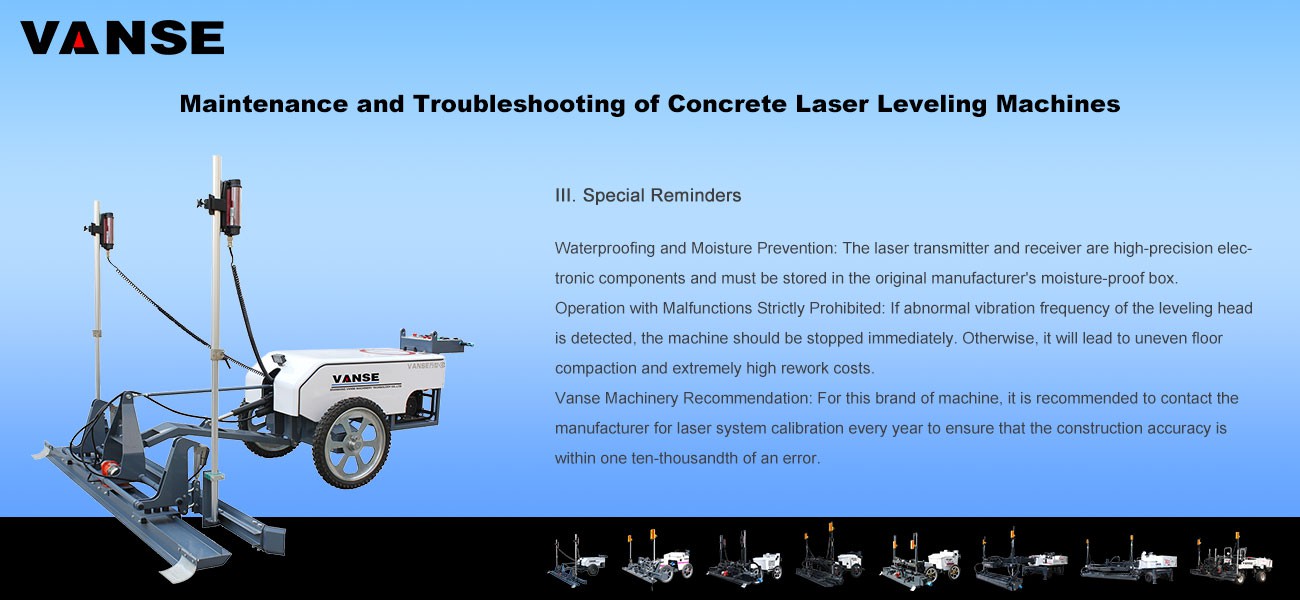
As high-precision construction equipment, the maintenance and troubleshooting of concrete laser Leveling machines are crucial for ensuring floor flatness. Based on the operating standards of leading industry brands such as Vanse, the following is a detailed maintenance schedule and troubleshooting guide:
I. Maintenance Schedule
| Cycle | Key Inspection Items | Specific Procedures: |
| After each construction session | Full Machine Cleaning | The machine body, leveling head, and vibrating plate must be thoroughly rinsed with a high-pressure water gun before the concrete hardens; concrete adhesion is strictly prohibited. |
| Daily (before commencement) | Hydraulics and Lubrication | Check hydraulic oil level, engine oil level, and coolant level. Check if all moving joints require grease. |
| Weekly | Laser System | Check the stability of the laser transmitter tripod and the accuracy of the handheld receiver; clean the laser receiver lens (with a soft cloth). |
| Monthly (50-100 hours) | Fastening and Filtration | Tighten the chassis and leveling head bolts; check/clean the air filter; check for leaks in the hydraulic lines. |
| Quarterly (300 hours) | Oil Change | Change the engine oil and filter (replace within the first 50 hours of operation for new machines); check the hydraulic oil quality (whether it has emulsified). |
II. Common Troubleshooting Guide
1. Unstable or Lost Laser Signal
Symptom: The automatic lifting and lowering of the leveling head malfunctions, and the display alarm indicates no laser signal.
Troubleshooting Steps:
External Interference: Check if there are vehicles, pillars, or construction workers obstructing the laser transmitter.
Dirty Receiver: Check if there are concrete droplets on the laser receiver window mounted on the machine body. Wipe it with a non-woven cloth.
Excessive Vibration: Check if the laser transmitter tripod is placed on a stable surface to avoid interference from nearby heavy vehicles.
Battery Power: Check if the transmitter's power is reduced due to low battery power.
2. Unevenness of Ground After Leveling
Symptom: After the machine passes over the surface, wavy lines or significant height deviations appear.
Troubleshooting Steps:
Elevation Verification: Recalibrate the reference elevations of the laser transmitter and handheld receiver.
Leveling Head Angle: Check if the vibrating plate angle has shifted due to impact; it needs to be adjusted back to the standard horizontal position.
Leveling Head Angle: Check if the vibrating plate angle has shifted due to impact; it needs to be adjusted back to the standard horizontal position.
Concrete Slump: Check the concrete's consistency. If the concrete is too dry, the machine vibration will not adequately lift the slurry; if it is too thin, it is prone to collapse.
3. Weak Drive or Hydraulic System
Symptoms: Slow machine movement, sluggish steering, or slow lifting and lowering of the leveling head.
Troubleshooting Steps:
Insufficient Hydraulic Oil: Check the hydraulic oil level in the tank and replenish to the standard mark.
Clogged Filter: A clogged hydraulic return filter can cause excessive back pressure and requires replacement.
Loose Belt: Check if the hydraulic pump belt driven by the engine is slipping.
4. Engine Starting Difficulty/Automatic Shutdown
Symptoms: The starter motor makes noise but the engine fails to start, or the engine suddenly shuts off during operation.
Troubleshooting Steps:
Fuel System: Check the fuel tank for water and ensure the fuel filter is not clogged with low-quality diesel fuel.
Electrical Issues: Check the battery terminals for looseness or corrosion/oxidation.
III. Special Reminders
Waterproofing and Moisture Prevention: The laser transmitter and receiver are high-precision electronic components and must be stored in the original manufacturer's moisture-proof box. Operation with Malfunctions Strictly Prohibited: If abnormal vibration frequency of the leveling head is detected, the machine should be stopped immediately. Otherwise, it will lead to uneven floor compaction and extremely high rework costs.
Vanse Machinery Recommendation: For this brand of machine, it is recommended to contact the manufacturer for laser system calibration every year to ensure that the construction accuracy is within one ten-thousandth of an error.
Note: The parameters provided in this document are for reference only and are not mandatory. Due to differences in technical characteristics between different brands and models of laser levelers, please consult the manufacturer for a suitable solution before actual operation. This reference document assumes no responsibility for any issues arising from failure to follow the manufacturer's instructions.
Thanks to All the Friends Who Support and Trust Shandong Vanse Machinery Technology Co., Ltd.
If you want to know more about Shandong Vanse Machinery Technology Co., Ltd. or have any questions, please feel free to contact us:
Our Factory
Shandong Vanse Machinery Technology Co., Ltd.








Share this article

About the Author: Shandong Vanse Machinery Technology Co., Ltd.
Shandong Vanse Machinery Technology Co., Ltd. is a high-tech manufacturer specializing in concrete construction machinery, including laser screeds and related equipment. The company integrates R&D, production, and global sales, with products exported to over 60 countries and widely used in infrastructure projects worldwide.
Previous Post
Next Post
Related Articles
You Might Also Like
What’s so good about VANSE laser leveling machine?
[MANUAL PK EQUIPMENT] WHAT'S SO GOOD ABOUT VANSE LASER LEVELING MACHINE? We have all seen the exquisiteness of manual production, but after all, it is aimed at a small number of people and cannot be mass-produced, and manual work will prolong the construction time. Some time ago, VANSE Machinery specially conducted a man-machine battle, asking 8 senior technicians to compete with the laser leveling machine, and the result is self-evident. Concrete laser leveling machine has many advantages compared with traditional construction. Take the YZ30-4E concrete laser leveling machine as an example. After years of research and development, Shandong VANSE Machinery is the first to launch a laser leveling machine in China, which directly solves these troubles of customers . Let me tell you about the five advantages of our concrete laser leveling machine compared with traditional construction: About 8 workers use Wanshi laser leveling machine to form a construction team, which can complete 300 square meters of paving work per hour, and a single shift can complete 3000-5000 square meters. In large-area floor construction, manual construction with traditional techniques requires a team of about 15 people, and the workload of a single shift is within 700 square meters. The original labor needs to pay the formwork in advance, which wastes labor, delays the construction period, and cannot effectively return funds. Using VANSE concrete laser leveling machine, 3000-5000 square meters can be completed in one day. The original artificial formwork is supported in advance, the construction effect is low, and the construction period is prolonged. The working principle of VANSE Concrete Laser Leveling Machine is that the laser transmitter generates rotating laser, the laser receiver on the leveling machine receives the signal, and the laser measurement and control system analyzes it, and the deviation will be fed back to the sensitive computer control system on the leveling machine. The left and right electric push rods will adjust the height of the scraper to ensure leveling accuracy and high leveling. The technological principle of VANSE Concrete Laser Leveling Machine is to rely on gasoline generators to generate electricity, and use electric power to drive the laser measurement and control system, computer control system and servo drive system to use the leveling head to complete the leveling work. Laser leveling machine leveling does not need to pull the control line, and also There is no need for side templates to control the ground elevation, but it is controlled in real time by the laser measurement and control system on the leveling machine. As long as the laser transmitter is not disturbed, no matter where the leveling machine moves, the overall elevation of the paved ground can be ensured Not affected. Our VANSE laser leveling machine uses a high-frequency vibrator of 4,000 times per minute. The uniform high-frequency vibration of the vibrating plate of the leveling head makes the concrete floor dense and can avoid ground cracks caused by stress concentration caused by deformation. It can reduce cracks and effectively solve the problems of hollowing, shelling, cracking and inequality on the ground.Causes and preventive measures of cracks in emery wear-resistant floor
1. Analysis of the causes of cracks The emergence of cracks in the emery wear-resistant floor during use not only affects its aesthetics, but may also reduce its service life. The causes of cracks mainly include the following points: ♦ Material quality issues: If the quality of the emery wear-resistant material used is not up to standard, contains impurities or does not meet the design requirements, it will cause the floor to crack during use. ♦ Improper construction technology: If the laying, compaction, and maintenance steps during the construction process are not standardized or are not carried out in accordance with the construction requirements, it may also cause the floor to crack. ♦ Effect of temperature stress: Due to temperature changes, especially the large temperature difference between winter and summer, the floor material will expand due to thermal expansion and contraction, resulting in stress. When the stress exceeds the tolerance range of the material, cracks will appear. ♦ Ground foundation problems: If the ground foundation is not handled properly, such as insufficient ground flatness, insufficient foundation strength, etc., it will affect the construction quality of the emery wear-resistant floor, which will lead to the occurrence of cracks. 2. Overview of preventive measures In view of the above causes of cracks, in order to ensure the quality and service life of the emery wear-resistant floor, the following preventive measures should be taken: ♦ Material selection and inspection: Select emery wear-resistant materials with stable quality and reliable performance, and conduct material quality inspection before construction to ensure that they meet the design requirements. ♦ Construction process control: Carry out construction in strict accordance with the construction requirements to ensure that every step meets the specification requirements, especially key steps such as laying, compaction, and maintenance. ♦ Temperature control and management: During the construction process, pay attention to temperature changes, especially in seasons with large temperature differences, and take corresponding measures, such as using temperature control equipment, to reduce the impact of temperature stress on the floor. In summary, in order to ensure the quality of emery wear-resistant flooring, comprehensive measures should be taken from the aspects of material selection, construction technology, temperature control, etc. to prevent the occurrence of cracks.The development of concrete laser leveling machine is the need of the times!
The development of concrete laser leveling machine is the need of the times! The concrete laser leveling machine adopts the principle of laser leveling, which is more scientific and accurate than the traditional manual measurement method, and greatly reduces the error value caused by manual measurement. For some environments that require ultra-flat ground Said that this way of working is more acceptable and more in line with the needs of users. (1) The leveling principle of the laser leveling machine is realized under the automatic control of the computer by using precision laser technology, closed-loop control technology and highly precise hydraulic system. This is the most prominent difference between it and other floor construction processes. specialty. (2) The leveling principle of the precision laser leveling machine is to rely on the leveling head driven by hydraulic power, cooperate with the laser system and the computer control system to complete the leveling work while automatically leveling. The leveling head is equipped with an integrated scraper, vibrator and leveling plate, which integrates all leveling, leveling, vibration and compaction work, and completes it at one time. The computer control system automatically adjusts the elevation 10 times per second in real time, and the vibration frequency of the vibrator with a balanced design reaches 3000 times per minute. (3) The laser transmitter used to control the ground level is arranged independently, so that the level of the ground is not controlled by the template, and no cumulative error will occur. The original traditional labor-intensive operation methods no longer meet the needs of development. The integration of machinery and equipment and intelligence must have become the mainstream of the times. The current construction industry has already adopted laser leveling machines to replace the traditional ground paving mode. Rapid paving of large areas can ensure the quality of construction. The ground paved by this equipment is more flat and compact, so that the flatness of the ground is guaranteed. The laser leveling machine has a high leveling ground, which significantly improves the flatness of the ground. The ground constructed by the laser leveling machine and the traditional method are tested at 22 points (one point every 5mx4m), and the average flatness is 1.3mm and 4.1mm respectively. The leveling quality of the laser leveling machine can be improved by more than 3 times compared with the traditional method. Reduce the amount of side formwork dismantling: Based on the statistics of 20,000 square meters of concrete pavement, the traditional method needs to dismantle 5800m of side formwork, but with advanced equipment such as laser leveling machines, the dismantling of 2500m can reduce the support modulus by more than 74%. Fast construction speed: use laser leveling machine and other equipment to construct large slabs, which improves the work efficiency by 3 times compared with the traditional beam vibrator method, saves 30%, and can complete 3000 square meters per day on average, especially suitable for large-scale concrete surface construction. High degree of automation and low labor intensity: the use of laser leveling machine equipment can change the heavy manual labor into mechanical paving, vibrating, leveling, pulp extraction, and surface plastering, reducing the number of operators by 30% and reducing labor intensity. The application of equipment such as laser leveling machines can realize large-scale construction, effectively reduce a large number of construction joints, and the concrete slump can also be significantly reduced. The concrete strength is guaranteed, so that the ground integrity is good and cracks are not easy to appear. High economic benefit, the use of laser leveling machine can save 2-3 yuan per square meter compared with the traditional process, less seams, and lower maintenance costs in the later period, so that the economic benefit can be significantly improved.