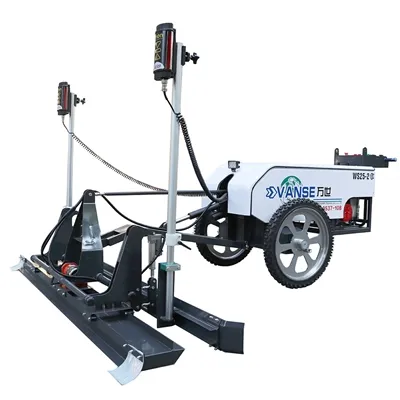
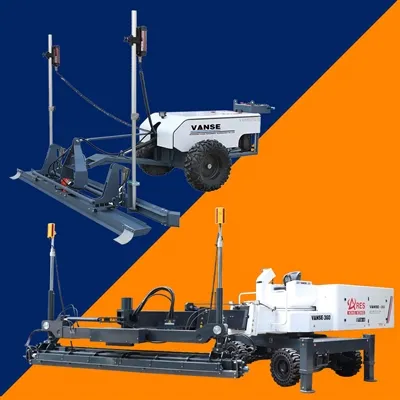
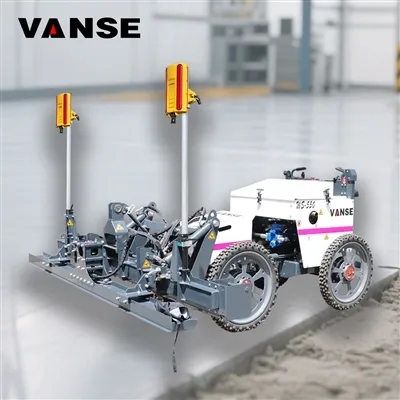
Technical Knowledge
What are the specific advantage of concrete laser leveling machine in improving the quality of floor construction?

Concrete laser leveling machines offer several advantages in enhancing the quality of floor construction
🎈High Precision in Leveling
✨Accurate Elevation Control:
The concrete laser leveling machine utilizes a laser-controlled leveling system. It takes the plane formed by the rotating laser beam emitted by the laser transmitter as the control reference. As long as the laser transmitter is not disturbed, the elevation of the entire floor can be accurately controlled. This ensures that the error in floor elevation is extremely small, reaching millimeter-level accuracy. In contrast to traditional manual leveling methods that rely on multiple reference points, which are prone to errors, the concrete laser leveling machine only requires 1-2 reference point elevations for the entire floor, reducing errors caused by multiple reference points.
✨Minimal Flatness Error:
The laser-controlled leveling system of the machine can continuously and accurately measure and adjust the height of the concrete surface during the leveling process. This results in a much better-controlled flatness of the ground, with the flatness and levelness of the ground being more than three times better than that of traditional manual leveling operations.
🎈Good Ground Integrity
✨Large-Area Paving:
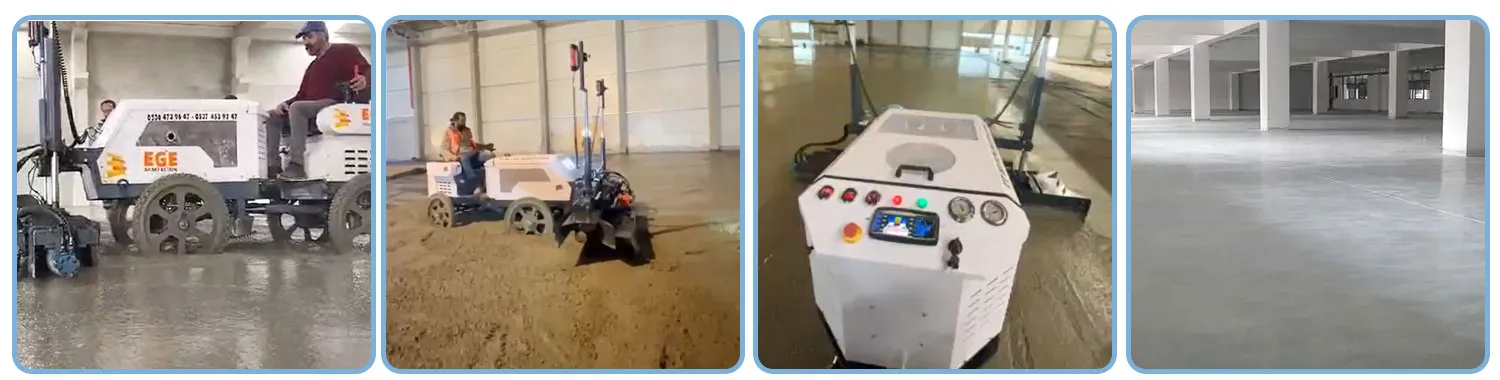
The concrete laser leveling machine facilitates large-area, one-time integral paving of the floor. It can continuously operate until the completion of the entire floor according to the required block-division construction, effectively avoiding problems such as easy hollowing and cracking caused by the layered pouring of the floor. This is difficult to achieve with traditional construction techniques.
✨Reduced Construction Joints:
The large-area integral paving method significantly reduces the number of construction joints. Fewer construction joints mean less potential for damage along the joints due to factors such as wheel loads, which improves the overall integrity of the ground and also helps to reduce subsequent maintenance costs.
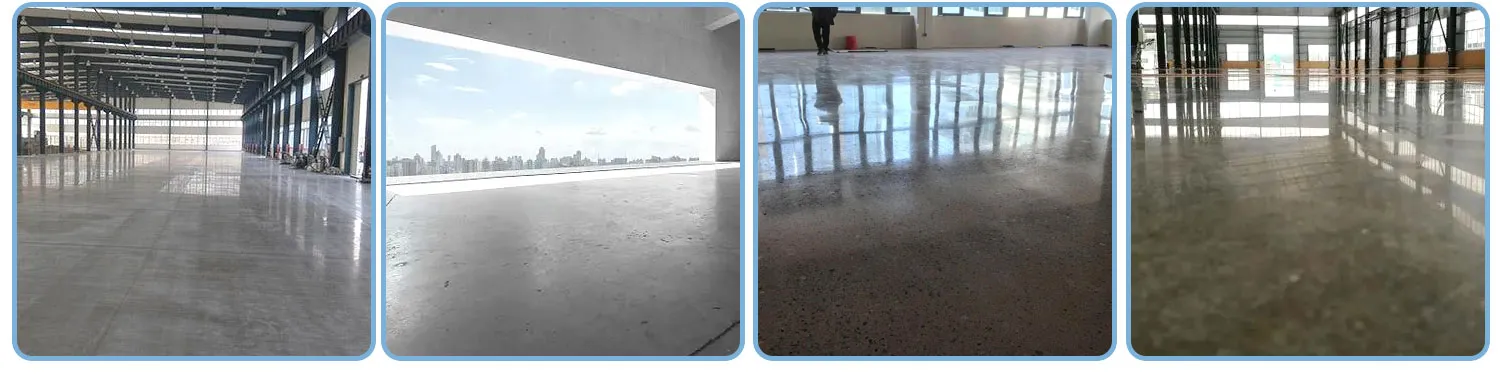
🎈Uniform and Dense Ground
✨High-Frequency Vibration and Compaction: During the leveling of concrete, the concrete laser leveling machine operates at a constant speed. The leveling head's vibrating plate is equipped with a high-frequency vibrator that vibrates at 4000 times per minute. This generates uniform high-frequency vibrations, which effectively compact the concrete, making the ground more uniform and dense. The density of the concrete can be increased by more than 20%, which is beneficial for improving the strength and durability of the ground.

🎈Good Adaptability to Different Types of Concrete
– The concrete laser leveling machine is suitable for use with various types of concrete, including dry-hard concrete, fiber-reinforced concrete, and large-aggregate concrete. It can meet the construction quality requirements for different types of concrete floors, demonstrating strong adaptability.
Click the below to jump immediately!!!

ARMOUR JOINT

CONCRETE LEVELING MACHINE


POWER TROWEL

SLIPFORM MACHINE


TOPPING SPREADER

Thanks to All the Friends Who Support and Trust Shandong Vanse Machinery Technology Co., Ltd.
If you want to know more about Shandong Vanse Machinery Technology Co., Ltd. or have any questions, please feel free to contact us:
Our Factory
Shandong Vanse Machinery Technology Co., Ltd.








Share this article

About the Author: Shandong Vanse Machinery Technology Co., Ltd.
Shandong Vanse Machinery Technology Co., Ltd. is a high-tech manufacturer specializing in concrete construction machinery, including laser screeds and related equipment. The company integrates R&D, production, and global sales, with products exported to over 60 countries and widely used in infrastructure projects worldwide.
Previous Post
Next Post
Related Articles
You Might Also Like
The tunnel concrete pavement adopts the entire construction technology of laser truss split roller paver
Concrete laser leveling: an important tool to improve construction efficiency ☑1. Introduction In the field of construction engineering, concrete is the main building material widely used in various infrastructures and buildings. However, leveling concrete is a time-consuming and labor-intensive task. In order to improve construction efficiency and reduce labor costs and material waste, concrete laser leveling machines came into being. This advanced leveling equipment uses laser technology to achieve high-precision concrete leveling, providing an efficient and precise construction method for construction projects. ☑2. Precise control, one-time molding The traditional concrete leveling method relies on the experience and technology of workers, and is prone to problems such as uneven flatness and rework. In contrast, the concrete laser leveling uses a laser transmitter and receiver, which can quickly and accurately detect the height difference on the concrete surface through high-precision laser ranging technology. The leveler adjusts the height of the scraper based on real-time detection data to achieve precise concrete leveling. By forming in one go, the need for rework and repetitive work can be significantly reduced, significantly improving construction efficiency. ☑3. Automated operation, saving manpower Traditional concrete leveling work requires a lot of manual operations such as scraping, plastering, etc. These jobs are not only labor-intensive, but also require a large amount of manual labor. The concrete laser leveling machine adopts an automated control system to achieve continuous concrete laying and leveling work. Operators only need to make simple monitoring and adjustments during the operation of the equipment, which greatly reduces the need for manpower. Automated operations can not only save labor costs, but also improve the accuracy and consistency of construction, further improving construction efficiency. ☑4. Shorten construction time Traditional concrete leveling methods take longer to complete the job because they require repeated scraping and plastering. The concrete laser leveling machine can significantly shorten the construction time through the advantage of one-time molding. In addition, since automated operations reduce the need for manual intervention, construction progress is further accelerated. Shortening construction time means faster project delivery and higher productivity, which is of great significance to construction companies. ☑5. Reduce material waste Traditional concrete leveling methods tend to waste materials because they require multiple scrapings and plasters, resulting in excess concrete being discarded. Concrete laser levelings minimize material waste through precise control and high-precision measurement. It only needs to be laid and leveled once, reducing the need for rework and repetitive work, thus reducing the amount of concrete used. Reducing material waste not only helps reduce costs, but also contributes to environmental protection and sustainable development. ☑6. Conclusion In summary, concrete laser leveling machines improve construction efficiency by precisely controlling automated operations, shortening construction time, and reducing material waste. As an advanced construction method, it brings many advantages and benefits to the field of construction engineering. With the continuous development and improvement of technology, concrete laser levelings will play a more important role in future construction projects. It not only improves construction efficiency, but also helps reduce costs, improve project quality, and has a positive impact on the development of the construction industry.What are the key operational differences and ideal uses for walk-behind versus boom type concrete laser leveling models?
The core operational difference is the operator's position and the machine's reach. Choosing between them is primarily a function of project scale and site accessibility, with walk-behind models excelling in tight, complex areas and boom-type machines dominating large, open floors. Here is a direct comparison to match the machine type to your job: Feature / Consideration Walk-Behind Laser Leveling Boom-Type (Ride-On) Laser Leveling Primary Operational Role Precision Leveling High-Speed Placement & Leveling Key Operation Difference The operator walks behind, manually guiding the machine's fixed-width (2.5-3m) Leveling head over placed concrete. The operator rides in a cab, remotely controlling a long, articulating boom (5.5-6m+) to place, spread, and level concrete from a distance. Ideal Job Size Small to Medium (up to ~20,000 sq ft / 2,000 m² per day). Medium to Very Large (30,000 to 100,000+ sq ft / 3,000-10,000+ m² per day). Optimal Site Accessibility Confined, obstructed, or complex layouts. Perfect for areas with walls, columns, tight corners, and strip pours. Wide-open, unobstructed slabs. Essential for vast, clear spaces like warehouses and distribution centers. Labor & Skill Impact Requires a small crew to manage concrete and assist. Operator has direct, physical control. Dramatically reduces labor; one operator replaces a large raking crew. Requires skill to manage the boom's reach and functions. Mobilization & Logistics Transportable on a trailer or in a pickup truck. Easy to move around site. Requires a low-boy trailer, semi-truck, and significant on-site space. Higher mobilization cost. Concrete Placement Strategy Works with concrete that has been dumped and roughly spread in front of it. Can actively pull concrete from large piles to fill low areas, enabling efficient "point-load" pouring. Use this decision flow to select the right type: Many Obstructions → Walk-behind (e.g., Vanse DZ25-2/DZ30-2). Fully Open → Proceed to Step 2. Under ~25,000 sq ft → Compact Ride-on (e.g., Vanse WS940C or compact boom model YZS2-4). Over ~30,000 sq ft → Full-size Boom-type (e.g., Vanse YZ40-4E, YZ30-4E). Indoor/Enclosed Site → Consider an Electric model (e.g., Vanse WS25-2D) for zero emissions. Critical Floor Flatness (FF/FL) → Boom-type machines generally produce superior, more consistent results. Multiple Small Pads or Additions → Walk-behind offers superior mobility between locations. Choose a Walk-Behind model when accessibility and agility are your top priorities for smaller, complex pours. Choose a Boom-Type model when production speed and efficiency are critical for dominating large, open slabs. If you can share details about your specific project's square footage, layout (presence of columns/walls), and pour method, I can help suggest a more precise model from a manufacturer's lineup. Note: The parameters provided in this document are for reference only and are not mandatory. Due to differences in technical characteristics between different brands and models of laser levelers, please consult the manufacturer for a suitable solution before actual operation. This reference document assumes no responsibility for any issues arising from failure to follow the manufacturer's instructions.New technology application of concrete laser leveling machine
Based on the current application of new technologies and major trends in the construction industry, its future development will focus on the core dimensions of "intelligence," "unmanned operation," "greening," and "integration." The following is a detailed outlook: This is one of the ultimate goals of future development. Current automation only assists operators, but in the future, true "unmanned operation" will be achieved. Environmental Perception and Obstacle Avoidance: leveling machines will be integrated with advanced sensors such as LiDAR, millimeter-wave radar, and computer vision cameras, enabling real-time perception of their surroundings, identifying obstacles (such as materials, workers, and other equipment), and automatically planning paths or initiating emergency braking to ensure construction safety. High-Precision Navigation and Positioning: Combining GNSS (Global Navigation Satellite System), RTK (Real-Time Kinematic), and SLAM (Simultaneous Localization and Mapping) technologies, leveling machines will achieve centimeter-level positioning and autonomous movement in the dynamic and unstructured environment of construction sites, without the need for human intervention. Cluster collaborative work: On a large construction site, multiple unmanned leveling machines, unmanned trowels, and unmanned transport vehicles will be uniformly dispatched and directed by a central control system ("honeycomb brain"), working together like a swarm of bees, automatically dividing areas, and efficiently and seamlessly connecting to achieve 24-hour uninterrupted construction. AI will be upgraded from a "support" role to a "decision-making" one. AI Predicting Construction Quality: Using machine learning models, AI can analyze data such as vibration frequency, concrete slump feedback, and ambient temperature and humidity during the leveling process in real time to predict potential quality issues (such as cracking and sanding) in the final floor, and instantly adjust leveling parameters (such as speed and vibration intensity) to avoid defects. Intelligent Path Planning and Optimization: AI algorithms will automatically calculate and select the most efficient and appropriate leveling path and sequence based on factors such as the work area shape and the initial setting time of concrete, maximizing equipment utilization and construction efficiency. Predictive Maintenance Upgrade: Future systems will not only generate alarms but also accurately predict the remaining life of components (such as engines and hydraulic pumps) by analyzing historical data and real-time operating status (such as hydraulic oil temperature and engine vibration spectrum). This allows for pre-ordering of parts and scheduling of repairs, significantly reducing the risk of unplanned downtime. The leveling machine will become a key data collection terminal for building a "digital twin construction site." Real-time Mapping: Sensors on the leveling machine will simultaneously generate a high-precision digital twin model of the physical floor during construction. This model includes not only geometric dimensions but also attribute data such as construction time and compaction level. Full Traceability: Owners and project managers can review every moment of floor construction and access construction data at any point, enabling precise tracing of quality issues and significantly streamlining the acceptance process. Providing a Foundation for Subsequent Processes: The resulting high-precision digital model can be directly used for subsequent automated construction (such as AGV navigation and rack installation), facilities management (FM), and operations and maintenance (BIM operations and maintenance), becoming the data cornerstone for building lifecycle management. Full-Scale Adoption of Pure Electric Vehicles: With increasing battery energy density and decreasing costs, pure electric levelings will become mainstream, particularly in indoor applications and areas with stringent environmental requirements. Their advantages of quiet operation, zero emissions, and low operating costs are irreplaceable. Exploring Hydrogen Fuel Cells: For large-scale, outdoor projects requiring long, continuous operations, hydrogen fuel cells may become a complementary solution, offering faster energy replenishment and longer battery life, enabling truly zero-carbon construction. Lightweighting and New Material Applications: The use of more advanced composite materials and optimized structural designs can reduce equipment weight, reducing stress on unpaved floors and improving energy efficiency. Quick-Change Attachments: The main machine design will be more modular, allowing for quick connection and replacement of actuators with different functions, such as switching from a "leveling head" to a "dry hardener spreader" or "curing agent sprayer." This allows for multiple uses of one machine and reduces equipment investment costs. Adaptability to Diverse Materials: With the increasing use of new concrete materials (such as self-leveling, ultra-high-strength, and fiber-reinforced concrete), the leveling machine's vibration system and scraper design will become more intelligent and adjustable to adapt to the rheological properties of different materials for optimal application results. The future concrete laser leveling will no longer be a single-function construction machine, but a self-driving robot with an integrated AI brain and perceptual capabilities. It will be an intelligent node in the smart construction site network, seamlessly connected to all aspects of the process, including design, scheduling, and operations and maintenance, via the cloud. For construction companies, this means: Ultimate Quality: Construction results will closely resemble the perfect design of the digital model. Maximize Efficiency: Labor costs will drop dramatically, and construction cycles will be significantly shortened. Digital Management: Decisions will be based on real, comprehensive data, resulting in more transparent and precise management. Safer/Greener Operations: Reduced manual labor risks will enable low-carbon, environmentally friendly construction. Click the below to jump immediately!!!