Technical Knowledge
How to use vibratory leveling to assist concrete laser leveling machine in small areas
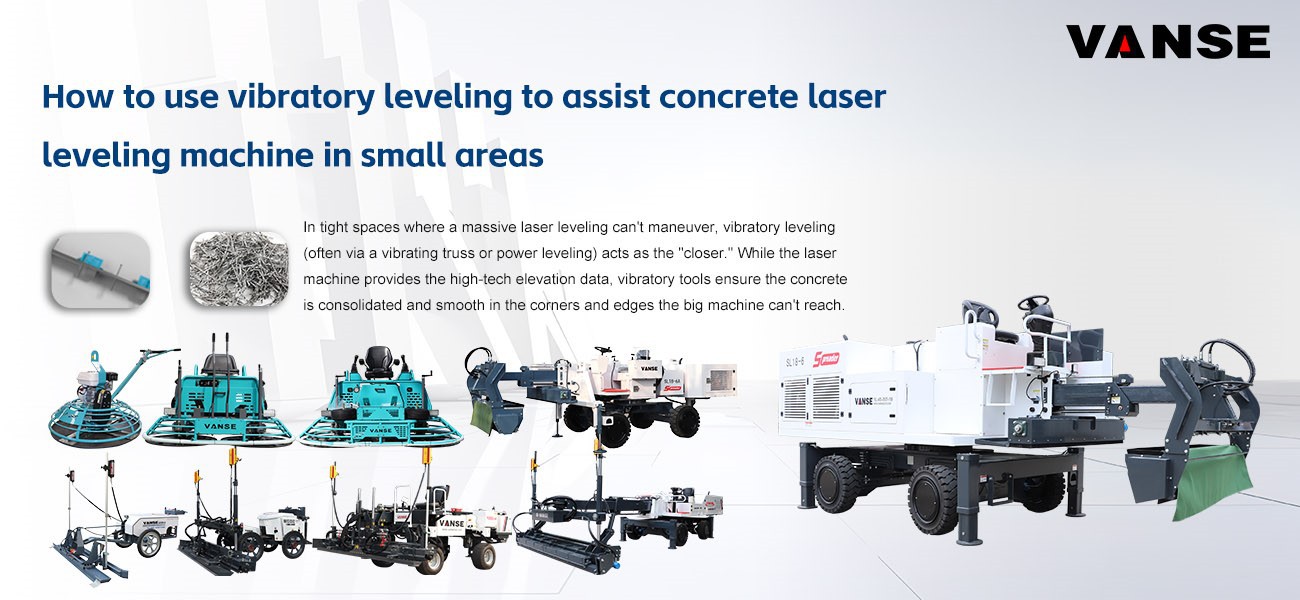
In tight spaces where a massive laser leveling can't maneuver, vibratory leveling (often via a vibrating truss or power leveling) acts as the "closer." While the laser machine provides the high-tech elevation data, vibratory tools ensure the concrete is consolidated and smooth in the corners and edges the big machine can't reach.
Here is how to effectively integrate the two for a seamless, flat finish.
1. Establishing the "Laser Baseline"
Before the vibratory equipment touches the wet concrete, the laser leveling machine must establish the grade.
Benchmark Sync: Ensure your handheld laser receiver (used for the vibratory leveling) is calibrated to the exact same benchmark as the laser leveling machine. Even a 3mm discrepancy will create a visible "lip" where the two areas meet.
The Overlap Zone: Always have the laser machine pass slightly into the "small area" or perimeter. This creates a leveled "pad" of concrete that your vibratory leveling can use as a guide.
2. Setting Perimeter Forms or "Wet leveling"
In small areas, the vibratory leveling needs physical points of reference since it lacks the automatic hydraulic adjustments of the laser machine.
Wet leveling: Use the laser machine to strike off a strip of concrete. Use this leveled strip as one "rail" for your vibratory leveling to ride on.
Handheld Laser Receivers: Mount a receiver to the pole of your vibratory leveling. As you pull the leveling, the "beep" or visual indicator tells you if you are pushing too hard (too low) or riding too high.
3. Techniques for Consolidation
Vibration is key for small areas because concrete near forms and corners tends to "honeycomb" (trap air).
The Leading Edge: Keep a small "roll" of concrete (about about 2cm to 5cm high) in front of the vibratory blade. This head of pressure ensures that as the vibration liquefies the concrete, it fills all voids and matches the height set by the laser.
Speed Control: Move the vibratory leveling at a slow, consistent pace-roughly 1m per minute. Moving too fast leaves "waves"; moving too slow sinks the aggregate too deep, leaving a weak, cream-heavy surface.
Best Practices for Seamless Integration
| Task | Laser Machine Role | Vibratory leveling Role |
| Main Slab | Handles 90% of the volume and leveling. | Follows behind to "knit" edges. |
| Edges/Columns | Cannot reach; stays 0.5m away. | Primary tool for leveling and consolidation. |
| Grade Check | Automatic/Constant. | Manual check via handheld laser rod. |
| Finish | High-speed strike-off. | Final "cream" pull for easy power troweling. |
Common Mistake: "Over-Vibration"
In small areas, it’s tempting to hover the vibratory leveling in one spot to "make it flat." Don't. This causes the heavy aggregate to sink and the water/laitance to rise, which leads to surface scaling later. If the grade is wrong, add or remove concrete manually, then做 one final pass with the vibratory tool.
Would you like me to find a specific checklist for calibrating handheld laser receivers to match your main laser leveling? Contact us NOW
Note: The parameters provided in this document are for reference only and are not mandatory. Due to differences in technical characteristics between different brands and models of laser levelers, please consult the manufacturer for a suitable solution before actual operation. This reference document assumes no responsibility for any issues arising from failure to follow the manufacturer's instructions.
Thanks to All the Friends Who Support and Trust Shandong Vanse Machinery Technology Co., Ltd.
If you want to know more about Shandong Vanse Machinery Technology Co., Ltd. or have any questions, please feel free to contact us:
Our Factory
Shandong Vanse Machinery Technology Co., Ltd.








Share this article

About the Author: Shandong Vanse Machinery Technology Co., Ltd.
Shandong Vanse Machinery Technology Co., Ltd. is a high-tech manufacturer specializing in concrete construction machinery, including laser screeds and related equipment. The company integrates R&D, production, and global sales, with products exported to over 60 countries and widely used in infrastructure projects worldwide.
Previous Post
Next Post
Related Articles
You Might Also Like
How to prevent flatness problems on concrete pavement?
To prevent the problem of flatness of concrete pavement, it is necessary to strictly control the quality in various links such as construction preparation, concrete pouring, pavement paving and subsequent maintenance. The specific measures are as follows: – Do a good job of roadbed treatment: The roadbed is the foundation of the road surface and must be guaranteed to be solid, stable and uniform. Before construction, the original ground should be carefully cleaned, weeds, tree roots, garbage and other debris should be removed, and the soft soil, silt and other unfavorable geological areas should be replaced and reinforced. Fill and compact the roadbed according to the design requirements, control the moisture content of the fill, fill and compact in layers, ensure that the compaction meets the standard, and avoid uneven settlement of the roadbed in the later stage and affect the flatness of the road surface. – Precise measurement and layout: Use high-precision measuring instruments, such as total stations, levels, etc., to accurately measure and lay out the center line, side line, elevation, etc. of the road surface. During the construction process, the measurement control points should be reviewed regularly to ensure the accuracy of the measurement data. At the same time, according to the measurement results, set the road template or the guide line of the paver to provide an accurate benchmark for road construction. – Check construction equipment: Ensure that the performance of construction equipment such as concrete mixing equipment, transport vehicles, pavers, and rollers is good and can operate normally. Carry out regular maintenance and maintenance of the equipment, and conduct a comprehensive inspection and commissioning of the equipment before construction. For example, check whether the screed of the paver is flat, whether the vibrating device is working properly, whether the roller wheel of the roller is evenly worn, etc., to ensure that the equipment operates stably during the construction process and avoid problems with the flatness of the road surface due to equipment failure. – Control concrete mix ratio: According to the road design requirements and construction conditions, determine the reasonable concrete mix ratio through experiments. Strictly control the quality and amount of raw materials such as cement, sand and gravel, water, and admixtures to ensure that the workability, strength, and durability of the concrete meet the requirements. In particular, attention should be paid to controlling the slump of concrete. The slump should not be too large or too small. If it is too large, it will easily cause concrete segregation and surface water seepage, affecting the smoothness of the road surface; if it is too small, it will make it difficult to spread and vibrate the concrete. – Ensure the quality of concrete mixing: Use a forced mixer to mix to ensure that the concrete is mixed evenly. Strictly control the mixing time. Determine the appropriate mixing time according to the mix ratio of concrete and the performance of the mixer. Generally, it should not be less than 90 seconds to ensure that the various components of the concrete are fully mixed to avoid uneven distribution of cement slurry and stone clumping, which will affect the working performance of the concrete and the smoothness of the road surface. – Reasonably arrange concrete transportation: Choose appropriate transportation vehicles to ensure that concrete does not segregate or leak during transportation. According to the distance and traffic conditions of the construction site, reasonably arrange the number of transportation vehicles and transportation routes to ensure that concrete can be supplied to the construction site in time, avoid waiting for too long during transportation, resulting in excessive slump loss, and affecting the quality of concrete spreading and vibration. – Standardize paving operation: When using a paver for concrete paving, adjust the working parameters of the paver, such as the elevation angle of the screed, vibration frequency, paving speed, etc. The paver should move forward at a uniform speed, and the speed is generally controlled at 2-3m/min to avoid too fast or too slow speed. During the paving process, a special person should be arranged to follow the machine and deal with the leakage and uneven parts on both sides of the paver in time. If manual paving is used, the paving thickness and surface flatness must be strictly controlled. Use tools such as scrapers and shovels to roughly flatten the concrete, and then vibrate it with a vibrating beam or a flat vibrator. – Strengthen vibration control: Vibration is a key link to ensure the density and flatness of concrete. According to the slump and paving thickness of the concrete, choose the appropriate vibration equipment and vibration method. Generally, a combination of an inserted vibrator and an attached vibrator is used for vibration. The inserted vibrator should be inserted vertically into the concrete, and the vibration points should be evenly distributed. The spacing should not be too large, generally about 1.5 times the radius of the vibrator. The vibration time is based on the concrete surface no longer having bubbles, slurry and sinking, generally 20-30 seconds. The attached vibrator should be installed on the formwork to make the concrete dense by vibrating the formwork. During the vibration process, the vibrator should be prevented from colliding with the formwork, steel bars and force transmission rods, so as not to affect the flatness and structural dimensions of the road surface. – Do a good job of finishing: After the concrete is vibrated, the finishing operation should be carried out in time. The finishing is generally done in two times. The first finishing is done after the concrete surface absorbs water. A wooden trowel is used to scrape the surface slurry, gravel, etc. to make the road surface flat. The second finishing is done before the concrete is initially set. An iron trowel is used for fine finishing to make the road surface flatter and smoother. At the same time, attention should be paid to controlling the strength and number of finishing to avoid excessive finishing, which may lead to excessive thickness of cement slurry on the surface, cracks, peeling, etc. – Standard roughening treatment: After finishing, roughening should be done in time to increase the roughness of the road surface and improve driving safety. The depth and spacing of roughening should be uniform. Generally, the depth of roughening is 2-3mm and the spacing is 2-4cm. Roughening can be done with tools such as a roughening machine or a broom. The roughening direction should be consistent with the driving direction of the road surface to ensure uniform and beautiful roughening quality. – Timely maintenance of the road surface: After the concrete road surface is poured, it should be maintained within 12 hours. The maintenance method can be to cover with moisturizing materials such as geotextiles and straw mats, and regularly sprinkle water to keep it moist, or spray curing agents for maintenance. The maintenance time is generally not less than 7 days. For high-strength concrete or concrete constructed in high temperature and dry environments, the maintenance time should be appropriately extended. During the maintenance period, it is necessary to ensure that the concrete surface is always moist to avoid shrinkage cracks caused by water loss in the concrete, which will affect the flatness of the road surface. – Strict traffic control: During the maintenance of the concrete pavement, strict traffic control must be carried out, and all vehicles and pedestrians are prohibited from passing on the road surface until the concrete reaches the design strength. Before the road surface is opened to traffic, the road surface must be inspected and accepted to ensure that the various indicators such as the flatness and strength of the road surface meet the design requirements. At the same time, obvious warning signs should be set up on the road surface to guide vehicles and pedestrians to bypass the construction area to avoid damage to the road surface that has not been fully formed. ARMOUR JOINT CONCRETE LASER LEVELING MACHINE LIGHT TOWER POWER TROWEL STEEL FIBER TRACKED MINI DUMPERSummarization and Application of Reinforced Concrete Cutting Technology
Concrete cutting process With the accelerated pace of urbanization, urban construction with each passing day. In the big city, the ground has been unable to meet the traffic requirements, urban traffic up to the elevated, light rail, down to the subway. Some elevated posts now seem to be factors that constrain urban development. It is inevitable that some of the elevated structures are to be demolished, and that part of it is not affected and reused, which has become a problem before us. In the traditional demolition of this construction can not do anything, advanced reinforced concrete cutting method is safe, efficient and environmentally friendly features. Reinforced concrete cutting technology mainly disc cutting method and diamond wire cutting method. Diamond wire cutting method has faster speed, greater flexibility and lower construction noise. Especially in the construction renovation project has been more and more applications. Disc cutting method to break the traditional wind pick chisel after the gas cutting or directional blasting construction methods, with diamond particles with cutting disc cutting, construction incision neatly, straight, without post-processing, free from construction sites, environmental protection , Duration, safety reasons and other conditions, is widely used in various types of large-scale building structural transformation and cutting construction. The steel wire cutting method is composed of high power hydraulic press, transmission locating pulley and steel wire with diamond sawtooth. The hydraulic motor drives the steel wire around the cutting object to rotate at high speed through the drive pulley. It has the advantages of fast construction and noise Low, no vibration, no dust and other advantages of waste gas pollution, and incision straight and smooth, no need to do after the processing. The use of the technology, for some of the special requirements of the construction of the project, such as tight schedule, high environmental requirements, as well as some large concrete structure demolition, cutting works, these problems can be solved.Safety precautions for operating ride-on power trowels in confined indoor spaces
Operating a ride-on power trowel in a confined or enclosed indoor space is a high-risk task. The primary dangers aren't just the rotating blades, but the "silent killers"-carbon monoxide and poor visibility. Here are the essential safety precautions to implement before the engine ever starts. Internal combustion engines (gasoline or diesel) in enclosed spaces can reach lethal CO levels in minutes. Continuous Monitoring: Do not rely on "feeling okay." Use a portable CO monitor clipped to the operator's vest. If the alarm sounds, evacuate immediately. Active Ventilation: Natural airflow is never enough. Use high-volume axial fans and "sock" ducting to force fresh air into the work zone and push exhaust out. Catalytic Converters: Ensure the machine is equipped with a scrubbed exhaust system or a catalytic converter to reduce emissions. Alternative Power: If the space is truly "permit-required confined," consider using electric ride-on trowels or propane conversions (which still require ventilation but burn cleaner). Ride-on trowels are heavy, powerful, and lack the agility of a walk-behind. The 1-Meter Rule: Maintain a strict "no-go" zone of at least 1 meter (3 feet) between the machine and any wall, column, or person. Pinch Points: In tight spaces, the operator's knees or elbows often extend beyond the frame. A slight slip can result in a crush injury against a structural column. Obstacle Marking: Clearly mark floor drains, conduits, or rebar stubs with high-visibility spray paint. Hitting an obstacle in a tight space can cause the machine to "kick" or spin uncontrollably. Indoor lighting is often poor during the concrete phase. Machine Lighting: Ensure the ride-on has functional LED work lights on both the front and rear. Ambient Light: Use temporary overhead "string" lighting. Shadows can hide the "wetness" of the concrete, leading to steering errors. Reflective Gear: All ground crew must wear Class 2 or 3 reflective vests so the operator can spot them in the periphery. The "Dead-Man" Switch: Never bypass the seat sensor. The machine must shut down immediately if the operator is thrown or climbs off. Hearing Protection: In confined spaces, engine noise is amplified by wall reverberation. Dual-layer hearing protection (earplugs + earmuffs) is recommended. Fire Suppression: Keep a CO₂ or Dry Chemical fire extinguisher nearby. If a hydraulic line bursts onto a hot engine in an enclosed space, smoke will fill the room instantly. Action Protocol Fumes Detected Shut down machine; move operator to fresh air immediately. Hydraulic Leak Stop machine; use absorbent "snakes" to prevent slab contamination. Operator Fall Do not approach if blades are spinning; use remote kill-switch if available. In confined spaces, you have less room to recover from a skid. Slow Maneuvers: Avoid high-speed "spinning" turns near walls. The centrifugal force can slide the machine sideways into a barrier. Path Planning: Always have an exit strategy. Know which corner you will finish in so you don't "trowel yourself into a corner" where ventilation is worst. Would you like me to draft a brief "Safety Toolbox Talk" PDF outline that you can use to brief your crew before the next indoor pour? Contact us NOW Note: The parameters provided in this document are for reference only and are not mandatory. Due to differences in technical characteristics between different brands and models of laser levelers, please consult the manufacturer for a suitable solution before actual operation. This reference document assumes no responsibility for any issues arising from failure to follow the manufacturer's instructions.