Technical Knowledge
Grade of strength of concrete
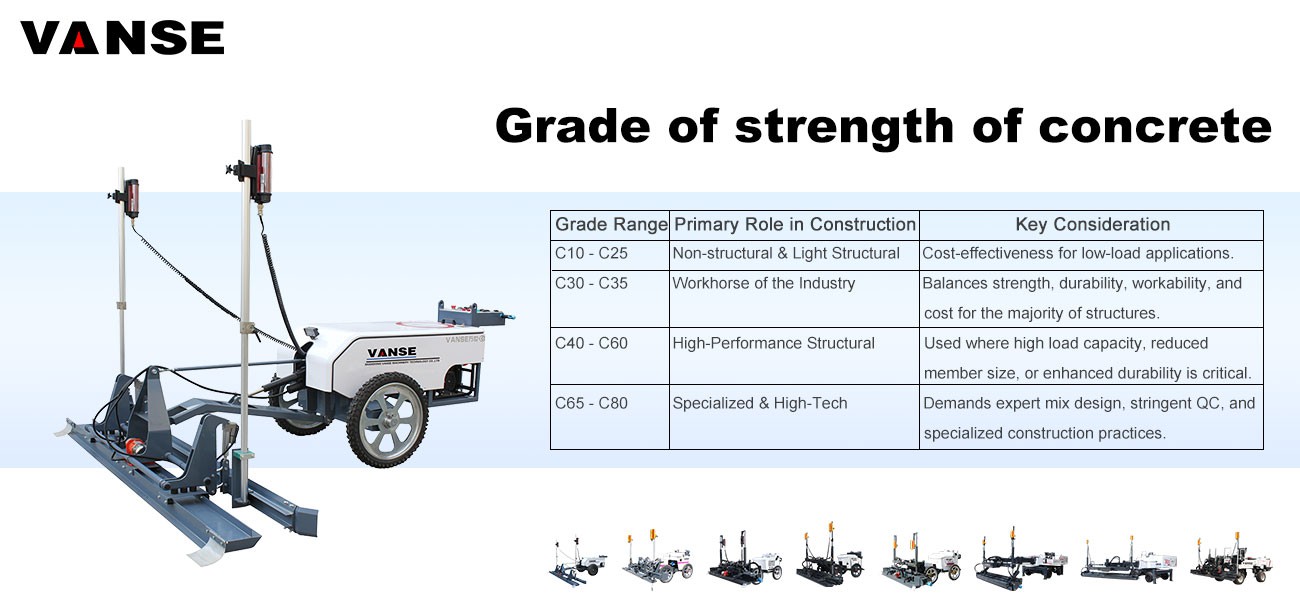
According to the relevant standards, the strength grade of building materials shall be expressed by the name of the material plus its strength standard value.Therefore, the Concrete strength grade is divided into C10, C15, C20, C25, C30, C35, C40, C45, C50, C55, C60, C65, C70, C75 and C80 by the symbol C(abbreviation of Concrete) and the standard value of cube compressive strength.
This "C" grading system is now the most widely recognized internationally. Here is a comprehensive breakdown of what these grades mean and how they are used.
Core Definition
The letter "C" stands for Concrete.
The number (e.g., 30 in C30) represents the characteristic compressive cylinder strength in Megapascals (MPa) after 28 days of standard curing.
For European Standards (EN): The number is the cylinder strength (fck,cylfck,cyl).
For Chinese Standards (GB): The number is the cube strength (fcu,kfcu,k). This is a key difference in definition, despite the same "C" notation.
Strength Class Groups & Typical Applications
The grades can be grouped by their strength level and primary use-case.
| Strength Grade | Compressive Strength (MPa) | Category | Typical Applications |
| C10 / C15 | 10 – 15 | Low Strength | Blinding concrete (under foundations), mass concrete fills, simple footpaths. Non-structural. |
| C20 / C25 | 20 – 25 | Normal Strength (General Use) | Domestic: house slabs, driveways, garden walls. Lightly loaded reinforced elements. |
| C30 / C35 | 30 – 35 | Standard Structural | The most common grades for general RC work. Beams, columns, slabs, foundations for multi-story buildings, pavements. |
| C40 / C45 | 40 – 45 | High Strength | Heavily loaded columns/long-span beams in high-rises, bridges, industrial floors, water-retaining structures, pre-cast elements. |
| C50 / C55 / C60 | 50 – 60 | High Strength | Long-span bridges, high-rise building cores (shear walls), offshore structures, specialized pre-stressed concrete. |
| C65 / C70 / C75 / C80 | 65 – 80 | Very High / Ultra-High Strength | Specialized civil engineering: tall buildings (>60 stories), iconic bridges, zones with extreme loads. Requires careful mix design and quality control. |
Critical Distinction: European (EN) vs. Chinese (GB) "C" Grades
This is the most important technical point. The same notation has a different physical meaning.
| Aspect | European Standard (EN 206) | Chinese Standard (GB 50010) |
| Test Specimen | Cylinder: 150mm diameter, 300mm height | Cube: 150mm x 150mm x 150mm |
| Strength Defined | Cylinder Strength (fck,cylfck,cyl) | Cube Strength (fcu,kfcu,k) |
| Meaning of C30 | Cylinder strength = 30 MPa | Cube strength = 30 MPa |
| Approximate Relation | Cube Strength ≈ Cylinder Strength × 1.25 | Cylinder Strength ≈ Cube Strength × 0.8 |
| (C30 cylinder ≈ 37.5 MPa cube) | (C30 cube ≈ 24 MPa cylinder) |
Practical Implication: A C30 concrete in China (GB) is structurally weaker than a C30 concrete in Europe (EN). In fact, China's C30 is roughly equivalent to Europe's C24/C25 in terms of cylinder strength.
Selection Factors for Choosing a Grade
Structural Design Requirements: The primary factor. Calculated loads determine the minimum required strength (fckfck).
Durability & Exposure Conditions: Often governs the choice more than strength. A harsh environment (marine, de-icing salts, freeze-thaw) may require a minimum grade (e.g., C35/XA3 for chemical attack) and a low water-cement ratio.
Constructability: Higher grades (C60+) are often stiffer, have shorter setting times, and require precise batching, placing, and curing techniques.
Economic Considerations: Higher grades use more cement and admixtures, increasing cost. The goal is to use the lowest grade that satisfies all structural and durability requirements.
Example Specification (EN Standard)
A full concrete grade specification under EN 206 includes more than just "C":
Example: C30/37 XC4 S4 Dmax 20
C30/37: Cylinder strength 30 MPa / Cube strength 37 MPa.
XC4: Exposure class for corrosion risk from carbonation (e.g., outdoor structures).
S4: Slump class (160-210mm), indicating workability.
Dmax 20: Maximum aggregate size 20mm.
Summary Table
| Grade Range | Primary Role in Construction | Key Consideration |
| C10 – C25 | Non-structural & Light Structural | Cost-effectiveness for low-load applications. |
| C30 – C35 | Workhorse of the Industry | Balances strength, durability, workability, and cost for the majority of structures. |
| C40 – C60 | High-Performance Structural | Used where high load capacity, reduced member size, or enhanced durability is critical. |
| C65 – C80 | Specialized & High-Tech | Demands expert mix design, stringent QC, and specialized construction practices. |
Note: The parameters provided in this document are for reference only and are not mandatory. Due to differences in technical characteristics between different brands and models of laser levelers, please consult the manufacturer for a suitable solution before actual operation. This reference document assumes no responsibility for any issues arising from failure to follow the manufacturer's instructions.
Thanks to All the Friends Who Support and Trust Shandong Vanse Machinery Technology Co., Ltd.
If you want to know more about Shandong Vanse Machinery Technology Co., Ltd. or have any questions, please feel free to contact us:
Our Factory
Shandong Vanse Machinery Technology Co., Ltd.








Share this article

About the Author: Shandong Vanse Machinery Technology Co., Ltd.
Shandong Vanse Machinery Technology Co., Ltd. is a high-tech manufacturer specializing in concrete construction machinery, including laser screeds and related equipment. The company integrates R&D, production, and global sales, with products exported to over 60 countries and widely used in infrastructure projects worldwide.
Previous Post
Next Post
Related Articles
You Might Also Like
How does the concrete laser leveling machine ensure the construction effect and ground flatness?
1. High-precision sensor: The concrete laser leveling machine is equipped with a high-precision sensor that can monitor the height and level of the concrete surface in real time. By comparing it with a preset elevation, the sensor can precisely control the movement and lifting of the leveling to ensure the smoothness of the concrete surface. 2. Automated control system: The concrete laser leveling machine adopts an automated control system, which can achieve precise control and intelligent adjustment. The control system can automatically adjust the operating status of the leveler, including speed, vibration frequency, etc., based on sensor feedback data to adapt to different ground conditions and ensure construction results. 3. Advanced working principle: The concrete laser leveling machine uses laser technology for positioning and calibration. The laser beam emitted by the laser transmitter is received by the sensor through the receiver to form an accurate reference plane. The leveling machine automatically adjusts the working height and direction according to this reference plane to ensure the flatness and elevation accuracy of the concrete surface. 4. Efficient vibration system: The concrete laser leveling machine is equipped with an efficient vibration system, which uses high-frequency vibration to evenly vibrate the concrete material and smooth the surface. The vibration system can adjust the amplitude and frequency as needed to adapt to different concrete types and thicknesses, improving construction results and smoothness. 5. Professional operators: Professionals who operate concrete laser leveling machines have been trained and are familiar with machine performance and operating techniques. They can adjust machine parameters according to actual conditions, choose appropriate construction methods, and master the correct operating procedures to ensure construction effects and ground flatness. To sum up, the concrete laser leveling machine ensures the construction effect and ground flatness through the combined effect of high-precision sensors, automated control systems, advanced working principles, efficient vibration systems and professional operators. The combined use of these technical means makes the concrete laser leveling an efficient and precise construction equipment that can meet the flatness requirements under various ground conditions.When writing about concrete laser screed machines, what research methods or data analysis tools can help us more accurately evaluate their performance?
– Using level and tower ruler: On the ground after the concrete laser leveling machine is constructed, set measurement points at a certain interval (such as every 1 meter or 2 meters). Use the level and tower ruler to measure the elevation of each point, and then calculate the flatness indicators of the ground, such as maximum deviation, mean square error, etc. This method can intuitively evaluate the control ability of the leveling machine on the flatness of the ground. For example, in a factory floor construction project, the ground after the laser leveling machine is measured. If the maximum deviation is within the allowable range (such as within 3-5mm of the industrial floor flatness requirement), it means that its flatness performance is good. – Laser scanner: The laser scanner can quickly obtain three-dimensional data of a large area of ground. Place the laser scanner in a suitable position, scan the ground after construction, and obtain the point cloud data of the ground. By processing these data with professional software, a three-dimensional model of the ground can be generated, and parameters such as the flatness and slope of the ground can be accurately calculated. Compared with levels and tower rulers, laser scanners are more efficient and can obtain more comprehensive data. – Concrete test block production and compression test: During the construction of the laser leveling machine, concrete test blocks are produced at the same time. The production conditions of these test blocks (such as concrete mix ratio, vibration method, etc.) should be consistent with the construction site. After the test blocks reach the specified curing period, the test blocks are tested for compressive strength using a pressure testing machine. By comparing the compressive strength of the test blocks with the design strength requirements, it is evaluated whether the construction process of the laser leveling machine has an impact on the strength of the concrete. For example, if the design requires the compressive strength of the concrete to be C30, after testing, the average compressive strength of the test blocks reaches or exceeds 30MPa, and the discreteness is small, indicating that the construction of the leveling machine has little effect on the strength and the performance is reliable. – Rebound Hammer Test: On the concrete surface after construction, a rebound test is performed using a rebound hammer. The rebound hammer infers the strength of the concrete by hitting the concrete surface and based on the rebound value. This method is easy to operate, and can be used to perform multi-point tests on a large area of concrete surface to quickly evaluate the strength uniformity of the concrete. However, the results of the rebound test are affected by factors such as the surface quality of the concrete and the depth of carbonization, and need to be comprehensively judged in combination with methods such as the test block compression test. – Construction time record: In concrete construction projects of different scales (such as different areas and thicknesses), record the time it takes for the laser leveler to start construction and complete the leveling task. At the same time, record the pause time during the construction process (such as equipment failure maintenance, material supply interruption, etc.), and evaluate its construction efficiency by calculating the amount of work completed per unit time (such as square meters/hour). For example, in a 1,000 square meter ground construction, if the laser leveler completes the construction in 8 hours without any fault, its construction efficiency is 125 square meters/hour. – Comparative test: Compare the concrete laser leveler with the traditional leveling method (such as manual vibration, small mechanical vibration, etc.) under the same construction conditions (such as the same amount of concrete, the same site environment, etc.). Record the respective construction time, manpower input, energy consumption and other data, and highlight the efficiency advantage of the laser leveler through comparative analysis. – Data collation and descriptive statistics: Input the data obtained from the experimental test (such as flatness measurement value, strength test value, construction time, etc.) into the statistical analysis software. Use the data collation function of the software to clean and preprocess the data to remove outliers, etc. Then perform descriptive statistical analysis to calculate statistical indicators such as mean, standard deviation, maximum value, minimum value, etc. to understand the central trend and dispersion of the data. For example, through the Excel data analysis plug-in, calculate the mean and standard deviation of the flatness measurement data to intuitively display the overall situation and fluctuation range of the ground flatness. – Correlation analysis: When studying the relationship between different performance indicators of the laser leveling machine, such as between construction efficiency and flatness, between construction time and strength, etc., statistical analysis software can be used for correlation analysis. By calculating the correlation coefficient, it is determined whether the two indicators are positively correlated, negatively correlated, or unrelated. For example, if a negative correlation is found between construction time and flatness, that is, the shorter the construction time, the worse the flatness, the further analysis of the cause is needed. It may be that the construction speed is too fast and affects the leveling effect. – 3D modeling and visualization analysis: Use software such as AutoCAD Civil 3D to import the ground 3D point cloud data obtained by the laser scanner to generate a high-precision ground 3D model. Through this model, you can intuitively view the flatness and slope of the ground, and perform virtual roaming and spatial analysis. For example, in concrete construction on complex terrain, the 3D model can accurately evaluate whether the laser leveling machine has completed the slope shaping of the ground according to the design requirements. – Structural analysis (for concrete structure performance): For situations involving concrete structure performance evaluation, such as the bearing capacity of large concrete slabs, use structural analysis software such as Midas Gen. Input the concrete structure parameters (such as thickness, strength, etc.) after the laser leveling machine is constructed into the software, and combined with the actual load conditions, structural mechanics analysis is performed to evaluate the safety and reliability of the structure. This kind of analysis is very important for some concrete projects with high requirements on bearing capacity (such as parking lots, industrial plant floors, etc.).How to perform regular maintenance on concrete laser leveling machine?
◆◆★◆◆ Introduction Concrete laser leveling machine is an indispensable and important equipment in modern building construction. Its performance stability and service life directly affect the quality and progress of the project. In order to ensure long-term efficient operation of the equipment and reduce the failure rate, regular maintenance is an essential link. This article will elaborate on how to perform regular maintenance on concrete laser levelings, aiming to provide operating guidelines for equipment operators and maintenance personnel. ◆◆★◆◆ The importance of maintenance Regular maintenance plays a vital role for concrete laser leveling machines. By regularly inspecting, cleaning, tightening, adjusting, and lubricating the equipment, the service life of the equipment can be effectively extended, sudden failures can be reduced, and leveling efficiency and construction quality can be improved. At the same time, maintenance can also detect potential safety hazards in time to ensure the safety of operators. ◆◆★◆◆ Maintenance cycles and projects 1. Daily maintenance: performed before and after daily work, mainly including equipment cleaning, checking whether all components are tight, and refueling lubrication points, etc. 2. Weekly maintenance: Carry out once a week. In addition to daily maintenance, it is also necessary to check the wear and tear of various moving parts, the oil level and oil quality of the hydraulic system, etc. 3. Monthly maintenance: Carry out once a month, including comprehensive inspection of all parts of the equipment, tightening loose parts, cleaning or replacing filter elements, etc. 4. Quarterly maintenance: Carry out once a quarter, mainly to conduct a comprehensive inspection, adjustment, tightening, lubrication of the equipment, and replace seriously worn parts, etc. 5. Annual maintenance: Carry out once a year, including comprehensive inspection of all parts of the equipment, replacement of severely worn parts, cleaning of oil tanks and hydraulic systems, etc. ◆◆★◆◆ Maintenance steps and methods 1. Equipment cleaning: Use a soft cloth or brush to remove dust and oil on the surface of the equipment, paying special attention to the cleaning of sensitive components such as laser receivers and control systems. 2. Inspection and tightening: Check whether all parts of the equipment are tightened. If they are loose, tighten them in time. Use appropriate tools and tighten to the specified torque. 3. Lubrication: According to the requirements of the equipment lubrication chart, refuel or change the oil at each lubrication point of the equipment. Use specified lubricating oil or grease to ensure the equipment is well lubricated. 4. Check the wear and tear: Check the wear and tear of each moving part of the equipment. If the wear is serious, replace it in time. Wear parts, such as blades, scrapers, etc., should be inspected and replaced regularly. 5. Clean the hydraulic system: Clean the hydraulic system tank and filter regularly, and replace the hydraulic oil. Check the hydraulic pipeline for leakage and damage. If so, repair or replace it in time. 6. Check the electrical sys tem: Ch eck whether the circuits and components of the equipment's electrical system are intact. If damaged, replace them in time. Dust and tighten electrical components regularly. 7. Adjustment and calibration: Adjust and calibrate the equipment according to the equipment usage and construction requirements. Such as adjusting the angle and position of the laser emitter to ensure leveling accuracy; calibrating control system parameters to improve leveling efficiency, etc. ◆◆★◆◆ Maintenance precautions 1. Stop the machine and disconnect the power supply before maintenance to ensure that the equipment is in a safe state. 2. Special tools and specified lubricants and greases should be used during maintenance. 3. During the maintenance process, attention should be paid to observing the operation of each component of the equipment. If there is any abnormality, the machine should be stopped for inspection and dealt with in time. 4. After maintenance, a trial run should be carried out to check whether the equipment is operating normally and there are no abnormalities. 5. Maintenance records should record in detail the time, content, replaced parts and other information of each maintenance to facilitate follow-up tracking and management. ◆◆★◆◆ Conclusion Regular maintenance is a key link to ensure long-term and efficient operation of the concrete laser leveling. By formulating reasonable maintenance cycles and projects, adopting correct maintenance steps and methods, and paying attention to safety and details during maintenance, the service life of the equipment can be effectively extended, the failure rate can be reduced, and the leveling efficiency and construction quality can be improved. . At the same time, regular maintenance can also reduce maintenance costs and improve the overall efficiency of the equipment. Therefore, construction units should attach great importance to regular maintenance of concrete laser leveling machines to ensure that the equipment is always in good operating condition.