Technical Knowledge
How to avoid concrete surface delamination
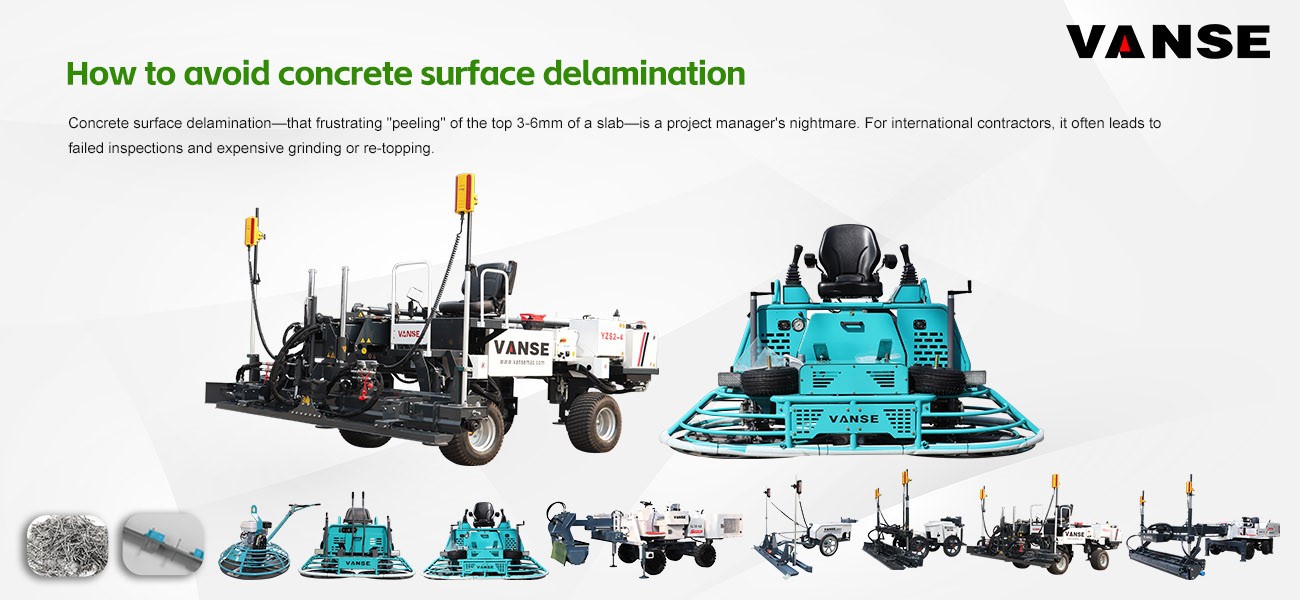
Concrete surface delamination-that frustrating "peeling" of the top 3-6mm of a slab-is a project manager's nightmare. For international contractors, it often leads to failed inspections and expensive grinding or re-topping.
In the industry, we know the main culprit: trapped bleed water or air. If you seal the surface too early, you create a hollow "blister" that eventually snaps off. To avoid this, you need a workflow that prioritizes timing and uniform compaction.
Here is how to eliminate delamination risks using a professional-grade fleet from Vanse Machinery.
1. Uniform Placement: The "Foundation" of Prevention
Delamination often starts with inconsistent concrete placement. If one part of the bay is thicker or wetter than the next, the bleed water will rise at different rates.
The Vanse Workflow: Instead of dumping large, uneven piles that create "wet spots," use a Vanse Concrete Distributor to ensure an even ribbon of material.
2. Consolidated Leveling: Eliminating Air Pockets
If the slab isn't consolidated from the bottom up, air pockets can migrate to the surface during finishing, leading to "blisters."
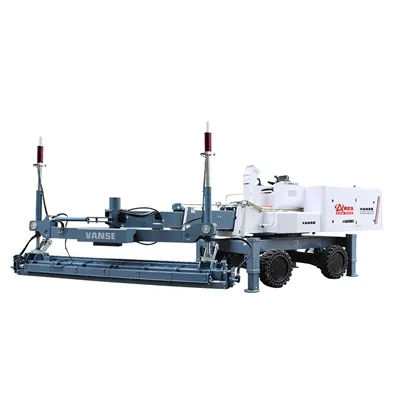
The Vanse Workflow: A Vanse Concrete Laser Leveling Machine (like the YZ28-4S or the telescopic YZ30-4E) doesn't just "scrape" the top; it uses high-frequency vibration (up to 4000rpm) to liquefy and consolidate the entire depth of the slab in one pass. This forces out excess air and ensures the bleed water rises naturally and evenly across the entire floor.
3. Integrated Hardening: Bonding the "Skin"
Many delamination issues occur because manual dry-shake hardener is applied unevenly, preventing a proper bond with the base slab.
The Vanse Workflow: Use the Vanse Automatic Topping Spreader. By mechanically applying the hardener immediately after the laser leveling pass, you ensure the material integrates perfectly with the wet paste. This creates a monolithic bond that won't "peel" under heavy forklift traffic.
4. Master the Timing: The Power Trowel Rule
The most common cause of delamination is premature troweling. If you start "burning" the floor while bleed water is still rising, you are guaranteed to have peeling issues.
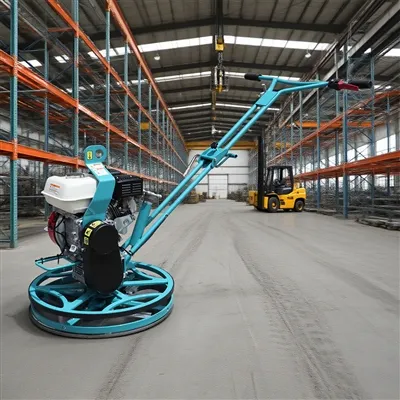
The Vanse Workflow: When you use a high-performance Vanse VS1046 Ride-on Power Trowel, you have the torque and weight to wait for the "Goldilocks" window. Because Vanse machines are so efficient, you don't have to rush the first pass. You can wait for the bleed water to fully evaporate, then use the precision pitch control to densify the surface without trapping moisture underneath.
5. Stress Relief: Precision Joint Cutting
Sometimes "peeling" happens near the edges of joints due to localized stress or "spalling."
The Vanse Workflow: As soon as the floor is hard enough to walk on, use a Vanse Concrete Cutting Machine (Floor Saw). A clean, straight cut ensures that the slab can "breathe" and move during the curing process, preventing the edges from lifting or delaminating during the critical first 48 hours.
Comparison: Why Pro Equipment Prevents Failures
| Technical Cause of Peeling | Prevention Strategy | Vanse Advantage |
| Inconsistent Placement | Controlled, even distribution. | Concrete Distributor & Mini Dumper |
| Trapped Air/Water | Bottom-up consolidation. | High-Frequency Laser Leveling Machine |
| Poor Hardener Bond | Mechanical, even application. | Automatic Topping Spreader |
| Premature Sealing | High-torque finishing at the right time. | VS836 / VS1046 Power Trowel |
| Edge Stress | Early, clean joint execution. | Stable Concrete Cutting Machine |
Final Thought
Avoiding delamination is all about respecting the concrete's timeline. You can't force the water to stop rising, but you can use equipment that works with the material. By combining the placement precision of the Mini Dumper, the leveling power of the Laser leveling, and the finishing torque of the Power Trowel, you ensure a floor that is as durable as it is flat.
Don't risk your reputation on a "peeling" floor. Explore the full professional lineup at www.vansemac.com and build it right the first time.
Note: The parameters provided in this document are for reference only and are not mandatory. Due to differences in technical characteristics between different brands and models of laser levelers, please consult the manufacturer for a suitable solution before actual operation. This reference document assumes no responsibility for any issues arising from failure to follow the manufacturer's instructions.
Thanks to All the Friends Who Support and Trust Shandong Vanse Machinery Technology Co., Ltd.
If you want to know more about Shandong Vanse Machinery Technology Co., Ltd. or have any questions, please feel free to contact us:
Our Factory
Shandong Vanse Machinery Technology Co., Ltd.








Share this article

About the Author: Shandong Vanse Machinery Technology Co., Ltd.
Shandong Vanse Machinery Technology Co., Ltd. is a high-tech manufacturer specializing in concrete construction machinery, including laser screeds and related equipment. The company integrates R&D, production, and global sales, with products exported to over 60 countries and widely used in infrastructure projects worldwide.
Previous Post
Next Post
Related Articles
You Might Also Like
In commercial facilities, how can laser leveling machines ensure floor flatness to provide a better customer experience?
A laser leveling is a piece of equipment used in concrete construction that uses laser technology to measure and adjust the flatness of concrete floors. Here are some of the ways a laser leveling ensures floor flatness: Laser transmitter: The laser leveling is equipped with a laser transmitter that emits a horizontal laser beam. This laser beam is used as a reference line to determine if the concrete floor is flat. Receiver: The laser leveling is also equipped with a receiver that detects the position of the laser beam and compares it to the actual floor. If the floor is not flat, the receiver sends a signal to the operator indicating that adjustments need to be made. Automatic adjustment: Some advanced laser levelings have an automatic adjustment function that automatically adjusts the height and angle of the machine based on the information received to ensure the flatness of the concrete floor. High-precision sensors: Laser levelings are usually equipped with high-precision sensors that can accurately measure the flatness of the concrete floor and transmit data to the control unit for necessary adjustments. Through the above methods, laser levelings can ensure the flatness of concrete floors in commercial facilities, providing customers with a better experience. For example, in places such as shopping malls and hotels, a flat floor is essential for walking comfort and safety. In addition, a flat floor can improve space utilization and make commercial facilities look neater and more professional.How to Choose the Particle Size & Mix Ratio of Colored Dry-Spread Hardener?
Choosing the particle size and mix ratio of a colored dry-spread hardener (wear-resistant flooring material) essentially involves balancing workability, surface abrasion resistance, and the final color appearance. Because colored flooring requires extremely high visual consistency, the selection of particles is more stringent than for natural-colored flooring. The following is a detailed selection guide: Particle size directly determines the impact resistance and surface smoothness of the floor. Coarse Aggregate (1.5 – 3.5 mm): * Suitable for: Heavy industrial workshops, logistics channels with frequent forklift traffic. Leak inspection: Carefully inspect the entire hydraulic system, including: Features: High impact resistance, but in colored flooring, too many coarse particles can result in a slightly rough surface texture and are prone to "pinholes" during polishing. Fine aggregate (0.1 – 1.5 mm): * Suitable for: Commercial spaces, sidewalks, cleanrooms. Features: Extremely smooth surface, high color fidelity, easy to achieve a mirror finish. Optimal gradation scheme: * Typically uses a continuous gradation, i.e., 30%-40% coarse aggregate + 60%-70% medium-fine aggregate. This combination ensures tight interlocking between aggregates, reducing porosity. Colored dry-spread hardeners are typically pre-mixed from hardening aggregates, high-grade cement, pigment powder, and specialized additives. Aggregate to cementitious material ratio: * Recommended ratio is generally 1:1 to 1.5:1. If the aggregate ratio is too high (e.g., exceeding 2:1), the material's adhesion will decrease, and the colored flooring will be prone to peeling and flaking. Pigment content: * Typically 3% – 8% of total weight. Note: Pigments are fine powders. Excessive content (>10%) will reduce the strength of the surface and increase the risk of cracking; insufficient content will result in unsaturated color, making the underlying concrete color more visible. The amount of paint applied directly affects the depth and wear resistance of the colored flooring. Expected Load Recommended dosage (kg/m2) Construction Methods Light Load (Pedestrian walkways, light storage) 4.0 – 5.0 Manual spreading or light equipment Medium Load (Parking lots, production workshops) 5.0 – 7.0 Automatic spreading machine (spreads material in two stages) Heavy Load (Heavy machinery, unloading areas) 7.0 – 9.0 Specialized equipment must be used to ensure compaction. Colored concrete flooring is most susceptible to color difference, which is directly related to particle size and mixing ratio: Batch Control: Ensure that the hardener used in the same area is from the same batch and has the same mixing ratio. Even slight differences in particle size between different batches can lead to inconsistent light reflection. Two-Coat Application Method: * Apply 2/3 of the amount in the first coat, using the concrete moisture to wet it; Apply 1/3 of the amount in the second coat, specifically to fill in any sparse areas of color left from the first coat. Use Nano Hardener: After construction, it is recommended to use a nano sealing and curing agent. It fills the tiny gaps between the aggregates, "locking in" the colored particles and improving color durability by more than 50%. Note: The parameters provided in this document are for reference only and are not mandatory. Due to differences in technical characteristics between different brands and models of laser levelers, please consult the manufacturer for a suitable solution before actual operation. This reference document assumes no responsibility for any issues arising from failure to follow the manufacturer's instructions.Important considerations for long-term storage of power trowel machines
Long-term storage of power trowel machines requires thorough preparation to prevent corrosion, fluid degradation, and damage to mechanical parts. These steps are crucial to ensure the machine starts up reliably and performs optimally when you need it next. Here are the most important considerations, broken down by category: Thorough cleaning is the foundational step, as concrete and dirt residue can trap moisture and accelerate corrosion. Remove All Concrete/Debris: Use a scraper, wire brush, and/or a pressure washer to completely remove all hardened concrete, mortar, and dirt from the blades, chassis, guard rings, and around the engine/gearbox. Crucial Note: Ensure the machine is completely dry after washing to prevent immediate rust formation. Engine/Motor Cleaning: Use low-pressure air or a brush to clear dust and debris from the heat sink, cylinder block, and any cooling fins. Clean any oil stains or grease from the exterior. Inspect and Repair: Before storing, check for and replace any worn-out or damaged parts like drive belts, clutch plates, spark plugs, or air filters Fluids can degrade and cause serious damage if left in the machine for an extended period. Drain Completely: Modern gasoline, especially with ethanol, can absorb water and corrode the fuel lines and carburetor. Completely drain all fuel from the tank. Run Until Stop: Set the fuel switch to "Off," start the engine, and let it run until it stops naturally. This clears residual fuel from the carburetor/fuel lines. Change Oil: Drain the old engine oil (ideally when the engine is warm) and replace it with new oil. New oil contains better anti-corrosion properties and lacks acidic contaminants from use. Internal Rust Prevention: For extreme long-term storage, remove the spark plug, drip a small amount of new engine oil (about one tablespoon) into the cylinder, and manually pull the starter rope a few times to coat the cylinder wall. Reinstall the spark plug. Hydraulic Systems (Ride-On Trowels): Check the hydraulic fluid quality and level. If replacing the fluid, circulate it briefly. Ensure all piston rods of the hydraulic cylinders are fully retracted to protect the chrome surface from exposure and rust. Protecting exposed metal and moving components is vital to prevent seizing. Trowel Blades: Remove the blades, clean them, and apply a layer of heavy grease or a dedicated anti-rust oil (like WD-40 or a specialized coating) to all metal surfaces. Consider wrapping them in oiled paper and storing them separately. Exposed Metal Surfaces: Spray a thin layer of anti-rust agent or a rust-preventative spray on all exposed metal surfaces, including the chassis, guard rings, and any areas where paint has been scratched off. Lubrication: Apply grease or oil to all designated lubrication points, including: Gearbox gears (if applicable) Clutch forks Height and tilt adjustment screws and their threaded parts If the machine has an electric start or motor, special attention is needed. Air Filter: Remove the air filter element for cleaning or replacement. Seal the air inlet with a clean cloth or plug to prevent dust and pests from entering the engine. Disassemble and Charge: Disconnect and remove the battery. Fully charge it. Store Separately: Store the battery in a cool, dry place off the concrete floor. Maintenance Charge: Recharge the battery periodically (e.g., once every 1-2 months) to maintain its charge and lifespan, or use a "smart" maintenance charger. The physical location where the machine is stored is the final defense against damage. Indoor and Dry: Store the power trowel indoors in a clean, dry, and well-ventilated area. Avoid storage outdoors or in areas with high humidity or extreme temperature fluctuations, which can cause condensation and rust. Off the Ground: Place the machine on a flat wooden pad, pallet, or trolley to lift it off the concrete floor, which can draw moisture. Protection: Cover the machine with a breathable, waterproof tarp or a specialized equipment cover. Avoid using plastic sheeting, as it can trap moisture and encourage rust or mildew. Pest Control: Ensure the storage area is free of rodents, as they can chew on wiring, hoses, and filters. Would you like the specific steps for winterizing the engine, as that is the most common form of long-term storage? Note: The parameters provided in this document are for reference only and are not mandatory. Due to differences in technical characteristics between different brands and models of laser levelers, please consult the manufacturer for a suitable solution before actual operation. This reference document assumes no responsibility for any issues arising from failure to follow the manufacturer's instructions.