Technical Knowledge
On-site Remediation Plan for Color Difference or Strength Variation Caused by Uneven Broadcasting
It is a nightmare scenario: you finish a high-spec industrial floor, but as it dries, you see it-patchy dark spots, light "chalky" areas, and localized "dusting." This is usually called mottling or color variation, and it’s almost always caused by the "human element" during manual broadcasting of dry-shake hardener.
If you are facing a "leopard-print" floor or inconsistent surface strength, here is the professional On-site Remediation Plan, along with the Vanse technical workflow to ensure it never happens again.
Step 1: The Diagnosis (Why did it happen?)
Before you fix it, you need to know why it failed.
Uneven Broadcasting: Manual throwing from a bucket creates "thick" and "thin" zones.
Timing Issues: Some areas were "over-troweled" while still wet, while others were finished too late.
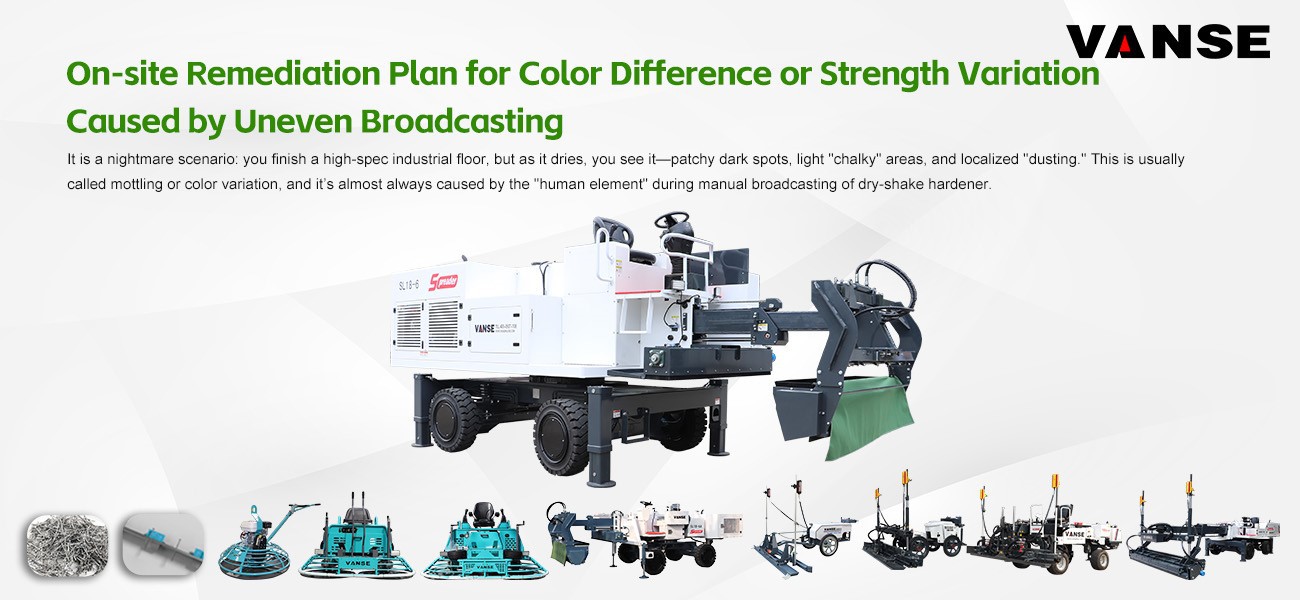
The Vanse Prevention Tip: The best remediation is prevention. Using the Vanse Automatic Topping Spreader instead of manual labor ensures a 100% uniform grams-per-square-meter application. By linking the spreader's output to the machine's speed, you eliminate the "human error" that causes color shifts and weak spots.
Step 2: The Remediation Plan (The "Cure")
1. Mechanical Leveling & Grinding
If the strength variation is severe (the surface is "powdering"), you have to remove the weak layer.
The Process: Use a planetary floor grinder with 30/40 grit metal-bond diamonds to strip away the inconsistent "skin."
The Vanse Tool for the Job: In cases where deep remediation is needed, use a Vanse Concrete Cutting Machine (Floor Saw) to create clean, straight boundaries around the affected area if a partial re-pour is required. This ensures the "patch" doesn't spall or crack at the edges.
2. Chemical Densification
Once the surface is opened up, you need to fix the strength variation.
The Process: Apply a high-quality Lithium or Sodium Silicate Densifier. This penetrates the concrete, reacts with the free lime, and creates a uniform, hard-shell finish across both the "weak" and "strong" zones.
Blending the Color: Use a tinted sealer or a "color-matched" penetrant during the densification process to mask the mottling and create a visually consistent finish.
3. Re-Burnishing for a Mirror Finish
After densifying, you need to "seal" the surface mechanically.
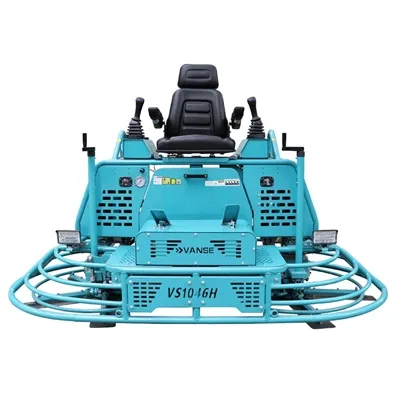
The Process: Transition to a Vanse Ride-on Power Trowel. With its high-torque engine and precision pitch control, you can "burnish" the densified surface. The heavy compaction of the Vanse rotors helps to blend the color and close the pores, resulting in a dense, dust-free, and uniform finish.
Step 3: Proactive Prevention (The Vanse Workflow)
Global buyers are moving away from manual methods because the cost of remediation is 3x higher than the cost of doing it right the first time. Here is the Vanse "Gold Standard" Workflow to avoid color and strength issues:
Uniform Placement: Use a Vanse Concrete Distributor or a Mini Dumper to place the base slab. This ensures the water-cement ratio is consistent across the entire bay, preventing "wet spots" that cause color variation.Consolidated Leveling: Use a Vanse Concrete Laser Leveling Machine . Its high-frequency vibration consolidates the slab from the bottom up, ensuring a uniform "paste" is available to bond with the hardener.
Mechanical Spreading: The Vanse Automatic Topping Spreader is your insurance policy. It applies the hardener in a single, even pass immediately behind the laser leveling, guaranteeing uniform strength and color.
Precision Finishing: The Vanse Power Trowel provides the final compaction, "locking in" the color and density.
Final Thought
Look, we’ve all been there-trying to "save money" by using manual labor for broadcasting, only to spend three times that amount on grinding and densifiers later. If you want to bid on FM1/FM2 high-spec projects, you need the precision of a Vanse fleet (www.vansemac.com).
Stop fixing floors and start finishing them. Visit Vanse Machinery today to see how our Topping Spreaders and Laser leveling can guarantee your color and strength consistency on every pour.
Note: The parameters provided in this document are for reference only and are not mandatory. Due to differences in technical characteristics between different brands and models of laser levelers, please consult the manufacturer for a suitable solution before actual operation. This reference document assumes no responsibility for any issues arising from failure to follow the manufacturer's instructions.
Thanks to All the Friends Who Support and Trust Shandong Vanse Machinery Technology Co., Ltd.
If you want to know more about Shandong Vanse Machinery Technology Co., Ltd. or have any questions, please feel free to contact us:
Our Factory
Shandong Vanse Machinery Technology Co., Ltd.








Share this article

About the Author: Shandong Vanse Machinery Technology Co., Ltd.
Shandong Vanse Machinery Technology Co., Ltd. is a high-tech manufacturer specializing in concrete construction machinery, including laser screeds and related equipment. The company integrates R&D, production, and global sales, with products exported to over 60 countries and widely used in infrastructure projects worldwide.
Previous Post
Next Post
Related Articles
You Might Also Like
Superflat floor construction technology
In the era of automated logistics and high-reach VNA (Very Narrow Aisle) warehouses, "flat" isn't just an aesthetic choice-it's a functional requirement. Superflat floor construction technology is designed to meet extreme tolerances, typically measured as FF (Floor Flatness) and FL (Floor Levelness) numbers (e.g., FF 50+ or FM1 standards). If you are a contractor looking to master this high-spec field, you don't just need workers; you need a synchronized ecosystem of precision machinery. Here is the ultimate professional workflow for Superflat success, featuring the specialized lineup from Vanse Machinery. Superflat precision begins before the leveling starts. If your concrete distribution is uneven, you create "slump variations" that lead to dips later. The Strategy: Use a Vanse Concrete Distributor to discharge the mix in uniform ribbons. To get material into tight strips or multi-level bays without the heavy footprint of a truck, the Vanse Mini Dumper (available in electric or gasoline) is the perfect "last-mile" tool. It allows your crew to place concrete with surgical precision, reducing the manual "shoveling" that often leads to inconsistencies. This is where the Superflat status is won or lost. Traditional manual leveling simply cannot hit FM1/FM2 numbers consistently. The Vanse Edge: The Vanse YZ30-4E Telescopic Boomed Laser leveling is the industry standard for large-scale precision. Its 6-meter telescopic boom allows the leveling head to strike off the concrete while the machine remains stationary, eliminating the "tire track" issues that ruin FL scores. For smaller projects, the agile Vanse YZ25-4 offers the same high-frequency vibration and laser-controlled precision in a compact frame, ensuring every square meter is consolidated from the bottom up. VNA floors must be incredibly wear-resistant. However, manual "dry-shake" broadcasting is notoriously uneven, which can lead to color variations and localized "dusting." The Strategy: Transition to a Vanse Automatic Topping Spreader. By mechanically applying the wear-resistant hardener immediately behind the laser leveling, you ensure a perfectly uniform grams-per-square-meter application. This creates a monolithic bond with the base slab, preserving the flatness achieved by the laser leveling machine while adding iron-clad durability. Once the concrete begins to set, you need to "seal" it. In Superflat flooring, this isn't just for looks; it's about surface density. The Vanse Edge: A machine like the Vanse Ride-on Power Trowel, provides the heavy compaction needed to "burnish" the floor. Its precision pitch control allows the operator to make micro-adjustments to the blades, smoothing out any remaining micro-imperfections to create a mirror-like finish that meets the highest FF (Flatness) requirements. Even the perfect slab will fail if the joints are ragged. In VNA lanes, joint integrity is critical for forklift wheel health. The Strategy: Use a Vanse Concrete Cutting Machine (Floor Saw) for early-entry or standard contraction joints. Its stable chassis and high-speed blade ensure clean, straight cuts that won't spall or lift, protecting the floor's long-term FF/FL integrity. When you visit www.vansemac.com, you're not just looking for a "smoothing tool"; you're looking for a guaranteed result. Here is why international contractors are making the switch: Labor Savings: A full Vanse fleet can turn a 12-man manual crew into a high-output 5-man team, often paying for itself in labor savings within 6-12 months. Reduced Rework: Avoid the nightmare of "grinding" a floor that failed its F-number test. Vanse machines are designed to hit the spec the first time. Reliability: By using world-class components (Honda, Rexroth, Danfoss), Vanse ensures your fleet stays on the job site, not in the repair shop. Superflat floor construction is the "Formula 1" of the concrete world. You wouldn't take a family sedan to a race track-so don't take "standard" equipment to a Superflat job site. Equip your team with the precision of Vanse (www.vansemac.com) and transform every pour into a high-performance asset. Ready to upgrade? Check out the full range of Superflat solutions at Vanse Machinery and see how we can help you set a new standard in your market. Note: The parameters provided in this document are for reference only and are not mandatory. Due to differences in technical characteristics between different brands and models of laser levelers, please consult the manufacturer for a suitable solution before actual operation. This reference document assumes no responsibility for any issues arising from failure to follow the manufacturer's instructions.What floor materials are suitable for metal power trowels?
– Newly poured concrete: Metal trowels are hard and strong, and are very suitable for rough and fine grinding of newly poured concrete floors. After the initial setting of concrete, the use of metal trowels can effectively compact the concrete surface, eliminate pores and tiny cracks on the surface, and make the floor smoother. For example, when building the floor of a large industrial plant, the use of metal trowels can quickly handle large areas of newly poured concrete, improve construction efficiency and floor quality. – Old concrete repair: For the repair of old concrete floors, such as floor wear and sanding, metal trowels can grind and trim the damaged parts. It can remove the loose layer on the surface and provide a good bonding foundation for subsequent repair materials (such as epoxy floor paint, concrete repair mortar, etc.). – Floor leveling layer: In interior decoration, cement mortar is often used for floor leveling. Metal trowels can be used for smoothing after the cement mortar has initially set, so that the surface of the leveling layer is flat, which is convenient for the subsequent laying of floor tiles, wooden floors and other floor materials. Its hardness can ensure that it will not be excessively worn due to the sand particles in the cement mortar during the smoothing process, and at the same time it can effectively compact the cement mortar. – Decorative cement mortar floor: For some cases where colored cement mortar is used as a decorative floor, metal trowels can make the floor achieve a better finish and enhance the decorative effect. For example, in some retro-style buildings, using metal trowels to smooth the colored cement mortar floor can show delicate texture and luster. – Rough grinding stage: There are multiple stages in the production process of terrazzo floor, such as rough grinding, fine grinding and polishing. In the rough grinding stage, metal trowels can be used to remove excess stone and cement slurry on the surface of terrazzo, so that the stone is evenly exposed, laying the foundation for subsequent fine grinding and polishing. Since the terrazzo floor contains hard stones, the high hardness of the metal trowel can withstand the friction of the stones and will not be easily damaged. – Surface defect repair: During the use of the terrazzo floor, if there are surface scratches, pits and other defects, the metal trowel can be used to polish and repair these local areas. Through proper polishing, the damaged area can be restored to the level with the surrounding ground, and then polished to restore the original beauty of the ground. – Forming trowel: The emery wear-resistant floor is formed after the emery wear-resistant material is spread in the initial setting stage of concrete. The metal trowel plays a key role in this process. It can fully combine the emery wear-resistant material with the concrete surface, compact and smooth it. Because the emery itself has a high hardness, the metal trowel can cooperate with it to form a hard and wear-resistant surface on the ground, which is widely used in industrial workshops, warehouses and other places. – Post-maintenance: In the post-maintenance of diamond abrasive wear-resistant floors, metal polishing sheets can be used to regularly polish and clean the floors to remove surface dirt and slight wear marks, thereby extending the service life of the floors.What operations should be avoided when using a concrete laser leveler to vibrate and compact concrete?
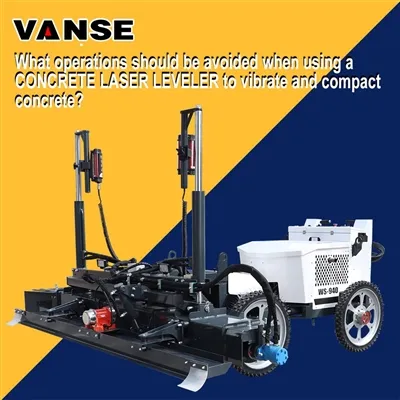
Improper operation of a concrete laser leveling machine during compaction can lead to problems such as segregation, uneven surfaces, and insufficient density. The following key practices should be avoided: Over-vibration: Excessive vibration frequency (exceeding the equipment's recommended range, such as over 5,000 vibrations per minute) or prolonged vibration time can cause aggregate to sink and mortar to float, resulting in segregation (gravel concentrates at the bottom and excessive laitance on the surface), impacting structural strength and durability. Insufficient vibration: Excessive vibration frequency or insufficient vibration depth (failure to reach the bottom of the concrete) can prevent internal bubbles from being expelled and gaps between aggregates from being filled, leading to honeycombs and voids, and reduced density. Parameters not adapted to concrete characteristics: Parameters not adjusted according to concrete slump (e.g., using a low frequency for dry, hard concrete and a high frequency for plastic concrete) can result in either inadequate vibration or segregation. Repeatedly vibrating the same area: Repeatedly vibrating the same location will damage the concrete's initial structure and exacerbate segregation, especially when performed on concrete in the initial setting stage. This can cause sanding and cracking of the surface. Missed edges or corners: The vibrator fails to reach areas such as the edge of the formwork or areas with dense rebar. These areas are prone to honeycombing due to insufficient vibration energy and require manual assisted vibration (such as using an inserted vibrator). However, this should avoid interfering with the laser leveling machine. Mismatching vibration and travel speed: If the machine travels too fast, the vibrator will stay in a specific area too short, failing to achieve adequate compaction. If the machine travels too slowly, excessive vibration may cause segregation, impacting construction efficiency. Failure to promptly level after vibration: After vibration, the concrete surface will fluctuate due to vibration. If this is not promptly leveled using the laser leveling system, the surface will exceed the required flatness, requiring additional repairs and increasing costs. Forced vibration when the concrete slump exceeds the specified value: Concrete with a large slump (e.g., over 200mm) is inherently fluid and can easily segregate due to excessive vibration. Concrete with a small slump (e.g., less than 50mm) has difficulty transmitting energy through vibration, which can lead to insufficient density. Therefore, the concrete mix proportions should be adjusted before construction. Vibrating after initial setting: After initial setting (loss of plasticity), vibration can damage the existing structural framework, causing surface cracking and reduced strength. Vibration timing must be strictly controlled and synchronized with the concrete pouring rhythm. Continuing to use a vibrator when the vibrator is worn or stuck: Wear on the vibrator blades will attenuate the vibration energy, while sticking can cause localized severe impact, resulting in localized concrete segregation or surface damage. Regularly inspect the equipment. Failure to adjust the vibration depth based on the construction thickness: Too shallow a vibration depth (less than 2/3 of the concrete thickness) can result in a loose, deeper layer; too deep a vibration depth (contacting the formwork or base) can damage the formwork due to vibration impact or introduce impurities into the base, affecting concrete quality. By avoiding these practices, the laser leveling can ensure efficient concrete compaction during the vibration process while maintaining surface accuracy and structural strength, reducing subsequent repair costs. Click the below to jump immediately!!! ARMOUR JOINT CONCRETE LASER LEVELING MACHINE LIGHT TOWER POWER TROWEL SLIPFORM MACHINE STEEL FIBER TOPPING SPREADER TRACKED MINI DUMPER