Technical Knowledge
How to avoid concrete surface delamination
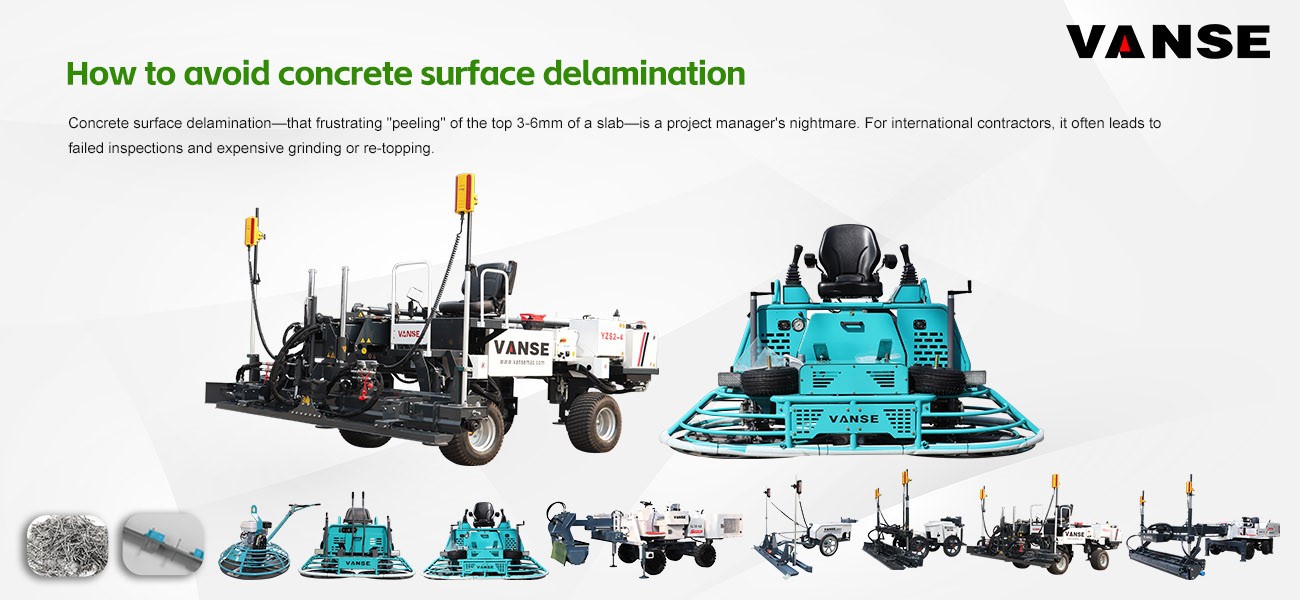
Concrete surface delamination-that frustrating "peeling" of the top 3-6mm of a slab-is a project manager's nightmare. For international contractors, it often leads to failed inspections and expensive grinding or re-topping.
In the industry, we know the main culprit: trapped bleed water or air. If you seal the surface too early, you create a hollow "blister" that eventually snaps off. To avoid this, you need a workflow that prioritizes timing and uniform compaction.
Here is how to eliminate delamination risks using a professional-grade fleet from Vanse Machinery.
1. Uniform Placement: The "Foundation" of Prevention
Delamination often starts with inconsistent concrete placement. If one part of the bay is thicker or wetter than the next, the bleed water will rise at different rates.
The Vanse Workflow: Instead of dumping large, uneven piles that create "wet spots," use a Vanse Concrete Distributor to ensure an even ribbon of material.
2. Consolidated Leveling: Eliminating Air Pockets
If the slab isn't consolidated from the bottom up, air pockets can migrate to the surface during finishing, leading to "blisters."
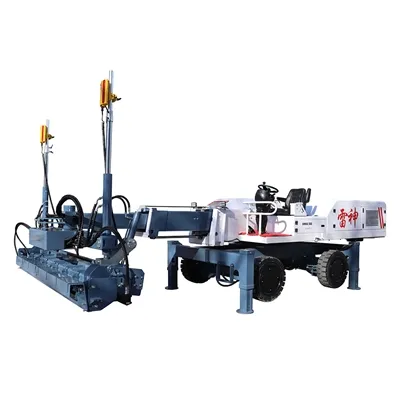
The Vanse Workflow: A Vanse Concrete Laser Leveling Machine (like the YZ28-4S or the telescopic YZ30-4E) doesn't just "scrape" the top; it uses high-frequency vibration (up to 4000rpm) to liquefy and consolidate the entire depth of the slab in one pass. This forces out excess air and ensures the bleed water rises naturally and evenly across the entire floor.
3. Integrated Hardening: Bonding the "Skin"
Many delamination issues occur because manual dry-shake hardener is applied unevenly, preventing a proper bond with the base slab.
The Vanse Workflow: Use the Vanse Automatic Topping Spreader. By mechanically applying the hardener immediately after the laser leveling pass, you ensure the material integrates perfectly with the wet paste. This creates a monolithic bond that won't "peel" under heavy forklift traffic.
4. Master the Timing: The Power Trowel Rule
The most common cause of delamination is premature troweling. If you start "burning" the floor while bleed water is still rising, you are guaranteed to have peeling issues.
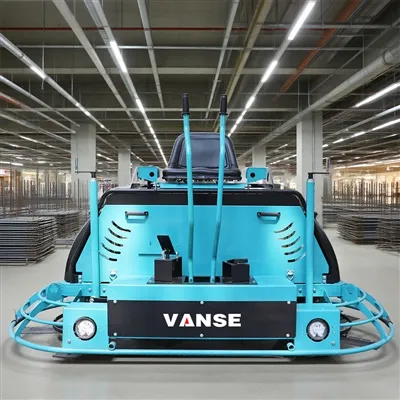
The Vanse Workflow: When you use a high-performance Vanse VS1046 Ride-on Power Trowel, you have the torque and weight to wait for the "Goldilocks" window. Because Vanse machines are so efficient, you don't have to rush the first pass. You can wait for the bleed water to fully evaporate, then use the precision pitch control to densify the surface without trapping moisture underneath.
5. Stress Relief: Precision Joint Cutting
Sometimes "peeling" happens near the edges of joints due to localized stress or "spalling."
The Vanse Workflow: As soon as the floor is hard enough to walk on, use a Vanse Concrete Cutting Machine (Floor Saw). A clean, straight cut ensures that the slab can "breathe" and move during the curing process, preventing the edges from lifting or delaminating during the critical first 48 hours.
Comparison: Why Pro Equipment Prevents Failures
| Technical Cause of Peeling | Prevention Strategy | Vanse Advantage |
| Inconsistent Placement | Controlled, even distribution. | Concrete Distributor & Mini Dumper |
| Trapped Air/Water | Bottom-up consolidation. | High-Frequency Laser Leveling Machine |
| Poor Hardener Bond | Mechanical, even application. | Automatic Topping Spreader |
| Premature Sealing | High-torque finishing at the right time. | VS836 / VS1046 Power Trowel |
| Edge Stress | Early, clean joint execution. | Stable Concrete Cutting Machine |
Final Thought
Avoiding delamination is all about respecting the concrete's timeline. You can't force the water to stop rising, but you can use equipment that works with the material. By combining the placement precision of the Mini Dumper, the leveling power of the Laser leveling, and the finishing torque of the Power Trowel, you ensure a floor that is as durable as it is flat.
Don't risk your reputation on a "peeling" floor. Explore the full professional lineup at www.vansemac.com and build it right the first time.
Note: The parameters provided in this document are for reference only and are not mandatory. Due to differences in technical characteristics between different brands and models of laser levelers, please consult the manufacturer for a suitable solution before actual operation. This reference document assumes no responsibility for any issues arising from failure to follow the manufacturer's instructions.
Thanks to All the Friends Who Support and Trust Shandong Vanse Machinery Technology Co., Ltd.
If you want to know more about Shandong Vanse Machinery Technology Co., Ltd. or have any questions, please feel free to contact us:
Our Factory
Shandong Vanse Machinery Technology Co., Ltd.








Share this article

About the Author: Shandong Vanse Machinery Technology Co., Ltd.
Shandong Vanse Machinery Technology Co., Ltd. is a high-tech manufacturer specializing in concrete construction machinery, including laser screeds and related equipment. The company integrates R&D, production, and global sales, with products exported to over 60 countries and widely used in infrastructure projects worldwide.
Previous Post
Next Post
Related Articles
You Might Also Like
Requirements and treatment for troweling the concrete base layer before grinding special floors (such as epoxy floors and curing agent floors)
The success of special floors (such as epoxy floors and curing agent floors) is "70% dependent on the base layer and 30% on the materials". The quality and treatment of the base concrete's smoothing are the key prerequisites for determining the final floor effect and lifespan. The following are the detailed requirements and treatment procedures for the concrete base layer before grinding. The objective of the base concrete is to provide a "canvas" that is of high strength, dense and smooth, dry and clean, and free of defects. This refers to the operation carried out using a mechanical trowel during the period from the initial setting to the final setting of concrete. The requirements are far higher than those for ordinary concrete floors. The strength should not be lower than C25, and it is recommended to be above C30. The water-cement ratio should be low (generally ≤0.5) to reduce bleeding, enhance surface strength and wear resistance. The aggregate (sand and gravel) particle size is moderate and the mud content is low, ensuring a fine surface. It is necessary to vibrate thoroughly to expel air bubbles and ensure that the concrete is dense, free of voids and honeycombs. Preliminary leveling: After the concrete is laid, a laser screed or a scraper is used for initial leveling. Bleeding treatment: Allow the free water on the surface to fully evaporate. Start the operation before the initial setting (when the depth of the human footprint is about 2-3mm). The first coat of troweling (lifting the slurry) : Use a circular troweling machine to run at low speed to lift and smooth the surface slurry, filling in local unevenness. The second coat of smoothing (compaction) : When the surface moisture has further evaporated (and the footprints left by a person standing on it are very shallow), switch to a trowel blade (iron plate), run at medium speed, and apply in a cross direction to compact and smooth the surface. The third coat of polishing (fine polishing) : Before the concrete has finally set (with no standing water on the surface and slight marks when pressed by fingers), use a trowel blade to finely grind at high speed. This step is of vital importance as it can significantly enhance the surface density and flatness, resulting in a smooth and uniform hardened surface. When using a 2-meter straightedge for inspection, the gap should not exceed 3mm. The high-standard project requirement is ≤2mm. The overall slope should comply with the design requirements and there should be no water accumulation areas. After the smoothing is completed, full curing must be carried out immediately (it is recommended to cover with plastic film or spray a special curing agent) to prevent cracking due to excessive evaporation of water. The curing period should be no less than 7 days, with 14 to 28 days being the best. Even a well-polished floor must undergo strict inspection and targeted treatment before grinding. This stage is usually carried out after the concrete pouring and curing are completed (at least 28 days after the strength meets the standard). Strength: Tested by a rebound tester, the surface compressive strength is ≥ 25MPa. For curing agent floors, the higher the strength of the base layer, the better the final effect. Moisture content: Detected using an electronic hygrometer. Epoxy flooring has strict requirements (the moisture content of the base layer should be ≤ 4%, or as per the requirements of the material supplier). The curing agent floor has a relatively high tolerance for moisture, but it must not have standing water either. Flatness: Check again with a 2-meter straightedge and mark the areas that exceed the standard. Defect inspection: Carefully examine for hollowing (by tapping with a small hammer), cracks, oil stains, floating slurry, cement lumps, exposed steel bar ends, etc. Cleaning: Thoroughly sweep the floor and use an industrial vacuum cleaner to suck up all dust and sand particles. Hollowing and Defect repair Remove all hollow and loose parts. V-shaped grooves should be made for non-structural cracks, and they should be filled and repaired with high-strength non-shrinking epoxy resin or polymer cement mortar. The exposed ends of the steel bars on the ground should be cut to at least 3mm below the surface, then treated with anti-rust paint and filled with repair mortar. For local pits or height differences, they should be leveled with a professional grinding machine or milling machine and then filled with matching repair materials. Oil stain treatment: For oil stains, they must be thoroughly removed. Light oil stains can be wiped with special cleaning agents or solvents. Severely penetrating oil stains should be treated with fire roasting, milling or special degreasing agents. If necessary, the contaminated concrete should be knocked off and re-poured. Floating slurry and weak layer treatment: This is one of the core purposes of grinding. Even on a well-polished floor, there may still be a layer of cement slurry film (floating slurry) with relatively low strength formed due to bleeding on the surface. The primary task of the grinding machine is to remove this layer of floating Stage Key requirements for epoxy flooring Key requirements for concrete hardener flooring Polishing requirements Extremely high. The denser and flatter the surface is, the better the adhesion of the epoxy coating will be and the brighter and smoother the coating effect will be. It needs to be polished to perfection. High. The surface density directly affects the uniformity of the curing agent's penetration and the final hardening effect, and it also requires a fine finish. Strength requirements High (≥C25). The base layer is solid, and the coating is not prone to cracking due to base layer cracking. Very high (it is recommended to be ≥C30). The strength of the base layer is the foundation of the final strength, and the curing agent is an addition reaction. Moisture content requirement Extremely strict (≤4%). Moisture can cause the epoxy coating to bubble and delaminate. It should be relatively loose, but the ground must be dry and free of standing water. The curing agent can react with the hydration products of cement. Pretreatment before grinding The key points are absolute dryness, dust-free, oil-free and high flatness. The floating slurry layer must be removed to ensure adhesion. The key points are to remove the floating slurry, open the pores, deal with the defects and ensure the surface is smooth. Grinding opens up channels for the penetration of curing agents. Grinding particle size Usually, grinding to 80-120 mesh is sufficient to provide adequate roughness (anchor texture) for the epoxy primer. Usually, a coarser finish (such as starting at 30-40 mesh) is required to open up the surface, followed by multiple grinding processes to a higher mesh count (such as 1000-3000 mesh) for a brighter finish. Communication in advance: Before the concrete pouring, the floor construction unit should conduct a detailed technical briefing with the general contractor of the civil engineering, clearly defining the plastering standards and curing requirements. On-site supervision: The floor construction party should send personnel to supervise and guide during the concrete smoothing stage. System treatment: Regard the base treatment as a systematic project, from pouring to curing, and then to the inspection and repair before grinding, each step is interlinked and no step can be omitted. Professional assessment: For the renovation of old floors, a comprehensive assessment must be conducted by professionals before grinding, and a detailed treatment plan should be formulated. Only by following the above requirements and procedures can a perfect foundation be laid for the subsequent epoxy resin coating or concrete sealant and hardener construction, thereby creating a high-performance and long-life high-quality floor. Note: The parameters provided in this document are for reference only and are not mandatory. Due to differences in technical characteristics between different brands and models of laser levelers, please consult the manufacturer for a suitable solution before actual operation. This reference document assumes no responsibility for any issues arising from failure to follow the manufacturer's instructions.Application Case of Ultra-flat Floors in Automated Warehousing and Logistics Centers
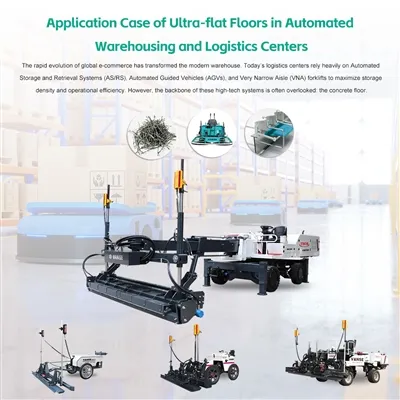
The routine inspection, fault early warning and maintenance points of the hydraulic system of the concrete laser leveling are a crucial topic, as the health condition of the hydraulic system directly determines the construction efficiency, leveling accuracy and equipment service life of the leveling. The following is a detailed and systematic guide. In a traditional warehouse, minor floor undulations might only cause slight operator discomfort. In an automated facility, they can lead to catastrophic inefficiencies. VNA Forklift Stability: VNA trucks routinely lift heavy loads to heights exceeding 15 meters (50 feet). A floor variation of just a few millimeters at ground level translates to significant mast sway at maximum height. Ultra-flat floors, measured by strict Floor Flatness (FF) and Floor Levelness (FL) metrics, eliminate this static lean, preventing collisions with racking systems. AGV and Robotics Performance: Automated Guided Vehicles use sophisticated optical and laser sensors for navigation. Uneven surfaces cause sensor misalignment, triggering automatic safety shutdowns and halting the entire supply chain. A perfectly leveled floor ensures AGVs run continuously at their designed maximum speeds. Investing in an ultra-flat floor poured and leveled with advanced concrete laser leveling provides immediate and long-term ROI for logistics operators: Maximized Operational Speed: Material Handling Equipment (MHE) can operate at 100% capacity without the need to slow down for floor defects. Reduced Equipment Maintenance: Bumps and uneven joints cause severe wear and tear on the expensive polyurethane wheels and bearings of VNA trucks and AGVs. A seamless, ultra-flat surface dramatically extends the lifespan of this machinery and reduces maintenance downtime. Optimized Storage Density: Super-flat conditions allow racks to be built higher and closer together, maximizing the cubic storage capacity of the warehouse footprint. Achieving these exacting standards requires more than traditional manual pouring. The construction of logistics center floors demands state-of-the-art concrete laser leveling machines. These machines utilize advanced laser receivers and automated hydraulic systems to continuously adjust the leveling head, guaranteeing precise elevation control and eliminating human error. Furthermore, integrating high-quality steel fibers and precision armor joints during the construction process ensures the floor remains durable under heavy dynamic loads, preventing joint spalling and shrinkage cracks. In the era of smart logistics, the concrete floor is no longer just a structural component; it is an active operational asset. By prioritizing ultra-flat floor construction, logistics centers lay the literal foundation for automation success, ensuring high-speed throughput, maximum safety, and unparalleled efficiency. Note: The parameters provided in this document are for reference only and are not mandatory. Due to differences in technical characteristics between different brands and models of laser levelers, please consult the manufacturer for a suitable solution before actual operation. This reference document assumes no responsibility for any issues arising from failure to follow the manufacturer's instructions.A collection of questions about purchasing concrete laser levelers / leveling
With the continuous increase in the use of laser leveling machines, the number of manufacturers and types of leveling machines is also increasing. The increase in the number undoubtedly creates conditions for users to choose, but at the same time, it also brings a lot of trouble. How to choose a more cost-effective laser leveling machine from among the many laser leveling machines with varying quality and widely different prices has become a challenge that every user must face. In order to help you choose a more desirable laser leveling machine equipment, our company has summarized some purchase questions about leveling machines in detail, and now I will give you detailed answers one by one. Question 1: What brand of laser leveling machine is better? Answer: What brand of laser leveling machine is better? This should be a question every user asks before making a purchase. After all, everyone hopes that what they buy is better, and they hope to worry less when using it. But as far as the current market situation is concerned, when it comes to which brand is better, many well-known brands of laser leveling machines are good, and they are doing well in terms of quality and after-sales service. So when choosing a brand, you can't go wrong if you choose those with relatively guaranteed word-of-mouth and popularity. You can use it with confidence. You don't have to worry about too many problems when the equipment is working. The most important point is the efficiency of the work. high. Question 2: Is it cost-effective to buy a second-hand laser leveling? Answer: Now the second-hand market of laser leveling machines is very hot, and there are a lot of people buying them. However, some people have expressed doubts, that is, is it worthwhile to buy this second-hand equipment? Judging from the current market situation, many people still trust second-hand laser leveling machines. I feel that the price of second-hand is affordable, and many second-hand ones are even 80% or 90% new. When I buy it, I can buy it at a second-hand price, which is very cheap. Therefore, in fact, it is also revealed that second-hand ones can be bought, but it still depends on the quality. If the price is affordable but the quality is not good, then this item is not worth buying, so as to avoid too frequent and expensive repairs after buying it in the future.