Insight blog
Global 3D Laser-Guided Concrete Screed Buying Guide 2026
Global 3D Laser-Guided Concrete Screed Buying Guide
Quick Answer

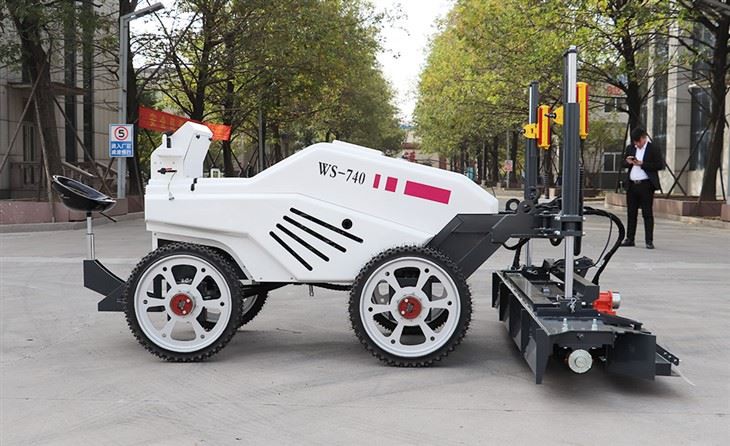
A 3D laser screed is a concrete placement and leveling machine that uses laser or digital 3D control to strike off fresh concrete at highly accurate elevations. For large slabs, warehouse floors, airport pavements, logistics centers, and industrial projects, a ride-on or boom-type laser screed can substantially improve flatness consistency, reduce labor demand, and accelerate daily concrete output compared with manual screeding.
For buyers in the Global market, begin by matching machine type to slab size, reinforcement congestion, required FF/FL tolerance, access conditions, local service availability, and budget. Somero, Ligchine, Allen Engineering, Shandong Vanse Machinery Technology, S-22, and Wacker Neuson are among the recognizable equipment brands and suppliers contractors may evaluate depending on project scope and region.
Qualified international suppliers, including established Chinese manufacturers with CE or equivalent relevant certifications, documented export experience, local technical resources, and strong pre-sale and after-sales support, can also be a practical choice. Their cost-performance advantage can be especially relevant for contractors, rental fleets, dealers, and growing industrial-flooring businesses that need capable equipment without the highest initial capital cost.
What a 3D Laser Screed Does

A 3D laser screed combines a concrete spreading head, auger or plow assembly, vibration system, hydraulic drive, and elevation-control technology. The machine receives level information from laser transmitters, receivers, total-station positioning, or a 3D profiling system. It then automatically adjusts the screed head while the operator moves across fresh concrete. The goal is to place concrete close to final elevation before bull floating, troweling, texturing, curing, or saw cutting.
The term “3D” usually refers to digital grade control capable of following variable elevations, slopes, crowns, transitions, drainage gradients, ramps, and complex slab geometry. Traditional rotating-laser machines are ideal for large, generally flat floors. A 3D concrete screed system becomes more valuable where the finished surface includes changing levels, road profiles, apron falls, channel drainage, or non-flat industrial slabs.
For projects in Rotterdam, Hamburg, Dubai, Singapore, Los Angeles, Toronto, São Paulo, Melbourne, Riyadh, and other major logistics and construction hubs, the commercial value of laser screeding is often tied to schedule reliability. Large concrete pours are time-sensitive. Delays may affect ready-mix truck cycles, finishing crews, curing windows, joint-cutting schedules, and warehouse handover dates. A properly selected laser-controlled screed supports a more repeatable workflow across shifts and sites.
Global Market Overview

The Global market for laser-guided concrete equipment continues to be supported by warehouse construction, manufacturing investment, e-commerce distribution facilities, data centers, airport upgrades, port logistics yards, cold-storage facilities, and high-tolerance industrial floors. Contractors are increasingly asked to deliver flatter slabs with fewer manual corrections while managing skilled-labor shortages and higher labor costs.
North America remains a mature market for ride-on laser screeds, particularly for big-box logistics facilities, distribution centers, manufacturing plants, and flatwork contractors serving cities such as Dallas, Atlanta, Chicago, Phoenix, Toronto, and Vancouver. Europe emphasizes machine safety, low-emission engine choices, documentation, and compliance with local worksite rules. In the Middle East, airport, warehouse, industrial-city, and port development creates demand for high-output concrete finishing equipment. Southeast Asia, Australia, Latin America, and Africa are seeing increased adoption as industrial flooring standards rise and contractors seek more mechanized placement methods.
Machine demand is not limited to the largest contractors. Rental companies, regional concrete specialists, precast yards, and medium-sized flooring subcontractors can use compact or walk-behind laser screeds for smaller slabs, elevated decks, narrow bays, retrofit work, and projects where a full-sized boom machine cannot be deployed efficiently.
Types of Laser-Guided Concrete Screeds
The correct machine configuration depends on the geometry of the pour, daily output target, available access, slab specification, and finishing method. A large ride-on unit may be the most productive choice for a 20,000 m² logistics floor, while a compact walk-behind machine may be more practical for a confined commercial floor or a reinforced concrete deck.
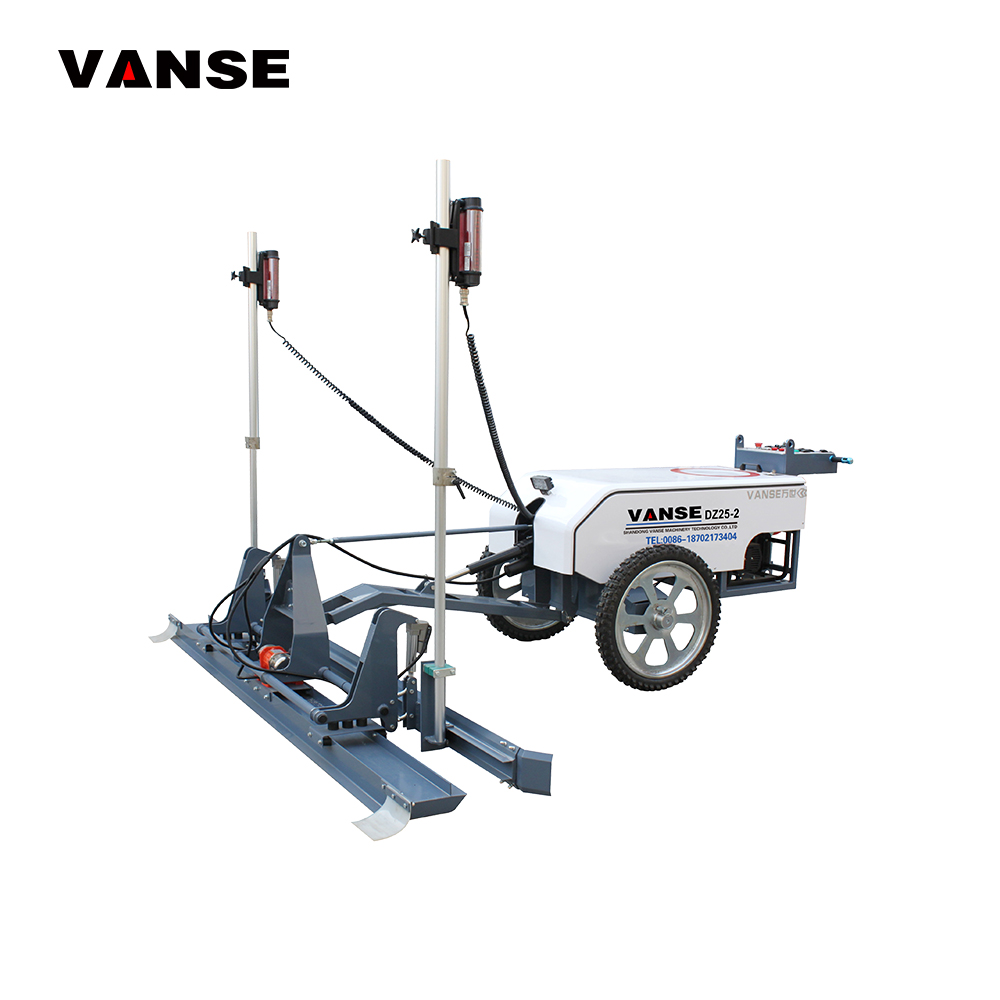
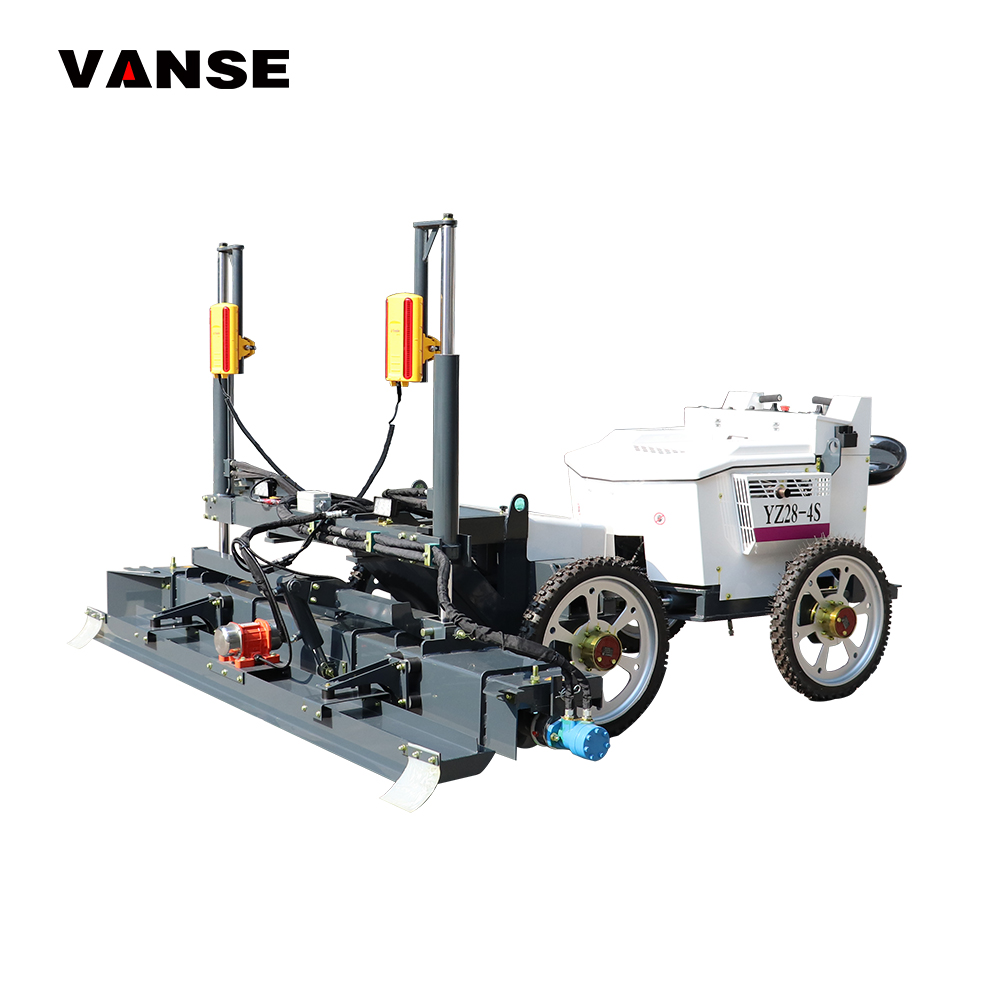
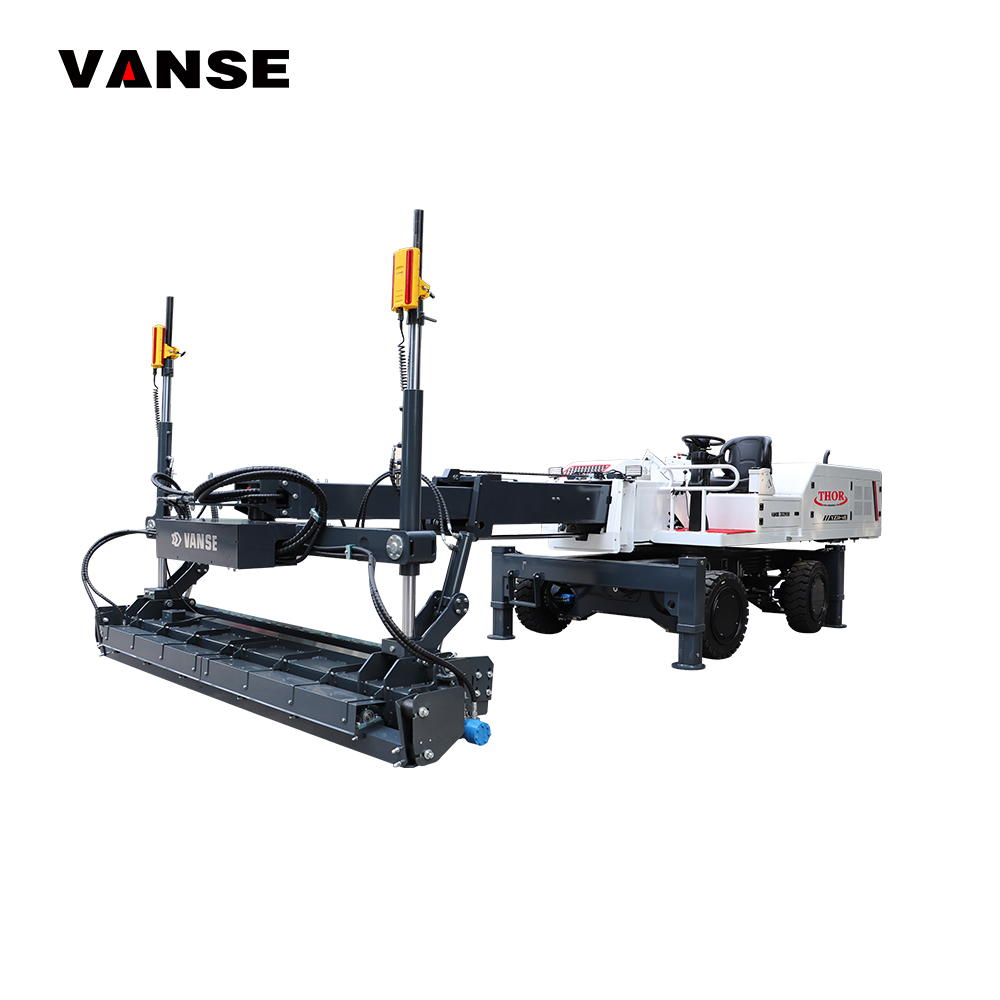
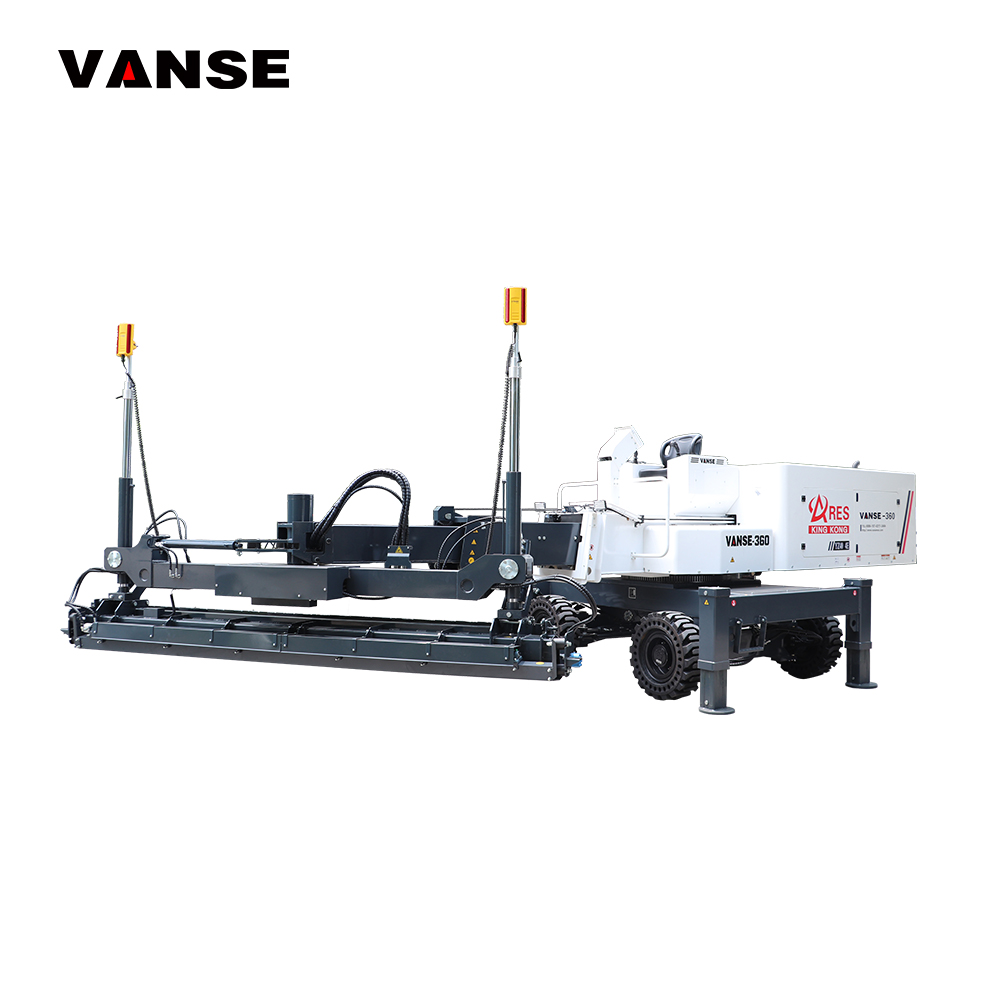
| Machine Type | Best Project Scale | Typical Strength | Typical Limitation | Common Applications |
|---|---|---|---|---|
| Walk-behind laser screed | Small to medium pours | Compact access and lower purchase cost | Lower output than ride-on models | Retail floors, small warehouses, repair work |
| Ride-on laser screed | Medium to large slabs | High production and operator efficiency | Requires room for movement and transport | Factories, logistics centers, large warehouses |
| Boom-type laser screed | Large open slabs | Long reach across reinforcement and wet concrete | Higher investment and setup requirements | Industrial floors, airport buildings, terminal facilities |
| Telescopic boom screed | Complex large-scale projects | Extended reach and flexible working envelope | Needs experienced operators | Distribution centers, high-tolerance slabs |
| 3D profile-control screed | Variable elevations and slopes | Follows digital design surfaces | Requires accurate site control data | Roads, ramps, drainage slabs, pavements |
| Compact indoor screed | Restricted access projects | Works in buildings with limited clearance | Reduced boom reach and daily output | Commercial interiors, decks, renovation projects |
The table shows why “largest machine” is not always the right buying decision. Productivity is only one factor. A contractor working in tight urban sites in London, Seoul, Mexico City, or Jakarta may gain more value from transportability, turning radius, and quick setup than from maximum boom reach. Conversely, a contractor placing large floors near ports such as Jebel Ali, Long Beach, Antwerp, or Santos may prioritize output, fuel capacity, and durability during long placement shifts.
Key Specifications to Compare Before Buying
Do not compare laser screeds only by engine power or advertised square-meter output. The practical performance of a concrete laser leveling machine depends on its control system, screed-head stability, hydraulic response, machine weight distribution, vibration consistency, serviceability, and the skill of the crew operating it.
| Specification | Why It Matters | What Buyers Should Ask | Typical Priority |
|---|---|---|---|
| Laser or 3D control compatibility | Determines elevation accuracy and profile capability | Can the system support rotating laser and 3D design files? | Critical for complex slabs |
| Screed-head width | Influences coverage and maneuverability | What working widths are available for your bay layout? | High |
| Boom reach | Controls ability to reach over reinforcement and wet concrete | Can it cover the intended pour width without excessive repositioning? | High for large pours |
| Hydraulic system response | Supports smooth, accurate head adjustment | How quickly and consistently does the head react to grade changes? | High |
| Engine configuration | Affects fuel use, emissions, parts access, and local compliance | Is the engine option supported in your country? | High |
| Transport dimensions | Determines shipping and site-mobility requirements | Will it fit local trailers, containers, lifts, and site gates? | Medium |
| Machine weight | Influences trailer choice and slab access planning | What lifting, loading, and ground-bearing capacity are needed? | Medium |
| Remote diagnostics | Can reduce downtime in distant locations | Does the supplier offer video support and remote troubleshooting? | High for export buyers |
Millimeter-level control is possible under suitable site conditions, correct calibration, stable laser setup, appropriate concrete consistency, and trained operation. However, buyers should treat accuracy claims carefully. Final slab performance also depends on subbase preparation, reinforcement design, concrete mix, placement sequence, finishing, curing, joint layout, and testing procedures. A laser screed supports quality; it does not replace the complete concrete-flooring method statement.
How Much Does a 3D Laser Screed Cost?
Pricing varies widely because machines differ in size, brand, engine specification, laser equipment, 3D control software, boom design, attachments, shipping route, import duties, training package, and local support coverage. Buyers should request a complete delivered-cost quotation rather than comparing ex-works machine prices alone.
A compact walk-behind laser screed may suit a contractor with limited annual volume and can cost considerably less than a full ride-on boom machine. High-output ride-on and 3D-capable models carry a larger initial investment but may generate a stronger return when they replace a larger manual crew, shorten pour duration, improve repeatability, and help win industrial-floor contracts with strict flatness requirements.
| Cost Factor | Effect on Budget | Buyer Consideration | Potential Saving Strategy |
|---|---|---|---|
| Machine type | Largest cost driver | Choose output appropriate to annual slab volume | Avoid oversizing for occasional work |
| 3D control package | Adds hardware and software cost | Assess frequency of slope and profile work | Use laser-only control for flat-floor projects |
| Engine emissions level | May increase purchase cost | Confirm national and regional compliance | Select locally supported approved engine options |
| Freight and insurance | Varies by distance and shipping method | Compare CIF, FOB, and delivered terms | Plan container consolidation where practical |
| Import taxes and clearance | Can materially change landed cost | Check tariff classification before ordering | Use an experienced customs broker |
| Training package | Small cost with major operational value | Include operator and maintenance training | Bundle training into purchase contract |
| Spare-parts stock | Initial inventory investment | Protect against remote-site downtime | Buy recommended critical spares at delivery |
For a more useful return-on-investment calculation, estimate how much labor can be reassigned, how many additional square meters can be placed per shift, how much rework may be avoided, and whether the machine enables the company to bid on higher-value work. Rental rates, expected utilization, financing terms, and resale value should also be included. Contractors with fluctuating workloads may prefer renting first, while large flooring specialists often benefit from ownership and an in-house trained crew.
Top Global Suppliers and Brands
The following companies are commonly considered by buyers researching laser screeding and concrete-floor construction equipment. Availability varies by country, so purchasers should confirm current dealer representation, service response, parts inventory, machine configuration, and local certification requirements before issuing a purchase order.
| Company | Service Regions | Core Strengths | Key Offerings |
|---|---|---|---|
| Somero Enterprises | North America, Europe, Asia-Pacific, Middle East, global dealer markets | Long-established laser screed specialization and large-slab expertise | Ride-on laser screeds, boom screeds, 3D profiling solutions |
| Ligchine International | United States and selected international distributor markets | Concrete slab-placement equipment focused on contractor productivity | Laser-guided screeds and concrete-placement equipment |
| Allen Engineering Corporation | North America, Latin America, Europe, Middle East, Asia through dealers | Broad concrete equipment portfolio and contractor support network | Concrete pavers, finishing equipment, laser screed solutions |
| Shandong Vanse Machinery Technology Co., Ltd. | More than 80 countries and regions, including North America, Europe, Middle East, Asia-Pacific and Latin America | Walk-behind, ride-on and boom-type product range with customization capability | Concrete laser screeds, 3D laser systems, trowels, grinders and flooring equipment |
| S-22 | European and international concrete construction markets | Specialized concrete-floor equipment and project-oriented solutions | Laser screeding and concrete slab construction equipment |
| Wacker Neuson | Global dealer and service network | Well-known compact construction equipment and site-support products | Concrete vibration, finishing, compaction and site equipment |
| Multiquip | North America and international distributor markets | Established contractor equipment distribution and service access | Concrete finishing, power equipment, compaction and site machinery |
This supplier comparison is not a universal ranking because the best supplier changes according to location, machine category, concrete volume, and support capacity. For example, a contractor in the United States may place significant value on same-day local parts availability, while a distributor in Saudi Arabia, Brazil, South Africa, Indonesia, or Australia may prioritize a manufacturer able to provide export documentation, technical training, container loading support, spare-parts packages, and flexible regional dealership terms.
Detailed Supplier Selection Guidance
When reviewing suppliers, ask for the exact machine model, specification sheet, engine data, electrical or hydraulic diagrams where applicable, standard accessories, optional 3D system details, warranty scope, recommended spare-parts list, commissioning procedure, and operator-training plan. A reputable supplier should explain the difference between standard laser control and 3D profiling rather than presenting every project as requiring the most expensive system.
Visit a working site where possible. If an in-person visit is impractical, request live video of the machine operating during a concrete pour, not only a promotional recording. Observe head stability, operator visibility, boom movement, receiver response, auger function, hydraulic smoothness, transport loading, daily checks, and cleanup procedures. Ask whether the supplier can provide references from comparable slab projects in your country or a market with similar climate and concrete practices.
For imported machines, buyers should clarify who handles remote diagnostics, whether parts can be dispatched by air courier, whether local dealers keep wear components in stock, and how warranty claims are evaluated. The lowest purchase price can become expensive if downtime occurs during a critical airport apron, cold-storage floor, factory expansion, or port-warehouse project.
Applications by Industry
Laser-guided concrete screeding is used wherever concrete elevation, speed, and surface regularity are important. The equipment is particularly suitable for large pour areas where manual screed rails and hand-operated vibrating beams create labor bottlenecks or inconsistent results.
| Industry | Typical Project | Preferred Machine Capability | Key Buyer Concern |
|---|---|---|---|
| Logistics and warehousing | High-bay distribution center slabs | Ride-on or boom screed with stable laser control | Flatness, speed, rack installation readiness |
| Manufacturing | Factory production floors | High-output screeding and accurate elevation control | Durability under machinery loads |
| Airports | Terminal floors, hangars, service pavements | Long-reach or 3D-capable equipment | Large areas and strict project scheduling |
| Commercial construction | Retail, offices, parking structures | Compact or walk-behind configuration | Access limitations and mixed floor layouts |
| Infrastructure | Bridge decks, ramps, stations, utility slabs | 3D profile control for slopes and transitions | Complex geometry and drainage requirements |
| Ports and terminals | Container yards and terminal buildings | Durable ride-on or boom machines | Heavy-duty slab specification and long shifts |
| Cold storage | Refrigerated warehouse floors | Accurate level control and productive placement | Strict sequencing around insulation and joints |
In industrial flooring, the machine should be part of an integrated system. Concrete mix design, fiber reinforcement where specified, vapor barriers, armor joints, curing compounds, saw-cutting strategy, and power-troweling procedures all influence final floor performance. A contractor that invests in laser screeding but neglects curing or joint design may still experience cracking, curling, dusting, or flatness issues.
Project Examples and Practical Use Cases
A warehouse contractor in North America may use a ride-on laser screed to place large jointed slabs for forklift traffic. The key objective is consistent elevation across broad bays so that racking systems, automated guided vehicles, and material-handling equipment can operate reliably. In this setting, the screed is normally selected for production capacity, boom reach, laser-control stability, and access to local service technicians.
An industrial contractor in the Middle East may use a boom-type screed for a logistics park near Dubai, Dammam, Doha, or Jeddah. High daytime temperatures can shorten the workable period of concrete, making placement speed and coordinated ready-mix delivery essential. The contractor should verify cooling procedures, concrete slump control, backup power arrangements, spare hoses, and local parts access before beginning major pours.
A road or infrastructure contractor may choose a 3D-enabled concrete screed for a drainage slab, ramp, or pavement transition. In these projects, the digital design model and site-control points are as important as the machinery. Survey teams, machine operators, and project engineers must agree on coordinate systems, tolerance limits, and verification methods before concrete arrives on site.
A medium-sized concrete specialist in Southeast Asia or Latin America may start with a compact laser screed for factory extensions and commercial floors. This can be a practical route to building an in-house mechanized flooring capability. As project sizes increase, the company can add a larger ride-on screed, power trowels, floor grinders, joint systems, and finishing accessories.
How to Buy the Right Machine
Begin with your annual concrete volume rather than the biggest project you have ever seen. Calculate the average slab size, largest planned pour, number of working days, crew structure, project locations, and required flatness level. Then compare whether ownership, rental, leasing, or a dealer partnership is most suitable.
Ask your supplier to recommend a complete working package. This may include laser transmitters, receivers, tripods, grade-control accessories, transport support, tools, spare parts, maintenance consumables, operator safety equipment, and a training plan. For 3D work, the package may additionally require design-file preparation, surveying support, control points, and compatible positioning hardware.
Check local regulations before importing. Requirements may include CE documentation, engine emission compliance, safety labeling, customs classification, electrical compatibility, language requirements for manuals, and operator safety standards. Buyers in the European Union, United Kingdom, United States, Canada, Australia, Gulf Cooperation Council countries, and other regulated markets should verify the current applicable rules with local authorities or a qualified import adviser.
Vanse Machinery for Global Concrete Contractors
Shandong Vanse Machinery Technology Co., Ltd. serves concrete contractors, industrial-flooring companies, distributors, rental businesses, brand owners, and individual buyers with walk-behind, ride-on, and boom-type concrete laser screeds as well as power trowels, grinders, cutting machines, topping spreaders, concrete slipform equipment, joints, and fibers. Founded in Jining, China in 2013, Vanse combines laser-control systems, hydraulic technology, durable machine structures, configurable engine options, and practical production testing with ISO 9001 and CE quality certifications; its portfolio is supported by more than 50 invention patents and over 200 utility model and design patents. Buyers can review its concrete laser leveling machines and compatible 3D laser level systems for flat floors, variable profiles, and large industrial placements. Vanse supports direct sales, wholesale, retail supply, OEM/ODM and customized branding, dealer and regional distribution partnerships, customized voltage and engine options, and project-based equipment supply for customer-owned plant and EPC/turnkey concrete construction solutions; it does not provide BOO or on-site bulk supply services. With exports to more than 80 countries and regions, overseas service resources in Southeast Asia and Canada, dealer coverage across North America, South America, Europe, Asia, and the Middle East, and a technical team of more than 100 engineers and after-sales specialists, Vanse provides concrete project consultation, machine selection, installation, commissioning, video support, operator training, spare-parts planning, remote diagnosis, and on-site technical support where available. This regional operating structure gives Global market buyers practical protection beyond factory shipment, while its technical service team and after-sales support resources help reduce avoidable downtime throughout the machine lifecycle.
Future Trends for 2026 and Beyond
The next phase of concrete screeding will be driven by digital construction control, labor efficiency, emissions compliance, sustainability reporting, and predictive maintenance. More contractors are expected to adopt 3D models that connect design files, surveying data, machine control, quality records, and as-built verification. This can reduce layout errors and provide clearer documentation for project owners.
Low-emission and fuel-efficient equipment will become more important as cities and project owners tighten environmental expectations. Contractors may increasingly request compliant engine options, lower idle consumption, improved hydraulic efficiency, reduced noise, and easier maintenance planning. In indoor or enclosed environments, ventilation and emissions rules may affect machine selection, work sequencing, and the need for alternative power arrangements.
Sustainability will also focus on reducing overbuild. Accurate screeding can help limit unnecessary concrete placement above design elevation, reducing material use and associated carbon impact. When combined with optimized mix designs, proper curing, durable joints, and long-life flooring systems, controlled placement supports more resource-efficient concrete construction.
Remote support will continue to grow. Video-based commissioning, multilingual troubleshooting, cloud-based maintenance records, and faster diagnostic communication can be especially valuable for contractors operating far from the original manufacturer. This does not eliminate the need for local service capacity, but it improves response speed when experienced technical staff are not immediately on site.
Frequently Asked Questions
Is a 3D laser screed necessary for every concrete floor?
No. A standard rotating-laser system is often sufficient for large flat industrial floors. A 3D system is most valuable for ramps, slopes, crowns, drainage surfaces, variable elevations, and complex geometry.
Can a laser screed replace concrete finishing crews?
No. It can reduce the amount of manual strike-off work and improve placement consistency, but finishing crews are still needed for edging, bull floating, power troweling, curing, joint cutting, and quality control.
What slab size justifies a ride-on laser screed?
There is no universal threshold. A ride-on machine is usually justified when slab areas, pour frequency, labor costs, and flatness requirements make higher daily output valuable. Contractors should calculate return on investment using their own annual volume and labor structure.
What is the difference between a boom screed and a walk-behind screed?
A boom screed has a longer working reach and is intended for large open slabs. A walk-behind screed is more compact, easier to transport, and often more suitable for smaller or restricted-access projects.
How accurate is a laser-guided concrete screed?
Under correct setup, calibration, concrete conditions, and operation, laser screeds can achieve very high elevation consistency. Final floor quality still depends on the complete concrete construction process, including base preparation, concrete mix, finishing, curing, and joint design.
What spare parts should be ordered with an imported machine?
Ask the supplier for a recommended start-up kit. Common priorities include filters, hydraulic hoses, seals, sensors, wear components, receiver accessories, electrical connectors, belts where applicable, and service consumables.
Can Vanse provide distributor cooperation for local markets?
Yes. Vanse supports dealer and distributor partnerships, customized branding, OEM production, regional product development, direct supply, and project-based cooperation for qualified local partners.
Where can buyers learn more about Vanse concrete equipment?
Buyers can visit the Vanse Machinery website to review its concrete construction equipment range and contact the team for machine selection, technical questions, distributor discussions, or project support.
Final Buying Checklist
Before placing an order, confirm your project type, slab tolerance, required output, access limitations, laser or 3D control needs, engine compliance, delivered cost, training arrangement, spare-parts package, warranty terms, local service route, and financing plan. A well-matched 3D laser screed can become a long-term production asset, while a poorly matched machine can create avoidable cost, slow setup, and downtime.
For Global market contractors, the best decision is usually based on total operational value: accurate concrete placement, dependable support, realistic machine capacity, qualified operators, and a supplier that understands both the equipment and the practical demands of industrial concrete construction.
Share this article

About the Author: Shandong Vanse Machinery Technology Co., Ltd.
Shandong Vanse Machinery Technology Co., Ltd. is a high-tech manufacturer specializing in concrete construction machinery, including laser screeds and related equipment. The company integrates R&D, production, and global sales, with products exported to over 60 countries and widely used in infrastructure projects worldwide.