Technical Knowledge
The standardized construction process of coarse grinding followed by fine grinding, and the timing for switching between the trowel disc and the trowel on the power trowel.
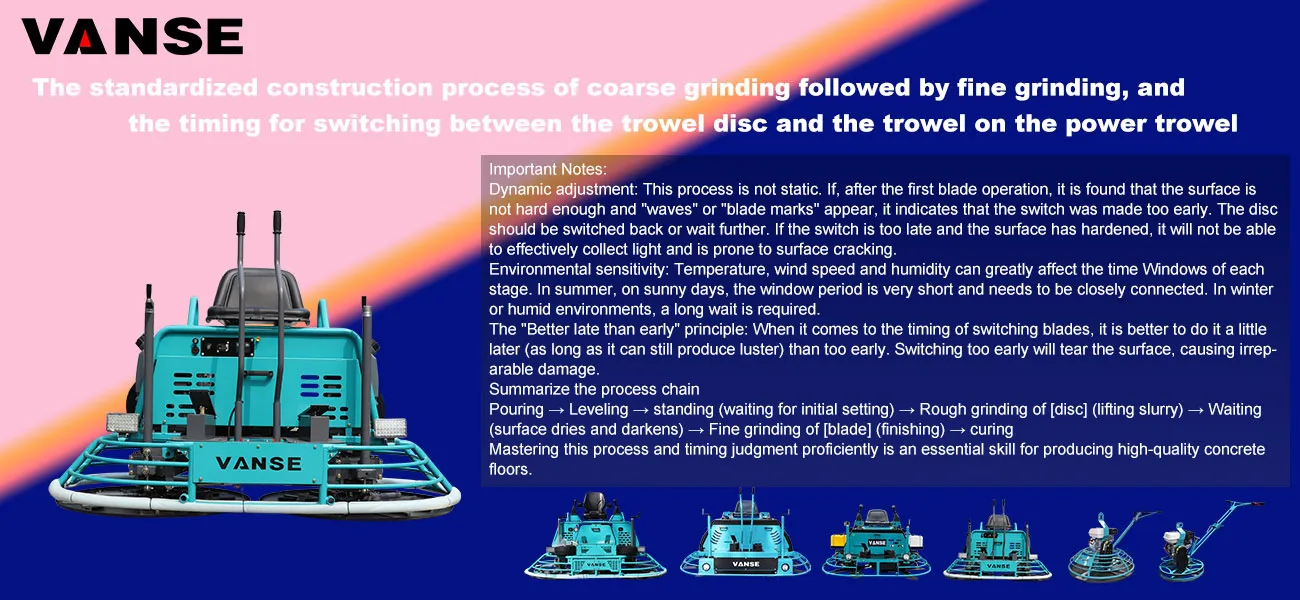
Let's take a detailed look at the standardized construction process of concrete plastering, especially the technique of "rough grinding first and then fine grinding", as well as the key switching timing between the grinding plate and the power trowel. This is the core link to ensure that the concrete floor (especially the industrial floor) achieves a dense, flat and high-strength surface.
Standardized construction process for concrete smoothing: "Rough grinding first, then fine grinding"
This process is a dynamic one that advances based on the setting state of the concrete. The entire process can be summarized into the following stages:
Phase Zero: Preparatory work and grassroots handling
Concrete pouring: Ensure that the concrete pouring is smooth and slightly higher than the designed elevation.
Vibration and leveling: Use a vibration rod to compact it tightly, and then perform an initial leveling with a long straightedge or a laser screed.
Natural settlement and bleeding: Let the concrete settle naturally and bleed out. No mechanical operations are allowed before the bleeding water has completely evaporated.
Phase One: Rough grinding – Slurry lifting and leveling (using a power trowel disc/power trowel disc)
Core objective
Slurry lifting: Bringing the slurry rich in cement and fine aggregates on the surface to the surface layer.
Preliminary leveling: Eliminate the large undulations left by the straightedge, and slightly press the aggregate down to make the large area basically flat.
Seal the pores: Compact the surface layer to lay a solid foundation for subsequent fine grinding.
Entry timing (first disc operation) :
Concrete condition: When a person stands on it, it sinks by 3 to 5 millimeters, with clear footprints but no obvious overflow of slurry water. This is the critical point of "initial condensation".
Test method: The same as the finger pressure method and scratch method mentioned above. This is the signal for the first entry of the power trowel machine.
Key points of operation
Installation disc: Ensure that the power trowel machine is equipped with a plastic or magnesium alloy power trowel disc.
Blade Angle: Adjust the power trowel blade (even if not in use) or keep the chassis parallel to the ground.
Operation mode
Start the machine and slowly cut into the concrete area at an Angle.
Operate along an overlapping route to ensure that each path overlaps with the previous one by one-third.
Maintain a slow and steady moving speed to allow the disc sufficient time to knead and lift the slurry.
When encountering uneven areas, you can appropriately increase the rotational speed or stay in the local area for a while longer.
Effect inspection: After rough grinding is completed, the surface should be a uniform and moist layer of cement slurry, without obvious exposed stones, and the large area should be smooth.
Phase Two: Fine grinding – Compaction, Polishing (using a power trowel/blade)
Core objective
Compact the surface layer: Further enhance the surface density and strength.
Final leveling and smoothing: Eliminate the fine scratches left by the disc to achieve the designed flatness and smoothness.
Surface sealing: Seal the surface capillary pores to enhance wear resistance, impermeability and dust resistance.
Entry timing (first blade operation) :
Concrete condition: This is the most crucial judgment throughout the entire process. After completing the first disc operation, it is necessary to wait for the concrete to continue hardening. When the following phenomena occur, it can be switched to blade:
Surface moisture disappearance: The previously moist and reflective surface layer has become dull and lackluster.
When people walk on it, they leave only very shallow marks or no footprints at all.
When touched by hand, there is a distinct sense of resistance (roughness), but it does not stick to the slurry.
In simple terms: When the surface of the concrete changes from "wet bright" to "dry dark" and has a certain load-bearing capacity.
Key points of operation
Switch the power trowel: Remove the disc and install the metal power trowel (blade). Make sure the blade is installed flat.
Adjust the Angle: For the final finishing, you can slightly lift the tail of the power trowel to form a small Angle (about 5°) between the front edge of the blade and the ground. This will achieve a better shearing and calendering effect.
Operation mode
Cross-operation methods (for example, one horizontal pass and one vertical pass) can be adopted to ensure flatness.
Increase the machine's rotational speed appropriately and speed up the lateral movement.
Perform multiple rounds of polishing, each lighter and faster than the previous one, with the aim of "flattening" the surface.
Final polishing: Before the concrete is about to set, a final fine polishing is carried out. At this time, the best bright effect can be achieved.
Summary of the switching timing between the grinding disc and the power trowel of a power trowel machine
For a more intuitive understanding, we can summarize the switching timing as follows:
| Component | Homework stage | Core role | Judgment of switching timing (Key signal) | Description of concrete state |
| Grinding plate/disc | Rough grinding | Slurry extraction and initial leveling | First entry: The concrete reaches initial setting. | "Wet soft and malleable" |
| Subsequent disc operation: When the surface is damaged due to operation and slurry needs to be lifted again. | • The footprint depth is 3 to 5mm | |||
| • Scratches can be maintained | ||||
| • No free bleeding | ||||
| Spatula/blade | Fine grinding | Compact and finally smooth | The first switch: After rough grinding, the moisture on the surface of the concrete evaporates and its hardness increases. | "Dry, dark, tough and astringent" |
| • The surface water luster disappears | ||||
| • The footprints are extremely shallow or non-existent | ||||
| • It feels rough when touched and is not sticky to the hand |
Important Notes:
Dynamic adjustment: This process is not static. If, after the first blade operation, it is found that the surface is not hard enough and "waves" or "blade marks" appear, it indicates that the switch was made too early. The disc should be switched back or wait further. If the switch is too late and the surface has hardened, it will not be able to effectively collect light and is prone to surface cracking.
Environmental sensitivity: Temperature, wind speed and humidity can greatly affect the time Windows of each stage. In summer, on sunny days, the window period is very short and needs to be closely connected. In winter or humid environments, a long wait is required.
The "Better late than early" principle: When it comes to the timing of switching blades, it is better to do it a little later (as long as it can still produce luster) than too early. Switching too early will tear the surface, causing irreparable damage.
Summarize the process chain
Pouring → Leveling → standing (waiting for initial setting) → Rough grinding of [disc] (lifting slurry) → Waiting (surface dries and darkens) → Fine grinding of [blade] (finishing) → curing
Mastering this process and timing judgment proficiently is an essential skill for producing high-quality concrete floors.
Note: The parameters provided in this document are for reference only and are not mandatory. Due to differences in technical characteristics between different brands and models of laser levelers, please consult the manufacturer for a suitable solution before actual operation. This reference document assumes no responsibility for any issues arising from failure to follow the manufacturer's instructions.
Thanks to All the Friends Who Support and Trust Shandong Vanse Machinery Technology Co., Ltd.
If you want to know more about Shandong Vanse Machinery Technology Co., Ltd. or have any questions, please feel free to contact us:
Our Factory
Shandong Vanse Machinery Technology Co., Ltd.








Share this article

About the Author: Shandong Vanse Machinery Technology Co., Ltd.
Shandong Vanse Machinery Technology Co., Ltd. is a high-tech manufacturer specializing in concrete construction machinery, including laser screeds and related equipment. The company integrates R&D, production, and global sales, with products exported to over 60 countries and widely used in infrastructure projects worldwide.
Previous Post
Next Post
Related Articles
You Might Also Like
Concrete Laser Leveling Machine-Basic Configuration Of Floor Equipment
The use and promotion of concrete paving and leveling machines has ended the traditional construction of using mortar to punch piers, finding elevations, laying out side formwork, dump trucks to transport concrete, manual preliminary leveling, scraping with flat plates, and vibrating concrete with vibrators. Then a special double-row steel pipe is used to vibrate and tamp and level it back and forth. So how much do you know about this device? Next, I will give you a detailed introduction to the basic configuration of the concrete paving and leveling machine equipment. Let's learn more about it together. The basic configuration of concrete paving and leveling machine equipment is introduced in detail as follows: 1. The laser leveling machine uses precision laser technology, closed-loop control technology and a highly precise integrated hydraulic system, and is realized under the automatic control of a microcomputer. This is what distinguishes it from other floor construction techniques. 2. The concrete paving and leveling machine relies on a hydraulically driven leveling mechanism and cooperates with the laser system and computer control system to complete the leveling work while automatically leveling. 3. The laser transmitter used by the concrete leveling machine to control the ground elevation is independently arranged, and the floor elevation will not produce cumulative errors. Compared with traditional methods, the construction joints on the floor can be greatly reduced, and the subsequent maintenance costs of the ground and the use of formwork are also greatly reduced. 4. The laser transmitter equipped with the concrete paving and leveling machine can automatically control both the plane and the two-way slope. It is also completed by the laser system, microcomputer system, hydraulic system, and mechanical and electronic system. For complex-shaped floors with high requirements such as drainage, a three-dimensional special-shaped ground treatment system can also be selected. 5. Using solid anti-puncture tires, paving and leveling operations can be performed directly on the steel mesh. 6. The concrete paving and leveling machine comes with a high-pressure cleaning system, which greatly facilitates the cleaning of the bonded concrete on the machine, ensures the normal use of the machine, and extends the service life of the machine. Scope of application: Laser leveling machines are developed based on the increasing demand for ground quality such as strength, flatness, and levelness in modern industrial plants, large shopping malls, warehouses, and other large-area cement concrete floors. Indoor floors: ① Modern large-scale industrial plants, workshops, and automated three-dimensional warehouses. ②. Clean factories for electronic appliances, food materials, medicine, etc. ③, Large-scale warehouse supermarkets, logistics centers, convention and exhibition centers, etc. Outdoor floors: ①, terminals, container yards, freight yards, ②, airport runways, aprons, parking lots, ③, squares, residential floors, municipal roads, etc.Concrete laser leveling machine+car type power troweling machine
For large-scale industrial plants, the quality of concrete floor construction directly affects the normal production. Therefore, the floors of industrial plants now generally require special bearing capacity, anti-slip wear resistance, and flatness. Through practical research, we found that in the construction of steel fiber concrete wear-resistant ground in industrial plants, using a wider range of concrete laser leveling/ leveling machines for leveling, coupled with driving double-disc trowels for ground finishing, can Greatly improve the construction quality and speed of the floor. The following briefly introduces the characteristics, principles, processes and benefits of the construction of the concrete laser leveling/ leveling machine + car troweling machine. ◤Construction method characteristics◥: ◆ Higher construction quality: The floor elevation can reach laser-level precision, and the ground flatness and levelness are more than three times that of traditional manual leveling operations, which can guarantee the owner's requirements for ground flatness and levelness. ◆ Faster construction speed: It can greatly shorten the construction period and improve the work efficiency by 100~300% (150~300 square meters of paving work can be completed per hour, and 1500~2500 square meters can be completed every day on average), and the manpower can be reduced by more than 30%. It is especially suitable for engineering projects that require tight construction schedules, large injection areas, and high quality requirements. ◆ Better integrity of the ground: It is very easy to achieve large-area overall paving. This paving technology can avoid the hollowing problem caused by layered pouring of the floor. On the other hand, it can reduce a large number of construction joints and make the overall floor Sex is better. ◆ The post-maintenance cost of the ground is greatly reduced: due to the large-area overall paving, the construction joints can be reduced by 3-5 times, and the construction joints are easily damaged by the load, which can greatly reduce the post-maintenance cost of the ground. ◆ Wide scope of application: Not only can it be constructed on reinforced concrete ground with single-layer or double-layer steel mesh. Among them, the light-duty laser leveling machine is suitable for all kinds of concrete floors and reinforced concrete floors with single or double-layer steel mesh, especially suitable for large-scale, high-quality ground construction. ◤Process Principle◥: ◆ Concrete laser leveling machine leveling principle: use precision laser technology, closed-loop control technology and highly precise hydraulic system to achieve leveling under the automatic control of the computer. This closed-loop control can adapt to the elevation of the concrete surface and can Automatic adjustment 6 times. ◆ Concrete laser leveling machine leveling principle: Rely on the hydraulically driven leveling head, cooperate with the laser system and computer control system to complete the leveling work while automatically leveling. The leveling head is equipped with a scraper with integrated design and a leveling beam with a vibrator, which integrates all leveling work into one body. The computer control system automatically adjusts the elevation 6 times per second in real time, and the vibration frequency of the vibrator with balanced design can reach 30005000 times per minute. ◆ Principle of driving-type troweling machine finishing: the driving-type troweling machine is equipped with a double-disk knife holder, and the hydraulic drive system provides power and torque for the two non-overlapping knife holders respectively. To achieve better results, use the joystick on the handle to control the sprinkler system, so that the dry ground can be sprinkled at any time for remediation. ◤Construction process◥: Construction preparation ➨ D ividing separation joints ➨ Processing the ground base ➨ Supporting construction formwork ➨ Setting up laser leveling system and debugging equipment ➨ Pouring concrete ➨ Leveling with concrete laser leveling machine ➨ Manual leveling after mechanical leveling ➨ Disc extraction ➨ Scattering Abrasion-resistant aggregate ➨ disk operation ➨ drive-on trowel finishing ➨ maintenance and cutting. Compared with the original concrete floor construction technology, the benefits of using the dual-machine operation of concrete laser leveling machine + driving trowel machine are: fast construction speed, low construction investment, good overall appearance of the ground, and large investment in ground construction joints and corresponding materials. reduce and so on. In the future, with the continuous improvement of construction quality requirements for building ground engineering, this construction method will be widely promoted and applied.Important considerations for long-term storage of power trowel machines
Long-term storage of power trowel machines requires thorough preparation to prevent corrosion, fluid degradation, and damage to mechanical parts. These steps are crucial to ensure the machine starts up reliably and performs optimally when you need it next. Here are the most important considerations, broken down by category: Thorough cleaning is the foundational step, as concrete and dirt residue can trap moisture and accelerate corrosion. Remove All Concrete/Debris: Use a scraper, wire brush, and/or a pressure washer to completely remove all hardened concrete, mortar, and dirt from the blades, chassis, guard rings, and around the engine/gearbox. Crucial Note: Ensure the machine is completely dry after washing to prevent immediate rust formation. Engine/Motor Cleaning: Use low-pressure air or a brush to clear dust and debris from the heat sink, cylinder block, and any cooling fins. Clean any oil stains or grease from the exterior. Inspect and Repair: Before storing, check for and replace any worn-out or damaged parts like drive belts, clutch plates, spark plugs, or air filters Fluids can degrade and cause serious damage if left in the machine for an extended period. Drain Completely: Modern gasoline, especially with ethanol, can absorb water and corrode the fuel lines and carburetor. Completely drain all fuel from the tank. Run Until Stop: Set the fuel switch to "Off," start the engine, and let it run until it stops naturally. This clears residual fuel from the carburetor/fuel lines. Change Oil: Drain the old engine oil (ideally when the engine is warm) and replace it with new oil. New oil contains better anti-corrosion properties and lacks acidic contaminants from use. Internal Rust Prevention: For extreme long-term storage, remove the spark plug, drip a small amount of new engine oil (about one tablespoon) into the cylinder, and manually pull the starter rope a few times to coat the cylinder wall. Reinstall the spark plug. Hydraulic Systems (Ride-On Trowels): Check the hydraulic fluid quality and level. If replacing the fluid, circulate it briefly. Ensure all piston rods of the hydraulic cylinders are fully retracted to protect the chrome surface from exposure and rust. Protecting exposed metal and moving components is vital to prevent seizing. Trowel Blades: Remove the blades, clean them, and apply a layer of heavy grease or a dedicated anti-rust oil (like WD-40 or a specialized coating) to all metal surfaces. Consider wrapping them in oiled paper and storing them separately. Exposed Metal Surfaces: Spray a thin layer of anti-rust agent or a rust-preventative spray on all exposed metal surfaces, including the chassis, guard rings, and any areas where paint has been scratched off. Lubrication: Apply grease or oil to all designated lubrication points, including: Gearbox gears (if applicable) Clutch forks Height and tilt adjustment screws and their threaded parts If the machine has an electric start or motor, special attention is needed. Air Filter: Remove the air filter element for cleaning or replacement. Seal the air inlet with a clean cloth or plug to prevent dust and pests from entering the engine. Disassemble and Charge: Disconnect and remove the battery. Fully charge it. Store Separately: Store the battery in a cool, dry place off the concrete floor. Maintenance Charge: Recharge the battery periodically (e.g., once every 1-2 months) to maintain its charge and lifespan, or use a "smart" maintenance charger. The physical location where the machine is stored is the final defense against damage. Indoor and Dry: Store the power trowel indoors in a clean, dry, and well-ventilated area. Avoid storage outdoors or in areas with high humidity or extreme temperature fluctuations, which can cause condensation and rust. Off the Ground: Place the machine on a flat wooden pad, pallet, or trolley to lift it off the concrete floor, which can draw moisture. Protection: Cover the machine with a breathable, waterproof tarp or a specialized equipment cover. Avoid using plastic sheeting, as it can trap moisture and encourage rust or mildew. Pest Control: Ensure the storage area is free of rodents, as they can chew on wiring, hoses, and filters. Would you like the specific steps for winterizing the engine, as that is the most common form of long-term storage? Note: The parameters provided in this document are for reference only and are not mandatory. Due to differences in technical characteristics between different brands and models of laser levelers, please consult the manufacturer for a suitable solution before actual operation. This reference document assumes no responsibility for any issues arising from failure to follow the manufacturer's instructions.