Technical Knowledge
What Kind Of Consumables Do Concrete Laser Leveling Need?
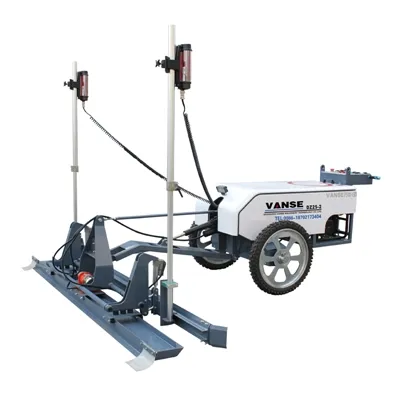
Concrete laser leveling machine is a kind of equipment used in concrete construction. Its function is to achieve flatness and smoothness of the concrete surface. In the process of using the concrete laser leveling machine, some consumables are needed to ensure the normal operation and construction effect of the equipment.
Here are some supplies you may need for your concrete laser leveling:
1. Laser:
One of the main components of the concrete laser leveling machine is the laser, which is used to emit laser beams to control the flatness and height of the concrete surface. Therefore, the quality and performance of the laser have an important impact on the effectiveness and service life of the leveler.
2. Laser head:
The laser head is the key component of the laser. It is responsible for focusing and projecting the laser beam onto the concrete surface. The quality and performance of the laser head will also affect the effectiveness and service life of the leveler.
3. Mixer:
Concrete laser leveling machines are usually equipped with a mixer, which is used to mix the concrete evenly to ensure the construction effect. The quality and performance of the agitator also affects the effectiveness and service life of the leveler.
4. Filter element:
The concrete laser leveling machine will inhale a large amount of dust and debris during operation, so a filter element is needed to filter the air to ensure the normal operation of the equipment and construction results.
5. Lubricant:
The concrete laser leveling needs regular lubrication to reduce wear and failure. Therefore, lubricating oil is needed to lubricate various parts of the equipment.
6. Cleaning agent:
During the operation of the concrete laser leveling machine, it will be affected by dust, debris and other dirt, so cleaning agents need to be used to clean the equipment. In addition, the concrete laser leveling machine also needs some other accessories and tools to clean the equipment. Auxiliary construction, such as scrapers, trowels, measuring rulers, etc. The quality and performance of these accessories and tools will also affect the effectiveness and service life of the leveler
In short,
the consumables of the concrete laser leveling need to be determined according to the specific model and usage of the equipment. When choosing consumables, you need to choose brands and models with reliable quality and stable performance to ensure the normal operation of the equipment and construction results. At the same time, it is also necessary to regularly inspect and maintain the equipment, promptly replace damaged parts and replenish consumables to ensure the long-term stable operation and service life of the equipment.
Thanks to All the Friends Who Support and Trust Shandong Vanse Machinery Technology Co., Ltd.
If you want to know more about Shandong Vanse Machinery Technology Co., Ltd. or have any questions, please feel free to contact us:
Our Factory
Shandong Vanse Machinery Technology Co., Ltd.








Share this article

About the Author: Shandong Vanse Machinery Technology Co., Ltd.
Shandong Vanse Machinery Technology Co., Ltd. is a high-tech manufacturer specializing in concrete construction machinery, including laser screeds and related equipment. The company integrates R&D, production, and global sales, with products exported to over 60 countries and widely used in infrastructure projects worldwide.
Previous Post
Next Post
Related Articles
You Might Also Like
Concrete laser leveling machine market situation and development trends
1. Market Overview The concrete laser leveling machine market is in a stage of rapid development. With the prosperity of infrastructure construction and the real estate market, the requirements for concrete construction quality are getting higher and higher. As an efficient and high-precision construction equipment market, the concrete laser leveling machine market Demand continues to grow. 2. Competitive Landscape At present, the concrete laser leveling machine market is showing fierce competition among domestic and foreign brands. Domestic brands have advantages in price and service, while foreign brands have advantages in technology and brand influence. In the future, with the continuous advancement of technology and the gradual maturity of the market, competition will become more intense. 3. Product innovation In order to meet the changing market demand, manufacturers of compacted soil laser leveling machines continue to innovate products. In the future, product innovation will continue to be an important driving force for market development. The main directions include improving leveling accuracy, increasing automation, and optimizing the human-machine interface. 4. User needs Users' demands for concrete laser leveling machines are increasingly diversified. They not only pay attention to the leveling effect and efficiency of the equipment, but also pay attention to the reliability, ease of use and after-sales service of the equipment. Manufacturers should actively understand user needs, strengthen communication with users, and continuously optimize products and services. 5. Technological progress With the continuous development of laser technology and computer technology, the technical level of concrete laser leveling machines continues to improve. In the future, technological progress will continue to drive market development, including improving equipment accuracy, increasing equipment functions, and reducing energy consumption. 6. Policy Impact The government's emphasis on infrastructure construction and environmental protection continues to increase, and the introduction of relevant policies will have an impact on the concrete laser leveling machine market. Manufacturers should pay attention to policy trends, strengthen communication and cooperation with the government, and seize market opportunities. 7. Future Outlook In the future, the concrete laser leveling machine market will continue to maintain steady growth. With the intensification of market competition and technological advancement, the market will gradually mature. Manufacturers should increase investment in R&D to improve product competitiveness, while focusing on environmental protection and energy-saving design to meet market demand and policy requirements. 8. Industry Challenges The concrete laser leveling machine industry faces some challenges, such as technical bottlenecks, high costs, and talent shortages. Manufacturers should actively respond to challenges, strengthen technology research and development and talent training, and improve production efficiency and service quality. At the same time, the industry should strengthen cooperation and exchanges to jointly promote industry development. 9. International Market With the continuous development of global infrastructure construction and the strengthening of technical exchanges, the demand for concrete laser leveling machines in the international market is also growing. Domestic manufacturers should actively explore international markets and increase brand awareness and influence. In the international market, attention should be paid to local market demands and policy environments, and cooperation and communication with local customers should be strengthened. At the same time, it is also necessary to strengthen the internationalization and localization design of products to better adapt to the market needs of different countries and regions.Which components of the concrete laser leveling are most prone to damage and need to be stocked in advance?
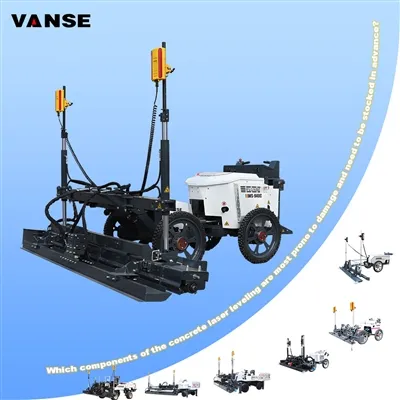
As a high-precision and high-strength construction equipment, the wear and damage of the components of the concrete laser leveling machine are inevitable. To minimize downtime and ensure construction progress, it is a very wise move to stock up on key vulnerable components in advance. Based on the structure and working principle of the equipment, the following components are the most prone to damage. It is recommended that you stock up in advance according to the construction intensity and project conditions These are the "legs and feet" of the leveling, which have the highest working intensity and come into direct contact with the concrete, making them the most prone to wear and tear. The reason is that it directly rubs against and flattens the concrete aggregates, making it the component that wears out the fastest. It is usually made of wear-resistant steel plates, but after long-term use, it will inevitably wear out and become thinner, losing its smooth effect. Suggestion: This is a component that must be stocked in stock, and 2-3 sets of spare parts with different degrees of wear and tear should be prepared according to the scale of the project. The reason is that walking on unsolidified concrete makes it easy to be scratched or punctured by sharp aggregates such as stones and steel bar ends. Although most of them are solid tires, the rubber itself can also wear out. It is highly recommended to have a complete set of tire assemblies for the entire vehicle (usually four), especially for construction sites with complex ground environments and exposed steel bars. Reason: The load is heavy when driving the entire machine to move. Although it is not prone to damage itself, the internal drive gears, bearings, seals and other components are vulnerable points. Especially when the sealing parts age and cause oil leakage, it will accelerate internal wear. Suggestion: It is advisable to prepare a set of reducer assembly as a core backup, or at least a set of drive gear and seal maintenance kits for quick repair. This is the "blood circulation system" of the leveling machine. Faults often lead to the paralysis of the entire machine. The reason is that there are a large number of seals at all parts of the hydraulic system (cylinders, motors, valve block interfaces). Due to long-term operation under high pressure and high temperature, rubber will age and wear out, leading to oil leakage, which is the most common hydraulic failure. Suggestion: Purchase a set of maintenance kits for the entire machine's sealing parts. It is not expensive, but it can quickly solve the problem when oil leakage occurs, making it the spare part with the best cost performance. The reason is that the cleanliness of the hydraulic oil is directly related to the lifespan of the entire hydraulic system. Regular replacement of the filter element is a necessary maintenance item. If the filter element is clogged or fails, it will cause severe wear of core components such as hydraulic pumps and motors. Suggestion: According to the equipment maintenance manual, always keep at least one set (such as return oil filter elements, suction oil filter elements, etc.) on hand. The reason is that the drive shaft connecting the engine (or hydraulic motor) and the hydraulic pump operates under high torque. If it is poorly lubricated or subjected to shock, the universal joint bearing is prone to damage. Suggestion: Prepare a complete drive shaft assembly or at least a universal joint maintenance kit. This is the "eyes and brain" of the leveling, where the precision lies and requires careful protection. Reason: Although it is an electronic component itself, the construction site environment is harsh and it may be damaged due to collision or splashing concrete. It is the key to ensuring flatness.Suggestion: This is a core electronic component that is strongly recommended as a backup. Once damaged, the entire machine will not be able to level itself automatically. Reason: As a precision optical instrument, it is vulnerable to dropping, shock and dust. Although it is more durable than the receiver, once a problem occurs, it will affect the entire working area.Suggestion: If the project is of great significance and the schedule is tight, it is advisable to consider having one as a backup. For construction sites where multiple leveling machines work in coordination, having a spare transmitter is a standard operation. The reason is that there are a large number of seals at all parts of the hydraulic system (cylinders, motors, valve block interfaces). Due to long-term operation under high pressure and high temperature, rubber will age and wear out, leading to oil leakage, which is the most common hydraulic failure. Suggestion: Purchase a set of maintenance kits for the entire machine's sealing parts. It is not expensive, but it can quickly solve the problem when oil leakage occurs, making it the spare part with the best cost performance. The reason is that the cleanliness of the hydraulic oil is directly related to the lifespan of the entire hydraulic system. Regular replacement of the filter element is a necessary maintenance item. If the filter element is clogged or fails, it will cause severe wear of core components such as hydraulic pumps and motors. Suggestion: According to the equipment maintenance manual, always keep at least one set (such as return oil filter elements, suction oil filter elements, etc.) on hand. The reason is that the drive shaft connecting the engine (or hydraulic motor) and the hydraulic pump operates under high torque. If it is poorly lubricated or subjected to shock, the universal joint bearing is prone to damage. Suggestion: Prepare a complete drive shaft assembly or at least a universal joint maintenance kit. Priority Component name Stock preparation suggestions ★★★★★ (Highest) Scraper bottom plate It is necessary to stock up. Prepare 2 to 3 sets according to the project volume Hydraulic seal kit It offers the best cost performance and must be stocked Walking tire It is strongly recommended to prepare a complete set ★★★★ (High) Laser receiver It is recommended to have one core electronic component Hydraulic filter element Essential maintenance items should be stocked according to the maintenance cycle Reducer gears/seals It is determined based on the historical failure conditions of the equipment ★★★ (Middle) Universal joint for drive shaft Maintenance kits or assemblies are available Vibrating rod/bearing It is determined by the frequency of equipment usage Laser emitter Large or key projects are recommended as backups ★★ (Low) Battery It depends on the condition of the old battery Here's a tip for you finally: When purchasing equipment, one should ask the manufacturer or supplier for a recommended list of vulnerable parts and understand the expected service life of these components. At the same time, establish maintenance files for your own equipment, recording the replacement times of each component. Only in this way can you carry out predictive stocking more scientifically, ensuring that your equipment is always in the best condition and creating the greatest value for the project. Note: The parameters provided in this document are for reference only and are not mandatory. Due to differences in technical characteristics between different brands and models of laser levelers, please consult the manufacturer for a suitable solution before actual operation. This reference document assumes no responsibility for any issues arising from failure to follow the manufacturer's instructions.Safety tips for ride-on power trowels in tight indoor spaces
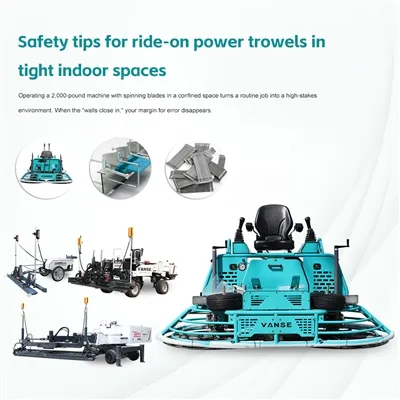
Operating a 2,000-pound machine with spinning blades in a confined space turns a routine job into a high-stakes environment. When the "walls close in," your margin for error disappears. Here is the safety protocol for maneuvering ride-on trowels in tight indoor quarters. This is the #1 danger for indoor ride-on use. Standard gas or diesel engines produce Carbon Monoxide (CO), which can reach lethal levels in minutes in a closed room. Active Ventilation: Do not rely on "open doors." You need high-volume axial fans (blowers) to create a "push-pull" airflow system. CO Monitors: The operator must wear a personal CO monitor clip. If it beeps, the site is evacuated immediately. Catalytic Converters: Ensure your machine is fitted with a "scrubber" (catalytic muffler) to reduce emissions, or better yet, use Propane-powered or Electric trowels for indoor work. In tight spaces, the machine's "tail swing" is your biggest enemy. No-Go Zones: Establish a rule that no ground crew (manual finishers) can be within 10 feet of the machine when it is near a wall or pillar. Pillar Strategy: When circling columns, always keep the machine moving in a direction where the operator has a clear line of sight to the gap between the machine and the obstruction. Avoid "Backing Into" Corners: Always try to nose into tight corners so you have the best visibility to back out into the open. If a spinning blade hits a protruding pipe, drain, or a structural steel column, the machine can jerk or spin violently. Mark Obstructions: Use bright spray paint or "flags" on any floor penetrations (pipes/conduit) that are shorter than the operator's seated eye level. Low Speed Near Edges: Reduce RPM when working within 2 feet of a wall. This gives you more reaction time if the machine "catches" an edge. Indoor spaces often have poor airflow for flammable vapors. Cool Down Before Fueling: Never refuel a hot engine inside. The "flash point" of spilled gas on a hot manifold in a room with no wind is a recipe for a fireball. Spill Kits: Keep a spill kit nearby. A hydraulic hose burst on fresh concrete is a slip hazard and a nightmare to clean. Danger Preventive Action CO Poisoning Use CO monitors + High-velocity fans Wall Impact Maintain "Slow-Zone" within 3ft of walls Tip-Over Watch for floor "drop-offs" or open elevator shafts Communication Use hand signals (it's too loud for shouting) Lighting Ensure 2,000+ lumens of temporary work lighting Before starting, test the kill switch. In a tight space, if you lose control or the throttle sticks, you have a fraction of a second to shut down before hitting a structural wall. If the seat-activated safety switch is bypassed or broken, do not operate the machine. Would you like me to look up the OSHA (or local) requirements for CFM airflow based on the square footage of your indoor project? Contact us NOW Note: The parameters provided in this document are for reference only and are not mandatory. Due to differences in technical characteristics between different brands and models of laser levelers, please consult the manufacturer for a suitable solution before actual operation. This reference document assumes no responsibility for any issues arising from failure to follow the manufacturer's instructions.