Technical Knowledge
How to avoid concrete splashing when operating a concrete laser leveling?

When operating a concrete laser leveling, avoiding concrete splashing is an important safety measure to ensure the safety of workers and the efficient operation of the equipment. Here are specific methods and suggestions for avoiding concrete splashing when operating a concrete laser leveling:
1. Suitable concrete mix ratio and consistency
The mix and consistency of concrete play a key role in avoiding concrete splashing. Operators should work closely with the concrete supplier to ensure that the concrete mix and consistency are suitable for the laser leveling's operating requirements. Proper consistency reduces the fluidity of the concrete during the leveling process, thereby reducing the potential for splashing.
2. Control pouring speed and distribution uniformity
When pouring concrete, operators should control the pouring speed to avoid being too fast or too slow. Too fast a pouring rate can cause concrete to spatter during the leveling process. At the same time, the fabric should be even to avoid accumulation or shortage. Operators can achieve uniform distribution by adjusting the speed of the conveying equipment and the distribution method.
3. Reasonably adjust the operating parameters of the laser leveler
The operating parameters of the laser leveling also have an important impact on concrete spatter. The operator should reasonably adjust the scraper height, vibration frequency, driving speed and other parameters of the leveler according to the consistency of the concrete and the working environment. With proper adjustment, the vibration and impact of the concrete during leveling can be reduced, thereby reducing the possibility of splashing.
4. Maintain appropriate working distance and angle
When operating the laser leveler, the operator should maintain an appropriate working distance and angle. Too close a distance or too steep an angle can cause concrete to spatter during the leveling process. The operator should reasonably adjust the working distance and angle according to the consistency of the concrete and the performance of the leveling to ensure that the leveling can operate smoothly and evenly.
5. Regular inspection and maintenance of equipment
Proper operation of equipment is critical to avoid concrete splashing. Operators should regularly inspect and maintain the laser leveling machine to ensure that all parts of the equipment are in good working order. Particularly easy-to-wear parts such as flat plates, vibrators and tracks should be replaced or repaired in time to maintain the normal operation and leveling effect of the equipment.
6. Improve operational skills and safety awareness
Operator skill and safety awareness are equally important to avoid concrete splash. Operators should receive professional training and education to improve their operating skills and safety awareness. During the operation, operators should concentrate, abide by operating procedures and safety requirements, and avoid blind operations or illegal operations.
7. Take necessary protective measures
When operating a laser leveling, operators can take some necessary protective measures to reduce the risk of concrete splashing. For example, wear personal protective equipment such as protective glasses, masks, and gloves to reduce damage to the body from splashes. In addition, baffles or fences can be set up around the work area to prevent splashes from spreading to the surrounding environment.
8. Pay attention to the working environment and weather conditions
The working environment and weather conditions will also have an impact on concrete splashing. Operators should pay close attention to changes in the working environment and avoid working under unfavorable conditions such as high temperature, strong winds or moisture. Under high temperature conditions, concrete is prone to drying and hardening, which may Increased risk of splashing; in windy conditions, the wind may blow the concrete surface, causing splashing; in wet conditions, the concrete surface may slide, causing the leveling to become unstable, thereby increasing the possibility of splashing.
9. Clean and maintain the work area in a timely manner
Cleaning and maintenance of the working area is equally important to avoid concrete splashing. Before operation, the operator should clean up debris and accumulated water in the working area to ensure that the working surface is flat and dry. After the operation is completed, the concrete surface should be maintained in time. and protection from surface cracking or breakage. Maintenance measures can include watering, covering with moisturizing materials, etc. to keep the concrete surface moist and stable.
Summarize:
Avoiding concrete splash is an important task when operating a concrete laser leveling. By controlling the mix ratio and consistency of concrete, adjusting the pouring speed and distribution uniformity, reasonably adjusting the operating parameters of the laser leveling, maintaining appropriate operating distances and angles, regularly inspecting and maintaining equipment, improving operating skills and safety awareness, and taking necessary measures Protective measures, paying attention to the working environment and weather conditions, and timely cleaning and maintenance of the working area can effectively reduce the risk of concrete splashing. Operators should comprehensively consider these factors and ensure that safety regulations and operating procedures are strictly followed during operation to ensure safe and efficient operations. At the same time, continuous learning and summarizing experience, improving operating skills and safety awareness are also the keys to avoiding concrete splashing.
Thanks to All the Friends Who Support and Trust Shandong Vanse Machinery Technology Co., Ltd.
If you want to know more about Shandong Vanse Machinery Technology Co., Ltd. or have any questions, please feel free to contact us:
Our Factory
Shandong Vanse Machinery Technology Co., Ltd.








Share this article

About the Author: Shandong Vanse Machinery Technology Co., Ltd.
Shandong Vanse Machinery Technology Co., Ltd. is a high-tech manufacturer specializing in concrete construction machinery, including laser screeds and related equipment. The company integrates R&D, production, and global sales, with products exported to over 60 countries and widely used in infrastructure projects worldwide.
Previous Post
Next Post
Related Articles
You Might Also Like
Safety measures in concrete floor construction
Safety measures in concrete floor construction Concrete floor construction is a complex project involving many links, among which safety issues are particularly critical. From safety preparation before construction to management of the construction site, to the operation of mechanical equipment, personal protection and equipment, high-altitude operations and protection, electrical safety and fire prevention, as well as emergency handling and rescue, each link is directly related to the life safety of construction personnel and the smooth progress of the project. Therefore, this article will focus on these aspects and discuss in detail the safety measures in concrete floor construction: 1. Safety preparation before construction Safety preparation before construction is the basis for ensuring the smooth progress of concrete floor construction. First of all, the construction unit should formulate a detailed safety construction plan, clarify the safety construction goals, responsible persons and safety measures, and conduct safety technical briefings for construction personnel so that they can fully understand the safety risks and countermeasures that may be encountered during construction. Secondly, a comprehensive inspection should be carried out on the construction site to eliminate safety hazards, such as checking whether the construction power lines are intact and whether the mechanical equipment is operating normally. At the same time, according to the needs of the construction, the construction area should be reasonably arranged, and obvious safety warning signs should be set up to ensure that construction personnel can clearly identify dangerous areas. 2. Construction site management Construction site management is an important link to ensure the safety of concrete floor construction. The construction unit should establish a sound construction site management system and clarify various safety management regulations, such as prohibiting smoking at the construction site and prohibiting the random discarding of construction waste. At the same time, a dedicated person should be set up to be responsible for on-site safety management, regularly inspect the construction site, and promptly correct violations. In addition, the construction site should be kept clean and orderly, and construction materials and equipment should be stored in categories to avoid confusion and misoperation. 3. Safety of mechanical equipment operation Concrete floor construction involves a large number of mechanical equipment, such as mixers, rollers, pumping equipment, etc. In order to ensure the safety of mechanical equipment operation, first of all, it should be ensured that the operator has the corresponding operating qualifications and skills, and is familiar with the working principle and operating procedures of mechanical equipment. Secondly, mechanical equipment should be regularly maintained to ensure that it is in good working condition. At the same time, when operating mechanical equipment, it should be strictly carried out in accordance with the operating procedures, and overload operation or illegal operation is prohibited. 4. Personal protection and equipment Construction workers in concrete floor construction need to wear appropriate personal protective equipment to reduce the risk of injury. First of all, construction workers should wear basic protective equipment such as safety helmets, safety shoes and protective glasses. To deal with possible injuries such as falling objects and splashes. Secondly, depending on the construction environment, construction workers should also wear specific protective equipment such as dustproof mouthpieces and anti-noise earplugs to deal with occupational hazards such as dust and noise. In addition, construction units should regularly check and replace personal protective equipment to ensure that it is always in an effective state. 5. High-altitude work and protection In the construction of concrete floors, high-altitude work is inevitable. In order to ensure the safety of high-altitude work, construction units should set up special safety nets, safety fibers and other protective facilities to prevent construction workers from falling and causing accidents. At the same time, construction workers should wear safety belts when working at heights, and ensure that the connection between the safety belts and the fixed points is firm and reliable. In addition, construction units should also regularly inspect the high-altitude work areas to eliminate potential safety hazards in a timely manner. 6. Electrical safety and fire prevention Electrical safety and fire prevention are safety issues that require special attention in the construction of concrete floors. Construction units should strictly abide by the relevant national regulations on electrical safety and fire prevention to ensure that the electrical equipment and lines at the construction site are safe and reliable. At the same time, the construction site should be equipped with a sufficient number of fire-fighting equipment and facilities, such as fire extinguishers, fire hydrants, etc., to deal with possible fire accidents. In addition, construction workers should master basic firefighting knowledge and skills, and be able to quickly take effective countermeasures when a fire occurs. 7. Emergency handling and rescue Although we can take various preventive measures to reduce the safety risks in concrete floor construction, accidents may still occur. Therefore, it is crucial to establish a sound emergency handling and rescue mechanism. The construction unit should formulate a detailed emergency plan to clarify the response measures and rescue procedures for various accidents. At the same time, emergency drills should be organized regularly to improve the emergency handling capabilities and rescue skills of construction personnel. In the event of an accident, the construction unit should immediately activate the emergency plan and quickly organize rescue forces to deal with it, minimizing the losses caused by the accident. In summary, safety measures in concrete floor construction involve many aspects, which require the joint efforts of construction units and construction personnel. By strengthening pre-construction safety preparation, construction site management, mechanical equipment operation safety, personal protection and equipment, high-altitude operations and protection, electrical safety and fire prevention, and emergency handling and rescue, we can effectively reduce the safety risks in concrete floor construction and ensure the life safety of construction personnel and the smooth progress of the project. At the same time, construction units and construction personnel should continue to learn new knowledge and master new technologies to adapt to the ever-changing safety needs and challenges in concrete floor construction.Tell you how effective the concrete laser leveling machine is!
Tell you how effective the concrete laser leveling machine is! Many consumers are still hesitating whether they should buy a concrete laser leveling machine, because they have no concept of the construction effect of the equipment. Today we will introduce the use effect of the equipment. First of all, the biggest feature of this equipment is that it is fast, and the time-consuming is 1/10 of manual work, which is enough to make many construction teams excited; secondly, it is flat, and the ground level error after paving is small , is almost negligible. 1. Requirements for concrete and formwork ① Concrete: Concrete must be produced, conveyed or pumped to the flooring site by a commercial concrete production plant. ② Concrete specifications: C25~C30 concrete, the strength of which is not less than 25MPa in 28 days, according to the design requirements. ③ Water-cement ratio: N o more than 0.5, no water can be added during the feeding process. ④ Cement: Use ordinary Portland cement with a grade of not less than 42.5. ⑤ Aggregate: Well-graded aggregate should be used. Crushed granite or pebbles are used as coarse aggregate, and the maximum diameter is not more than 25mm. The fine aggregate is clean river sand with a fineness modulus of 2.4-2.7. ⑥ Concrete mix ratio: The amount of cement is not less than 350Kg/m3. In order to avoid surface quality problems, the sand rate should be controlled at 35% to 40%. ⑦ Concrete slump: 14±2cm, maximum 16cm. ⑧ Setting time: The initial setting time should be controlled within 3-5 hours. In order to avoid the excessive deviation of the surface elevation affecting the joints, the formwork should be steel formwork. The height of the formwork should be controlled within +0 and -2mm, and the steel formwork should be within 1-1.2 meters from the surrounding walls. 2. Construction cooperation requirements ① The concrete feeding speed should be determined according to the ground thickness and pouring area to determine the minimum hourly feeding speed. For a floor with a thickness of 200 mm, if the width of one-time pouring reaches 40 meters, the minimum feeding speed should reach 40 cubic meters per hour, otherwise there will be cold joint problems, which will affect the quality of ground construction. ② Manually coordinate the concrete sent to the platform, and workers need to remove it as soon as possible and roughly level it. In addition, the areas around the formwork, walls, columns, trenches, equipment foundations, floor drains or around pipelines that cannot be leveled require manual cooperation for local leveling. Generally, 3-4 workers are required to cooperate with the construction (provided by Party A). ③ Other precautions In order to ensure the flatness of the ground, attention should be paid to: 1) The slump of concrete sent to the platform must be consistent each time. 2) Ensure that the concrete feeding speed reaches 40 cubic meters per hour or above, and the initial setting time of each batch of concrete must be consistent. 3) Ensure that the formwork elevation is accurate and cannot be disturbed during construction. 4) Environmental cooperation. The concrete floor that has just been constructed cannot be exposed to sunlight, wind, rain, etc. that are unfavorable to concrete health. ④ Other requirements: A. In order to avoid random cracks in the floor, the cutting time of shrinkage joints should be carried out as early as possible (within 24 hours). B. At the same time as the construction of the laser leveling machine, there should be no electric welding machines on site, and no reflective objects (such as glass windows). C. The foundation must reach a certain hardness to ensure that the laser leveling machine does not collapse when working on the ground. D. The height of the ground in the factory building shall be calibrated by Party A, and the points must be evenly distributed, and there must be no error in the levelness. E. Pouring concrete must be operated according to the requirements of Party B's technicians.When using the gasoline power trowel, what types of blades should be selected based on the different hardness levels of the concrete?
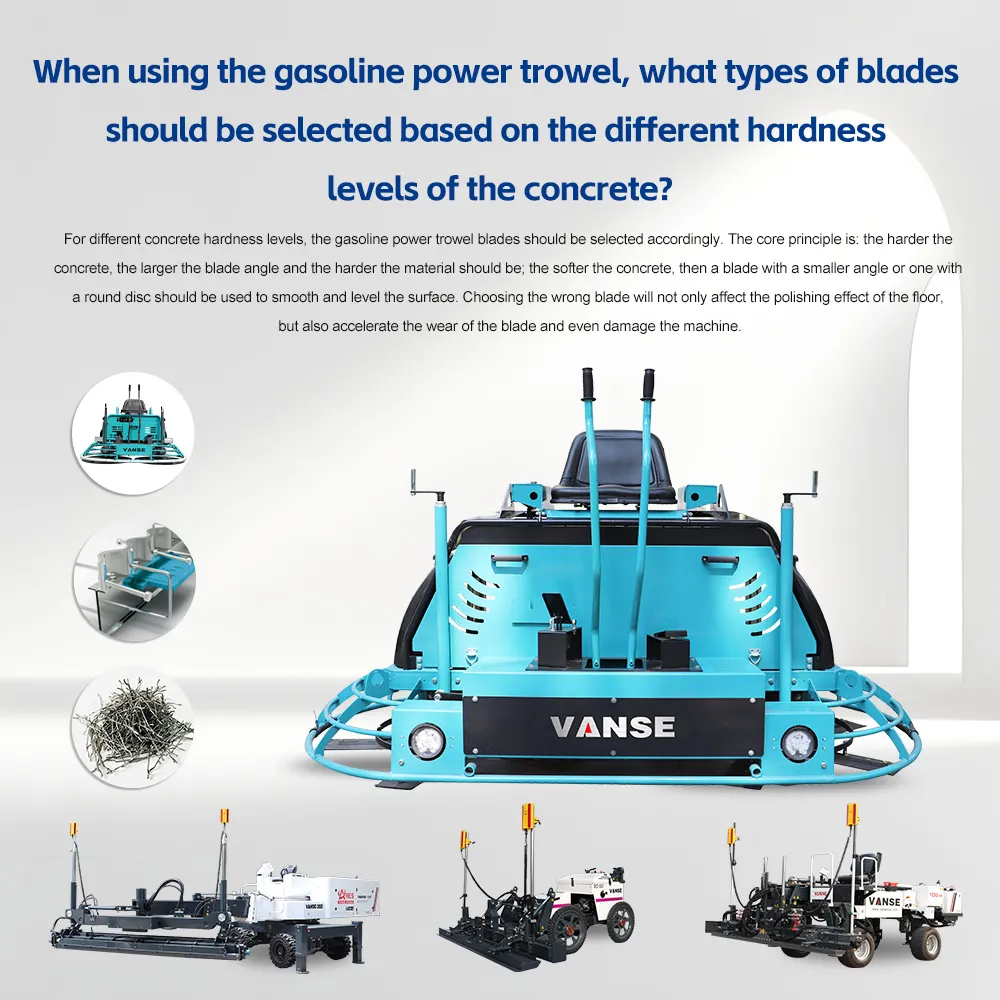
For different concrete hardness levels, the gasoline power trowel blades should be selected accordingly. The core principle is: the harder the concrete, the larger the blade angle and the harder the material should be; the softer the concrete, then a blade with a smaller angle or one with a round disc should be used to smooth and level the surface. Choosing the wrong blade will not only affect the polishing effect of the floor, but also accelerate the wear of the blade and even damage the machine. According to the hardening process of concrete from initial setting to final setting, it is generally divided into three stages, and different types of blades need to be selected for each stage: Construction stage Concrete hardness state Recommended blade types Key parameters/materials Functions and Effects First stage: Mixing and leveling Immediately after pouring, the concrete is soft and has high fluidity. Disc-shaped polishing blade (requires installing the disc onto the blade) The diameter of the disc is usually greater than the length of the blade. Compaction, levelling and initial leveling. The disc can prevent the blade from cutting too deeply, lift the surface slurry and provide an initial levelness for the ground. Second stage: Smoothing After the concrete begins to set, the surface starts to harden. When stepping on it, there are slight footprints (about 1-3mm deep). Regular polishing blade Material: 65 manganese steel or high manganese steel; thickness: approximately 2mm; blade size: common lengths such as 345mm, 355mm, etc. Level the ground and remove the disc marks. At this point, the disc should be removed and the blade used for the operation. The blade angle should be adjusted to be smaller (about 0 – 10 degrees), mainly for leveling purposes. Third stage: Finishing Before the concrete fully sets, the surface becomes hard. When stepping on it, there are almost no footprints. Fine-tuning/finishing blade Alloy steel with a harder material and a smoother surface; or used old blades (because the edges have been smoothed out more smoothly). Make the ground smooth, wear-resistant and dense. The blade angle should be increased (about 10 – 15 degrees) to increase the pressure on the ground and repeatedly press to create a smooth surface. The material of the blade determines its lifespan: The search results repeatedly mention that high-quality blades are usually made of 46# high manganese steel or 65 manganese steel, with a thickness of approximately 2mm. This material combines hardness and toughness, being able to withstand intense friction with concrete while also being less prone to breaking. Poor-quality blades, on the other hand, are prone to uneven polishing due to insufficient strength. The blade angle can be adjusted: The tilt angle of the blade on an gasoline power trowel is usually adjustable between 0 and 15 degrees. The greater the angle, the deeper the blade cuts into the concrete, exerting greater pressure on the ground, and is suitable for the harder polishing stage; the smaller the angle, the softer it is, and is suitable for the initial smoothing stage. This is a key mechanical parameter for controlling the polishing effect. Replace worn-out blades in time: When the blade wears down to 30mm on one side, it can be considered to switch to the other side to achieve the effect of two blades. If the wear is severe and causes imbalance, a new blade must be replaced; otherwise, it will cause the machine to shake and affect the flatness of the ground. Soft ground requires hard tools, while hard ground needs soft tools is a misconception: Please remember, the softer the concrete, the more you should use round discs or small-angle blades (to avoid cutting); the harder the concrete, the more you should use large-angle sharp blades (to increase friction). Combination of new and old blades: Experienced workers will keep a pair of worn-out but still suitable old blades specifically for the final polishing process, because their edges are smoother and rounder, and are less likely to leave marks. Safety and maintenance: When replacing blades or cleaning residual concrete, make sure the machine has been turned off and the blades have completely stopped rotating. After each use, clean the cement slurry on the blades promptly and apply grease for rust prevention. I hope this guide can help you choose the right blades at different construction stages. If you can tell me approximately which stage of hardening your current concrete is in, or if you encounter specific ground effect problems (such as knife marks, lack of shine), I can help you further analyze and adjust the plan. Contact us NOW Note: The parameters provided in this document are for reference only and are not mandatory. Due to differences in technical characteristics between different brands and models of laser levelers, please consult the manufacturer for a suitable solution before actual operation. This reference document assumes no responsibility for any issues arising from failure to follow the manufacturer's instructions.