Technical Knowledge
What are the common specifications and sizes of concrete power trowels?
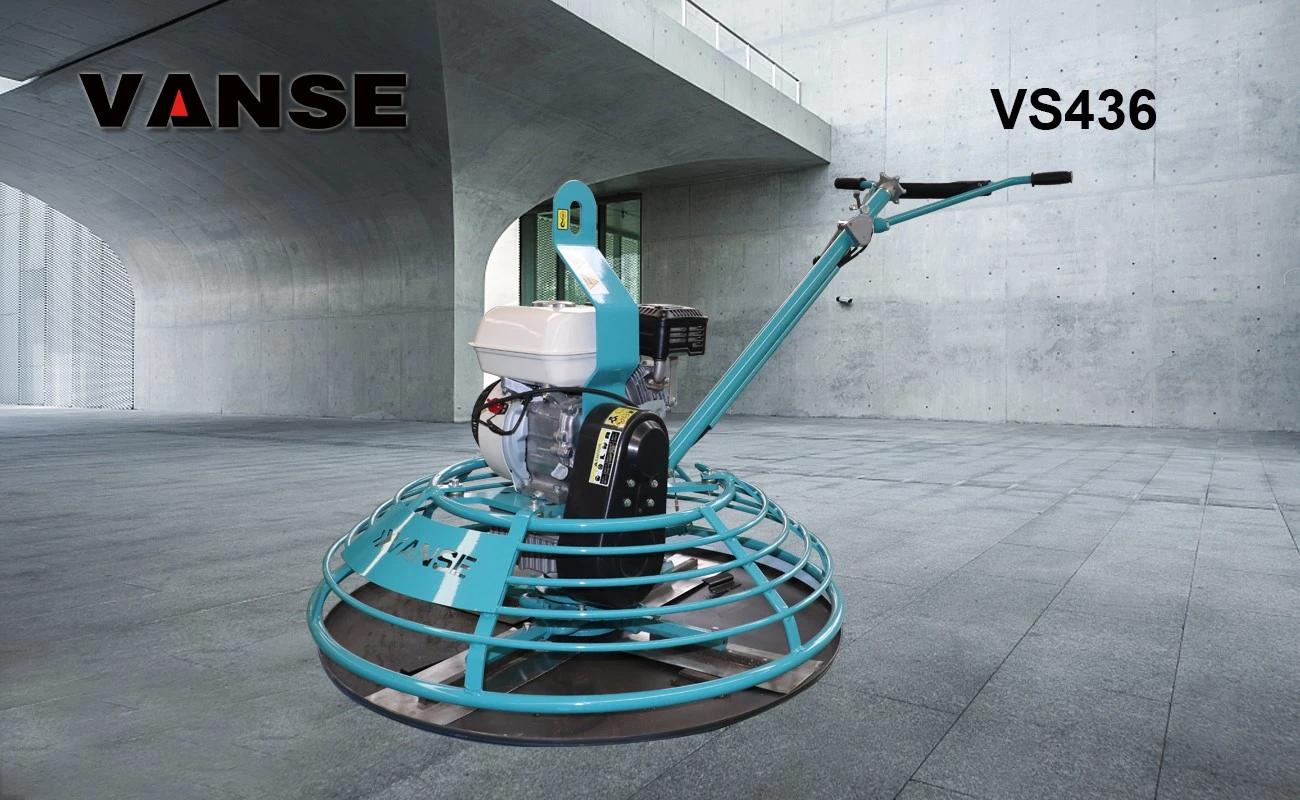
The dimensions of a concrete trowel (also called a concrete screed or concrete leveler) can vary by manufacturer and model, but here are some common ranges:
1. Working width: The working width of a trowel is usually between 60cm and 1.2m. Wider machines are suitable for large areas, while narrower machines are suitable for small or confined areas.
2. Blade diameter: The blade diameter of a trowel is generally between 600mm and 1200mm, which is used to ensure the flatness of the ground.
3. Machine length: The length of a trowel is usually between 1.5m and 2.5m, which affects the machine's operational flexibility and ease of transportation.
4. Machine height: The height of a trowel is usually adjustable, with an adjustment range of approximately 70cm to 110cm to suit different construction needs.
5. Weight: The weight of a trowel can range from 100kg to 300kg, with heavier machines generally providing better compaction.
6. Engine power: The engine power of the trowel can range from 5 horsepower to 20 horsepower or more, depending on the size of the machine and the construction requirements.
7. Fuel tank capacity: The fuel tank capacity is usually between 20 liters and 40 liters, which determines the working time of the machine between refueling.
8. Water tank capacity: For trowels with a water cooling system, the water tank capacity may be between 20 liters and 60 liters.
9. Operating handle length: The length of the operating handle is usually between 1.2 meters and 1.8 meters to provide a comfortable operating experience.
10. Number of blades: Some trowels may be equipped with multiple blades to improve work efficiency.
Please note that these specifications are for reference only, and the specific size should be determined according to the actual construction needs and the model provided by the manufacturer. When choosing a trowel, factors such as the construction environment, construction area, ground type, and required flatness should be considered.
Thanks to All the Friends Who Support and Trust Shandong Vanse Machinery Technology Co., Ltd.
If you want to know more about Shandong Vanse Machinery Technology Co., Ltd. or have any questions, please feel free to contact us:
Our Factory
Shandong Vanse Machinery Technology Co., Ltd.








Share this article

About the Author: Shandong Vanse Machinery Technology Co., Ltd.
Shandong Vanse Machinery Technology Co., Ltd. is a high-tech manufacturer specializing in concrete construction machinery, including laser screeds and related equipment. The company integrates R&D, production, and global sales, with products exported to over 60 countries and widely used in infrastructure projects worldwide.
Previous Post
Next Post
Related Articles
You Might Also Like
In what scenarios is the concrete laser leveling machine used?
Concrete laser leveling machines have been widely used in many scenarios due to their high efficiency, precision and high flatness. The following are common application scenarios of concrete laser leveling machines: 1. Industrial plants: Including various manufacturing plants and workshops, especially those that require high-flatness floors, such as automobile manufacturing plants, electronic assembly plants, etc. 2. Large commercial facilities: Shopping centers, supermarkets, exhibition halls and other places that require large-scale flat floors to meet the needs of large traffic and display of goods. 3. Logistics and warehousing: Logistics centers, warehouses, distribution centers and other places, which usually require solid floors that can withstand the weight of heavy shelves and handling vehicles. 4. Infrastructure: Such as airport runways, aprons, port terminals, container yards, etc., these places have very high requirements for the strength and flatness of the ground. 5. Public buildings: Public places such as stadiums, conference centers, hospitals, schools, etc., which require beautiful and durable floors. 6. Parking lots: Whether indoor or outdoor parking lots, flat floors are required to facilitate vehicle driving and parking. 7. Road construction: Some sections of urban roads and highways, especially in new construction or renovation projects, laser leveling machines can provide higher quality road surfaces. 8. Bridge deck: Bridge decks require particularly strong and flat surfaces to support passing vehicles and pedestrians. 9. Residential area: In some high-end residential or villa areas, in order to improve the overall quality of the community, laser leveling technology is also used to create high-quality outdoor activity spaces. 10. Special purpose sites: For example, weapons and ammunition production workshops and warehouses, nuclear industry centers, aerospace manufacturing centers, etc., these places often have extremely high requirements for the ground, not only requiring flatness, but also requiring certain special properties such as anti-static or fireproof. In general, any occasion that requires large-area, high-quality concrete floors can consider using concrete laser leveling machines for construction. Laser leveling technology is particularly suitable for engineering projects that have strict requirements on ground flatness and levelness.Detailed explanation of concrete laser leveling machine pouring leveling construction and leveling control matters
Detailed explanation of concrete laser leveling machine pouring leveling construction and leveling control matters 1. Preparation 1.1 After the base layer is processed, the equipment of the laser paver is debugged, and the fixed reference level point is drawn according to the original level point; the non-woven fabric is laid, the side formwork is supported, the laser transmitter is erected, and the ground level is introduced according to the original level point. Laser leveling machine. 1.2 Conveying concrete Commercial concrete is used, and the commercial concrete is transported to the entrance and exit of the garage by tank truck, and then transported to the construction site by a three-wheel dump truck. 1.3 Standard calibration Use a hand-held laser receiver to check the elevation of the floor, introduce the elevation into the laser paver, and adjust the reference point (±0.00) on the leveling machine. 2. Concrete paving Pouring steps: (1) After the formwork is supported, the warehouse should be cleaned one day in advance before pouring concrete, rinsed and soaked with water. When pouring is approaching, drain the open water and sweep the cement slurry or interface agent. At this time, no obvious water accumulation is strictly prohibited. If there is, it must be resolutely removed before paving concrete. (2) After the concrete is put down, it should be preliminarily leveled, and the leveling height should be 3 cm thicker than the elevation. Then level it with a laser paver. The corners that cannot be leveled can be leveled with a gasoline leveler or manually. (3) When the warehouse near the wall is being poured, after the leveling machine walks over, it must be scraped with a scraper in time. and so on. (4) For areas where concrete mixer trucks cannot be driven to the site, tractors should be used to transfer concrete. After the pouring is completed, the floor finishing construction begins when the concrete is initially set. (5) When the warehouse near the wall is being poured, it must be leveled with a scraper in time after the leveling machine has passed by. and so on. (6) For areas where concrete mixer trucks cannot be driven to the site, tractors should be used to transfer concrete. After the pouring is completed, the floor finishing construction begins when the concrete is initially set. 3. During construction, the laser signal received by the receiver of the laser paver (frequency of 10 times per second) automatically adjusts the elevation in real time to ensure that the construction elevation is always at the set standard. Because the laser transmitter is fixed after being set up, it can ensure that the construction of a large area of ground does not produce cumulative errors. 4. During the construction, the operator uses a hand-held laser receiver to detect the ground after the machine is constructed, and again ensures that the flatness error is within the controllable range. If there is anything you don't understand, you can consult us, and we will continue to answer for you.Introduction to Sports flooring
When you leap with all your might on the sports field and your running shoes draw graceful arcs on the track, the ground beneath your feet is your most loyal "invisible guardian". The sports ground is not merely a "flooring material", but a precise system that integrates materials science, ergonomics and sports mechanics. Sports flooring refers to the ground material layer specially designed and constructed for various sports competitions and fitness activities. It needs to meet the requirements of elasticity, anti-slip, wear resistance, shock absorption and environmental protection for sports, and adapt to the technical requirements of different sports. 1. Concept: The plastic track floor is an elastic ground material made of synthetic resins such as polyurethane (PU) and polyvinyl chloride (PVC) as the main binders, mixed with rubber particles and other raw materials. It is also known as an all-weather sports floor and is commonly seen in basketball courts, badminton courts and other venues. Due to its good elasticity, anti-slip and wear-resistant properties, it has become the mainstream choice for modern sports venues. 2. Advantages: Excellent elasticity, good anti-slip performance, high rebound rate, wear-resistant and shock-resistant, customizable according to the needs of different sports venues, and highly practical. 3. Disadvantages: Large initial investment, may release a slight odor at high temperatures, improper construction is prone to problems such as bulging and delamination, and the difficulty of later repair is relatively high. 4. Applicable venues: ball game venues, various types of track and field tracks, comprehensive sports venues in schools and stadiums, simple sports venues in communities and parks. Concept: Acrylic flooring is a new type of environmentally friendly flooring material composed of acrylic resin as the core component, combined with pigments, fillers and additives. 2. Advantages: Green, environmentally friendly and pollution-free, with excellent weather resistance and anti-aging ability, stable structure and not easy to fall off, long-term stable and reliable material performance, and simple construction process, short cycle and quick effect, suitable for a wide range of scenarios 3. Disadvantages: It has high requirements for the flatness of the base layer. An uneven base layer can easily lead to cracking and peeling of the coating. It has a relatively weak ability to resist the impact of heavy objects and is prone to damage when subjected to long-term heavy pressure or sharp object impacts. The stain resistance is average. Stubborn stains need to be cleaned up in time; otherwise, it is easy to leave marks. In low-temperature environments, its toughness decreases. Long-term use in extremely cold regions may lead to brittle cracking, and color differences are likely to remain after repair. 4. Applicable venues: Indoor and outdoor basketball courts, tennis courts, badminton courts and other professional sports venues as well as sports venues for leisure and entertainment. 1. Concept: Artificial turf can be classified into two major categories based on the production process: injection-molded artificial turf and woven artificial turf. (1) Injection-molded artificial turf: It adopts an integrated injection molding process, where plastic particles are extruded into shape in a dedicated mold at one time. Subsequently, professional bending techniques are used to make the grass leaves present a naturally curved shape. The arrangement of its grass leaves follows the rule of equal spacing and equal quantity, maintaining a completely uniform height, with excellent flatness and regularity. (2) Woven artificial turf: With synthetic fibers that imitate the shape of natural grass leaves as the core material, the fibers are precisely implanted into the woven base fabric through specialized equipment, and then a fixed coating is evenly applied to the back to enhance structural stability. It has a high degree of simulation, excellent toughness and is applicable in a wide range of scenarios. 2. Advantages and disadvantages: (1) The injection molding type adopts an integrated injection molding process, featuring regular grass leaves, low cost, wear resistance and easy maintenance. Its safety is suitable for children's scenarios, but its simulation degree and elasticity are average. (2) The woven type involves embedding synthetic fibers into the base fabric and applying a fixed coating. It features high simulation, comfortable foot feel, and excellent elasticity, making it suitable for professional venues. However, it has a relatively high cost and requires regular maintenance 3. Applicable scenarios (1) Injection-molded artificial turf can be used in multiple aspects such as activity areas in kindergartens, auxiliary areas of sports fields, balcony decoration, urban greening projects, and the laying of sand and gold fields. (2) Woven artificial turf can be widely applied in professional sports fields, leisure activity areas, golf courses, courtyard floor laying and urban greening projects, etc. 1. Concept: The silicon PU court floor is composed of elastic base material for the court, wear-resistant surface material, topcoat, marking lines and other parts 2. Advantages: It features outstanding wear resistance, weather resistance and anti-fouling properties. Moreover, the surface layer of the court can be adjusted to various colors as needed to beautify the environment and bring visual enjoyment. 3. Disadvantages: Higher initial investment cost, strict environmental requirements for construction, slight yellowing may occur when exposed to strong light for a long time, affecting the consistency of appearance, weak resistance to scratches from sharp objects, easy to leave marks when scratched by hard objects, and there may be color differences after repair. 4. Applicable scenarios: It is suitable for professional sports venues such as indoor and outdoor basketball courts, tennis courts, and badminton courts. It is also compatible with activity areas in kindergartens, school playgrounds, leisure and fitness areas, and children's play areas. 1. Concept: Suspended modular floor, also known as modular sports floor, is made of high-strength polypropylene environmentally friendly material at its core. It does not require professional bonding and can be directly laid on flat base surfaces such as cement and asphalt. Through the unique locking structure of the floor itself, it can be quickly assembled and fixed. 2. Advantages: It features environmental friendliness, durability, convenience, portability, cold and heat resistance, anti-aging, comfort, safety and health, as well as excellent sports performance 3. Disadvantages: It relies on the flatness of the base layer, the lock buckle is prone to loosening due to high-intensity use or temperature changes, the texture is relatively hard, the movement buffering performance is average, the anti-slip performance will decline with the passage of time, and it is prone to cracking at low temperatures. 4. Applicable scenarios: It can be used to lay ideal high-performance basketball courts, tennis courts, roller skating courts, table tennis courts, and multi-functional courts such as volleyball and badminton courts. It can also be used in various domestic sports venues and playgrounds and sports fields in kindergartens and primary schools. The texture, safety and comfort of sports fields are all hidden in every detail of the floor. Whether it is the wear resistance and elasticity required for professional events or the environmental protection and anti-slip features valued in school playgrounds and community leisure areas, high-quality floors silently protect every run, jump and laugh, laying a solid foundation of peace of mind for sports moments in different scenarios. Note: The parameters provided in this document are for reference only and are not mandatory. Due to differences in technical characteristics between different brands and models of laser levelers, please consult the manufacturer for a suitable solution before actual operation. This reference document assumes no responsibility for any issues arising from failure to follow the manufacturer's instructions.