Technical Knowledge
How to improve the safety of concrete laser leveling machine?

Improving the safety of concrete laser leveling machines requires building a systematic safety protection system from multiple dimensions, including personnel operating specifications, equipment safety design, working environment management, and emergency mechanisms. The following are specific safety improvement measures:
1. Professional training requirements
Certification required: Operators must pass the training of manufacturers or professional institutions, master the equipment principles, operation procedures and emergency shutdown methods, and hold valid certificates to work after passing the assessment.
Regular refresher training: Safety operation refresher training is carried out every six months, focusing on strengthening practical skills such as coping with new working conditions (such as slope operation, night construction), emergency handling of equipment abnormalities, etc.
Case warning education: Analyze typical accident cases in the industry (such as leveling beam falling, laser system misjudgment leading to collision), and clarify the hazards of illegal operations.
2. Safety awareness training
It is strictly forbidden to work after drinking or fatigue, stay focused during operation, and it is forbidden to make phone calls or distracted operations during operation.
Establish a "double confirmation" system: key actions (such as equipment displacement, parameter modification) require two people to check and confirm to avoid single-person misoperation.
1. Mechanical safety protection
| Emergency stop button | The machine body and operating handle are equipped with red emergency stop buttons. When pressed, the power system is immediately cut off, and the response time is ≤0.5 seconds. |
| Anti-fall protection | The leveling beam lifting system is equipped with a double brake device (hydraulic lock + mechanical lock). When the hydraulic system fails, the mechanical lock automatically locks to prevent the beam from falling. |
| Overload protection | The hydraulic system is equipped with a relief valve, which automatically relieves the pressure when the pressure exceeds 110% of the rated value; the motor is equipped with an overload protector to prevent the motor from being burned by excessive current. |
| Protective cover for moving parts | Metal protective covers are installed on rotating parts such as chains and pulleys. The protective covers must pass the 100N force test without deformation to prevent people from contacting and getting injured. |
2. Electrical and laser system safety
Leakage protection: The electrical system is equipped with a leakage circuit breaker (operating current ≤30mA, operating time ≤0.1 second), and the cable joints are waterproof and sealed to prevent rainwater from seeping in and causing electric shock.
Laser safety level: Use Class 3B or lower laser transmitters (wavelength 630-670nm, power ≤50mW), avoid direct exposure to human eyes, and set up "Laser Danger" warning signs in the operating area.
Anti-electromagnetic interference: The control system line uses shielded cables, away from interference sources such as electric welders and high-frequency equipment, to prevent laser signal misjudgment from causing equipment out of control.
1. Site pretreatment
Survey the site before construction, remove hidden dangers such as underground pipelines, steel bar heads, and water pits, and lay steel plates (thickness ≥ 20mm) on soft ground to prevent the equipment from sinking and rolling over.
Define the working area, set up cordons and warning signs, and keep non-operating personnel at least 5 meters away from the equipment to avoid collision when the leveling beam rotates.
2. Safety measures for special working conditions
Night/low-light operation: Install LED work lights (brightness ≥ 200lux) to ensure that there is no shadow in the operating area; add reflective signs to the laser receiver to assist manual observation of the equipment position.
Slope operation: When the slope exceeds 5°, the stability of the equipment must be tested first (run without load for 10 minutes), and the walking speed must be controlled to ≤1.5km/h during operation to avoid sudden stops and sudden turns.
Rainy days/humid environment: Stop open-air operations. If construction is necessary, check the waterproof performance of electrical components, and operators must wear insulating shoes and gloves. The grounding resistance of the equipment must be ≤4Ω.
1. "Three-step inspection" before operation
Mechanical inspection: Test the lifting and traveling system of the leveling beam to confirm that there is no jamming in each action and the pressure of the hydraulic system is normal (the pressure gauge shows within the rated value ±0.5MPa).
Electrical inspection: Test the calibration accuracy of the laser system (target ruler measurement error ≤3mm), check whether the sensor signal transmission is stable, and the backup battery power is ≥80%.
Safety device test: Press the emergency stop button to confirm that the equipment stops immediately; simulate the loss of pressure in the hydraulic system to verify whether the mechanical lock starts automatically.
2. Key points for safe operation during operation
It is forbidden to climb the fuselage or adjust the components when the equipment is running. When maintenance is required, the equipment must be shut down and the power must be cut off.
When transferring the site, the leveling beam must be raised to the lowest position and locked, the driving speed must be ≤5km/h, and the height and weight limit must be confirmed before passing through the bridge and tunnel (equipment height + 0.5m safety margin).
When multiple people work together, a dedicated person should be assigned to direct, and an intercom (fixed channel) or hand signals (such as the "stop" gesture is to extend the arm horizontally forward) should be used to avoid communication errors.
V. Safety regulations in maintenance
1. Power-off and sign-out system
Before maintenance, turn off the main power switch and hang a "no closing" warning sign. The key is kept by the maintenance personnel to prevent accidental start-up.
Hydraulic system pressure relief: Loosen the cylinder exhaust valve and confirm that the pressure drops to 0MPa before disassembling the pipeline to avoid high-pressure oil spray and injury.
2. High-altitude work protection
When inspecting the laser transmitter (height ≥ 2 meters), use an anti-slip ladder (load bearing ≥ 150kg) or a lifting platform, and the operator wears a safety belt (hook fixed to an independent anchor point).
It is forbidden to stand or walk on the leveling beam. When the beam needs to be inspected, it needs to be supported by a safety bracket (support point load bearing ≥ 1.5 times the weight of the equipment).
1. Emergency response process for sudden failures
| Fault type | Emergency measures |
| Laser system failure | Immediately switch to manual mode, stop operation, evacuate personnel, and notify technicians to calibrate or replace the receiver. |
| Hydraulic system oil leakage | Turn off the engine, surround the oil leak area with sandbags to prevent spread, use oil-absorbing cotton to clean, and strictly prohibit open flames from approaching (hydraulic oil ignition point ≥ 180℃). |
| Risk of equipment tipping over | Operators immediately evacuate to a safe area, slowly reset with a jack (the support point must be at the specified position of the frame), and it is strictly forbidden to force the equipment to start. |
2. Safety plan and drills
Formulate the "Laser Leveler Safety Accident Emergency Plan", clarify the handling procedures for electric shock, mechanical injury, laser burns, etc., and equip first aid kits (including tourniquets, burn ointments, etc.).
Organize emergency drills every quarter to simulate scenarios such as equipment out of control and personnel injuries, improve the team's response speed, and archive the drill records for future reference.
Daily inspection form: Formulate an "Equipment Safety Inspection Form", which includes 20 inspection items such as braking system, lighting, safety devices, etc., and the operator signs and confirms before daily operation.
Responsibility traceability mechanism: Incorporate safety indicators into the performance appraisal of operators. For those who violate the regulations and cause accidents, deduct bonuses or pursue legal liability according to the degree of responsibility.
Technology upgrade investment: Regularly update equipment safety modules (such as installing GPS positioning anti-crossing system and blind spot camera), and use intelligent monitoring system to warn abnormal data in real time (such as alarm when hydraulic oil temperature exceeds 90℃).
Through the above measures, the operation risk of concrete laser leveling machine can be systematically reduced. It is recommended to combine the equipment instruction manual and industry safety standards (such as GB 2894-2008 "Safety Signs and Guidelines for Their Use"), formulate a personalized safety manual, and continuously track the application of new technologies (such as AI visual anti-collision system) to dynamically improve the level of safety protection.
Thanks to All the Friends Who Support and Trust Shandong Vanse Machinery Technology Co., Ltd.
If you want to know more about Shandong Vanse Machinery Technology Co., Ltd. or have any questions, please feel free to contact us:
Our Factory
Shandong Vanse Machinery Technology Co., Ltd.








Share this article

About the Author: Shandong Vanse Machinery Technology Co., Ltd.
Shandong Vanse Machinery Technology Co., Ltd. is a high-tech manufacturer specializing in concrete construction machinery, including laser screeds and related equipment. The company integrates R&D, production, and global sales, with products exported to over 60 countries and widely used in infrastructure projects worldwide.
Previous Post
Next Post
Related Articles
You Might Also Like
How should maintenance standards for equipment used in concrete construction be established?
When developing maintenance standards for concrete construction equipment, it's necessary to consider the technical characteristics of each equipment type (such as mixing equipment, conveying equipment, pouring equipment, and vibrating equipment), construction scenario requirements, and industry standards. This approach aims to create a systematic standard that covers the entire lifecycle, is quantifiable and implementable, and assigns specific responsibilities. The following is the specific framework and core content: Before developing standards, it's important to first clarify the underlying foundations to ensure they are legally compliant, practical, and avoid being divorced from equipment characteristics or industry requirements. Equipment Technical Documentation Based on the manufacturer's operating and maintenance manuals, key parameters (such as lubrication cycles, replacement thresholds for wearing parts, and maintenance tool models) are extracted. For example, for a mixer, "mixing blades should be replaced if wear is ≤3mm" and "gear oil should be changed every 500 hours for the reducer" are standard "technical baselines." Industry and national standards Reference mandatory or recommended specifications, such as: Technical Regulations for Safety in the Use of Construction Machinery (JGJ33-2012): Clarifies safety requirements for equipment maintenance (such as powering off before maintenance and posting warning signs); Technical Specifications for Concrete Mixing Plants (Buildings) (GB/T 10171-2021): Specifies maintenance cycles and performance testing indicators for mixing equipment; Technical Specifications for Concrete Pumps (GB/T 13333-2014): Clarifies maintenance requirements for the hydraulic system and piping of concrete pumps. Construction scenarios and equipment load Based on project specific adjustments (e.g., high temperature, high humidity, or high-frequency construction scenarios require shortened maintenance intervals): For example, for concrete mixer trucks in tropical regions, the hydraulic oil filter replacement interval needs to be shortened from the standard 1,000 hours to 800 hours. For example, when continuously pouring large volumes of concrete, the insulation layer of the vibrator needs to be inspected every 8 hours instead of every 8-hour shift. Concrete construction equipment varies greatly. Based on the principle of "classification and standardization," the standard should be broken down into "equipment classification modules." Each module covers four dimensions: daily maintenance, scheduled maintenance, fault prevention, and safety requirements, ensuring coverage of the entire equipment lifecycle. Using the four most critical types of equipment in concrete construction as examples, this standard specifies specific maintenance content, cycles, standards, and responsible individuals: Device Type Maintenance Dimension Maintenance cycle Core maintenance content (quantifiable standards) 1. Mixing equipment (mixing machine, batching machine, cement silo) Daily Maintenance Daily before/after construction 1. Mixer: Clean any remaining concrete in the drum (no lumps or adhesion), and check the blade/liner fastening bolts (no looseness, torque ≥ 80 N·m). 2. Batching machine: Clean any debris from the hopper, and check the conveyor belt for deviation (≤ 50 mm/10 m). 3. Cement silo: Check the sensitivity of the level gauge (analog signal response time ≤ 2 seconds), and the safety valve for leaks. Periodic Maintenance (Medium Repair) Every 300-500 man-hours 1. Replace the mixer liner (if wear ≥ 5 mm). 2. Change the gear oil in the reducer (oil quality test: viscosity ≥ 220 cSt, no metal debris). 3. Adjust the tension of the batching machine conveyor belt (deflection ≤ 15 mm/1 m span). Periodic Maintenance (Major Repair) Every 2000-3000 man-hours 1. Disassemble the mixer shaft and check the bearing clearance (≤ 0.05 mm). 2. Calibrate the batching scale for accuracy (error ≤ ±1%). 3. Repair the anti-corrosion coating on the cement silo interior (no rust on ≥ 0.1 m2). 2. Conveying equipment (concrete pump trucks, trailer pumps, mixer trucks) Daily Maintenance Daily after construction 1. Pump Truck: Flush the delivery pipeline (no concrete residue, smooth water flow), check the outrigger cylinder seals (no oil leakage, no scratches on the piston rod); 2. Mixer Truck: Clean the tank (no hardening on the tank wall), check the tire pressure (±0.2 bar). Periodic Maintenance Every 1000 km / 500 man-hours 1. Pump Truck: Replace the hydraulic oil filter (pressure differential ≥ 0.3 MPa), inspect the boom welds (no cracks, weld height ≥ 8 mm); 2. Mixer Truck: Replace the tank liner (wear ≥ 10 mm), and maintain the drive system (bearing temperature ≤ 60°C). 3. Vibrating equipment (insertion vibrator, flat plate vibrator) Daily Maintenance Every 8-hour shift 1. Check the cable insulation (no damage, ground resistance ≤ 4Ω); 2. Vibrator: Test run (amplitude ≥ 0.8 mm, no abnormal noise), and check the connectors for looseness. Periodic Maintenance Every 50 shifts 1. Replace the vibrator bearing (clearance ≥ 0.1 mm); 2. Clean the motor cooling vents (no dust blockage, temperature rise ≤ 40°C). 4. Measuring equipment (sand and gravel scales, cement scales, admixture scales) Daily Maintenance Daily 1. Clear the scale hopper of any accumulated material (no material hanging, no skew); 2. Calibrate the zero point (error ≤ ±0.5kg) and check the sensor wiring (no looseness). Periodic Maintenance Every 30 days 1. Perform dynamic calibration (load 100% of the rated weight, error ≤ ±1%); 2. Check the sensor protection (no moisture, no deformation due to impact). Lubrication Management Standards Follow the "Equipment Lubrication Chart" (specify the lubricant type, filling point, cycle, and amount). For example, use 3# lithium-based grease for the mixer bearings, refilling every 100 working hours at a rate of 50g each time. After lubrication, record the "lubrication time, person performing the lubrication, and oil quality" to avoid over-lubrication or under-lubrication. Consumable Parts Management Standards Maintain a "consumable parts ledger" (including model, inventory threshold, and replacement cycle), such as for agitator blades, conveyor belts, vibrators, and cables, with a minimum inventory of three sets. When replacing consumable parts, "model matching" is required. Substitution with non-genuine parts is prohibited (exceptional circumstances require approval from the technical director). After replacement, a test run is required to confirm compliance. Safety Maintenance Standards Before maintenance, power and gas must be turned off, and a warning sign must be posted (e.g., "Equipment under maintenance, do not start"). Safety belts must be worn and a warning area must be set up for overhead work (e.g., pump truck boom maintenance). Electrical equipment maintenance requires a "certified operator" (electrician's license). Hydraulic system maintenance must be depressurized (reduced to 0 MPa) to prevent hydraulic fluid spray and injury. Record and traceability standards Establish an "Equipment Maintenance Record Form" (electronic or paper) that includes: equipment number, maintenance date, maintenance items, test data, abnormalities, person responsible, and inspector. Record retention period should be ≥ the equipment's service life to facilitate tracing the cause of a malfunction (e.g., if a mixer blade breaks, the record can be used to verify whether it has not been replaced beyond the specified time limit). Clarify the responsibility system Responsibilities are divided into different levels: Operators are responsible for "daily maintenance" (cleaning, inspection, and simple tightening); repair workers are responsible for "regular maintenance" (disassembly, replacement, and calibration); technical leaders are responsible for "standard review and exception handling"; and project managers are responsible for "resource support (spare parts, tools, and funding)." A "Equipment Maintenance Responsibility Letter" is signed, linking maintenance effectiveness to performance appraisals (e.g., if equipment failure occurs due to inadequate maintenance, the responsible individual's performance will be deducted). Supervision and Inspection Mechanism Daily Inspections: Technicians will spot-check the Maintenance Record Form daily and verify maintenance effectiveness on-site (e.g., randomly checking the wear of the mixer blades to see if it matches the records). Regular Assessments: Monthly "Equipment Maintenance Evaluations" are conducted, rewarding teams/individuals with a maintenance compliance rate ≥95%. Those failing to meet the standards will be given a deadline to rectify the situation. Fault Review: After equipment failure, analysis will be conducted to determine whether the cause was maintenance failure, and standards will be updated (e.g., if a crack on a pump truck boom was caused by untimely weld inspection, the weld inspection cycle will be shortened). Personnel Training Standards New employees must pass "equipment maintenance training + practical assessment" (e.g., identifying wearing parts of the mixing unit and completing maintenance records) before they can begin work. Maintenance skills training is organized quarterly (manufacturer technicians are invited to explain key maintenance points and common troubleshooting for new equipment) to ensure personnel skills meet standard requirements. Concrete construction equipment technology evolves rapidly (e.g., new intelligent mixing plants and electric pump trucks), necessitating regular standard updates: Update Cycle: A comprehensive review is conducted annually. Revisions are required immediately if equipment upgrades, construction scenarios change, or industry standards are updated. Update Process: The technical department collects equipment failure data, maintenance feedback, and new regulatory requirements. Discussions are held with maintenance workers, operators, and manufacturer representatives. After revisions are made public, training sessions are held to ensure full awareness. The standards established through the above framework can not only cover the technical requirements of equipment, but also be implemented in specific positions and operations, avoiding "empty" concepts and ultimately achieving the goal of "reducing equipment failures, extending service life, and ensuring construction continuity." Note: The parameters provided in this document are for reference only and are not mandatory. Due to differences in technical characteristics between different brands and models of laser levelers, please consult the manufacturer for a suitable solution before actual operation. This reference document assumes no responsibility for any issues arising from failure to follow the manufacturer's instructions.How to improve construction efficiency of concrete laser leveling machine?
Improving the construction efficiency of concrete laser leveling machines is of great significance for reducing construction costs and shortening project cycles. The following is a comprehensive analysis of how to improve the construction efficiency of concrete laser leveling machines. Introduction As a highly efficient construction machine, concrete laser leveling machines are increasingly widely used in the field of construction. However, the improvement of construction efficiency not only depends on the performance of the equipment itself, but also requires comprehensive consideration of construction preparation, operating skills, construction management and other factors. 1. Preparation before construction Sufficient pre-construction preparation is the prerequisite for improving construction efficiency: – **Equipment inspection and maintenance: Ensure that the laser leveling machine is in the best working condition to avoid failures during construction. – **Construction plan optimization: Develop a reasonable construction plan based on the characteristics of the project, including construction process, equipment layout, etc. – **Material preparation: Prepare the required concrete materials in advance to ensure the continuity of material supply during construction. 2. Professional training of construction personnel Professional construction personnel are the key to improving construction efficiency: – **Operation skills training: Regularly conduct skill training for operators to improve their proficiency in operating laser leveling machines. – **Safety education: Strengthen safety education to ensure that construction workers comply with safety regulations while working efficiently. 3. Fine management during the construction process Fine construction process management can effectively improve construction efficiency: – **Construction scheduling: Rationally dispatch construction resources to avoid construction delays caused by waiting for materials or equipment. – **Real-time monitoring: Real-time monitoring of construction progress and equipment status, and quick response to possible problems. 4. Optimal use of construction equipment Optimizing the use of construction equipment can improve construction efficiency: – **Equipment configuration: Rationally configure the laser leveler according to construction needs to avoid excess or insufficient equipment capacity. – **Equipment automation: Use equipment automation functions to reduce manual intervention and increase construction speed. 5. Innovation and improvement of construction technology Innovation and improvement of construction technology is an important way to improve construction efficiency: – **Technology innovation: Explore new construction technologies, such as using premixed concrete, to reduce on-site mixing time. – **Technology integration: Integrate advanced technologies, such as GPS positioning, intelligent control systems, etc., to improve construction accuracy and speed. 6. Optimization of construction environment A good construction environment helps improve construction efficiency: – **Environmental control: Control the temperature, humidity and other conditions of the construction site to ensure a suitable construction environment for concrete. – **Construction site layout: Rationally plan the construction site layout to reduce the time for equipment movement and material transportation. 7. Quality and supply of construction materials High-quality construction materials and stable supply are crucial to improving construction efficiency: – **Material quality control: Ensure the quality of concrete materials and avoid construction interruptions caused by material problems. – **Supply chain management: Optimize supply chain management to ensure the timeliness and stability of material supply. 8. Collection and analysis of construction data Collecting and analyzing construction data helps to find room for efficiency improvement: – **Data collection: Collect various data during the construction process, such as construction speed, equipment utilization, etc. – **Data analysis: Analyze the data, find out the factors that affect construction efficiency, and formulate improvement measures. 9. Maintenance and upgrading of construction machinery Regular maintenance and timely upgrading of construction machinery are the guarantee for maintaining construction efficiency: – **Regular maintenance: Formulate equipment maintenance plans to ensure that the equipment is in good condition. – **Technology upgrade: Pay attention to the development of industry technology and upgrade the technology of equipment in a timely manner. 10. Prevention and control of construction risks Preventing and controlling construction risks can reduce construction interruptions and improve efficiency: – **Risk assessment: Conduct construction risk assessment regularly to identify potential risk factors. – **Emergency plan: Develop an emergency plan to ensure that you can respond quickly when risks occur. 11. Conclusion Improving the construction efficiency of concrete laser leveling machines is a systematic project involving construction preparation, personnel training, process management, equipment use, process innovation, environmental optimization, material supply, data collection, machinery maintenance, risk control and other aspects. Through the comprehensive application of these measures, we can effectively improve construction efficiency, shorten the project cycle and reduce construction costs.How to use vibratory leveling to assist concrete laser leveling machine in small areas
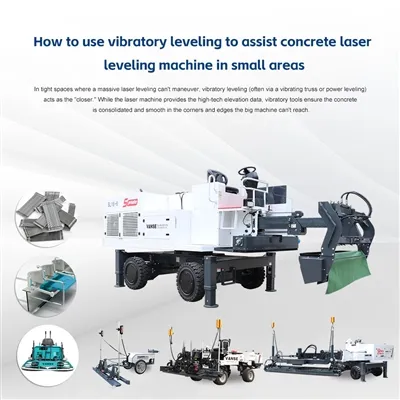
In tight spaces where a massive laser leveling can't maneuver, vibratory leveling (often via a vibrating truss or power leveling) acts as the "closer." While the laser machine provides the high-tech elevation data, vibratory tools ensure the concrete is consolidated and smooth in the corners and edges the big machine can't reach. Here is how to effectively integrate the two for a seamless, flat finish. Before the vibratory equipment touches the wet concrete, the laser leveling machine must establish the grade. Benchmark Sync: Ensure your handheld laser receiver (used for the vibratory leveling) is calibrated to the exact same benchmark as the laser leveling machine. Even a 3mm discrepancy will create a visible "lip" where the two areas meet. The Overlap Zone: Always have the laser machine pass slightly into the "small area" or perimeter. This creates a leveled "pad" of concrete that your vibratory leveling can use as a guide. In small areas, the vibratory leveling needs physical points of reference since it lacks the automatic hydraulic adjustments of the laser machine. Wet leveling: Use the laser machine to strike off a strip of concrete. Use this leveled strip as one "rail" for your vibratory leveling to ride on. Handheld Laser Receivers: Mount a receiver to the pole of your vibratory leveling. As you pull the leveling, the "beep" or visual indicator tells you if you are pushing too hard (too low) or riding too high. Vibration is key for small areas because concrete near forms and corners tends to "honeycomb" (trap air). The Leading Edge: Keep a small "roll" of concrete (about about 2cm to 5cm high) in front of the vibratory blade. This head of pressure ensures that as the vibration liquefies the concrete, it fills all voids and matches the height set by the laser. Speed Control: Move the vibratory leveling at a slow, consistent pace-roughly 1m per minute. Moving too fast leaves "waves"; moving too slow sinks the aggregate too deep, leaving a weak, cream-heavy surface. Task Laser Machine Role Vibratory leveling Role Main Slab Handles 90% of the volume and leveling. Follows behind to "knit" edges. Edges/Columns Cannot reach; stays 0.5m away. Primary tool for leveling and consolidation. Grade Check Automatic/Constant. Manual check via handheld laser rod. Finish High-speed strike-off. Final "cream" pull for easy power troweling. In small areas, it's tempting to hover the vibratory leveling in one spot to "make it flat." Don't. This causes the heavy aggregate to sink and the water/laitance to rise, which leads to surface scaling later. If the grade is wrong, add or remove concrete manually, then做 one final pass with the vibratory tool. Would you like me to find a specific checklist for calibrating handheld laser receivers to match your main laser leveling? Contact us NOW Note: The parameters provided in this document are for reference only and are not mandatory. Due to differences in technical characteristics between different brands and models of laser levelers, please consult the manufacturer for a suitable solution before actual operation. This reference document assumes no responsibility for any issues arising from failure to follow the manufacturer's instructions.