Technical Knowledge
Applicable scenarios of different types of concrete laser leveling machines in industrial plant construction

Concrete laser leveling machines mainly include hand-held, driving and telescopic arm models. Different models have different characteristics and are applicable to different scenarios in industrial plant construction, as follows:
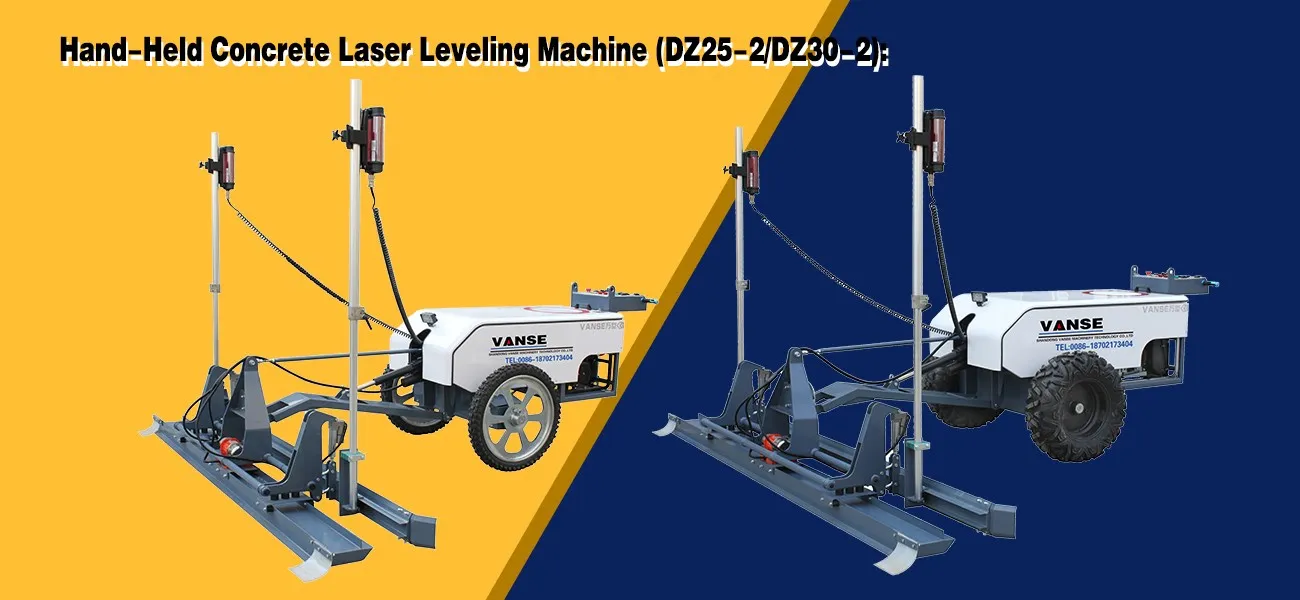
Hand-held concrete laser leveling machine (DZ25-2/DZ30-2):
Applicable scenarios:
Suitable for industrial plants with narrow spaces, scattered construction areas or areas with many obstacles, such as around the equipment foundation and near the column foot in the plant. In addition, for some industrial plants between floors, due to the limited bearing capacity of the floor, the hand-held laser leveling machine is light in weight and will not cause too much burden on the floor, which is suitable for floor construction on the floor.
Advantages:
Small size, flexible operation, can turn and move freely in a small space, and can easily reach areas that are difficult for large equipment to enter for construction. And the price is relatively low, which is cost-effective for some small industrial plants or local areas where the flatness requirements are not very high.
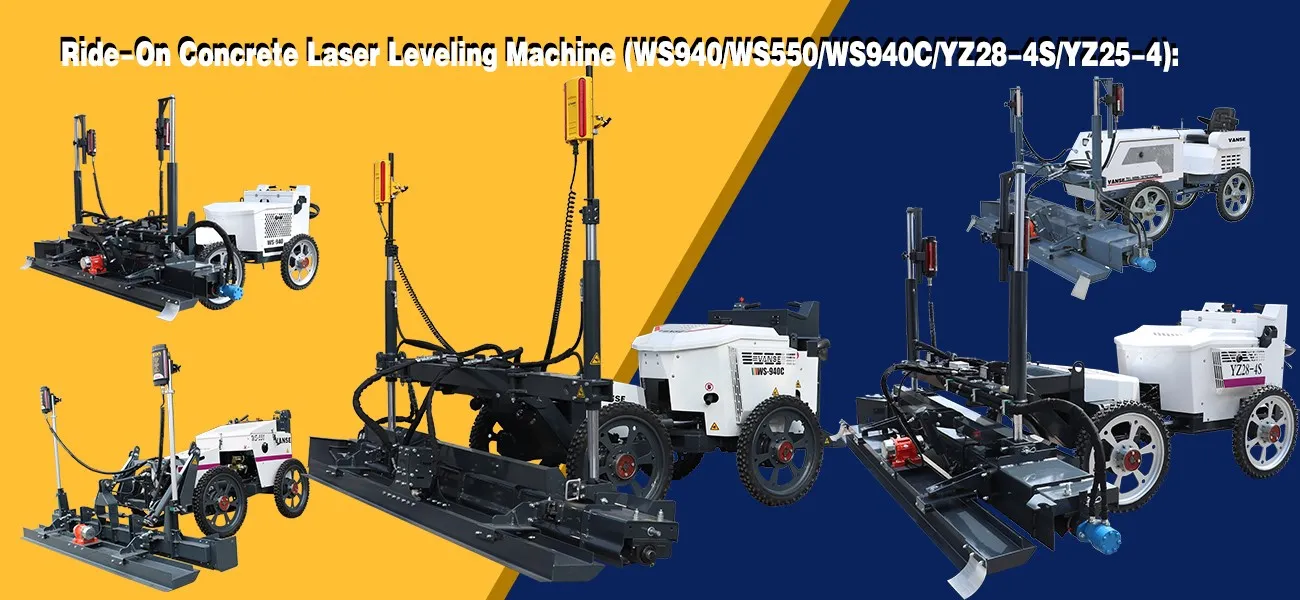
Ride-on concrete laser leveling machine (WS940/WS550/WS940C/YZ28-4S/YZ25-4):
Applicable scenarios:
Commonly used for large-area floor construction in large industrial plants, such as automobile manufacturing workshops, logistics storage centers, etc. These places have open ground and high requirements for construction efficiency, and ride-on laser screed machines can give full play to their advantages.
Advantages:
High construction efficiency, operators can sit in the cab to operate, and can quickly complete large-area concrete leveling work by controlling the equipment, which saves more manpower and time than hand-held types. At the same time, ride-on laser screed machines are usually equipped with more advanced laser control systems and hydraulic systems, with higher leveling accuracy, which can meet the strict requirements of industrial plants for ground flatness and horizontality.
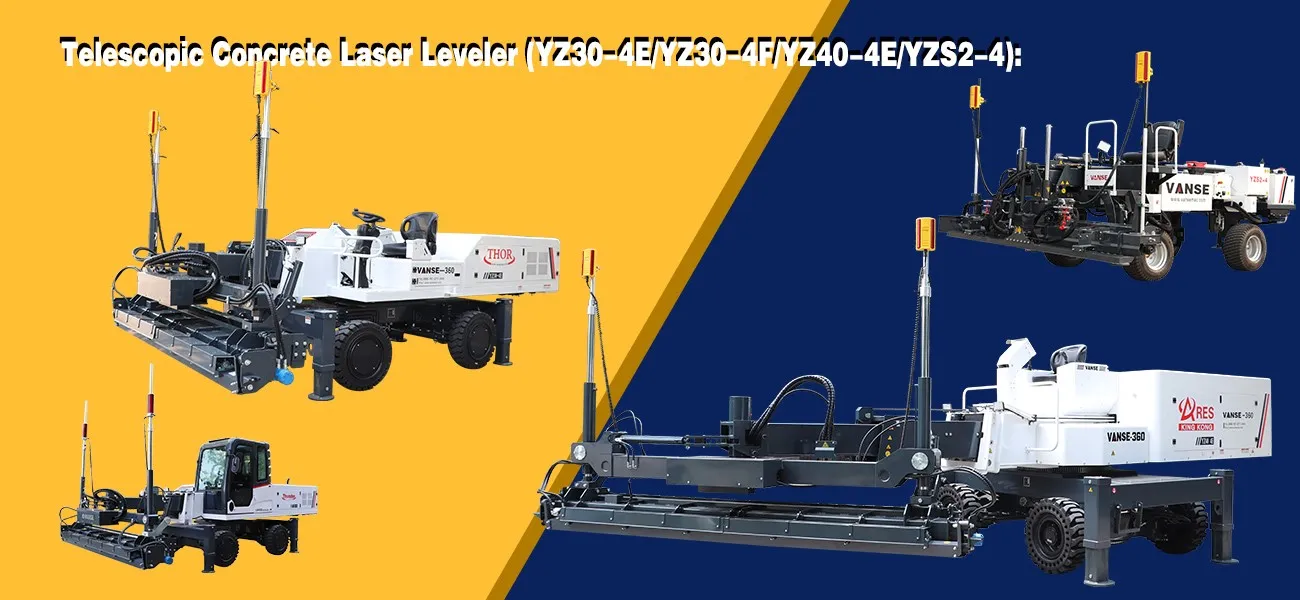
Telescopic concrete laser leveler (YZ30-4E/YZ30-4F/YZ40-4E/YZS2-4):
Applicable scenarios:
Suitable for large-scale industrial plant floor construction, as well as precision instrument production workshops and electronic and electrical plant buildings with extremely high flatness requirements. In addition, telescopic laser levelers can also adapt well to some industrial plant floors with special slope requirements or complex shapes, such as workshop floors with drainage slopes, corners of special-shaped plants, etc.
Advantages:
The leveling head is relatively wide, and the telescopic arm can be flexibly extended and retracted, which can cover a larger construction range and further improve construction efficiency. At the same time, it is equipped with advanced laser systems and computer control systems, which can achieve high-precision elevation control, ensure that large-area ground construction does not produce cumulative errors, and can better meet the construction requirements of high-standard industrial plants.
Click the below to jump immediately!!!

ARMOUR JOINT

CONCRETE LEVELING MACHINE


POWER TROWEL

SLIPFORM MACHINE


TOPPING SPREADER

Thanks to All the Friends Who Support and Trust Shandong Vanse Machinery Technology Co., Ltd.
If you want to know more about Shandong Vanse Machinery Technology Co., Ltd. or have any questions, please feel free to contact us:
Our Factory
Shandong Vanse Machinery Technology Co., Ltd.








Share this article

About the Author: Shandong Vanse Machinery Technology Co., Ltd.
Shandong Vanse Machinery Technology Co., Ltd. is a high-tech manufacturer specializing in concrete construction machinery, including laser screeds and related equipment. The company integrates R&D, production, and global sales, with products exported to over 60 countries and widely used in infrastructure projects worldwide.
Previous Post
Next Post
Related Articles
You Might Also Like
The impact of the maturity of the rental market on the sales strategies of power trowels and the business models of manufacturers
The maturity of the leasing market is a core variable influencing the construction machinery industry, especially for equipment like power trowels. It will have a fundamental impact on the sales strategies and business models of manufacturers. Let's explore this influence in detail in two parts below. The maturity of the rental market directly changes who the manufacturers' "customers" are and how they deal with them. Target customers: mainly end users, such as construction team leaders, individual contractors, and small and medium-sized construction companies. Core of sales strategy Price-driven: Customers are extremely sensitive to prices, and their purchase decisions are mainly based on the initial purchase cost. Function and durability promotion: Emphasize the basic functions, power and "durability" of the product, as the equipment is used and maintained by the owner themselves, and what they care about is "how long it can be used without recouping the cost". Channel penetration: Relying on a wide network of distributors to cover scattered end customers, providing timely in-stock purchases and basic after-sales services. Marketing methods: mainly offline stores, industry exhibitions, and referrals from acquaintances. Target customers: Professional leasing companies have become core major customers (such as United Leasing, Solar Belt Leasing, etc.), as well as large contractors. Core of sales strategy Value and total cost of ownership driven: Price is no longer the only factor. Leasing companies are more concerned about the total cost of ownership, including: Reliability & Attendance Rate: Does the machine rarely break down? Because idle machines mean a loss of rent. Maintenance convenience & Service Cost: Is it easy to maintain on a daily basis? Are the components cheap and readily available? Residual value: How much can the equipment still be sold for after several years of use? This is directly related to the asset return of the leasing company. Standardization and universality: Leasing companies hope that for products of the same brand or even the same platform, their operation methods, maintenance procedures and components can be as universal as possible to reduce training costs and inventory pressure. Direct sales to major clients and customization: Manufacturers will establish dedicated major client teams to directly connect with large leasing companies, and even provide customized products based on their specific needs (such as special color markings, software interfaces, and security configurations). Data and service support: Remote data monitoring (optional) is provided to assist leasing companies in managing equipment fleets, predicting maintenance times, and optimizing equipment deployment The maturity of the rental market has not only changed "what to sell" and "to whom to sell", but also profoundly promoted the transformation of manufacturers' "who I am". Core model: Production, manufacturing and sales The core of a manufacturer is to produce a product and then sell it. The business chain is basically over at this point. The profits mainly come from the sales of new machines. After-sales service is a cost center, and its main purpose is to support sales and prevent customer complaints. The rise of the rental market has forced manufacturers to transform from mere "equipment manufacturers" to "comprehensive solution providers". Model Evolution One: From selling products to operating assets Manufacturers have realized that their equipment is the "asset" that leasing companies use to make money. Therefore, they need to ensure that this asset can operate efficiently and economically throughout its entire life cycle. This has given rise to an extreme pursuit of reliability, durability and residual value management. Manufacturers will proactively release residual value reports and design products that are easy to refurbish to maintain their brand's value in the second-hand market. Model Evolution Two: Financial Services Become a key pillar Financial companies affiliated with or cooperating with manufacturers have become crucial. They offer to leasing companies: Flexible financial leasing solutions help it expand its fleet. Credit support helps its customers (end tenants) rent equipment more easily. This is not only a tool to boost sales, but also a source of profit in itself. Model Evolution Three: The proportion of after-market and service revenue has increased The new machine sales market fluctuates with the economic cycle, but the large fleet of existing equipment brings stable after-market income. Manufacturers actively sell original factory parts, repair services, extended warranties and maintenance contracts. The profit margins of these businesses are usually higher than those of new machine sales. Services have transformed from a "cost center" to a "profit center". Model Evolution Four: Exploration of Datafication and Service Orientation By installing sensors on the equipment, manufacturers can offer: Remote diagnosis and predictive maintenance can notify the leasing company in advance that the equipment may need repair, reducing unexpected downtime. Fleet management report helps leasing companies understand equipment utilization rate, fuel consumption, working hours, etc., and optimize business decisions. This initiated an upgrade in the business model from "selling hardware" to "selling hardware + services + data". Model Evolution Five: Entering the second-hand equipment and leasing business Some powerful manufacturers (such as Caterpillar) establish official certification and resale channels for used equipment, which helps control residual value and provides customers with full life-cycle options. A few manufacturers may even directly enter the market, operate their own leasing businesses, compete or cooperate with downstream customers, and gain a deeper understanding of market demands. Dimension A low-maturity rental market A highly mature rental market Core customers Scattered end users Large leasing companies, major contractors Competitive focus Price, basic functions TCO (Total Cost of Ownership), reliability, residual value Product Strategy It meets basic needs with a wide variety of models Platform-based, standardized and customizable Sales relationship One-time transaction, through the distributor Strategic cooperation, direct management of major clients Source of profit It mainly relies on the sales of new models New machine sales + after-market services + financial services Service role Cost center, supporting sales Profit center, independent business segment Business model Equipment manufacturer Provider of equipment asset management and solutions The maturity of the leasing market is a key force driving the evolution of the power trowel machine and even the entire construction machinery industry. It forces manufacturers to shift their focus from one-time sales of products to the value of operating equipment throughout its entire life cycle. In mature markets, the competition among manufacturers is no longer a simple price war, but a comprehensive ecological competition concerning brand reputation, service networks, financial support and digital capabilities. For manufacturers who want to enter or establish themselves in mature markets such as North America and Europe, understanding and adapting to these rules of the game is a prerequisite for success. Note: The parameters provided in this document are for reference only and are not mandatory. Due to differences in technical characteristics between different brands and models of laser levelers, please consult the manufacturer for a suitable solution before actual operation. This reference document assumes no responsibility for any issues arising from failure to follow the manufacturer's instructions.Key points for purchasing second-hand power trowel and common methods to avoid pitfalls
Selecting a second-hand polishing machine is a job that requires a lot of experience and skills. It can help you obtain a practical device at a lower cost, but if you make a wrong judgment, the subsequent maintenance and delayed construction period may cause you to lose more than you gain. The following is a detailed list of key points for choosing a second-hand polishing machine and common methods to avoid pitfalls. We hope it can be of great help to you. Fuselage structure Chassis (grinding disc) : This is the most crucial part. Check if it is flat and free of deformation. Slight wear and tear is normal, but if the wear is severe, there are pits or obvious deformation, it will lead to poor polishing effect and higher replacement cost. Blade (scraper) : Check if there is still sufficient thickness. If the metal substrate has been worn out, it needs to be replaced immediately, and this cost should be included in the cost. Protective cover: Check for any damage or severe deformation, as this is related to operational safety. Overall framework: Check for any signs of welding, cracks or repairs, which could be a sign of severe impact or drop. Engine (heart) Brand: Give priority to well-known brands such as Honda, Kohler, Briggs & Stratton, etc. Spare parts are easy to find and maintenance is convenient. Appearance: Check for any cracks in the engine casing, especially in the base and radiator sections. Check for obvious oil stains or carbon deposits. This might be a sign of oil leakage or poor maintenance. Air filter: You can ask to remove the air filter to have a look. If the inside is very dirty or even soaked with oil, it indicates that the previous owner might not have paid much attention to maintenance. Engine oil: You can pull out the oil dipstick to check. If the engine oil is black, viscous or contains metal debris, it indicates that the engine wear may be relatively severe and the maintenance condition is poor. Transmission system Gearbox: Check if there are any signs of oil leakage on the gearbox housing. Rotate the drive shaft by hand to feel if it is smooth, and if there is any jamming or abnormal noise. Belt/chain: Open the protective cover and check if the belt has cracks, wear or looseness. Check if the chain is loose and free of oil and rust. Be sure to ask the seller to start the machine for testing! Startup performance Cold start is the most illustrative. Observe whether the rope pulling is smooth and whether the machine can start smoothly within one to three rope pulls. If it is difficult to start, there may be problems (such as carburetors, spark plugs, insufficient compression, etc.). Engine sound After starting, listen to the sounds of the engine idling and accelerating. The operation should be smooth. A regular "tap-tap" sound is normal (valve sound). If there are loud "clicking" sounds, knocking sounds or irregular noises, it indicates that there is severe wear inside. Transmission system sound Let the trowel run idle and listen for any abnormal "clattering" sounds from the gearbox and transmission parts. The voice should be even and deep. Vibration condition When the machine is running, it should be smooth and the vibration should be within a reasonable range. If the vibration is abnormally severe, it may be due to deformation of the chassis, unbalanced installation of the blades or problems with the engine base Purchase time and source: Inquire about the specific year and channel of purchase of the machine to determine its service life. Usage frequency and scenarios: Is it for occasional household use or long-term high-intensity use by professional teams? The latter naturally wears out more severely. Maintenance and repair history: This is of Paramount importance. Has there been any major overhaul? (Such as engine cylinder opening, gearbox replacement When was the last time the engine oil, air filter and spark plugs were changed? Have there been any accidents (such as tipping over or collision)? A reliable seller will tell the truth, while a evasive one needs to be on guard. If possible, conduct a brief load test (such as grinding it on the ground). Observe after the load is applied: Whether the engine is prone to stall and whether the power is sufficient. Check for any slippage or abnormal noise in the transmission system. Whether the machine moves smoothly and if it deviates. Trap description: Merchants thoroughly clean and paint the machines to make their appearance look as good as new, thereby covering up internal wear and tear and malfunctions. Avoidance methods Pay special attention to the screws and interfaces: It is very difficult for a refurbished machine to have no signs of any screws being turned. Check whether there are any signs of wear on the engine fixing screws, chassis screws, etc. Paint surface consistency: The original factory paint surface is usually uniform. If you find that the paint color of some parts does not match the overall color or the paint layer is too thick, it might be due to later spraying. Don't judge a machine by its appearance: Don't be deceived by a clean exterior. The key is to check its operating status and internal wear. Trap description: The machine was once sold after its chassis and frame were deformed due to a fall or collision. It was sold after simple repairs. Avoidance methods Check the flatness: Place the machine on a flat ground and observe from the side whether the chassis is fully in contact with the ground and if there is any warping. Check the welding points: Carefully inspect each connection point of the rack to see if there are any irregular or rough welding points in the later stage. Running test: During no-load operation, observe whether the machine is stable and if there is any regular swinging. This might be a sign of an uneven chassis. Trap description: Piecing together a complete machine with "good" parts from different scrapped machines, which has poor compatibility and stability. Avoidance methods Brand consistency: Check whether the brand, model and newness of the main components such as the engine and fuselage match. Assembly machines often give the impression of being "mismatched". Check the nameplate: Whether the information on the body nameplate (such as model and production date) is consistent with the seller's description. Poor comprehensive operation: When the assembly machine is in operation, various minor problems may occur frequently, making it feel "not smooth". Trap description: The machine performs okay when it is cold or unloaded, but once it is heated up or loaded, problems become apparent (such as insufficient power, severe abnormal noises, and engine stalling). Avoidance methods Persist in long-term testing: Let the machine run for 10 to 15 minutes and observe whether the state is stable after warming up. Load testing is required: This is the best way to verify the true state of the machine. Check the engine oil: After warming up the machine, stop it immediately and check the engine oil. If there are many small bubbles (emulsions) in the engine oil, it might be that the cylinder gasket is being washed away, which is a big problem. Before deciding to purchase, quickly check the following list: Inspection items Qualification standard Be cautious/give up Fuselage chassis Smooth, evenly worn, and without deformation Deformation, cracks, wear limit Engine Well-known brand, smooth start-up, stable operation, pure sound, no oil leakage Difficult to start, severe abnormal noise, oil leakage, and heavy smoke Transmission system The rotation is smooth without any abnormal noise, and the belt/chain is not aged There is abnormal noise, jamming and oil leakage Seller Description Be honest, answer all questions, and keep clear maintenance records Vague and evasive, concealing history Price In line with market conditions (approximately 30% to 50% of a new model) Far below the market price (" There's no such thing as a free lunch ") Test run situation The hot and cold units start well and operate stably under no-load or load conditions Any test is unqualified Final suggestion: If possible, bring along an experienced master craftsman or mechanic. Their experience can help you discover many problems that beginners fail to notice. When making a purchase, it is best to sign a simple written agreement with the seller, clearly stating the condition of the machine, and keep the payment voucher for unexpected needs. Remember, the primary principle when purchasing second-hand equipment is "It's better to miss out than to buy wrongly." Wish you could find a sturdy and durable good machine! Note: The parameters provided in this document are for reference only and are not mandatory. Due to differences in technical characteristics between different brands and models of laser levelers, please consult the manufacturer for a suitable solution before actual operation. This reference document assumes no responsibility for any issues arising from failure to follow the manufacturer's instructions.The key technical points of using power trowel to handle large-span floor slabs, high-standard factories, airports, large parking lots and other projects
Using a power trowel to handle large-span and high-standard floor projects is a systematic project, and it is by no means as simple as "starting up and smoothing". It involves the meticulous management of the entire process from the initial preparation, concrete batching, laser leveling to power troweling and finishing. The following are the key technical points of these large-scale and high-standard projects, which are elaborated at three levels: "Basic guarantee", "core control", and "advanced advancement". These key points are the prerequisites for success or failure. If they cannot be achieved, there is no need to talk about anything else. Density and flatness: The foundation must be uniformly compacted to prevent uneven settlement in the later stage. The flatness of the cushion layer (usually gravel or plain concrete) is of vital importance. Its elevation error should be strictly controlled (such as within ±10mm), otherwise a large amount of concrete will be wasted and the final flatness will be affected. Waterproofing and moisture-proofing: In areas with high groundwater levels, reliable waterproof and moisture-proof layers must be applied to prevent water vapor from rising and affecting the quality and service life of concrete. Low water-binder ratio: This is the lifeline of high-strength and wear-resistant floors. The water-cement ratio is usually required to be controlled below 0.45, and the lower the better. A low water-cement ratio can reduce bleeding, enhance strength and wear resistance, and minimize shrinkage cracks. Aggregate selection: Choose coarse and fine aggregates with good gradation and high hardness. The maximum aggregate particle size should not be too large (usually ≤25mm) to ensure the uniformity of the surface slurry. Admixtures and additives Mineral powder/fly ash: Reasonable use can improve workability, reduce hydration heat, and decrease temperature difference cracks. Water reducing agent: Highly efficient water reducing agents must be used to significantly reduce water consumption while ensuring fluidity. Fiber: In large-span floor slabs, it is strongly recommended to add polypropylene synthetic fibers, which can effectively suppress plastic shrinkage cracks in concrete. Reasonable pouring sequence and direction: Develop a detailed pouring plan to ensure continuous supply of concrete and avoid cold joints. For large-scale construction, it is necessary to pour in separate compartments and arrange the construction joints reasonably. This is the core operational step to achieve high flatness and high finish. High-precision laser leveling Equipment selection: A laser leveler with a laser emitter + laser receiver + automatic control hydraulic system must be used. This is the only way to achieve ultra-high flatness. Reference setting: The position of the laser emitter must be stable to ensure that there is no signal obstruction throughout the entire operation area. The elevation control points need to be rechecked multiple times. The "one-time molding" concept: The laser screed integrates scraping, vibration and leveling into one, leveling the concrete at the designed elevation in one go to form a dense and uniform base layer. This is the foundation for the subsequent work of the polishing machine. The "golden time window" for operating a power trowel machine The operation of the power trowel must closely follow the initial setting process of the concrete and be carried out in stages: Phase One: Preliminary slurry extraction (before initial setting) Timing: After the concrete pouring and laser leveling, when a person stands on it and sinks by about 3-5mm. Equipment: Use a disc smear. Operation: Run at low speed, press down the protruding aggregates on the surface, bring up the slurry, eliminate the slight tooth marks left by the screed, and make the surface tend to be uniform. The aim is not to smooth it out, but to compact and lift the slurry. Phase Two: Compaction and Polishing (initial setting to final setting) Timing: When a person stands and sinks about 1-2mm, there is no standing water on the surface, and a slight indentation appears when pressed with a finger. This is the most crucial moment. Equipment: Replace with a blade (power trowel). Operation Angle control: At the beginning, the Angle between the power trowel blade and the ground should be small (almost parallel) to perform low-speed and large-area finishing. Multiple cross-operation: Cross the light at least 2 to 3 times along both the longitudinal and transverse directions. Each time, increase the blade Angle appropriately compared to the previous time and raise the rotational speed. Objective: Eliminate the marks left by the disc, fully compact the surface slurry, and achieve a dense and bright effect. Phase Three: Final Calendering (before final setting) Timing: When standing on it, there is almost no sinking. Only by pressing hard with fingers can marks be left. Operation: The blade is at the maximum Angle to the ground and runs at high speed. This polishing is done to achieve an extremely high degree of smoothness and eliminate all spatula marks. Note: All operations must be completed before the concrete loses its plasticity. It is strictly prohibited to sprinkle water or cement for finishing. For airports, high-standard factories, etc., the following key points also need to be considered: Seam treatment technology Precise joint cutting: Cutting should be carried out immediately when the concrete reaches a certain strength (usually 6 to 12 hours after pouring, when it can be cut with a toothless saw without chipping). The depth of the cut seam should be 1/3 to 1/4 of the plate thickness, aiming to induce shrinkage cracks to occur at the predetermined position. Grouting material: Use high-quality and durable grouting glue to protect the seam edge from being damaged by hard objects such as forklifts. A complete maintenance system Timeliness: Start curing immediately after the final finishing is completed and the concrete surface is about to dry. Method selection Spray curing agent: Most suitable for large-scale construction, it can form a film to prevent water evaporation. It is necessary to ensure that the spraying is uniform and full coverage. Covering and water retention maintenance: If geotextiles, films, etc. are used for covering and continuous watering for moisture retention, the effect is the best but the cost is relatively high. Curing period: At least 7 days. For high-grade concrete with crack resistance requirements, it is recommended to cure for 14 days. Construction of special functional layers (if necessary) Wear-resistant aggregates (quartz sand, metal, alloy) : The timing of spreading: It should be carried out after laser leveling and before initial setting when the base concrete reaches a state "sufficient to bear the weight of people and spreader". Spread in several portions: Spread at least twice (60%/40% of the total amount) to ensure even distribution. Integrated finishing: After spreading, the wear-resistant aggregate is completely pressed into the surface layer of the concrete through the disc and blade operation of the power trowel machine and integrates with it. Sealant curing agent Construction should be carried out after the curing period has expired and the floor is completely dry. Through effective penetration and chemical reactions with the components in concrete, it can significantly enhance surface hardness, wear resistance and impermeability, making it a powerful tool for creating ultra-long-life floors. Stage Key points Objectives and Descriptions Preparatory work The foundation cushion layer is flat and dense Provide a stable foundation for the floor Low water-cement ratio concrete + fiber Ensure the material's own strength and crack resistance Core construction High-precision laser leveling The foundation for achieving ultra-high flatness (FF/FL value) Master the "Three Stages" of polishing The initial setting involves extracting the slurry, finishing before the final setting, and finally calendering to achieve a smooth finish Post-processing Cut the seams accurately and promptly Guide and control shrinkage cracks Maintain with sufficient time and materials Ensure the development of concrete strength and prevent cracking Function improvement Wear-resistant aggregates are evenly spread and integrated Enhance the surface wear resistance and impact resistance Penetrating sealant curing agent Significantly enhance hardness, density and chemical resistance The key to success lies in integrating all the above points into a seamless and controlled process. Any oversight in any link may lead to all previous efforts being wasted. Therefore, a high-quality construction team, advanced equipment and strict on-site management are all indispensable. Note: The parameters provided in this document are for reference only and are not mandatory. Due to differences in technical characteristics between different brands and models of laser levelers, please consult the manufacturer for a suitable solution before actual operation. This reference document assumes no responsibility for any issues arising from failure to follow the manufacturer's instructions.