Technical Knowledge
How can we promote market expansion and diversified applications of concrete laser leveling machines?
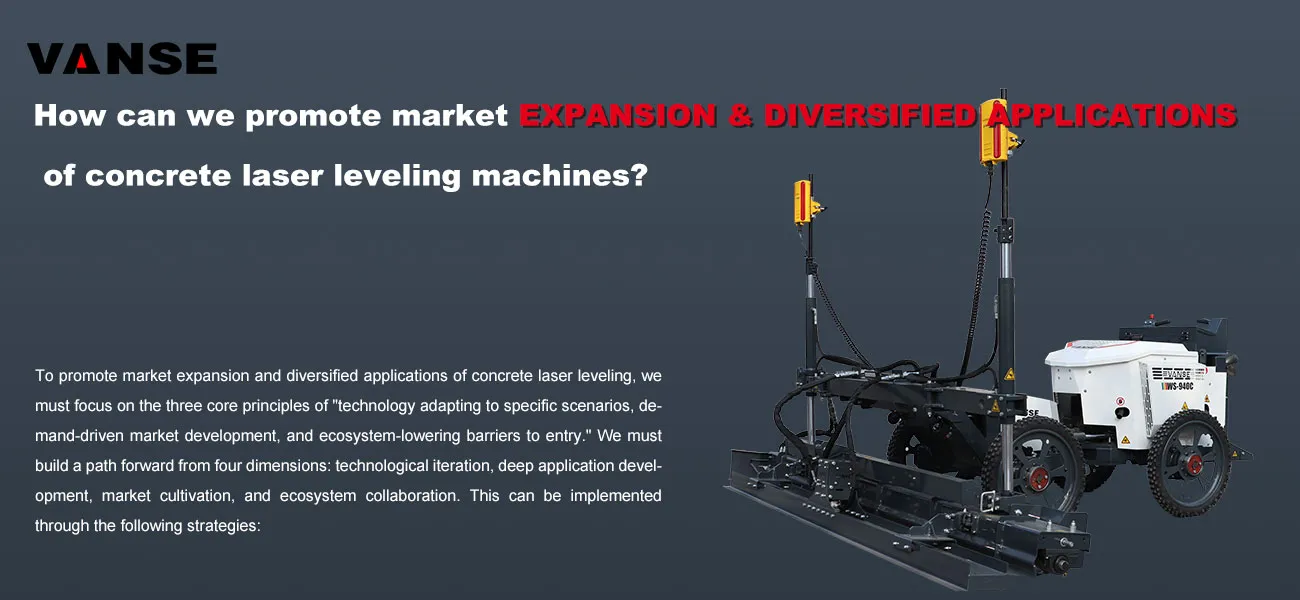
To promote market expansion and diversified applications of concrete laser leveling, we must focus on the three core principles of "technology adapting to specific scenarios, demand-driven market development, and ecosystem-lowering barriers to entry." We must build a path forward from four dimensions: technological iteration, deep application development, market cultivation, and ecosystem collaboration. This can be implemented through the following strategies:
1. Technological Iteration: Breaking Application Boundaries with Scenario-Based Innovation
The core bottleneck of concrete laser leveling is that general-purpose models are difficult to adapt to specific application scenarios. Technical customization and functional expansion are necessary to cover more construction scenarios:
Development of Specific Scenario-Specific Models
For small/special-shaped applications: Develop lightweight, splittable models (such as portable devices that can be disassembled into 2-3 modules) suitable for construction in small spaces such as indoor floors, villa courtyards, and narrow alleyways. This addresses the limitations of traditional large equipment, which often require limited access and maneuverability. This also reduces unit costs (targeting 1/3-1/2 of those of large equipment), attracting small and medium-sized construction teams.
For special material applications: Develop specialized models suitable for steel fiber reinforced concrete, permeable concrete, and lightweight concrete. For example, by adjusting the vibration frequency (for steel fiber reinforced concrete, reducing the frequency to avoid aggregate breakage) and optimizing the distribution structure (for permeable concrete, reducing aggregate compression), these machines address the pain points of low leveling accuracy and material segregation in special material construction, allowing them to enter niche markets such as municipal permeable pavement and industrial wear-resistant flooring.
Targeting extreme environments: Developing models suitable for high temperatures (above 50°C), low temperatures (below -20°C), and high altitudes (above 3,000 meters). By optimizing the hydraulic system's heat resistance, upgrading the battery's low-temperature endurance (e.g., using a low-temperature battery capable of starting at -40°C), and adjusting the laser sensor's anti-interference algorithm (to adapt to strong ultraviolet rays at high altitudes), we aim to expand into markets such as western infrastructure and northern winter construction.
Functional cross-industry integration and expansion
Integrated "leveling + inspection + repair" functionality: A real-time flatness detection module (e.g., laser rangefinder + data analyzer) is installed on the equipment to directly generate a flatness report after construction. For small defects, a small repair nozzle (capable of spraying concrete repair agent) is provided to achieve a closed loop of "construction – quality inspection – micro-repair," enhancing competitiveness in high-precision applications such as electronics factories and laboratory floors.
Linking upstream and downstream process equipment: Developing intelligent interfaces that connect with concrete pumps and automatic finishing machines. Using the Internet of Things, coordinated control of "delivery volume – leveling speed – finishing timing" is achieved (e.g., the pump automatically adjusts feed rate based on the progress of the finishing machine). This creates a "fully automated production line" and attracts large construction groups (e.g., China Construction and China Railway).
2. Deepening application scenarios: From "single sector" to "full industry coverage"
Currently, laser leveling machines are primarily used in industrial plants and large plazas. Through "demand exploration and case studies," they need to penetrate more industries.
Key industry breakthrough strategies
| Target industries | Core Demand Pain Points | Targeted Solutions |
| Municipal engineering | Tight construction schedules (e.g., road reconstruction), complex environments (e.g., numerous underground pipelines) | Developed "quick assembly and disassembly + narrow-width operation" models (such as the 1.2m narrow-width leveling head), suitable for municipal roadside and sidewalk construction; equipped with an underground pipeline positioning module (integrated with municipal BIM models) to avoid pipeline damage. |
| Agricultural facilities | Low cost and corrosion resistance (e.g., greenhouse floors) | Introduced an economical carbon steel model (reducing material costs by 30%) with an anti-corrosion coating; optimized leveling accuracy (meeting the needs of agricultural machinery, with an error of ≤5mm/3m), entering the construction of modern agricultural parks. |
| Transportation hubs | High loads (e.g., airport runways, high-speed rail stations), high precision | Developed a "heavy-duty" model (with a 50% increase in vibrating force to ensure concrete density); and utilized a dual laser system (primary laser + backup laser) to prevent single failures from impacting construction, meeting the high reliability requirements of transportation projects. |
| Prefabricated buildings | High precision requirements for the connection between prefabricated components and on-site floors | Developed an integrated "precast component leveling + on-site leveling" model. Laser scanning of precast component elevations automatically adjusts leveling parameters to ensure an error of ≤2mm at joints, making it suitable for floor construction in prefabricated factories and residential buildings. |
Differentiated Regional Market Expansion
First-tier Cities/Eastern Coastal Areas: Focusing on "high precision and intelligence" needs, promote high-end models equipped with 5G remote control and digital twins, focusing on "efficiency + quality" (e.g., electronics factories and high-end commercial buildings), and build brand awareness through case studies (e.g., the Shanghai Disneyland floor and Shenzhen Airport T3 Terminal).
Central and Western Regions/Third- and Fourth-tier Cities: Focusing on "cost-effectiveness and practicality," launch economical models (with a 20%-30% price reduction), simplify non-core functions (e.g., retaining foundation leveling and vibration, eliminating cloud management), and offer "rent-to-buy" services (lowering the initial investment threshold) to meet the needs of infrastructure construction in the central and western regions (e.g., county-level industrial parks and rural road paving).
3. Market Cultivation: Lowering the Barriers to Entry from "Purchase to Use to Maintenance"
Users (especially small and medium-sized construction teams) face challenges with high procurement costs, difficult operation, and expensive maintenance. They need to lower barriers to entry through "financial support + training services + after-sales optimization":
Lowering the Procurement Barrier
Financial Instrument Innovation: We collaborate with banks and leasing platforms to launch solutions such as "financial leasing" (30% down payment, 2-3 year installments), "rent-to-buy" (monthly rental as low as 1.5% of the total equipment price), and "old equipment replacement" (discounts on old traditional leveling equipment) to alleviate funding pressures for small and medium-sized teams.
Bulk Purchase Discounts: For large clients such as construction groups and local municipal investment companies, we offer "bulk purchase + customized services" (such as adjusting machine parameters according to project requirements), offering a 10%-15% bulk discount and bundled maintenance services (such as two years of free maintenance) to increase repeat purchase rates among large clients.
Simplified Operations and Training
Intelligent Operation: Developed a "foolproof" control system, presetting core parameters (such as leveling thickness and vibration frequency) for scenario modes like "Municipal Road" and "Factory Floor." Operators simply select the scenario and start the equipment, requiring no specialized skills (reducing training time from 7 days to 1 day).
Established a training system: Collaborated with local housing and construction departments and vocational colleges to offer "free operator training + certification" services (such as issuing a "Laser leveling Operator Certificate"). Furthermore, short video tutorials (such as the "One-Minute Startup Guide" on Douyin and Kuaishou) and an online simulation app were developed to reduce learning costs.
Optimized after-sales and maintenance
Localized Service Network: Regional Service Centers will be established in key regions (such as the Yangtze River Delta, Pearl River Delta, and Chengdu-Chongqing), staffed with maintenance engineers and spare parts warehouses. We promise a "2-hour response and 24-hour on-site service" (within 48 hours in remote areas), addressing the pain points of slow after-sales service and spare parts shortages.
Intelligent Operation and Maintenance Services: Equipment will be equipped with a "remote diagnostic module" that uses AI algorithms to monitor the status of key components (such as hydraulic pumps and laser sensors) in real time, providing early warning of faults (e.g., "Hydraulic oil temperature is too high, recommended replacement within 3 days") and automatically sending notifications of nearby repair locations to minimize downtime.
4. Ecosystem Synergy: Building a "Chain + Standard" Support System
A single company cannot drive market adoption. It is necessary to collaborate with industry chain partners, leverage policy initiatives, and establish industry standards to create synergistic effects:
Chain Chain Synergy
Upstream: Collaborate with concrete admixture companies (such as water-reducing agent manufacturers) and sensor companies (such as lidar manufacturers) to jointly develop "equipment + material" adaptation solutions (e.g., matching specific water-reducing agent formulas with equipment vibration frequency to improve leveling results), thereby reducing user trial-and-error costs.
Downstream: Collaborate with architectural design firms and supervisory agencies to incorporate laser leveling construction techniques into design specifications (e.g., specifying in construction drawings that "laser leveling technology is used, with a flatness error of ≤3mm/3m"), guiding construction adoption through design. Simultaneously, collaborate with real estate developers and municipal engineering general contractors to create "demonstration projects" (e.g., using laser leveling in a residential community to demonstrate the advantages of "no sanding and cracking"), fostering word-of-mouth communication.
Brand and Awareness Building
Industry Exhibition Promotion: Dedicated zones will be set up at major exhibitions such as Bauma China and the China Construction Expo, offering live demonstrations of various construction scenarios (e.g., narrow-width models operating in simulated tunnels, heavy-duty models operating on simulated airport runways) to visually showcase the equipment's advantages.
Customer Case Studies: "Customer Story" content will be produced and disseminated in industry media (such as Construction Machinery Magazine) and on short video platforms (Facebook, YouTube, Instagram, Douyin, and Video Accounts) to enhance the trust of potential users.
Through these strategies, we will achieve "technology adaptation to specific scenarios, lowering service barriers, and expanding the ecosystem's impact," transforming concrete laser leveling from a niche device to a standard feature in floor construction across all industries, ultimately achieving breakthroughs in both market size and application scenarios.
Note:
The parameters provided in this document are for reference only and are not mandatory. Due to differences in technical characteristics between different brands and models of laser levelers, please consult the manufacturer for a suitable solution before actual operation. This reference document assumes no responsibility for any issues arising from failure to follow the manufacturer's instructions.
Thanks to All the Friends Who Support and Trust Shandong Vanse Machinery Technology Co., Ltd.
If you want to know more about Shandong Vanse Machinery Technology Co., Ltd. or have any questions, please feel free to contact us:
Our Factory
Shandong Vanse Machinery Technology Co., Ltd.








Share this article

About the Author: Shandong Vanse Machinery Technology Co., Ltd.
Shandong Vanse Machinery Technology Co., Ltd. is a high-tech manufacturer specializing in concrete construction machinery, including laser screeds and related equipment. The company integrates R&D, production, and global sales, with products exported to over 60 countries and widely used in infrastructure projects worldwide.
Previous Post
Next Post
Related Articles
You Might Also Like
Discussion on the floor construction technology using laser leveling machine
1. Construction preparation: – Equipment debugging: Perform a comprehensive inspection and debugging of the laser leveling machine to ensure its good performance and normal operation. – Benchmark setting: Make at least 2 fixed benchmark leveling points based on the original leveling point to control the floor elevation. – Site cleaning: Remove debris, garbage, etc. in the construction area to ensure that the base is flat and clean. – Material preparation: Prepare the required concrete, hardened materials, etc., and ensure that their quality meets the requirements. 2. Concrete paving: – Within the effective range of the telescopic arm of the laser leveling machine, first spread the concrete roughly by hand, and the thickness is slightly higher than the design elevation. – Then the laser leveling machine completes the vibration, compaction, and leveling work at one time to ensure that the concrete surface is flat and uniform. 3. Spreading of hardened materials: – When the concrete is initially set (a 3-5mm mark is left by the finger pressure test), first spread 2/3 of the hardened aggregate (non-metallic aggregate or metal aggregate and alloy aggregate) evenly in the vertical and horizontal directions to allow the material to fully absorb the moisture in the concrete. – Use a smoothing machine to smooth it, and then spread the remaining 1/3 of the hardened aggregate evenly, smooth it several times and then smooth it. The corners should be smoothed and smoothed with a manual trowel. 4. Maintenance and cutting of expansion joints: – After the construction is completed, the curing agent (water plus film, wax, sealing curing agent) can be used for curing, and the curing time should not be less than 7 days. – Cutting should be carried out at the earliest time while ensuring that the cutting does not burst the edge. Generally, the cutting should be completed 1-3 days after completion depending on the weather conditions and the concrete conditions at the time to prevent irregular cracking. The spacing of the cutting joints is determined according to the distance between the workshop columns, and it is preferably no more than 6m. The cutting line should be uniformly marked to ensure that the cutting joints are neat and straight, and the cutting depth should be at least 1/3 of the thickness of the concrete base. 5. Flatness test: – Use f-meter or measuring equipment of the same level to test the flatness to ensure that the flatness of the floor meets the requirements. – Repair the uneven areas detected in time. 6. Seam filling: – Before using the floor, fill the cut seams with seam filling glue to prevent debris from entering the seams and affecting the service life of the floor. The use of laser leveling machine for floor construction can greatly improve the construction efficiency and quality, reduce manual errors, and make the floor flatter and smoother. During the construction process, the operation should be carried out strictly in accordance with the construction process requirements to ensure construction safety and quality.How serviceable is a concrete laser leveling machine?
The maintainability of the concrete laser leveling is one of its important characteristics, which directly affects the reliability and service life of the equipment. Here's a 2,000-word analysis of the serviceability of concrete laser levelings: 1. The importance of maintainability Maintainability refers to the ability of equipment to be easily repaired and parts replaced to restore its normal working condition after failure or damage. For concrete laser levelings, the importance of maintainability is reflected in the following aspects: Equipment reliability and longevity The maintainability of the concrete laser leveling directly affects the reliability and service life of the equipment. If equipment is difficult to repair or parts can be replaced after a failure, the reliability of the equipment will be severely affected and its service life will be shortened. Production efficiency and cost control If the repairability of the concrete laser leveling is not good, it will take more time and cost to repair and replace parts after the equipment fails. This will affect production efficiency and increase the company's operating costs. Safety If the serviceability of the concrete laser leveling is not good, there may be safety risks involved during the repair process. For example, if parts need to be replaced manually, the operator may be exposed to hazards such as high temperatures or high pressures. 2. Factors affecting maintainability Equipment design and construction The design and structure of a concrete laser leveling are important factors affecting its maintainability. If the design and structure of the equipment are not reasonable, you may encounter difficulties during the repair process or even be unable to repair it. Replacement of parts The replaceability of concrete laser leveling machine parts is also an important factor affecting its maintainability. If parts are difficult to purchase or replace, it will take more time and cost to repair the equipment after it fails. Operator skills and experience The operator's skills and experience are also important factors affecting the maintainability of the concrete laser leveling. If the operator does not receive adequate training or experience, effective repairs may not be possible after equipment failure. 3. Measures to improve maintainability Optimize equipment design and structure In order to improve the maintainability of the concrete laser leveling, its design and structure should be optimized. For example, the convenience of maintenance should be taken into consideration during the design process, and modular and standardized designs should be adopted as much as possible to reduce difficulties that may be encountered during the maintenance process. Improve part replaceability In order to improve the maintainability of the concrete laser leveling, the replaceability of components should be improved. For example, choose components that are easy to purchase and replace and avoid parts or materials that are too specialized. In addition, a complete spare parts inventory system should be established to ensure that parts can be replaced in time when equipment fails. Improve operator skills and experience In order to improve the maintainability of concrete laser leveling machines, the operator's skills and experience should be improved. Operators should receive adequate training and skills improvement programs to understand the performance and use of equipment, as well as how to perform effective repairs when equipment malfunctions. In addition, operators should be regularly organized to conduct experience exchanges and technical seminars to improve the technical level of operators. Develop maintenance plans and record maintenance logs In order to improve the maintainability of the concrete laser leveling, a reasonable maintenance plan should be developed and a maintenance log should be recorded. By formulating a reasonable maintenance plan, potential fault problems can be discovered and solved in time to avoid the expansion of faults. At the same time, recording maintenance logs can help operators understand the maintenance history and fault conditions of the equipment, and provide reference for subsequent maintenance and upkeep. 4. Summary The maintainability of the concrete laser leveling is one of its important characteristics, which directly affects the reliability and service life of the equipment. In order to improve the maintainability of equipment, a series of measures should be taken, including optimizing equipment design and structure, improving the replaceability of components, improving operator skills and experience, formulating maintenance plans and recording maintenance logs, etc. These measures can help companies improve production efficiency and cost control capabilities while ensuring the safety and reliability of equipment.How to perform regular maintenance on concrete laser leveling machine?
◆◆★◆◆ Introduction Concrete laser leveling machine is an indispensable and important equipment in modern building construction. Its performance stability and service life directly affect the quality and progress of the project. In order to ensure long-term efficient operation of the equipment and reduce the failure rate, regular maintenance is an essential link. This article will elaborate on how to perform regular maintenance on concrete laser levelings, aiming to provide operating guidelines for equipment operators and maintenance personnel. ◆◆★◆◆ The importance of maintenance Regular maintenance plays a vital role for concrete laser leveling machines. By regularly inspecting, cleaning, tightening, adjusting, and lubricating the equipment, the service life of the equipment can be effectively extended, sudden failures can be reduced, and leveling efficiency and construction quality can be improved. At the same time, maintenance can also detect potential safety hazards in time to ensure the safety of operators. ◆◆★◆◆ Maintenance cycles and projects 1. Daily maintenance: performed before and after daily work, mainly including equipment cleaning, checking whether all components are tight, and refueling lubrication points, etc. 2. Weekly maintenance: Carry out once a week. In addition to daily maintenance, it is also necessary to check the wear and tear of various moving parts, the oil level and oil quality of the hydraulic system, etc. 3. Monthly maintenance: Carry out once a month, including comprehensive inspection of all parts of the equipment, tightening loose parts, cleaning or replacing filter elements, etc. 4. Quarterly maintenance: Carry out once a quarter, mainly to conduct a comprehensive inspection, adjustment, tightening, lubrication of the equipment, and replace seriously worn parts, etc. 5. Annual maintenance: Carry out once a year, including comprehensive inspection of all parts of the equipment, replacement of severely worn parts, cleaning of oil tanks and hydraulic systems, etc. ◆◆★◆◆ Maintenance steps and methods 1. Equipment cleaning: Use a soft cloth or brush to remove dust and oil on the surface of the equipment, paying special attention to the cleaning of sensitive components such as laser receivers and control systems. 2. Inspection and tightening: Check whether all parts of the equipment are tightened. If they are loose, tighten them in time. Use appropriate tools and tighten to the specified torque. 3. Lubrication: According to the requirements of the equipment lubrication chart, refuel or change the oil at each lubrication point of the equipment. Use specified lubricating oil or grease to ensure the equipment is well lubricated. 4. Check the wear and tear: Check the wear and tear of each moving part of the equipment. If the wear is serious, replace it in time. Wear parts, such as blades, scrapers, etc., should be inspected and replaced regularly. 5. Clean the hydraulic system: Clean the hydraulic system tank and filter regularly, and replace the hydraulic oil. Check the hydraulic pipeline for leakage and damage. If so, repair or replace it in time. 6. Check the electrical sys tem: Ch eck whether the circuits and components of the equipment's electrical system are intact. If damaged, replace them in time. Dust and tighten electrical components regularly. 7. Adjustment and calibration: Adjust and calibrate the equipment according to the equipment usage and construction requirements. Such as adjusting the angle and position of the laser emitter to ensure leveling accuracy; calibrating control system parameters to improve leveling efficiency, etc. ◆◆★◆◆ Maintenance precautions 1. Stop the machine and disconnect the power supply before maintenance to ensure that the equipment is in a safe state. 2. Special tools and specified lubricants and greases should be used during maintenance. 3. During the maintenance process, attention should be paid to observing the operation of each component of the equipment. If there is any abnormality, the machine should be stopped for inspection and dealt with in time. 4. After maintenance, a trial run should be carried out to check whether the equipment is operating normally and there are no abnormalities. 5. Maintenance records should record in detail the time, content, replaced parts and other information of each maintenance to facilitate follow-up tracking and management. ◆◆★◆◆ Conclusion Regular maintenance is a key link to ensure long-term and efficient operation of the concrete laser leveling. By formulating reasonable maintenance cycles and projects, adopting correct maintenance steps and methods, and paying attention to safety and details during maintenance, the service life of the equipment can be effectively extended, the failure rate can be reduced, and the leveling efficiency and construction quality can be improved. . At the same time, regular maintenance can also reduce maintenance costs and improve the overall efficiency of the equipment. Therefore, construction units should attach great importance to regular maintenance of concrete laser leveling machines to ensure that the equipment is always in good operating condition.