Technical Knowledge
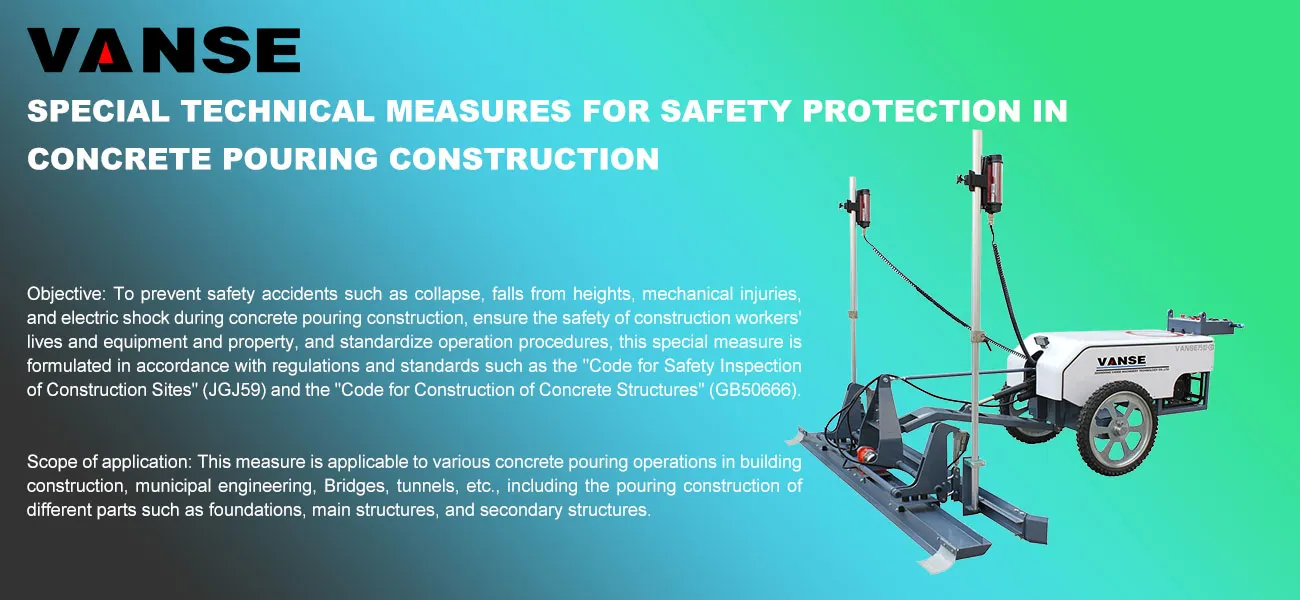
Special technical measures for safety protection in concrete pouring construction
Special technical measures for safety protection in concrete pouring construction
Ⅰ. General Provisions
Objective: To prevent safety accidents such as collapse, falls from heights, mechanical injuries, and electric shock during concrete pouring construction, ensure the safety of construction workers' lives and equipment and property, and standardize operation procedures, this special measure is formulated in accordance with regulations and standards such as the "Code for Safety Inspection of Construction Sites" (JGJ59) and the "Code for Construction of Concrete Structures" (GB50666).
Scope of application: This measure is applicable to various concrete pouring operations in building construction, municipal engineering, Bridges, tunnels, etc., including the pouring construction of different parts such as foundations, main structures, and secondary structures.
Ⅱ. Safety Preparations Before Work
(1) Technical Preparation and Briefing
Before construction, a special construction plan should be prepared, clearly specifying the pouring sequence, material distribution method, machinery selection and safety protection requirements. It should be implemented after approval by the technical supervisor.
Conduct three-level safety briefings for all personnel involved in the operation: project-level briefing on the overall safety risks of the construction, team-level briefing on the operation norms of the positions, and on-site briefing on the potential hazards of specific operation points (such as edges, openings, and high-voltage line locations). The briefings must be signed for confirmation and archived.
(2) On-site environmental inspection
Inspect the surrounding environment of the pouring area:
Clear the debris on the work surface, and confirm that 1.2-meter-high guardrails have been set up at the edges (such as foundation pits, floor slab edges) and openings (with 20cm high toe boards at the bottom of the guardrails and an additional horizontal bar in the middle). The guardrails should be painted with red and white warning paint and hung with close-mesh safety nets.
Check the load on the working surface:
Verify the bearing capacity of the formwork support system to ensure that the concrete stacking height does not exceed the specification requirements (the stacking height during floor slab pouring is ≤100mm), and prevent the support from collapsing due to overloading.
Check for electrical safety:
Confirm that the distribution box meets the requirements of "one machine, one switch, one leakage protection, and one protection". The cables in the pouring area should be overhead or run through pipes for protection to prevent damage from being crushed. When working in a humid environment, the lighting voltage should be 36V or lower, which is a safe voltage.
(3) Equipment and Material Preparation
Concrete conveying equipment (pump trucks, ground pumps, placing machines) :
Check whether the braking system, hydraulic system and pipe joints of the equipment are in good condition. The outriggers of the pump truck need to be supported on a solid ground (with steel plates or square timbers as pads), and confirm that the outriggers are fully extended and the ground bearing capacity meets the requirements.
Protective supplies:
Personal protective equipment such as safety helmets, anti-slip shoes, insulating gloves, and dust masks should be provided. When working at heights, safety belts (high hanging and low use) and operation platforms (fully covered with scaffolding boards and surrounded by guardrails) should be prepared. Backup emergency supplies (such as first aid kits, fire extinguishing equipment, and warning tapes).
Ⅲ. Safety Protection during Pouring Process
(1) Personnel operation protection
High-altitude work protection:
When the pouring height is ≥2 meters, an operation platform or scaffolding must be used. It is strictly prohibited to stand on formwork or steel bars for work. Workers should fasten their safety belts, and the hooks of the safety belts should be hung on solid structural components. It is strictly prohibited to walk on unfixed components.
Edge operation protection:
When pouring foundation pits, slopes and other edge parts, set up warning areas and prohibit non-operation personnel from entering. Workers should maintain a safety distance of no less than 1 meter from the edge of the edge. Anti-slip scaffolding boards should be laid if necessary.
Dust-proof and heat-proof protection:
During summer pouring, shading measures should be taken to prevent personnel from suffering from heatstroke. When pouring in winter, when hot water is used to mix concrete, it is necessary to prevent steam scalding. Workers should wear anti-scalding gloves. When there is a lot of cement dust, wear dust masks and set up spray dust suppression equipment on site.
(2) Mechanical operation protection
Operation precautions for pump trucks and material distribution machines:
No one is allowed to stand within the rotation radius of the material distribution rod of the pump truck. Before operation, make sure there are no high-voltage lines or obstacles within the rotation range. The placing machine should be firmly fixed. Before use, check whether the outriggers and the rotating mechanism are locked. It is strictly forbidden to carry out pouring operations when the placing machine is in motion.
Vibrator usage protection:
The operator of the vibrator should wear insulating shoes and insulating gloves. The cable of the vibrating rod should be protected from damage. It is strictly forbidden to drag the cable. When vibrating, avoid touching the steel bars and formwork to prevent the vibration rods from bouncing and injuring people. When the vibrator is not in use, cut off the power supply and place it in a dry area.
Concrete transportation protection:
When transporting concrete by tanker, the driver must abide by traffic rules. No one is allowed to stand under the unloading port of the tanker. The ground pump conveying pipeline is firmly fixed. Check the sealing condition of the pipeline joints to prevent concrete leakage and spraying from injuring people. When replacing the pipeline, first turn off the power of the ground pump, release the pressure, and then disassemble it.
(3) Support system protection
During the pouring process, dedicated personnel should be assigned to monitor the formwork support system, with a focus on checking the verticality of the vertical rods, the spacing of the horizontal rods, and the setting of the sweeping rods. If any deformation of the vertical rods or loosening of the horizontal rods is found, the pouring should be immediately halted, and personnel should be organized to evacuate. Work can resume only after the reinforcement and rectification are completed.
The pouring sequence follows the principle of "symmetrical pouring and layered pouring" to avoid instability of the support system due to excessive local loads. The thickness of the layered pouring shall be carried out in accordance with the specifications (generally ≤500mm), and it is strictly prohibited to pour the formwork in a centralized manner at one time to avoid deformation.
Ⅳ. Mechanical and Electrical Safety Management
(1) Mechanical maintenance and operation
Regular maintenance and servicing of concrete conveying equipment, vibrators and other machinery should be carried out. The operating status of the equipment should be recorded. If any fault is found, the machine should be stopped immediately for repair. It is strictly prohibited to operate with faults. Mechanical operators must be certified and familiar with the equipment operation procedures. Unlicensed personnel are strictly prohibited from operating.
When the pump truck is in operation, a dedicated person should be assigned for command. The command personnel should use standard signals (flag language or walkie-talkies) to avoid communication errors with the driver. When the fabricating machine is moving, it should proceed slowly to prevent collision with structural components or personnel.
(2) Electrical Safety Management
On-site electricity usage should be operated by professional electricians. It is strictly prohibited for non-electricians to connect or disconnect wires. The distribution box in the pouring area is locked and a warning sign saying "Beware of Electric Shock" is posted. There are no debris within 1.5 meters around the distribution box.
When working in rainy weather, cover the distribution box and electrical equipment, and check the grounding resistance (grounding resistance ≤4Ω) to prevent leakage accidents. After the operation is completed, cut off the power supply of all equipment, organize the cables, and avoid crushing or soaking them.
Ⅴ. Emergency Response Measures
Collapse accident handling:
In the event of a collapse of the formwork support, immediately stop the operation, organize personnel to evacuate to a safe area, and prohibit blind rescue. Call the 120 emergency number and at the same time use excavators, jacks and other equipment to clear the collapsed objects and rescue the trapped people to prevent secondary collapse.
Handling of falls from heights and mechanical injuries:
In the event of a person's fall or mechanical injury, immediately stop the operation, transfer the injured person to a safe area, check the injured person's consciousness and breathing. If fractures or bleeding occur, take temporary immobilization and hemostasis measures, and call 120 for medical treatment. In the event of an electric shock accident, cut off the power supply first, then rescue the injured person to prevent the rescuers from getting electrocuted.
Fire accident handling:
In case of fire caused by electrical faults or flammable materials burning, immediately cut off the power supply, use on-site fire extinguishing equipment to put out the fire, evacuate people to a safe area, call 119 to report the fire, and at the same time clear flammable materials around to prevent the fire from spreading.
Ⅵ. Safety Inspection and Acceptance
Daily inspection:
Before each day's work, the team conducts a pre-shift safety inspection, with a focus on personal protective equipment, equipment status, and protective facilities. The project organizes safety inspections every week to identify potential hazards and issue rectification notices, and follows up on the rectification progress.
Special acceptance:
Before pouring, a special acceptance shall be conducted on the formwork support system, operation platform and electrical equipment. Only after the acceptance is qualified and signed for confirmation can the pouring operation begin. If the acceptance is not qualified, construction is strictly prohibited until the rectification meets the standards.
Ⅶ. Safety Education and Training
Safety education and training should be provided to newly arrived workers. Only after passing the assessment can they take up their posts. Regularly organize special training on concrete pouring safety, explaining accident cases, operation norms, and emergency skills to enhance personnel's safety awareness.
Special operation personnel (such as pump truck drivers, electricians, and scaffolders) must hold relevant certificates to work. Those with expired certificates or those that have not undergone annual review are prohibited from engaging in related operations. Regularly organize refresher training for special operation personnel to update their safety knowledge.
Instructions for Use:
This plan is a general template. Before the specific implementation of each project, it should be refined and supplemented according to the characteristics of the project (such as super-high, super-heavy, large-span structures, etc.), especially the control measures for major hazard sources.
Thanks to All the Friends Who Support and Trust Shandong Vanse Machinery Technology Co., Ltd.
If you want to know more about Shandong Vanse Machinery Technology Co., Ltd. or have any questions, please feel free to contact us:
Our Factory
Shandong Vanse Machinery Technology Co., Ltd.








Share this article

About the Author: Shandong Vanse Machinery Technology Co., Ltd.
Shandong Vanse Machinery Technology Co., Ltd. is a high-tech manufacturer specializing in concrete construction machinery, including laser screeds and related equipment. The company integrates R&D, production, and global sales, with products exported to over 60 countries and widely used in infrastructure projects worldwide.
Previous Post
Next Post
Related Articles
You Might Also Like
Superflat Floor Flatness Standards (FF/FL Values) Interpretation and Testing Methods
In logistics warehousing, precision manufacturing, and other fields, **superflat floors** are fundamental to ensuring the smooth operation of high-reach forklifts, automated guided vehicles (AGVs), and high-precision equipment. The core indicator for measuring floor quality is the F-Numbers (F-value), which mainly includes two values: FF and FL. The following is an in-depth summary of its standard interpretation and testing methods: Compared to the traditional "3-meter straightedge test method," the F-value system uses statistical analysis of the undulations of the floor surface to more scientifically reflect the actual working performance of the floor. Meaning: Describes the degree of "undulation" (local unevenness) of the floor surface. Calculation Principle: Calculates the curvature change by measuring the height difference every 300mm (1 foot). Performance Characteristics: A higher FF value indicates a smoother floor, resulting in less shaking and bumping when forklifts are in motion. Meaning: Describes the overall inclination of the floor relative to the design horizontal plane (macro slope). Calculation Principle: Measures the total height difference over a distance of 3000mm (10 feet). Performance Characteristics: A higher FL value indicates a floor closer to absolute level. This is crucial for the verticality of high-bay racking (VNA). According to ACI (American Concrete Institute) 302.1R standard, floor grades are typically classified as follows: Flooring Classification Specify overall flatness (FF) Specify overall flatness (FF) Applicable Scenarios Standard 20 15 Machine rooms, parking lots, general warehouses Standard Grade 25 20 Light industrial and commercial office buildings Flat Grade 35 25 Narrow aisle warehouses (non-high-rise), laboratories Extra Flat Grade 45 35 Ice rinks, precision manufacturing plants Super Flat Grade 60+ 40+ High-rise VNA warehouses (above 12 meters), television studios The internationally accepted testing standard is ASTM E1155. Domestically, this standard or industry regulations are typically referenced for acceptance testing. This is currently the most widely recognized testing tool. It is a walking electronic level; the operator pushes it across the ground, and the device automatically records the elevation difference between every two points (usually 300mm apart). Golden Time: Testing should be conducted within 24 to 72 hours after concrete pouring. Reason: Because concrete undergoes long-term shrinkage and warping, early testing reflects construction quality, while later testing is affected by structural deformation. Test Line Layout: Multiple parallel and perpendicular test lines are typically laid out within each test section. Total Length Requirement: At least 34 elevation measurements are required per 1000 square feet (approximately 93 square meters) to ensure the validity of the statistical data. The acceptance report will show two key evaluation dimensions: Specified Overall Value (SOV): The average score for the entire floor slab, which must meet the design specifications. Minimum Local Value (MLV): The permissible baseline for quality (typically 60%-70% of the SOV). Even if the overall score is acceptable, if a local MLV fails to meet the standard, that area must be repaired. Laser leveling: Using a high-precision laser leveling is essential to achieving an F-value > 40. Repeated Scraping with a Highway Straightedge: Before the concrete initially sets, repeated cross-scraping with a large leveling (Highway Straightedge) is crucial for improving the F-value. Segmented Construction: Using a long-strip construction method makes it easier to control precision compared to large-area pouring. Note: The parameters provided in this document are for reference only and are not mandatory. Due to differences in technical characteristics between different brands and models of laser levelers, please consult the manufacturer for a suitable solution before actual operation. This reference document assumes no responsibility for any issues arising from failure to follow the manufacturer's instructions.How to make laser leveling machine parts last longer?
As a brand-new floor construction equipment, the laser leveling/ leveling machine has been widely concerned by the industry due to its excellent construction efficiency and construction accuracy once it has entered the market, and has been more and more used in warehouses, basements, parking lots, Large-area concrete floors such as industrial plants are under construction. Like other construction machinery, the laser leveling/ leveling machine is also a whole composed of many parts, and the construction environment is relatively complicated, so it is easier to wear than the parts of general machinery during long-term work. In order to prolong the effective life of the laser leveling/ leveling machine, the following is a brief introduction to the main components of its components and the skills of use and maintenance. —-THE CORE COMPONENTS AND FUNCTIONS OF LASER LEVELING/ leveling MACHINE— ➤Drive Train: mainly composed of transmission, universal joint, drive shaft and drive axle; ➤Driving System: composed of frame/axle/suspension/wheels, etc. The function is to support the quality of the whole vehicle and ensure the driving of the laser leveling machine; ➤Steering system: composed of steering wheel, steering gear, steering knuckle, steering knuckle arm, tie rod, straight tie rod, etc., the function is steering; ➤Hydraulic brake: The hydraulic brake device is composed of brake pedal, brake pump, wheel cylinder, drum brake and oil pipe and other parts; ➤Transmission: It is composed of transmission housing, transmission cover, first shaft, second shaft, intermediate shaft, reverse gear shaft, gears, bearings, operating mechanism and other parts, used for changing speed and output torque of laser leveling machine; ➤Leaf Spring and Shock Absorber: The role of the leaf spring is to maintain an elastic connection between the frame and body and the wheels or axles. The function of the shock absorber is to ease the vibration when the laser leveling machine is subjected to shock; ➤Starter: The function is to convert electrical energy into mechanical energy, drive the crankshaft to rotate, and start the engine. If the continuous starting time is too long, it will cause a large amount of battery discharge and the starter coil will overheat and smoke, which will easily damage the laser leveling machine parts; ➤Battery: The role of the battery is to supply electricity to the starter, and to supply power to the engine ignition system and other electrical equipment when the engine is started or running at low speed. When the engine is running at high speed, the generator generates enough electricity, and the battery can store excess electricity; ➤Motor: The motor is the power device of the laser leveling machine. Its main function is to generate driving torque as a power source for electrical appliances or various machinery. Its main function is to convert mechanical energy into electrical energy. At present, it is more commonly used to use heat energy, water energy, etc. to drive the rotor of the generator to generate electricity. —USE AND MAINTENANCE OF CORE COMPONENTS OF LASER LEVELING MACHINE— ➤Change lubricating oil regularly: Regularly replace the lubricating oil to ensure that all parts of the machine are well lubricated and reduce the wear of the parts; ➤Clean the whole machine and parts regularly: Keep regular cleaning of the whole and each part, and fasten loose parts in time to prevent parts from being worn or lost due to looseness; ➤Pay attention to the working load of each component during the running-in period: Pay attention to the workload of each component during the running-in period. Generally, the workload during the running-in period should not exceed 80% of the rated workload, and an appropriate workload should be deployed to prevent damage caused by the long-term continuous operation of the laser leveler. The occurrence of overheating; ➤Start the leveling engine every half a month: Start the leveling engine once every half a month, charge the battery, and run all hydraulic actuators at the same time, such as rotating hydraulic motors, telescopic cylinders, etc. Do not remove the battery from the machine to prevent damage to the controller caused by long-term parking of the equipment Symptoms of missing internal software programs; ➤Start the leveling regularly: Start the leveling machine regularly and turn on all hydraulic functions on the machine, so that the hydraulic drive components work regularly to prevent the related seals from being damaged due to long-term parking, and metal components such as cylinder rods from rusting and other failures. Shrink all the cylinder rods into the hydraulic cylinder chamber to better protect the surface of the cylinder rods. Reasonable use and regular maintenance of various parts are effective ways to prolong the service life of the laser leveling machine and improve the economic efficiency of the operation. It is suggested that before using the leveling machine, one should be fully familiar with the composition and function of each component of the machine, master the correct operation method, and strengthen daily maintenance and maintenance.How to use vibratory leveling to assist concrete laser leveling machine in small areas
In tight spaces where a massive laser leveling can't maneuver, vibratory leveling (often via a vibrating truss or power leveling) acts as the "closer." While the laser machine provides the high-tech elevation data, vibratory tools ensure the concrete is consolidated and smooth in the corners and edges the big machine can't reach. Here is how to effectively integrate the two for a seamless, flat finish. Before the vibratory equipment touches the wet concrete, the laser leveling machine must establish the grade. Benchmark Sync: Ensure your handheld laser receiver (used for the vibratory leveling) is calibrated to the exact same benchmark as the laser leveling machine. Even a 3mm discrepancy will create a visible "lip" where the two areas meet. The Overlap Zone: Always have the laser machine pass slightly into the "small area" or perimeter. This creates a leveled "pad" of concrete that your vibratory leveling can use as a guide. In small areas, the vibratory leveling needs physical points of reference since it lacks the automatic hydraulic adjustments of the laser machine. Wet leveling: Use the laser machine to strike off a strip of concrete. Use this leveled strip as one "rail" for your vibratory leveling to ride on. Handheld Laser Receivers: Mount a receiver to the pole of your vibratory leveling. As you pull the leveling, the "beep" or visual indicator tells you if you are pushing too hard (too low) or riding too high. Vibration is key for small areas because concrete near forms and corners tends to "honeycomb" (trap air). The Leading Edge: Keep a small "roll" of concrete (about about 2cm to 5cm high) in front of the vibratory blade. This head of pressure ensures that as the vibration liquefies the concrete, it fills all voids and matches the height set by the laser. Speed Control: Move the vibratory leveling at a slow, consistent pace-roughly 1m per minute. Moving too fast leaves "waves"; moving too slow sinks the aggregate too deep, leaving a weak, cream-heavy surface. Task Laser Machine Role Vibratory leveling Role Main Slab Handles 90% of the volume and leveling. Follows behind to "knit" edges. Edges/Columns Cannot reach; stays 0.5m away. Primary tool for leveling and consolidation. Grade Check Automatic/Constant. Manual check via handheld laser rod. Finish High-speed strike-off. Final "cream" pull for easy power troweling. In small areas, it's tempting to hover the vibratory leveling in one spot to "make it flat." Don't. This causes the heavy aggregate to sink and the water/laitance to rise, which leads to surface scaling later. If the grade is wrong, add or remove concrete manually, then做 one final pass with the vibratory tool. Would you like me to find a specific checklist for calibrating handheld laser receivers to match your main laser leveling? Contact us NOW Note: The parameters provided in this document are for reference only and are not mandatory. Due to differences in technical characteristics between different brands and models of laser levelers, please consult the manufacturer for a suitable solution before actual operation. This reference document assumes no responsibility for any issues arising from failure to follow the manufacturer's instructions.