Technical Knowledge
What inspection & maintenance work needs to be done before a long-idle concrete laser leveling machine is reactivated?
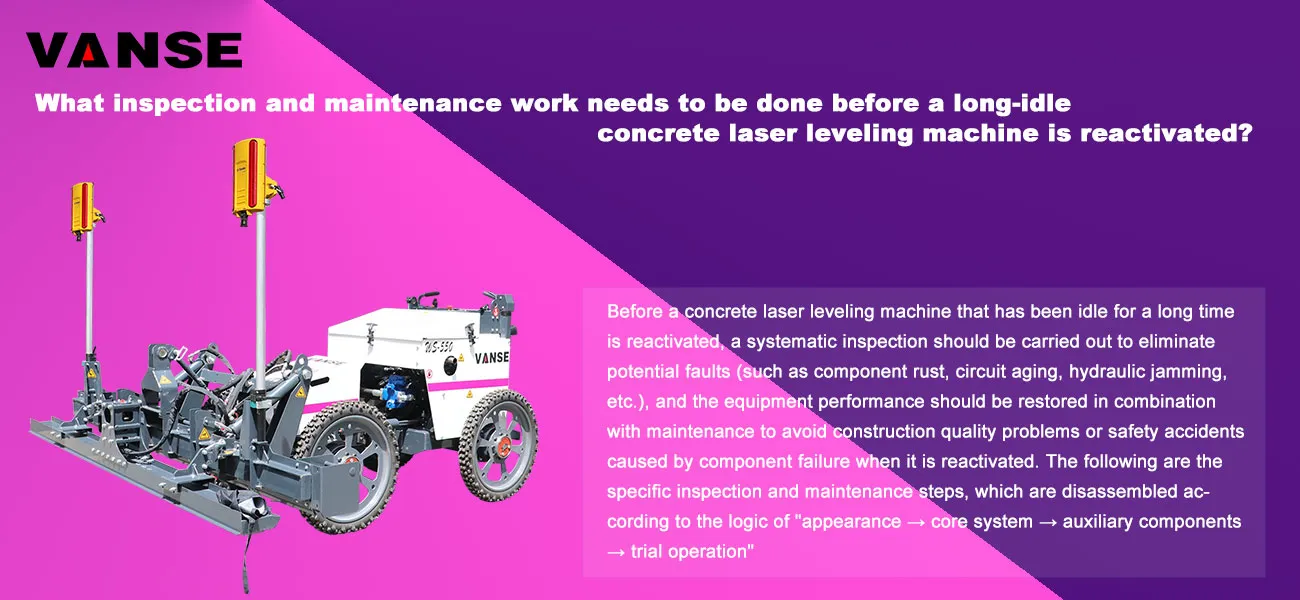
Before a concrete laser leveling machine that has been idle for a long time is reactivated, a systematic inspection should be carried out to eliminate potential faults (such as component rust, circuit aging, hydraulic jamming, etc.), and the equipment performance should be restored in combination with maintenance to avoid construction quality problems or safety accidents caused by component failure when it is reactivated. The following are the specific inspection and maintenance steps, which are disassembled according to the logic of "appearance → core system → auxiliary components → trial operation"
I. Inspection of appearance and basic components: Eliminate obvious damage and rust
First, inspect thex eterior of the equipment and its easily worn parts, with a focus on checking for physical damage, rust or loosening caused by long-term idleness. This is the foundation for ensuring subsequent system checks.
Fuselage and structural components
Check whether the frame of the machine body, the leveling scraper and the vibration beam have any deformation or cracks (especially at the welding parts). If there is any slight deformation, it needs to be corrected. If there are cracks, they need to be repaired by welding and ground smooth.
Check whether all exposed metal parts (such as bolts, pins, and connecting brackets) are rusted. Rusted areas should be cleaned with a wire brush and then coated with anti-rust oil. Severely rusted parts (such as pins that are stuck) need to be replaced.
Walking wheels/tracks
If it is a wheeled model: Check whether the tire pressure is normal (refer to the standard value in the equipment manual), whether there are cracks, bulges or foreign objects embedded in the tire surface, and whether the valve stems are leaking.
If it is a tracked model: Check whether the track plate is excessively worn (the tread depth should be replaced if it is less than 1mm), whether the track tension is appropriate (press the middle section of the track with your hand, and the subsidence should be controlled within 10-15mm), and whether the track pin shaft is stuck (try to rotate it after injecting grease).
Safety components
Check whether the protective covers of the emergency stop button and the operating handle are intact. After the emergency stop button is pressed, it should be able to immediately cut off the power and start normally after resetting.
Check whether the warning lights and buzzers are functioning properly (test after power-on), and whether the safety guardrails and anti-slip steps are firm, without any looseness or missing parts.
Ⅱ. Core System Inspection and Maintenance: Ensuring power and control accuracy
The core performance of the laser leveling machine machine relies on the power system, hydraulic system and laser control system. It is necessary to check each internal potential hazard one by one to avoid "breaking down" or precision failure when it is put into use.
1. Power system (engine/motor) : Ensure stable power output
Classify and check by model (diesel engine or electric motor)
| Type | Inspection items | Maintenance measures |
| Diesel engine | 1. Oil level and quality | If the engine oil is below the mark, it needs to be replenished (using the same type of engine oil). If it deteriorates (turns black or contains impurities), it should be completely replaced |
| 2. Fuel tank and fuel quality | 2. Drain the deteriorated diesel from the fuel tank, clean the tank and then add new diesel. Check if the fuel filter element is clogged (if it is clogged, it needs to be replaced). | |
| 3. Coolant level | 3. If the coolant is insufficient, it needs to be replenished. (Mix the antifreeze in proportion and avoid adding tap water directly.) | |
| 4. Air filter element | 4. Remove the air filter element and blow it clean in reverse with compressed air (if the filter element is damaged, it needs to be replaced). | |
| 5. Spark plugs/fuel injectors | 5. Remove the spark plugs to clean the carbon deposits (if the gap is abnormal, adjust it). The fuel injectors need to be disassembled to check the atomization effect (if the atomization is poor, clean it). | |
| Electric motor | 1. Motor housing and terminal blocks | Clean the dust off the motor casing and check if the terminal blocks are loose or oxidized (oxidation should be sanded with sandpaper). |
| 2. Carbon brushes (if any) | When the carbon brush is worn down to one-third, it needs to be replaced to ensure good contact between the carbon brush and the commutator | |
| 3. Insulation resistance | 3. Measure the insulation resistance with a megohmmeter. A resistance of ≥0.5MΩ is qualified (to avoid leakage). |
2. Hydraulic system: Prevent leakage and jamming (core of leveling action)
Long-term idleness of the hydraulic system is prone to deterioration of the oil and aging of the sealing parts, which requires special inspection:
Hydraulic oil inspection: Open the oil tank cover and observe the color of the oil (normally light yellow. If it turns black or becomes turbid, it needs to be replaced) and the liquid level (it should be within the range of "MIN-MAX" on the oil gauge. If it is insufficient, add the same type of hydraulic oil). If the oil has been idle for more than six months, it is recommended to replace it even if its appearance is normal (the oil will oxidize and become ineffective).
Leakage inspection: Check the hydraulic oil pipes, joints, and cylinders (especially the leveling cylinder and traveling cylinder) for any leakage marks. If leakage is found, replace the sealing parts or damaged oil pipes. The joint should be re-tightened according to the manual torque (to avoid over-tightening and damaging the thread).
Maintenance of hydraulic components
Clean the hydraulic oil filter element (if it is a paper filter element, replace it if it is clogged) to prevent impurities from entering the cylinder and causing wear.
Manually push the piston rod of the oil cylinder to check for any jamming (if there is jamming, disassemble the oil cylinder to clean the internal impurities and refill the hydraulic oil).
Before starting the equipment, manually rotate the coupling of the hydraulic pump to ensure there is no jamming (to avoid damage to the pump body).
3. Laser Control System: Ensuring leveling Accuracy (Key Function)
The laser system is the "eyes" of the leveling machine. When idle, it is prone to sensor moisture and poor circuit contact, and precise inspection is required
Laser emitter
Clean the dust off the transmitter lens (wipe it with a soft cloth to avoid scratches), and check the battery power (replace it if insufficient).
Power on and test whether the transmitter can emit laser normally (the laser line should be uniform and free of flicker). If the laser is weak or there is no laser at all, check the internal circuit or replace the transmitter.
Laser receiver
Check whether the receiver probe is damaged or damp (if damp, it needs to be dried), and whether the terminal blocks are loose.
Bring the receiver close to the transmitter to test if it can receive signals normally (the indicator light needs to switch normally according to the "high and low positions"). If the signal is unstable, the receiver needs to be calibrated (perform zero point calibration according to the steps in the equipment manual).
Control circuit: Check whether the connection lines of the laser control system (from the receiver to the controller, and from the controller to the hydraulic valve) are damaged or aged. The line joints need to be re-plugged and unplugged to ensure good contact (to avoid signal interruption and accuracy deviation).
Ⅲ. Inspection of Auxiliary Components: Cover details to prevent minor malfunctions from affecting the overall situation
Apart from the core system, minor issues with auxiliary components may also cause the equipment to fail to operate normally. Each one needs to be confirmed
Electrical system
Check the battery level (measure the voltage with a multimeter. For a 12V battery, a voltage of ≥12.4V is normal. If it is insufficient, it needs to be charged; if it has been idle for more than 3 months, it needs to be charged before use to avoid battery depletion and scrapping).
Clean the dust inside the distribution box, check whether the fuses are intact (replace the fuses of the same specification if they are blown), and whether the contacts of the relays and contactors are oxidized (if oxidized, sand them with sandpaper).
Lubrication system
Apply grease to the "lubrication points" marked in the equipment manual (such as walking bearings, scraper connection shafts, and laser receiver rotating shafts) (use lithium-based grease and avoid mixing different types of grease). Each lubrication point should be filled until grease overflows (ensure adequate lubrication).
Fuel/electrical auxiliary components
Diesel model: Check whether the fuel pump and fuel line are unobstructed (you can manually pump fuel to remove air), and whether the exhaust pipe is blocked (clean carbon deposits).
For electric models: Check if the charger is functioning properly (the indicator light needs to switch normally during charging), and if the cable is damaged (any damage should be repaired with insulating tape to prevent leakage).
Ⅳ. Trial Operation: From no-load to load, gradually verify the performance of the equipment
After completing all inspections and maintenance, it is necessary to conduct a trial run to confirm that the equipment is free of faults and avoid direct construction under load.
No-load test run (without concrete)
Start the equipment (engine/motor), let it idle for 5 to 10 minutes, and observe whether the power system is stable (without abnormal noise or vibration) and whether there is any leakage in the hydraulic system.
Test each action of the operation handle: walking (forward/backward, turning), lifting and lowering of the leveling scraper, and vibration of the vibrating beam. Ensure that the actions are smooth and without any lag. The laser control system can normally control the leveling height (for example, when the receiver detects the laser offset, the equipment can automatically adjust the height of the scraper).
Load test run (simulating construction state)
Lay a small amount of concrete (about 10-15cm thick) in an open area, start the equipment for leveling operation, and inspect:
Whether the walking speed is uniform (no sudden fast or slow);
Whether the vibration frequency of the vibrating beam is normal (no abnormal noise, no obvious honeycomb on the concrete surface);
The flatness of the concrete surface after leveling (measured with a 2-meter straightedge, the error should be ≤3mm/2m, meeting the construction standards).
During the trial operation, if any abnormality is detected (such as noise, leakage, or accuracy deviation), the machine must be stopped immediately and the fault rechecked.
Ⅴ. Summary: Key Points to Note
Refer to the equipment manual: The structure of laser leveling machine machines of different brands may vary. All inspections and maintenance should be based on the parameters in the equipment manual (such as hydraulic oil type, lubrication point position, torque value) to avoid misoperation.
Pre-idle record: If conditions permit, a record should be made before the next idle period (such as the time of oil change and the status of components) to facilitate targeted inspection during the next activation.
Safety precautions: During inspection and maintenance, the power source must be cut off (remove the key, disconnect the negative terminal of the battery) to prevent accidental start-up. Safety belts must be worn during high-altitude inspections (such as the installation of laser emitters) to prevent falls.
Through the above steps, the potential risks of long-term idleness can be comprehensively eliminated, ensuring that the laser leveling machine machine performs stably and meets the precision standards after being reactivated, and avoiding rework or safety accidents caused by equipment failure during construction.
Note: The parameters provided in this document are for reference only and are not mandatory. Due to differences in technical characteristics between different brands and models of laser levelers, please consult the manufacturer for a suitable solution before actual operation. This reference document assumes no responsibility for any issues arising from failure to follow the manufacturer's instructions.
Thanks to All the Friends Who Support and Trust Shandong Vanse Machinery Technology Co., Ltd.
If you want to know more about Shandong Vanse Machinery Technology Co., Ltd. or have any questions, please feel free to contact us:
Our Factory
Shandong Vanse Machinery Technology Co., Ltd.








Share this article

About the Author: Shandong Vanse Machinery Technology Co., Ltd.
Shandong Vanse Machinery Technology Co., Ltd. is a high-tech manufacturer specializing in concrete construction machinery, including laser screeds and related equipment. The company integrates R&D, production, and global sales, with products exported to over 60 countries and widely used in infrastructure projects worldwide.
Previous Post
Next Post
Related Articles
You Might Also Like
How to choose a suitable concrete laser leveling?
When choosing a suitable concrete laser leveling, you need to consider the following aspects: 1. Demand analysis: First, the construction requirements need to be clarified, including the area of concrete to be processed, flatness requirements, construction efficiency, etc. Choose the appropriate model and power according to your needs. 2. Machine performance: The performance of the machine needs to be considered, including the degree of automation, accuracy, stability, durability, etc. of the leveling machine. Machines with higher performance can provide better construction results and smoothness. 3. Technical parameters: You need to understand the technical parameters of the leveling machine, including engine power, working width, leveling accuracy, etc. These parameters will directly affect the construction effect and efficiency. 4. Reputation and service: Choosing well-known brands and products with good reputation can ensure after-sales service and machine reliability. At the same time, understand the machine's warranty and maintenance policy so that you can receive timely support and assistance during use. 5. Price and cost-effectiveness: Price is one of the factors that need to be considered when choosing a machine, but it is not the only criterion. Factors such as machine performance, technical parameters and after-sales service need to be considered to comprehensively evaluate the cost performance and select the most suitable machine. 6. Convenience of operation: Machines with simple operation and easy maintenance can improve usage efficiency and reduce usage costs. Therefore, when choosing a leveler, you need to consider its ease of operation and maintenance. 7. Cases and actual inspections: If conditions permit, you can conduct on-site inspections of some construction sites where concrete laser leveling machines are used to understand the actual construction effects and flatness so that you can better choose a suitable machine. To sum up, choosing a suitable concrete laser leveling requires comprehensive consideration of many aspects, including demand analysis, machine performance, technical parameters, reputation and service, price and cost-effectiveness, ease of operation, cases and actual inspections, etc. By comprehensively evaluating these factors, you can find the most suitable concrete laser leveling machine to improve the construction effect and smoothness.How to prevent flatness problems on concrete pavement?
To prevent the problem of flatness of concrete pavement, it is necessary to strictly control the quality in various links such as construction preparation, concrete pouring, pavement paving and subsequent maintenance. The specific measures are as follows: – Do a good job of roadbed treatment: The roadbed is the foundation of the road surface and must be guaranteed to be solid, stable and uniform. Before construction, the original ground should be carefully cleaned, weeds, tree roots, garbage and other debris should be removed, and the soft soil, silt and other unfavorable geological areas should be replaced and reinforced. Fill and compact the roadbed according to the design requirements, control the moisture content of the fill, fill and compact in layers, ensure that the compaction meets the standard, and avoid uneven settlement of the roadbed in the later stage and affect the flatness of the road surface. – Precise measurement and layout: Use high-precision measuring instruments, such as total stations, levels, etc., to accurately measure and lay out the center line, side line, elevation, etc. of the road surface. During the construction process, the measurement control points should be reviewed regularly to ensure the accuracy of the measurement data. At the same time, according to the measurement results, set the road template or the guide line of the paver to provide an accurate benchmark for road construction. – Check construction equipment: Ensure that the performance of construction equipment such as concrete mixing equipment, transport vehicles, pavers, and rollers is good and can operate normally. Carry out regular maintenance and maintenance of the equipment, and conduct a comprehensive inspection and commissioning of the equipment before construction. For example, check whether the screed of the paver is flat, whether the vibrating device is working properly, whether the roller wheel of the roller is evenly worn, etc., to ensure that the equipment operates stably during the construction process and avoid problems with the flatness of the road surface due to equipment failure. – Control concrete mix ratio: According to the road design requirements and construction conditions, determine the reasonable concrete mix ratio through experiments. Strictly control the quality and amount of raw materials such as cement, sand and gravel, water, and admixtures to ensure that the workability, strength, and durability of the concrete meet the requirements. In particular, attention should be paid to controlling the slump of concrete. The slump should not be too large or too small. If it is too large, it will easily cause concrete segregation and surface water seepage, affecting the smoothness of the road surface; if it is too small, it will make it difficult to spread and vibrate the concrete. – Ensure the quality of concrete mixing: Use a forced mixer to mix to ensure that the concrete is mixed evenly. Strictly control the mixing time. Determine the appropriate mixing time according to the mix ratio of concrete and the performance of the mixer. Generally, it should not be less than 90 seconds to ensure that the various components of the concrete are fully mixed to avoid uneven distribution of cement slurry and stone clumping, which will affect the working performance of the concrete and the smoothness of the road surface. – Reasonably arrange concrete transportation: Choose appropriate transportation vehicles to ensure that concrete does not segregate or leak during transportation. According to the distance and traffic conditions of the construction site, reasonably arrange the number of transportation vehicles and transportation routes to ensure that concrete can be supplied to the construction site in time, avoid waiting for too long during transportation, resulting in excessive slump loss, and affecting the quality of concrete spreading and vibration. – Standardize paving operation: When using a paver for concrete paving, adjust the working parameters of the paver, such as the elevation angle of the screed, vibration frequency, paving speed, etc. The paver should move forward at a uniform speed, and the speed is generally controlled at 2-3m/min to avoid too fast or too slow speed. During the paving process, a special person should be arranged to follow the machine and deal with the leakage and uneven parts on both sides of the paver in time. If manual paving is used, the paving thickness and surface flatness must be strictly controlled. Use tools such as scrapers and shovels to roughly flatten the concrete, and then vibrate it with a vibrating beam or a flat vibrator. – Strengthen vibration control: Vibration is a key link to ensure the density and flatness of concrete. According to the slump and paving thickness of the concrete, choose the appropriate vibration equipment and vibration method. Generally, a combination of an inserted vibrator and an attached vibrator is used for vibration. The inserted vibrator should be inserted vertically into the concrete, and the vibration points should be evenly distributed. The spacing should not be too large, generally about 1.5 times the radius of the vibrator. The vibration time is based on the concrete surface no longer having bubbles, slurry and sinking, generally 20-30 seconds. The attached vibrator should be installed on the formwork to make the concrete dense by vibrating the formwork. During the vibration process, the vibrator should be prevented from colliding with the formwork, steel bars and force transmission rods, so as not to affect the flatness and structural dimensions of the road surface. – Do a good job of finishing: After the concrete is vibrated, the finishing operation should be carried out in time. The finishing is generally done in two times. The first finishing is done after the concrete surface absorbs water. A wooden trowel is used to scrape the surface slurry, gravel, etc. to make the road surface flat. The second finishing is done before the concrete is initially set. An iron trowel is used for fine finishing to make the road surface flatter and smoother. At the same time, attention should be paid to controlling the strength and number of finishing to avoid excessive finishing, which may lead to excessive thickness of cement slurry on the surface, cracks, peeling, etc. – Standard roughening treatment: After finishing, roughening should be done in time to increase the roughness of the road surface and improve driving safety. The depth and spacing of roughening should be uniform. Generally, the depth of roughening is 2-3mm and the spacing is 2-4cm. Roughening can be done with tools such as a roughening machine or a broom. The roughening direction should be consistent with the driving direction of the road surface to ensure uniform and beautiful roughening quality. – Timely maintenance of the road surface: After the concrete road surface is poured, it should be maintained within 12 hours. The maintenance method can be to cover with moisturizing materials such as geotextiles and straw mats, and regularly sprinkle water to keep it moist, or spray curing agents for maintenance. The maintenance time is generally not less than 7 days. For high-strength concrete or concrete constructed in high temperature and dry environments, the maintenance time should be appropriately extended. During the maintenance period, it is necessary to ensure that the concrete surface is always moist to avoid shrinkage cracks caused by water loss in the concrete, which will affect the flatness of the road surface. – Strict traffic control: During the maintenance of the concrete pavement, strict traffic control must be carried out, and all vehicles and pedestrians are prohibited from passing on the road surface until the concrete reaches the design strength. Before the road surface is opened to traffic, the road surface must be inspected and accepted to ensure that the various indicators such as the flatness and strength of the road surface meet the design requirements. At the same time, obvious warning signs should be set up on the road surface to guide vehicles and pedestrians to bypass the construction area to avoid damage to the road surface that has not been fully formed. ARMOUR JOINT CONCRETE LASER LEVELING MACHINE LIGHT TOWER POWER TROWEL STEEL FIBER TRACKED MINI DUMPERDuring the construction process, how to ensure that the operators of the laser leveling machine can strictly abide by the operating procedures?
Ensuring that laser leveling machine operators strictly follow operating procedures is the key to construction safety and project quality. Here are some effective ways to achieve this goal: 1. **Comprehensive training**: Provide detailed theoretical and practical training to operators before they take up their posts. The training content should cover the working principle, operating steps, safety regulations and emergency handling procedures of the laser leveling machine. 2. **Operation manual and checklist**: Provide operators with clear operation manuals and daily checklists to ensure that they are familiar with each operation process and daily maintenance tasks. 3. **On-site guidance and supervision**: Arrange experienced old employees or supervisors to provide guidance and supervision at the construction site, correct improper operations in a timely manner, and answer operators' questions. 4. **Regular assessment and evaluation**: Implement regular skill assessments and assessments of compliance with operating procedures to ensure that operators' knowledge and skills remain up-to-date and proficient. 5. **Safety awareness education**: Regularly carry out safety awareness education activities to emphasize the importance of complying with operating procedures, including warnings about the consequences of illegal operations. 6. **Clear responsibility and reward and punishment mechanism**: Establish a clear responsibility system and reward and punishment mechanism, reward those who comply with the operating procedures, and punish those who violate the regulations, so as to motivate operators to comply with the regulations. 7. **Equipment maintenance and inspection**: Ensure that the laser leveling machine is regularly maintained and inspected to maintain a good working condition and avoid operating errors caused by equipment failure. 8. **Smooth communication channels**: Establish effective communication channels to encourage operators to report equipment abnormalities or difficulties in operation, solve problems in a timely manner, and prevent small problems from turning into major accidents. 9. **Emergency drills**: Organize regular emergency drills to familiarize operators with the response measures for various possible emergencies. 10. **Technology update and training**: With the development of technology, laser leveling machines may have new functions or operating methods. Operators should be updated and trained in a timely manner to ensure that they master the latest technology. Through these measures, the professional quality and safety awareness of operators can be effectively improved, ensuring that they strictly abide by the operating procedures during the construction process, thereby ensuring construction safety and project quality.