Technical Knowledge
Analysis of the correlation between the causes of common surface defects (such as color difference, scratches, and peeling) during construction and the operation of concrete laser leveling machine
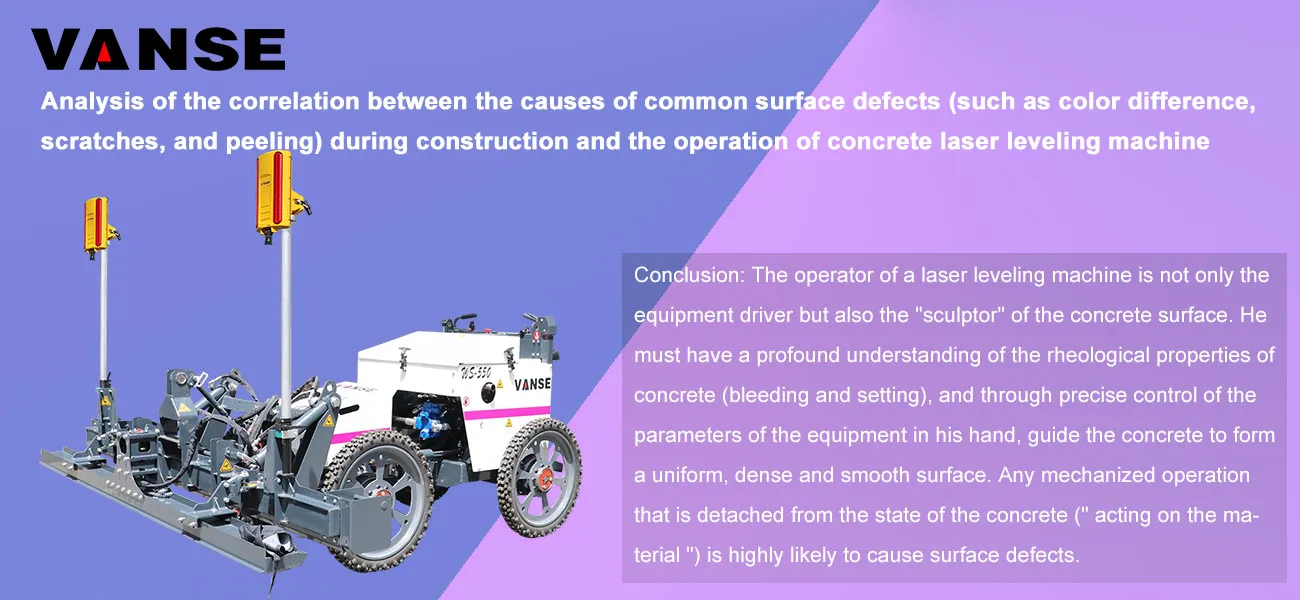
Concrete laser leveling machines are powerful tools for achieving high-precision floors, but if not operated properly, they can also directly cause or exacerbate various surface defects.
The following will conduct a detailed analysis of the causes of three common defects: color difference, scratches, and peeling, and will focus on elaborating their correlation with the operation of laser leveling machines.
Core viewpoint
The laser leveling machine itself is a neutral tool, but parameters such as its operation timing, traveling speed, knife plate Angle, and vibration frequency will directly affect the bleeding, slurry distribution, and density of the concrete surface, thus becoming the "cause" or "inducement" of surface defects.
Defect 1: Color difference
Defect description: After the floor was completed, there were uneven colors, with some areas being darker and others lighter.
Root cause analysis
The essence of color difference lies in the uneven composition of the surface slurry and the distribution of moisture. Specifically, it is manifested as Uneven water-cement ratio: Excessive or insufficient moisture in some areas. Bleeding phenomenon: Water is overly vibrated or squeezed onto the surface. After evaporation, it leaves cement slurry, which is bluish and dark in color. Slurry deficiency: Insufficient surface mortar, exposed aggregates, light and grayish color.
The correlation with the operation of laser leveling machines
| Operational issues | The mechanism causing color difference | Intensity of correlation |
| 1. The timing of the leveling was inappropriate | • Premature leveling: When the concrete is still bleeding in large quantities, the knife plate of the leveling machine will stir and mix the water and slurry, disrupting the natural bleeding process and causing local water spots. | Extremely high |
| • Late leveling: The concrete has already begun to set, and the trowel cannot bring sufficient slurry to the surface, resulting in slurry loss, exposed aggregates, and the formation of light-colored patches. | ||
| 2. Uneven walking speed | • Excessive speed: The knife plate fails to bring sufficient mortar to the surface in time, resulting in uneven coverage of the mortar. | High |
| • Speed fluctuates: In the slow zone, the equipment will rub the concrete excessively, causing concentrated bleeding and darkening of the color. In the rapid area, the slurry is insufficient and the color becomes lighter. | ||
| 3. Improper vibration frequency | • Excessive vibration frequency: Especially when the slump of concrete is large, excessive vibration will intensify bleeding, causing a large amount of water and fine particles to float up, forming dark water marks or slurry spots. | High |
| 4. The Angle and height of the knife plate were set incorrectly | • Too flat Angle (too small attack Angle) : The blade mainly serves to level rather than lift the slurry, which may result in insufficient surface slurry. | Medium |
| • Too steep Angle: Excessive compression of concrete can also promote bleeding. | ||
| • The height setting is too low: The knife plate overly compresses the concrete surface, forcing the slurry and water to float up. |
Summary: Improper operation of the laser leveling machine is one of the direct causes of color difference. By controlling the "waiting time" (allowing the concrete to have a stable bleeding process), maintaining a uniform speed, and adjusting the vibration frequency according to the state of the concrete, color differences can be greatly avoided.
Defect 2: Scratches
Defect description: Obvious knife plate scratches or "serpentine" trajectories appear on the surface.
Root cause analysis
The direct cause of the scratches is that the knife plate of the leveling machine left marks on the initially formed surface, and these marks cannot heal by themselves before the concrete solidifies.
The correlation with the operation of laser leveling machines
| Operational issues | The mechanism that causes scratches | Intensity of correlation |
| 1. The knife plate is not clean | The initially set concrete blocks bonded on the knife plate will create deep grooves on the new surface. This is the most common reason. | Extremely high |
| 2. The timing for leveling was too late | The concrete has entered the initial setting period and lost its fluidity. At this moment, the blade was not leveling but plowing the land, and the marks left could not be smoothed and healed. | Extremely high |
| 3. Walking too fast | The blade quickly cuts across the surface, and the concrete has no time to level and merge behind the blade, forming waves and marks. | High |
|
4. The equipment jolts up and down
|
The base layer is uneven or the equipment's tracks/tires are moving on the soft concrete, causing the leveling head to rise and fall accordingly. The knife plate cuts into the surface too deeply, forming periodic dents. | High |
| The laser signal receiver is subject to vibration and constantly corrects the height of the machine head, which can also cause slight jolts. | ||
| 5. The material or type of the knife plate is inappropriate | For fast-setting concrete, using hard plastic knife plates can reduce scratches more effectively than using metal knife plates. | Medium |
Summary: Scratches are almost 100% related to the operation of the leveling. Keeping the knife board clean, mastering the correct construction window period, and maintaining a uniform and stable operation on a flat base layer are the keys to eliminating scratches.
Defect 3: Peeling and sanding
Defect description: A layer of slurry or mortar on the surface separates from the lower layer of concrete, with extremely low strength. It can be easily scraped off by hand or with a hard object.
Root cause analysis
The mechanism of peeling is that a weak layer with an excessively high water-cement ratio and low strength is formed on the surface, which fails to combine well with the main structure. This weak layer mainly comes from:
Excessive bleeding: A large amount of water rises to the surface, forming a layer of cement slurry with an extremely high water-cement ratio.
Secondary surface finishing damage: When there is bleeding on the surface, troweling is carried out to press the cement slurry back to the surface layer.
Surface loss of mortar: The operation of the leveling machine "takes away" or "destroys" the valuable mortar on the surface.
The correlation with the operation of laser leveling machines
| Operational issues | The mechanism causing peeling | Intensity of correlation |
| 1. Excessive vibration frequency/premature timing | Excessive vibration during the bleeding period of concrete is the primary cause of excessive bleeding. A large amount of water and fine particles are forcibly discharged to the surface, forming a weak layer. This layer of slurry has a large shrinkage and low strength, and is very prone to peeling. | Extremely high |
| 2. The height of the knife plate is set too low | The knife plate penetrates deep into the concrete like a "plough", not only squeezing and bleeding water, but also destroying the already compacted aggregate structure, causing segregation between the slurry and the aggregates, and forming a rich slurry layer without aggregates on the surface, which is prone to peeling. | High |
| 3. Too many leveling operations | Repeatedly leveling the same area back and forth is equivalent to repeatedly disturbing and rubbing the surface, which aggravates bleeding and damage to the surface structure. | Medium |
| 4. Indirect impact: Creating adverse conditions | Improper operation of the leveling machine can cause severe bleeding or color difference. When workers operate on it later, improper finishing timing (working when there is standing water) will increase the risk of peeling. | Indirect |
Summary: The laser leveling machine is the key cause of peeling. Excessive vibration and improper pressure on the knife plate are the main culprits for the formation of a weak surface layer. Controlling vibration and avoiding excessive leveling are at the core.
Comprehensive Preventive Measures Table
| Defect | Key control points of the laser leveling machine | Supporting management measures |
| Color difference | Seize the opportunity: Wait until the bleeding stabilizes before starting to level it. | Ensure the stability of the concrete mix ratio and the consistency of the slump. |
| 2. Walk at a constant speed: Maintain a stable and appropriate speed. | Ensure uniform unloading and avoid uneven local dryness and wetness. | |
| 3. Adjust the vibration properly: Dynamically adjust the frequency according to the slump of the concrete. | ||
| Scratch | 1. Keep clean: Clean the adhesive material on the knife plate at all times. | • Ensure proper equipment maintenance to guarantee the stability of the hydraulic and control systems. |
| 2. Seize the time: Complete all leveling work before the initial setting. | Train the operators to be familiar with the setting characteristics of concrete. | |
| 3. Smooth operation: Ensure the base is flat and the equipment moves smoothly. | ||
| Peeling | 1. Avoid over-vibration: It's better to have less than more, especially during the bleeding period. | Optimize the concrete mix proportion to reduce bleeding. |
| 2. Set the height: The height of the knife plate should be set just to level it. Do not press it down. | The education light collection team must carry out the light collection when there is no bleeding. | |
| 3. Reduce the frequency: Plan the path well to avoid repetitive work. |
Conclusion: The operator of a laser leveling machine is not only the equipment driver but also the "sculptor" of the concrete surface. He must have a profound understanding of the rheological properties of concrete (bleeding and setting), and through precise control of the parameters of the equipment in his hand, guide the concrete to form a uniform, dense and smooth surface. Any mechanized operation that is detached from the state of the concrete (" acting on the material ") is highly likely to cause surface defects.
Note: The parameters provided in this document are for reference only and are not mandatory. Due to differences in technical characteristics between different brands and models of laser levelers, please consult the manufacturer for a suitable solution before actual operation. This reference document assumes no responsibility for any issues arising from failure to follow the manufacturer's instructions.
Thanks to All the Friends Who Support and Trust Shandong Vanse Machinery Technology Co., Ltd.
If you want to know more about Shandong Vanse Machinery Technology Co., Ltd. or have any questions, please feel free to contact us:
Our Factory
Shandong Vanse Machinery Technology Co., Ltd.








Share this article

About the Author: Shandong Vanse Machinery Technology Co., Ltd.
Shandong Vanse Machinery Technology Co., Ltd. is a high-tech manufacturer specializing in concrete construction machinery, including laser screeds and related equipment. The company integrates R&D, production, and global sales, with products exported to over 60 countries and widely used in infrastructure projects worldwide.
Previous Post
Next Post
Related Articles
You Might Also Like
What are the advantages and disadvantages of electric concrete trowels and internal combustion concrete trowels?
– Environmental protection and energy saving: Electric trowels are powered by electricity and do not produce exhaust gas emissions. They are more environmentally friendly and have relatively low operating costs. Long-term use can save energy costs. – Less noise: Compared with internal combustion trowels, electric trowels produce relatively low noise when working, which helps reduce noise pollution at the construction site, improve the working environment, and reduce noise interference to surrounding residents and operators. – Easy to operate: The structure of the electric trowel is relatively simple and easy to operate. Usually, you only need to connect the power supply and press the switch to start. There is no need to perform complicated operations such as refueling and starting like the internal combustion trowel. In addition, the speed of the electric trowel is relatively stable, and it is easy to control the leveling and polishing effect. – Low maintenance cost: Since the electric trowel does not have complex mechanical parts such as internal combustion engines, it does not need to regularly replace engine oil, air filters, etc. Its maintenance work mainly focuses on the inspection and cleaning of parts such as motors, wires and switches. The maintenance cost is relatively low and maintenance is also relatively convenient. – Dependence on power supply: The electric trowel needs to be connected to an external power supply to work, which limits its working range and flexibility. In some construction sites without power sockets, it is necessary to equip a longer power cord or use a generator to provide electricity, which is not convenient to use, and the existence of the power cord may affect the convenience and safety of operation. – Limited power output: Generally speaking, the power output of the electric trowel is weaker than that of the internal combustion trowel. For large-area, high-intensity concrete troweling operations, it may take longer to complete the task, and the work efficiency is relatively low. – Not suitable for harsh environments: When using an electric trowel in a humid or dusty environment, special attention should be paid to the waterproofing and dustproofing of the motor and wires to avoid safety accidents such as leakage or short circuit, which will affect the normal use and life of the equipment. – Powerful: The internal combustion trowel uses gasoline or diesel engines as the power source, has high power and torque output, can easily cope with various complex concrete troweling conditions, and is especially suitable for large-area, high-strength concrete surface troweling operations. It has high work efficiency and can complete a large amount of work in a short time. – Not limited by power supply: The internal combustion trowel does not need to rely on external power supply, can be operated anytime and anywhere, has high flexibility and mobility, and is particularly suitable for use in some remote areas or construction sites without power supply. – Environmental pollution: The internal combustion engine will produce exhaust emissions during operation, which contain pollutants such as carbon monoxide, hydrocarbons, and nitrogen oxides, which will cause certain pollution to the environment and are not conducive to environmental protection. – High noise: The internal combustion trowel generates a lot of noise during operation, which will cause certain damage to the surrounding environment and the hearing of the operator, and may also affect the life and rest of residents near the construction site. – High maintenance cost: The engine and other mechanical parts of the internal combustion trowel are relatively complex and require regular maintenance and upkeep, such as changing the engine oil, air filter, spark plug, etc. The maintenance cost is relatively high, and the engine maintenance also requires professional technology and tools. Once a failure occurs, the maintenance difficulty and cost are high. – Fuel consumption: The internal combustion trowel needs to consume fuel to provide power. After long-term use, the fuel cost is high. In some areas, the supply of fuel may not be as convenient as electricity, and fuel needs to be reserved in advance, which increases the complexity and cost of use.How can the operation of concrete laser leveling be incorporated into the project’s comprehensive quality management system to achieve full-process quality control?
To incorporate the operation of concrete laser leveling into the project's comprehensive quality management system and achieve full-process quality control, a systematic approach is required. This is not merely about operating the machine itself, but rather managing it as a core link in the entire construction process. The following is a detailed framework and implementation plan on how to integrate it into the total quality management system in stages and at different levels: Traditional quality management relies on manual inspection and repair after pouring, while total quality management requires us to bring quality control forward and incorporate it throughout the entire process before, during and after the event. The laser leveling is an excellent tool for realizing this concept because it combines "measurement" and "leveling" into one, providing a data foundation for process control. The entire process can be divided into three main stages: This is the most crucial stage, which determines the success or failure of the subsequent assignments. Technical Preparation and briefing Specialized plan compilation: Prepare the "Specialized Construction Plan for laser leveling Machines", clearly defining key processes such as equipment selection, reference point layout rules, personnel division of labor, walking routes, pouring sequence, and joint treatment. Deepening design: Communicate with the design unit to clearly define the positions of the floor's partition joints and expansion joints on the drawings, as well as the operation zones of the laser leveling machine, to ensure that the leveling plan matches the structural design. Three-level technical briefing: Conduct layer-by-layer briefings for the company's management, project management, and work teams to ensure that all relevant personnel understand the quality objectives, operational key points, and acceptance criteria. Personnel training and qualification certification Operator certification: The operator of the laser leveling machine must undergo strict training by the equipment manufacturer or internal certification and hold a certificate to work. They not only need to understand machines, but also the characteristics of concrete. Team collaboration training: Conduct collaborative operation training for auxiliary workers (such as those responsible for loading materials, leveling, and handling edges and corners) to form an efficient operation team. Equipment and system verification Calibration of laser leveling: Before each operation, the laser emitter, receiver and elevation control system of the equipment must be calibrated and reset to zero. Establish the "Daily Inspection Form for Equipment". Reference system review: The surveyor independently reviews the laser reference network (or GPS reference) set up within the field to ensure that its absolute elevation and levelness meet the design requirements. This is the "origin" of quality and must be foolproof. Acceptance of grassroots and formwork: Base treatment: Strictly inspect the compactness, elevation and slope of the base (usually compacted crushed stone or concrete cushion). The quality of the base layer directly determines the final quality of the surface layer. Formwork erection: The top elevation of the formwork must be precise and firm and stable. The stiffness and stability of the template are the keys to preventing edge collapse and elevation loss of control. This is the execution stage, with the core being "real-time monitoring and immediate correction". Concrete incoming material control Slump management: Randomly check the slump of concrete at fixed points on the pouring site. The most suitable slump for a laser leveling is usually between 120mm and 150mm (adjusted according to specific equipment and process). If it is too high, it is prone to cracking; if it is too low, it will be difficult to level. Establish an exit mechanism for those with unqualified slump. Continuous supply guarantee: Coordinate with the mixing plant to ensure the continuity of concrete supply and avoid cold joints. Process control of laser leveling operation Guide system: Assign a dedicated person (usually a foreman or quality inspector) to check in front of the leveling whether the thickness of the loose concrete is appropriate and promptly direct adjustments. Real-time data recording: Utilize the built-in data output function of the leveling machine (if any), or have the quality inspector conduct a quick spot check on the just-leveled area using traditional tools (such as a straightedge or feeler gauge), and record the flatness data. Establish a "Laser Leveling Operation Process Record Form". Abnormal situation handling process: Clearly define the emergency response plan for abnormal situations such as equipment failure, laser signal loss, and sudden change in concrete quality (e.g., immediately suspend, switch to backup equipment, mark the problem area, etc.). Collaborative Work Management Follow-up operation: After the leveling machine is completed, personnel should be promptly arranged to handle the edge and corner treatment and bleeding treatment. The film coating or curing agent operation should be initiated during the initial setting stage to prevent surface water loss and cracking. This stage aims to confirm the achievements and form a closed loop. Digital Acceptance and Data Analysis High-precision acceptance: After the concrete reaches a certain strength, professional equipment (such as floor flatness testers, 3D laser scanners) is used for full coverage digital acceptance, generating flatness, elevation cloud maps and analysis reports. Comparison with the target: Compare the measured data with the quality targets set in the QMS (such as FF/FL values), and conduct statistics on the pass rate. Defect Analysis and traceability Conduct a root cause analysis of any areas that exceed the standard. Is it a grassroots issue? Template issue? Concrete problems? Is it still a problem with the operation of the leveling machine? Trace back using the process record sheet. Establish a quality defect database: Input typical cases, cause analysis and corrective measures into the company's knowledge base for training and improvement in subsequent projects. Outcome Feedback and System Optimization Project summary meeting: Organize a special summary to assess the quality, efficiency and cost of this laser leveling operation. Optimize standard documents: Based on the experiences and lessons learned from this practice, update the "Special Construction Plan for laser leveling Machines", "Operation Instruction Manual" and "Quality Control Point List" to achieve continuous improvement of the quality management system (PDCA cycle). To truly achieve "inclusion", it is necessary to clearly define in the system documents and organizational structure: Clarify the quality responsibility subject Project Manager: Fully responsible for the quality of the floor. Production Manager/Foreman: Responsible for the execution of operation plans and resource coordination. Quality Engineer/Quality Inspector: Responsible for independent quality supervision, inspection and record-keeping. laser leveling machine operator: Directly responsible for the quality of the leveling process. Update the quality management system documents In the company's "Quality Manual" and "Procedure Documents", add relevant chapters on "Quality Control of Mechanized Construction of Floor Engineering". Compile and improve the various operation instructions, quality standards and record forms mentioned above, making them standardized tools for the operation of the system. Utilizing information technology means (QMS software /BIM) Upload the process data and final acceptance data of the laser leveling machine to the project quality management platform to achieve data visualization. Compare the BIM model of the floor with the measured data to visually display the deviation between the construction quality and the design goals. Through the information system, the automatic push, rectification and closure process of quality issues is realized. Incorporating the operation of concrete laser leveling into the total quality management system essentially transforms an efficient construction machine into a controllable quality process that integrates personnel, methods, materials, measurements and the environment. Through the full-process management of "meticulous planning in advance, strict monitoring during the process, and scientific verification after the event", supplemented by clear responsibility systems, standardized documents and a complete information feedback mechanism, a true leap from "relying on experience" to "relying on data and processes" can be achieved, and ultimately high-quality concrete floors can be produced stably and efficiently. Note: The parameters provided in this document are for reference only and are not mandatory. Due to differences in technical characteristics between different brands and models of laser levelers, please consult the manufacturer for a suitable solution before actual operation. This reference document assumes no responsibility for any issues arising from failure to follow the manufacturer's instructions.Comparison of Concrete Floor Construction Equipment Standards in Different Countries
In the field of concrete floor construction, differences in equipment standards often stem from varying definitions of flatness, levelness, and construction environments across different countries. Currently, there are three main standard systems globally: the United States (ACI/ASTM), Europe (EN/TR34), and China (GB/JGJ). The following is a detailed comparative analysis of construction equipment and technical standards: The selection of construction equipment directly depends on how the country evaluates the quality of the flooring. Features American Standards (ACI/ASTM) European Standard (EN/TR34) Chinese Standards (GB/JGJ) Main Measurement System F-Number (FF/FL) FM/DM (TR34) Straightedge Method (2m/3m) Evaluation Dimensions Emphasizes flatness (FF) and levelness (FL) for random traffic areas. Distinguishes between free movement (FM) and defined movement (DM) Measuring surface flatness and perpendicularity deviations Trends in Mainstream Equipment Laser Leveling, digital measuring instrument High-precision laser leveling and grinding correction equipment Laser leveling machine, traditional Leveling, straightedge US Standards: ACI 302.1R strongly promotes large-area automated paving. Due to high labor costs and emphasis on the FF / FL index in the US, their equipment is typically equipped with high-frequency vibration and laser feedback systems to correct flatness in real time.European Standards: Especially in the UK and Germany, for very narrow aisle (VNA) warehouses, the equipment focuses more on lateral tilt control. The TR34 standard has very high requirements for "directional travel," so European floor finishing equipment often combines this with a "grinding and thinning" process. Chinese Standards: Early practices favored traditional construction methods, but with the popularization of standards such as the "Code for Construction and Quality Acceptance of Floor Engineering," large-area laser Leveling have become mainstream. However, the requirements for automated data analysis in equipment are slightly lower than in Europe and the US. United States (CPAA/ASCC): Emphasizes dry grinding and dust collection (OSHA silica dust standards). Equipment often features high power and multi-planetary grinding heads.Europe (CE Standards): Mandatory requirement for equipment to comply with CE safety certification, with a strong emphasis on low noise and low energy consumption during operation. China: Emphasizes efficiency and cost-effectiveness. Currently, domestically produced polishing machines have reached international standards in terms of weight and pressure adjustment, but there is still a gap compared to top European and American brands in terms of operational comfort (ergonomics) and intelligent control. This is the most significant "hard barrier" when using equipment across borders: USA: Commonly 110V/240V, 60Hz. Europe/China: 220V/380V, 50Hz. This means that the specifications for frequency converters and motors must be different. Europe (CE): Mandates emergency stop switches, protective guards, and strict electromagnetic compatibility (EMC) testing. USA (UL/OSHA): Places greater emphasis on fire risk prevention and operator dust protection. American System: The core principle is "data-driven." Equipment often requires the use of laser measuring instruments (such as Dipstick or FloorPro) to provide real-time FF values. European System: The core principle is "application-oriented." Floor surfaces are classified into FM (Free Movement) and DM (Defined Movement), and equipment requires more complex track or laser guidance systems during construction. Chinese System: The core principle is "acceptance-based." Although it is rapidly aligning with European and American standards, there is still greater diversity in the standardized interfaces of construction equipment (such as grinding head fixing methods). If you are planning to procure construction equipment internationally or need to develop construction plans based on specific national standards, I can assist you with: A detailed explanation of the calculation formula for the FF / FL value and equipment requirements; Providing construction process flowcharts for specific countries (such as German DIN or British TR34 standards). Which part would you like to learn more about? Contact us NOW Note: The parameters provided in this document are for reference only and are not mandatory. Due to differences in technical characteristics between different brands and models of laser levelers, please consult the manufacturer for a suitable solution before actual operation. This reference document assumes no responsibility for any issues arising from failure to follow the manufacturer's instructions.