Technical Knowledge
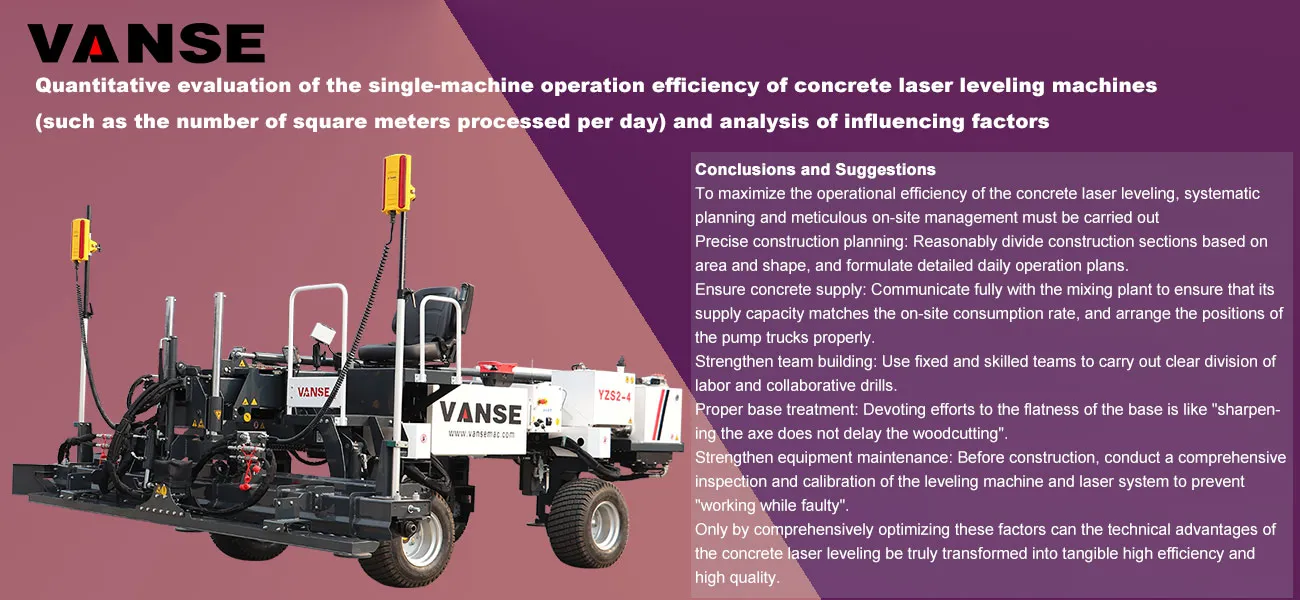
Quantitative evaluation of single-machine operation efficiency of concrete laser leveling machines (such as the number of square meters processed per day) and analysis of influencing factors
It is of vital importance to plan the construction period, conduct cost accounting and resource allocation for the construction party.
Ⅰ. Quantitative Evaluation of Single-Machine Operation Efficiency (Square meters/Day)
The operational efficiency of a concrete laser leveling is not a fixed value; it is significantly influenced by multiple factors. Therefore, we provide a range reference and theoretical calculation method.
1. Empirical efficiency range
In well-organized and well-conditioned industrial or warehouse floor projects, the typical operational efficiency of a concrete laser leveling is usually between 1,500 and 3,500 square meters per day.
Lower limit (below 1,500 m²/ day) : It usually occurs in the following situations:
Small in area, complex in shape, with many columns and reserved holes.
The grassroots conditions are poor and require multiple treatments.
The supply of concrete is unstable and there is a phenomenon of "waiting for materials".
The team coordination is not proficient and the process connection is not smooth.
Average/Good (2,000-2,500 m²/ day) : This is the efficiency that most well-planned projects can achieve. The working surface is relatively regular, the supply of concrete is continuous, and the teams work in perfect harmony.
High efficiency (above 3,000 m²/ day) : It usually occurs in the following ideal situations:
Warehouses and factories with large areas and blocks (over ten thousand square meters) and regular shapes.
The base layer has a high degree of flatness, and the concrete quality is good with an abundant supply.
Adopt the "multi-machine cooperative operation" model (such as two leveling machines working in coordination).
The team is extremely experienced and all processes are seamlessly connected.
2. Theoretical efficiency calculation
We can understand the composition of efficiency through a simple formula:
The daily operation area (m²/ day) = the effective working efficiency of the flattening head (m²/ hour) × the net daily operation time (hours)
Effective working efficiency of the flat head (m²/ hour) :
The working width of the leveling head of a concrete laser leveling usually ranges from 2.5m to 6m, with common models being 3m or 4m.
The walking speed is usually adjustable between 0.5 and 1.5 meters per minute.
Calculation example: Suppose a 3-meter-wide leveling is used and operates at an average speed of 1 meter per minute.
The working area per minute = 3m × 1m/min = 3m ²/min
The theoretical efficiency per hour = 3 m²/min × 60 min = 180 m²/h
However, this is a purely theoretical value and does not take into account turning, positioning, overlapping areas, etc. Therefore, the effective working efficiency is usually taken as 60% to 80% of the theoretical value, that is, 180 m²/h × 0.7 ≈ 126 m²/h.
Daily net working hours (hours) :
A working day is calculated as 8 to 10 hours.
The net operation time is far less than the total time, and the following non-productive time needs to be deducted:
Wait for the concrete transport vehicle.
Equipment fault debugging and laser instrument calibration.
Workers take a break and hand over shifts.
Area conversion, equipment movement.
On well-managed construction sites, the net daily working hours may only be 4 to 6 hours.
Comprehensive calculation
Effective working efficiency: 126 m²/h
Net daily working hours: 5.5 hours
The daily working area = 126 m²/h × 5.5 h = 693 m²
This calculation result seems lower than the empirical value because the concrete laser leveling is usually not a single-point operation. In practice, through efficient construction organization, a continuous operation of "spreading and initial leveling" and "laser fine leveling" will be achieved, thereby making the utilization rate of the leveling machine approach or even exceed its theoretical effective working efficiency, and thus reaching a high level of over 1,500 square meters per day.
Ⅱ. Analysis of Influencing Factors
The factors influencing work efficiency can be classified into the following five major categories:
1. Project and design factors
Working surface area and shape
The larger the area and the more regular the shape (such as a rectangle), the higher the efficiency. The equipment can operate continuously in a straight line for a long time, reducing the number of turns and repositioning. Small area and complex shape (multilateral, circular, with a large number of columns and equipment foundations) will significantly reduce efficiency, requiring frequent equipment movement and supplemented by a large amount of manual work.
Floor design thickness: An increase in thickness means a greater volume of concrete is needed. The paving and supply time of concrete will become a new bottleneck. Although it has little impact on the speed of the leveling itself, it will prolong the overall operation cycle.
2. Concrete-related factors
Concrete supply capacity and continuity: This is one of the most crucial constraints. If the supply of concrete is interrupted, the leveling machine and the entire team will have to stop work and wait for materials. The position and efficiency of the pump truck also directly affect the feeding speed.
The properties of concrete
Slump/Spread: A moderate slump (such as dry-hard or plastic concrete used for flooring) is beneficial for supporting equipment. The slump is too large, the concrete is too soft, and it needs to wait for initial setting, which wastes time. If it is too small, it will be difficult to spread.
Initial setting time: As mentioned in the previous question, the initial setting time determines the "operation window" of the concrete laser leveling. The time is too short, and the pressure on construction organization is huge. If the time is too long, it will affect the entry of subsequent processes (such as polishing).
3. On-site construction and organizational factors
The flatness and quality of the base layer: The flatness of the base layer (usually gravel or plain concrete bedding) directly affects the working load of the concrete laser leveling. If the base layer is uneven, more concrete will be consumed to level it and the traveling speed of the leveling will be reduced.
The proficiency of the construction team in cooperation
The cooperation between the "front team" (responsible for unloading, initial spreading, and edge treatment) and the "leveler operator" is of vital importance.
A well-coordinated team can ensure that the concrete materials are always kept at the optimal distance and volume in front of the leveling, achieving a smooth operation where "materials wait for people, not people waiting for materials".
Process connection: Whether the connection between processes such as laser leveling, grinding machine polishing, and curing agent spraying is tight determines the assembly line rhythm of the entire floor construction
4. Equipment and technical factors
The model and performance of the leveling: The power of the equipment, the track/wheel design, the width of the leveling head and the vibration frequency will all affect its adaptability and efficiency. The wider flat head covers a larger area at one time.
The sensitivity of the laser emission system and receiver: The stability and accuracy of the system determine whether the operator needs to frequently stop for calibration, which directly affects the smoothness of the operation.
Equipment reliability: Equipment failure can directly lead to work stoppages and cause huge losses.
5. Environmental factors
Weather conditions: High temperatures and strong winds will accelerate the evaporation of moisture on the surface of concrete, shorten the initial setting time, and bring huge pressure to the construction organization. Construction will be interrupted on rainy days.
Conclusions and Suggestions
To maximize the operational efficiency of the concrete laser leveling, systematic planning and meticulous on-site management must be carried out
Precise construction planning: Reasonably divide construction sections based on area and shape, and formulate detailed daily operation plans.
Ensure concrete supply: Communicate fully with the mixing plant to ensure that its supply capacity matches the on-site consumption rate, and arrange the positions of the pump trucks properly.
Strengthen team building: Use fixed and skilled teams to carry out clear division of labor and collaborative drills.
Proper base treatment: Devoting efforts to the flatness of the base is like "sharpening the axe does not delay the woodcutting".
Strengthen equipment maintenance: Before construction, conduct a comprehensive inspection and calibration of the leveling machine and laser system to prevent "working while faulty".
Only by comprehensively optimizing these factors can the technical advantages of the concrete laser leveling be truly transformed into tangible high efficiency and high quality.
Note: The parameters provided in this document are for reference only and are not mandatory. Due to differences in technical characteristics between different brands and models of laser levelers, please consult the manufacturer for a suitable solution before actual operation. This reference document assumes no responsibility for any issues arising from failure to follow the manufacturer's instructions.
Thanks to All the Friends Who Support and Trust Shandong Vanse Machinery Technology Co., Ltd.
If you want to know more about Shandong Vanse Machinery Technology Co., Ltd. or have any questions, please feel free to contact us:
Our Factory
Shandong Vanse Machinery Technology Co., Ltd.








Share this article

About the Author: Shandong Vanse Machinery Technology Co., Ltd.
Shandong Vanse Machinery Technology Co., Ltd. is a high-tech manufacturer specializing in concrete construction machinery, including laser screeds and related equipment. The company integrates R&D, production, and global sales, with products exported to over 60 countries and widely used in infrastructure projects worldwide.
Previous Post
Next Post
Related Articles
You Might Also Like
How can the accuracy of concrete laser leveling machines be guaranteed?
The accuracy guarantee of concrete laser leveling machine is a systematic project, which needs to be realized in coordination from many aspects such as equipment performance, pre-construction preparation, construction process control and subsequent maintenance. The following are specific guarantee measures: Laser transmitter: Using high-precision laser transmitter (such as wavelength stability ±5nm, range covering more than 300 meters), the horizontal laser surface is emitted by rotating prism, and the error can be controlled within ±2mm. Receiver sensitivity: Equipped with high-sensitivity laser receiver (response time <0.1 second), real-time capture of laser signals to ensure accurate feedback of elevation deviation. Control system algorithm: Built-in control algorithm, which can automatically adjust the lifting speed of leveling mechanism (such as scraper, vibrating beam) according to the deviation, with a response accuracy of ±1mm. Scraper and vibrating system: Using rigid alloy material, the scraper flatness error is ≤0.5mm/m, and the vibration frequency is stable at 3000-5000 times/minute to avoid elevation deviation caused by mechanical deformation. Drive system: hydraulic drive or servo motor drive (accuracy ±0.1mm), ensuring uniform travel speed (0.5-5m/min adjustable) to avoid speed fluctuations affecting the leveling effect. Use a total station or RTK measuring instrument (plane accuracy ±10mm, elevation accuracy ±15mm) to grid the site (recommended 5m×5m), establish a three-dimensional elevation model, and compare the design elevation with an error of ≤3mm. The laser transmitter needs to be installed at the center of the site to ensure that there is no blind spot in the signal coverage and the installation height error is ≤5mm. Horizontal calibration: Calibrate the horizontality of the fuselage through a high-precision level (accuracy ±0.1mm/m), and adjust the height of the legs to make the fuselage inclination <0.5°. Zero point calibration: Calibrate the receiver zero point at a known elevation point (such as a leveling point) to ensure that the elevation benchmark deviation is ≤2mm. No-machine trial run: Test the scraper lifting speed (required 100mm/s±5%), travel straightness (10m distance offset ≤10mm), and confirm that there is no abnormality in the mechanical system. The slump of concrete is controlled at 180-220mm to ensure that the fluidity meets the leveling requirements and avoid uneven thickness due to material segregation. When paving, reserve 5-10mm of leveling margin, and use the laser leveling machine to reach the designed elevation in one operation, with an error of ≤3mm. The operator views the elevation deviation data in real time through the display screen (display accuracy ±1mm), and performs secondary filling or scraping for local out-of-tolerance areas (such as deviations >5mm). For large-scale construction (such as >5000㎡), set a fixed calibration point every 500㎡, re-measure the elevation with a level, and adjust the equipment parameters immediately when the deviation exceeds 3mm. Temperature influence: When the temperature is >30℃, shorten the leveling operation time (control it within 1 hour before the initial setting of the concrete) to avoid surface settlement due to water evaporation, and control the error within ±5mm. Wind impact: When the wind speed is ≥ Level 4, set up a windproof barrier around the laser transmitter to prevent the laser beam from deviating and ensure signal stability. Use a 3m ruler or laser flatness meter (measurement accuracy ±1mm) for detection, with no less than 3 measuring points per 100㎡, and the allowable deviation is ≤3mm (GB 50204-2015 standard). After marking the out-of-tolerance area (such as deviation >5mm), use a small leveling machine or manual spatula to correct it until it meets the requirements. The equipment has a built-in data recorder to automatically save the elevation deviation curve during the leveling process, and generate an accuracy report after construction (including the error value of each area, pass rate, etc.), which is convenient for tracing the source of the problem. Replace the hydraulic oil filter every 50 hours, calibrate the laser transmitter every 200 hours (wavelength deviation ≤ 1nm), and check the scraper wear every 1000 hours (allowable wear ≤ 2mm). The receiver lens needs to be cleaned daily to prevent dust from affecting the accuracy of signal reception. Operators must undergo professional training (training time ≥ 50 hours), master equipment calibration, parameter adjustment and emergency handling skills, and can only take up their posts after passing the assessment. Before construction, you need to be familiar with the design drawings and clarify the location of the elevation control points to avoid deviations caused by human operating errors. Project Accuracy index Reference standards Elevation deviation ±3mm/3m GB 50204-2015 Flatness ±5mm/100㎡ Concrete Structure Engineering Construction Code Elevation difference between adjacent plates ≤2mm American ACI 302.1R-04 Standard The accuracy of the concrete laser leveling machine must rely on "high-precision hardware + scientific construction process + strict quality control". Through the full process control from equipment calibration to post-construction acceptance, the floor flatness error can be controlled within ±3mm, meeting the construction requirements of high-standard sites such as industrial plants and logistics warehouses. In actual applications, it is also necessary to flexibly adjust the process in combination with project characteristics (such as area, elevation complexity) to achieve optimal accuracy.Laser leveling machine needs temperature control! ! !
LASER LEVELING MACHINE NEEDS TEMPERATURE CONTROL ! ! ! No matter it is winter or summer, the use of laser leveling machine is inseparable from road construction. In the process of using leveling machine in summer, some parts inside the machine may overheat due to the increase in temperature. Thus affecting the leveling effect of the laser leveling machine. In order to improve the use value of the equipment and improve work efficiency, we need to do a good job of temperature control during the working process of the laser leveling machine. First of all, controlling the temperature of the laser leveling machine is one of the keys to ensure the quality of leveling. When the equipment is being leveled, it should meet the requirements of relevant standards according to the type of asphalt, label, consistency, ambient temperature, and leveling thickness. Secondly, when the construction temperature of expressways and highways is lower than 10°C, and when the construction temperature of other grades of roads is lower than 5°C, leveling is not suitable. If it is necessary to carry out leveling work, the temperature of the road leveling machine should be increased, and there are also low-temperature leveling requirements that meet the regulations. The transport vehicle must have insulation measures, and high-precision leveling machines should be used as much as possible to start paving. After the plate is heated and leveled, it is pressed immediately to shorten the length of the press. It should be remembered that during leveling, the requirements of relevant standards should be met according to the type of asphalt, label, consistency, ambient temperature, leveling thickness, etc. In this case, it is relatively simple and easy to control the temperature. Mastering the performance characteristics of the laser leveling machine will help us do a good job in temperature control. The above is the relevant knowledge that the manufacturer told you. I hope that through our narration, you can understand the temperature control method of the laser leveling machine during the construction process, and hope that your equipment can run smoothly. Contact us, we look forward to cooperating with you.What Fuel-Saving Measures Should Be Taken When Operating A Concrete Laser Leveling?
Nowadays, the amount of work is increasing. When operating the concrete laser leveling, you will feel that the fuel consumption of the machine is a bit high. This is because the workload itself is relatively large, and the construction time is also relatively long, so the fuel consumption is It is also a relatively common phenomenon, but in order to further save costs, we still need to take some measures, which can actually reasonably reduce the fuel consumption of concrete laser leveling machines. 1. Be proficient in the operation method of concrete laser leveling machine In order to reduce the unnecessary increase in fuel consumption in the concrete laser leveling machine, you must first understand the basic operations of the concrete laser leveling machine and master the correct operations of loading, walking, turning, leveling, slope repair and other operations. If the foundation is not good, it will increase the fuel consumption of the concrete laser leveling machine. I would like to remind novices who have just entered the industry to listen to the advice of the master and master the leveling operation. 2. Reduce unnecessary idling If you want to save fuel, you need to reduce the necessary idling speed of the engine. You should know that when the concrete laser leveling is idling, it is also using a hydraulic pump to circulate hydraulic oil. The longer the idling time, the more fuel is wasted. In fact, the correct way to save fuel is to try not to idle the concrete laser leveler during standby and rest periods. This is one of the secrets to saving fuel. 3. Reduce engine speed When performing excavation operations, when the engine speed is at a higher speed, the operating speed is fast, but the fuel consumption is high. When operating at non-full throttle, appropriately reduce the engine speed. Although the operating speed is reduced, fuel consumption can be reduced. Improve fuel efficiency. 4. Walking without full throttle When walking with the engine not at full throttle, everyone should know that the higher the engine speed, the faster the walking speed, and the higher the fuel consumption. Reducing the engine speed during operation can improve fuel consumption efficiency while walking.