Technical Knowledge
A comprehensive understanding of the components of high performance concrete laser leveling

The laser leveling machine can bring us many advantages when it is used. I believe that all the friends who have used it should have realized it. Although everyone is very comfortable when operating the leveling machine, it is necessary to talk about the laser leveling machine. The components, then many friends are not clear, it seems that everyone is not careful enough about the leveling machine, the following article will lead everyone to learn more about the components of the laser leveling machine.
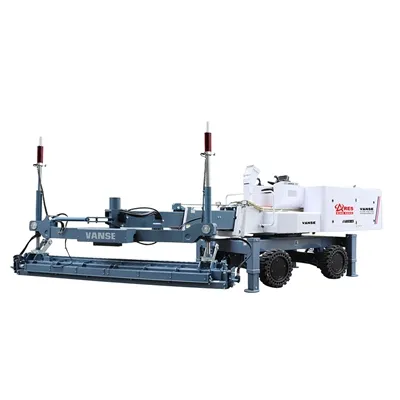
Vanse boomed laser leveling machine
Components of the laser leveler:
1. Steering system: It consists of steering wheel, steering gear, steering knuckle, steering knuckle arm, tie rod and straight rod. The function is steering.
Battery: The function of the battery is to supply power to the starter, and to supply power to the engine ignition system and other consumers during engine start or low speed operation. When the engine is running at high speed, the generator generates enough power and the battery can store excess power.
Hydraulic brake structure: The hydraulic brake device consists of a brake pedal, a master cylinder, a sub-pump, a drum (wheel) brake and a fuel pipe.
2. Motor: The motor is the power unit of the laser leveling machine. Its main function is to generate drive torque as a power source for electrical appliances or various machines. Its main function is to use mechanical energy to convert into electric energy. At present, it is more common to use heat energy, water energy, etc. to drive the generator rotor to generate electricity.
3. Transmission: It is composed of transmission case, transmission cover, first shaft, second shaft, intermediate shaft, reverse shaft, gear, bearing, operating mechanism, etc. It is used for variable speed and variable output torque of laser leveling machine.
4, leaf springs and shock absorbers: the role of leaf springs is to maintain a flexible connection between the frame and the body and the wheel or axle. The function of the shock absorber is to moderate the vibration when the laser leveler is subjected to shock.
5. Transmission system: It is mainly composed of transmission, universal joint, transmission shaft and drive axle.
6, driving system: consists of the frame, axle, suspension and wheels. Its basic function is to support the quality of the whole car and to ensure the driving of the laser leveler.
7. Starter: Its function is to convert electrical energy into mechanical energy, drive the crankshaft to rotate, and start the engine. If the continuous starting time is too long, it will cause a large discharge of the battery and the starter coil will overheat and smoke, which will easily damage the laser leveling machine.
Thanks to All the Friends Who Support and Trust Shandong Vanse Machinery Technology Co., Ltd.
If you want to know more about Shandong Vanse Machinery Technology Co., Ltd. or have any questions, please feel free to contact us:
Our Factory
Shandong Vanse Machinery Technology Co., Ltd.








Share this article

About the Author: Shandong Vanse Machinery Technology Co., Ltd.
Shandong Vanse Machinery Technology Co., Ltd. is a high-tech manufacturer specializing in concrete construction machinery, including laser screeds and related equipment. The company integrates R&D, production, and global sales, with products exported to over 60 countries and widely used in infrastructure projects worldwide.
Previous Post
Next Post
Related Articles
You Might Also Like
How does concrete laser leveling technology improve construction efficiency?
Concrete laser leveling technology is an innovative technology in the field of modern construction. It uses laser as a reference to achieve fast and precise leveling of concrete surfaces. This technology not only improves the efficiency of construction, but also ensures the stability and consistency of construction quality. The following is an in-depth analysis of how concrete laser leveling technology improves construction efficiency. Introduction In traditional concrete construction, ground leveling work usually relies on manual operation, which is not only labor-intensive and inefficient, but also difficult to ensure flatness and accuracy. With the improvement of the construction industry's requirements for construction quality and efficiency, concrete laser leveling technology has emerged, bringing revolutionary changes to construction. 1. Technical Overview Concrete laser leveling technology is a technology that uses laser as a reference to accurately level the concrete surface through automated equipment. The core of this technology lies in the effective coordination of laser transmitters, receivers, control systems and leveling equipment. > Learn more about customlzatlon >> 2. Working Principle The working principle of concrete laser leveling technology mainly includes the following steps: – **Laser transmitter**: emits a stable laser beam to form a horizontal reference plane. – **Receiver**: installed on the leveling machine, receives laser signals and converts them into electrical signals. – **Control system**: According to the received electrical signal, the working state of the leveler is automatically adjusted to ensure that the concrete surface is consistent with the laser plane. – **Leveling equipment**: According to the instructions of the control system, the concrete surface is leveled through vibration and scraping functions. > Learn more about customlzatlon >> 3. Key factors to improve construction efficiency The key factors for improving construction efficiency of concrete laser leveling technology include: – **High degree of automation**: Reduces manual intervention and improves construction speed. – **High construction accuracy**: Ensures the flatness and accuracy of the concrete surface. – **Stable construction quality**: Reduces rework caused by uneven construction quality. – **High material utilization rate**: Reduces material waste by accurately controlling the laying thickness of concrete. > Learn more about customlzatlon >> 4. Construction process optimization The application of laser leveling technology optimizes the construction process, including: – **Site preparation**: Quickly complete site cleaning and leveling. – **Laser transmitter setting**: Quickly and accurately set the laser transmitter. – **Concrete pouring**: With the assistance of the laser leveling machine, the concrete pouring is quickly completed. – **Leveling operation**: The laser leveler automatically completes the leveling of concrete according to the laser signal. – **Surface treatment**: Quickly complete the leveling and calendering of the concrete surface. – **Quality inspection**: Use professional equipment to quickly complete the flatness and levelness inspection of the concrete surface. > Learn more about customlzatlon >> 5. Technical advantages and practical applications Laser leveling technology has shown obvious advantages in practical applications: – **Industrial plant**: Quickly complete the leveling of large areas of ground and improve construction efficiency. – **Commercial facilities**: Ensure the flatness of the ground and improve customer experience. – **Airport runway**: Ensure the flatness and strength of the runway to ensure the safe takeoff and landing of aircraft. – **Roads and bridges**: Improve the flatness and bearing capacity of the road surface and extend its service life. > Learn more about customlzatlon >> 6. Technical challenges and coping strategies Although laser leveling technology has obvious advantages, it also faces some challenges in practical applications: – **Environmental factors**: Wind, temperature changes, etc. may affect the stability of the laser. – **Equipment maintenance**: The laser leveler needs regular maintenance to ensure its performance. – **Training of construction personnel**: Professional knowledge and skills are required to operate the laser leveling machine. Countermeasures include: – Improve the stability of the laser transmitter through technical improvements. – Establish a complete maintenance system and train operators. – Provide professional training courses to improve the operating skills of construction personnel. > Learn more about customlzatlon >> 7. Technological innovation and development trends With the continuous advancement of science and technology, laser leveling technology is also constantly innovating and developing: – **Intelligentization**: Integrate more intelligent sensors and control systems to improve the automation level of the leveling machine. – **Multifunctionality**: Develop a leveling machine that can complete multiple construction tasks at the same time. – **Environmentally friendly materials**: Research and use more environmentally friendly concrete materials to reduce the impact of construction on the environment. > Learn more about customlzatlon >> 8. Conclusion Concrete laser leveling technology has become an indispensable part of modern construction with its advantages of high efficiency, high precision and construction quality. By optimizing the construction process, improving material utilization and reducing rework rate, this technology has significantly improved construction efficiency. With the continuous development and innovation of technology, concrete laser leveling technology will play a greater role in the future and bring more possibilities to the construction industry. > Learn more about customlzatlon >>How can maintenance standards for equipment used in concrete construction be improved?
In concrete construction, improving equipment maintenance standards requires focusing on the characteristics of core equipment (such as concrete laser screeds and trowels) and the demands of construction scenarios. A closed-loop system encompassing four key dimensions: system improvement, process refinement, technical empowerment, and personnel management, should be established to ensure the equipment maintains efficient and safe operation. The following is a specific implementation path: Concrete laser screeds (relying on laser systems, hydraulic devices, and screed blades) and trowels (focused on grinding discs, power systems, and clutches) have significantly different structures and vulnerable components. Therefore, it is necessary to establish maintenance systems tailored to each device and component to avoid a one-size-fits-all approach. Precision of equipment files Create an independent electronic file for each laser leveler and trowel machine to record key information: Basic Information: Equipment model (e.g., SXP-200 laser leveler, MG-36 trowel), serial number, purchase date, warranty period; Core Components: Laser leveler laser transmitter, receiver, and hydraulic pump models; Trowel disc material (diamond/alloy), motor power, and clutch brand; Maintenance History: Date of each maintenance/repair, component replacement records, and cause of failure (e.g., laser receiver interference with dust, trowel disc wear). Quantified Tiered Maintenance Standards The three-level maintenance system, "daily – regular – seasonal", clarifies the specific operating requirements for the two types of equipment to avoid ambiguity: Maintenance Level Period Core Requirements for Concrete Laser Leveling Machines Key Requirements for Trowel Machines Daily Maintenance Daily before and after construction 1. Clean the laser transmitter/receiver lens with a dust-free cloth (to avoid dust that could affect accuracy); 1. Clean any remaining concrete from the grinding disc (use a scraper to remove it to prevent it from sticking after hardening). 2. Check the hydraulic oil tank oil level (must be above 2/3 of the scale line) and observe whether the oil is turbid; 2. Check the grinding disc mounting bolts for looseness (torque must comply with the manufacturer's instructions, e.g., 25 N·m). 3. Test the leveling blade for flatness and straighten if deformed. 3. Run the machine for one minute to listen for any unusual motor noises and ensure the clutch engages and disengages smoothly. Regular Maintenance Every 50 hours (or weekly) 1. Replace the hydraulic oil filter and refill with anti-wear hydraulic oil (must match the model, such as L-HM46); 1. Check the motor carbon brushes for wear (replace if the remaining length is less than 5 mm). 2. Calibrate the laser system: Use a standard ruler to ensure the leveling error is ≤ 2mm/2m; 2. Replace the grinding disc (when the grinding disc thickness is less than 10 mm, avoid uneven grinding discs that can cause sanding on the floor). 3. Lubricate the travel wheel bearings (fill with lithium-based grease, such as ZL-3). 3. Clean the electrical box and tighten the terminals to prevent concrete dust from causing a short circuit. Seasonal Maintenance Before construction in winter/summer 1. Winter: Replace with low-temperature hydraulic oil (such as L-HV32) and install an insulation cover on the laser system to prevent freezing due to low temperatures; 1. In winter: Check the cable insulation to prevent low-temperature cracking. 2. Summer: Clean the hydraulic system heat sink (use compressed air to remove dust) and check the motor cooling fan. 2. In summer: Apply high-temperature grease (such as ZL-4) to the motor bearings to prevent high-temperature seizures. Equipment failures often stem from overlooking minor issues. Maintenance should be integrated into the entire construction process, especially for precision-sensitive components on laser levelers and high-frequency wear components on trowels. Laser levelers: Prioritize checking the laser system's "effectiveness"-after powering on the machine, test the receiver's sensitivity using a calibration plate. If a "flashing signal" is detected, check the lens cleanliness or battery level (the laser transmitter battery must be fully charged to avoid power outages that could cause leveling errors). Also, check the hydraulic lines for leaks (focusing on the joints; if oil is present, replace the seals). Smoothing machines: Focus on testing the "power and clutch"-after starting, allow the machine to idle for 30 seconds to observe whether the grinding disc rotates smoothly (without eccentricity or wobble). When the clutch handle is pulled, the grinding disc should start and stop immediately. If there is a delay, adjust the clutch cable tension (too loose can cause the grinding disc to "slip," while too tight can burn the clutch plate). Stop the machine for inspection every two hours: Laser screeds should be inspected for stuck scrapers (concrete clumps can cause scraper deformation). Trowels should be inspected for grinding disc wear (if the disc edge appears jagged, the machine should be stopped and replaced to avoid scratches). Intensified inspections during extreme conditions: When pouring large volumes of concrete (ambient temperature > 35°C), check the laser screed hydraulic oil temperature every hour (if it exceeds 65°C, stop the machine and cool it down to prevent damage to the hydraulic pump). Trowels operating on rapidly hardening concrete surfaces should frequently check motor load (if the motor is overheating, reduce the operating speed to avoid overload and burnout). Laser screed machines: Use a high-pressure water jet (pressure ≤ 0.8 MPa to avoid damaging laser components) to rinse the concrete on the machine body, focusing on cleaning the scraper and travel wheels. The laser transmitter must be disassembled and stored separately (in a dry, dust-proof box to prevent moisture from getting on the lens). The hydraulic system must be run at no load for 5 minutes to expel air from the lines, then the power must be turned off. Troweling machines: First, scrape away any remaining concrete from the grinding disc, then use a wire brush to clean the gaps between the discs. Wipe the motor housing with a damp cloth (avoid direct water on the electrical components). Finally, coil the cables neatly and store them in a dry, well-ventilated area to avoid contact with sharp objects and damage. Traditional "rule-of-thumb" maintenance is prone to oversights, requiring the use of technology for more precise maintenance, especially for the core precision components of laser screed machines. Installation of intelligent monitoring equipment Laser levelers: Install a hydraulic oil temperature sensor and laser signal detector to collect real-time data and synchronize it to a mobile phone (e.g., via Bluetooth). When the oil temperature exceeds a threshold (e.g., 70°C) or the laser signal strength falls below a specified value (e.g., <80%), an alert is automatically sent to prevent manual inspections from missing information. Trowel machines: Install a current sensor on the motor to issue an alert when the motor load current exceeds the rated value (e.g., if the rated current of a 10A motor exceeds 12A), prompting a prompt to reduce operating intensity and prevent motor overload. Specialized tools ensure maintenance quality Laser levelers: Calibrate the laser system with a laser level (accuracy ±0.1mm). Replace hydraulic filters with a filter wrench (to avoid damaging the filter housing). Trowelers: Remove the grinding disc with a dedicated socket wrench (matching the disc bolt size, such as M12). Adjust the clutch cable with a cable tension gauge (ensure the tension meets the manufacturer's specifications, such as 50N). The core of equipment maintenance is people. Training, assessment, and responsibility division are essential to prevent equipment damage caused by improper operation. Layered training covering "operation – maintenance – emergency" Basic Training (Operator): Focuses on laser leveling machine "laser system protection" (avoid hitting the lens with hard objects) and trowel machine "grinding disc replacement specifications" (bolts must be tightened diagonally to prevent uneven wear). Advanced Training (Maintenance): In-depth explanation of the principles of the laser leveling machine hydraulic system (e.g., common hydraulic pump troubleshooting: loud noise may indicate oil contamination) and trowel machine motor maintenance (e.g., carbon brush replacement procedures). Emergency Training: Develop emergency response procedures for sudden failures (e.g., laser leveling machine hydraulic line rupture, trowel machine motor smoke) (immediately shut down the machine, disconnect the power supply, and replace with backup equipment). Assign responsibilities to individuals and establish a "maintenance assessment mechanism." Implementing an "equipment-to-personnel" responsibility system: Each laser leveler and trowel machine is assigned a dedicated operator and maintenance person, who sign and confirm the equipment records, clearly stating "operator, responsible for daily maintenance, and maintenance, responsible for regular inspections." Performance-linked: Equipment availability (target ≥ 95%) and downtime (target ≤ 1 hour/day) are incorporated into performance appraisals. If equipment malfunctions due to inadequate maintenance (e.g., laser receiver accuracy deviation due to dust not being cleaned) are reported, the relevant personnel will be held accountable. Long-term trouble-free equipment performance is rewarded. Through the above measures, a closed loop can be formed from the four dimensions of "system, process, technology, and personnel" to specifically solve the maintenance pain points of concrete laser leveling machines and trowel machines, and ultimately achieve the goals of reducing equipment failure rates, extending service life, and stabilizing construction quality. Note: The parameters provided in this document are for reference only and are not mandatory. Due to differences in technical characteristics between different brands and models of laser levelers, please consult the manufacturer for a suitable solution before actual operation. This reference document assumes no responsibility for any issues arising from failure to follow the manufacturer's instructions.How are complex slopes, two-way drains,or 3D floor designs poured using a concrete laser leveling?
Excellent question. You've pinpointed the exact transition from basic to advanced laser leveling. Moving beyond flat slabs to complex slopes, drains, and 3D designs is where modern laser leveling technology truly becomes revolutionary. It shifts from being a simple leveling tool to a robotic 3D concrete printing and finishing system. Here's a detailed breakdown of how it's done, focusing on the advanced systems you mentioned. The critical leap is abandoning the single spinning laser plane (which only creates a flat surface at a fixed grade). Instead, 3D Profiler Systems or 3D Machine Control is used. This system integrates three key components: The 3D Design Model: A digital blueprint (CAD file) of the finished slab, including all slopes, drains, and elevations. This is often a Digital Terrain Model (DTM). The Positioning System: Typically a robotic total station or GPS rover that tracks the leveling's exact location (X, Y, and Z) on the job site in real-time. The Laser leveling's Onboard Computer: This brain takes the design model and the real-time position, calculates the exact required height of the leveling head at that precise coordinate, and automatically adjusts the machine. Design: Engineers create a precise 3D model of the slab. For a two-way drain, this is a warped surface (a parabola or cone) sloping to a central point. For a ramp with a cross-slope, it's an inclined plane. For truly complex 3D floors (e.g., skate parks, test tracks), it's a fully sculpted surface. Site Calibration: The 3D model is geo-referenced to the physical job site. Surveyors establish control points. The robotic total station is set up with a clear view, and its position is registered in the same digital coordinate system as the design model. Machine Setup: A prism or GPS receiver is mounted on the laser leveling. The total station now "sees" the leveling and relays its position 5-10 times per second to the leveling's computer. This is where the magic happens. The process is fully model-driven. For a Two-Way Drain (Warped Surface): The operator drives the leveling onto the fresh concrete in a systematic pattern (e.g., spiral out from the drain or back-and-forth passes). In real-time, for every inch the machine moves: The total station reports: *"You are at coordinate X=105, Y=87."* The computer checks the 3D model: *"At coordinate (105,87), the design elevation is Z=100.25 inches."* The computer commands the leveling's hydraulic cylinders: *"Raise/Lower the strike-off head to exactly 100.25 inches NOW."* The leveling head continuously adjusts, tilting subtly in all directions, to perfectly match the design's curvature. It creates a smooth, mathematically perfect bowl without any manual grade checking. For a Slope or Ramp (Inclined Plane): The process is identical. The model defines a constant slope. As the leveling moves up the ramp, the computer constantly updates the target height, keeping the leveling head precisely on the inclined plane. For Complex 3D Terrain (e.g., a Skate Park Bowl): The operator drives in a tight, overlapping pattern (like mowing a lawn). The leveling head acts like a 3D printer nozzle, constantly adjusting its height and tilt to "touch" the virtual design surface. One pass might place the concrete for the transition, the next for the flat bottom, all seamlessly. Eliminates Physical Forms: No need to build intricate wood forms to define curved drains or slopes. This saves immense labor and material. Unmatched Accuracy & Consistency: Achieves tolerances of ±1/8" (3mm) or better over the entire complex surface. Manual sloping is prone to waves, flat spots, and inconsistencies. Speed: Complex geometry can be placed and finished at the same speed as a flat slab-often 10,000+ sq. ft. per day. Monolithic Quality: Large, complex areas are poured in one continuous operation, eliminating cold joints and ensuring uniform density and strength, which is critical for waterproofing in drainage applications. Data Verification: The system can log "as-built" data, proving the floor was built to specification. The operator's role shifts from "grade checker" to machine pilot and concrete manager: Path Planning: Choosing the optimal driving pattern to efficiently cover the area without trapping the machine. Managing Concrete Supply: Ensuring a consistent volume of concrete is placed ahead of the leveling, critical for maintaining the design profile. Monitoring Systems: Watching for signal loss from the total station and ensuring the system is functioning. Edgework & Finishing: The laser leveling does not do edges. Skilled finishers still hand-work perimeter details, using the levelinged surface as their guide. They also perform final finishing (bullfloating, troweling) on the perfectly placed surface. Multi-Prong Laser leveling: For very large pours, machines with multiple, independently controlled vibrating heads can cover more area faster, with each head adjusting to the 3D model. Gyroscope & Inertial Systems: Used in tandem with GPS for areas where satellite signal is lost (e.g., inside buildings), ensuring continuous accuracy. Think of it like this: The 3D Model is the sheet music. The Robotic Total Station is the conductor, keeping time and position. The Laser leveling's Computer is the musician reading the score. The Hydraulic Cylinders & Vibrating Head are the instrument, playing the exact notes (elevations) to produce the final product: a perfectly shaped, densely consolidated concrete slab. This technology has transformed complex concrete flooring from a high-skill, labor-intensive craft into a precise, digital fabrication process, enabling designs that were previously too costly or difficult to achieve with consistent quality. Note: The parameters provided in this document are for reference only and are not mandatory. Due to differences in technical characteristics between different brands and models of laser levelers, please consult the manufacturer for a suitable solution before actual operation. This reference document assumes no responsibility for any issues arising from failure to follow the manufacturer's instructions.