Technical Knowledge
Laser leveling machine needs temperature control! ! !
LASER LEVELING MACHINE NEEDS TEMPERATURE CONTROL ! ! !
No matter it is winter or summer, the use of laser leveling machine is inseparable from road construction. In the process of using leveling machine in summer, some parts inside the machine may overheat due to the increase in temperature. Thus affecting the leveling effect of the laser leveling machine. In order to improve the use value of the equipment and improve work efficiency, we need to do a good job of temperature control during the working process of the laser leveling machine.
First of all, controlling the temperature of the laser leveling machine is one of the keys to ensure the quality of leveling. When the equipment is being leveled, it should meet the requirements of relevant standards according to the type of asphalt, label, consistency, ambient temperature, and leveling thickness. Secondly, when the construction temperature of expressways and highways is lower than 10°C, and when the construction temperature of other grades of roads is lower than 5°C, leveling is not suitable.
If it is necessary to carry out leveling work, the temperature of the road leveling machine should be increased, and there are also low-temperature leveling requirements that meet the regulations. The transport vehicle must have insulation measures, and high-precision leveling machines should be used as much as possible to start paving. After the plate is heated and leveled, it is pressed immediately to shorten the length of the press. It should be remembered that during leveling, the requirements of relevant standards should be met according to the type of asphalt, label, consistency, ambient temperature, leveling thickness, etc. In this case, it is relatively simple and easy to control the temperature.
Mastering the performance characteristics of the laser leveling machine will help us do a good job in temperature control.
(1) The leveling principle of the laser leveling machine is realized under the automatic control of the computer by using advanced laser technology, closed-loop control technology and high hydraulic system, which is its outstanding feature different from other floor construction processes.
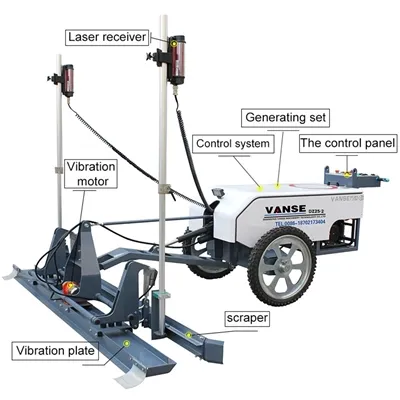
(2) The leveling principle of the leveling machine is to rely on the leveling head driven by hydraulic power, cooperate with the laser system and the computer control system to complete the leveling work while automatically leveling. The leveling head is equipped with an integrated scraper, vibrator and leveling plate, which integrates all leveling, leveling, vibration and compaction work, and completes it at one time. The computer control system automatically adjusts the elevation 10 times per second in real time, and the vibration frequency of the vibrator with a balanced design reaches 3000 times per minute.
(3) The laser transmitter used to control the ground level is arranged independently, so that the level of the ground is not controlled by the template, and no cumulative error will occur.
(4) The laser leveling machine can also automatically control the longitudinal and transverse slopes, which is also completed by the laser system, computer system, hydraulic system, and mechanical system. For complex-shaped ground with high requirements such as drainage, a three-dimensional special-shaped ground treatment system can also be selected to achieve it.
The above is the relevant knowledge that the manufacturer told you. I hope that through our narration, you can understand the temperature control method of the laser leveling machine during the construction process, and hope that your equipment can run smoothly. Contact us, we look forward to cooperating with you.
Thanks to All the Friends Who Support and Trust Shandong Vanse Machinery Technology Co., Ltd.
If you want to know more about Shandong Vanse Machinery Technology Co., Ltd. or have any questions, please feel free to contact us:
Our Factory
Shandong Vanse Machinery Technology Co., Ltd.








Share this article

About the Author: Shandong Vanse Machinery Technology Co., Ltd.
Shandong Vanse Machinery Technology Co., Ltd. is a high-tech manufacturer specializing in concrete construction machinery, including laser screeds and related equipment. The company integrates R&D, production, and global sales, with products exported to over 60 countries and widely used in infrastructure projects worldwide.
Previous Post
Next Post
Related Articles
You Might Also Like
Concrete laser leveling machine solves the big problem of concrete leveling
For many buildings today, perhaps the most basic is the paving and leveling of concrete floors. In the past, the development was not as fast as it is now, so the construction of large-area concrete floors would have the disadvantage of being uneven. Later, people slowly invented some methods, but they were also more time-consuming and laborious. But now there is a laser leveling machine, which solves the big problem of concrete leveling. Many friends may not know much about laser leveling machines. In fact, it is a machine that uses the laser emitted by the laser as a benchmark and can level the ground at any time through the detection of a laser probe. The principle of this machine is also very simple. The machine itself emits a laser, which is then received by its own receiver. If there is any deviation, it will be fed back to the central computer system. Then the height of the scraper is adjusted linearly on the left and right sides, and then the whole process is completed. Flat ground. The advantages of this machine are still very prominent. First of all, it does not require as much manpower and time as before. The machine's response is very fast, and there is basically no deviation. It is very accurate because it is controlled by a computer program. Unlike manual work, there will be discrepancies if you don't pay attention. Moreover, this machine does not need to find a balance line or add side templates. It is controlled by the machine's own control system. As long as the laser transmitter can operate normally without interference, the machine will adjust the elevation no matter where it is moved. It is also because of the many advantages of laser leveling machines that many large buildings, such as logistics centers, warehouses, and underground garages, will now purchase such machines to level concrete floors. From this point of view, the sales prospects of laser planing machines are relatively good.Construction Adaptability of Laser Leveling Machine in Low Temperature or High Humidity Environments
In the global commercial construction industry, project schedules rarely pause for ideal weather conditions. Contractors frequently face the challenge of pouring and leveling massive concrete slabs in sub-zero winters or sweltering, high-humidity tropical climates. Maintaining strict Floor Flatness (FF) and Floor Levelness (FL) specifications under these extremes requires highly adaptable equipment. Understanding the construction adaptability of a concrete laser leveling machine (laser Leveling) in extreme environments is crucial for international contractors looking to minimize downtime and prevent costly structural defects. Here is a comprehensive technical analysis of how advanced laser leveling machinery, such as the industry-leading solutions from Shandong Vanse Machinery Technology Co., Ltd. (www.vansemac.com), adapts to harsh environmental factors. Pouring concrete in freezing conditions introduces a host of mechanical and material challenges. Hydraulic fluids thicken, engines struggle to cold-start, and the concrete itself cures sluggishly, remaining stiff and difficult to manipulate. Reliable Powertrain and Cold-Start Capability: In cold weather, equipment reliability is paramount. Machines equipped with high-quality, cold-weather-rated engines-such as the reliable and fuel-saving Honda engines found in the Vanse YZ28-4S ride-on laser Leveling-ensure that the machine starts immediately, preventing disastrous delays during a freeze-sensitive pour. Intelligent Hydraulic Systems: Low temperatures increase hydraulic fluid viscosity, which can cause erratic boom movements or slow leveling head responses in standard machines. Advanced equipment like the Vanse WS550 Hydraulic Concrete Laser Leveling machine utilizes precision valves and thermal-stable fluids to maintain a smooth, fixed-speed walking and leveling pace, regardless of the ambient temperature drop. Consistent High-Frequency Vibration: Because cold concrete has a lower slump and sets rigidly, the Leveling must provide powerful, consistent surface vibration to draw the cement paste to the surface. The 4,000 RPM high-frequency vibrating plates on Vanse equipment fluidize the stiff matrix efficiently, preventing honeycombing and ensuring a dense, super-flat finish. High humidity, heavy fog, and frequent rain (common in Southeast Asia and Latin American markets) create entirely different operational hazards. Condensation interferes with laser optics, and wet subgrades lead to severe traction loss. Traction and Anti-Skidding Technology: A wet subgrade or vapor barrier can cause a wheeled machine to slip, instantly ruining the FL (levelness) metric. To combat this, models like the Vanse YZ28-4S come standard with an integrated anti-skidding system and are equipped with two types of easily interchangeable tires suitable for different muddy or slick working conditions. Keeping the Machine Off the Concrete: In high-humidity environments where the concrete bleed water takes hours to evaporate, driving on the slab is a major risk. Telescopic boom-type laser Leveling, such as the Vanse YZ30-4E and YZ40-4E, are engineered specifically for this. With a 360° rotating chassis and long telescopic arms, the machine remains stationary on stable ground while the leveling head extends over the wet concrete, totally eliminating footprint damage and traction issues. Electric Precision for Indoor Humidity: For enclosed commercial floors where high humidity traps exhaust fumes, the Vanse DZ25-2 offers a revolutionary solution. With an all-electric drive, it provides zero emissions and fast, responsive green energy operation, making it perfectly adapted for damp, poorly ventilated indoor construction sites. Extreme weather can play havoc with leveling precision. Thick fog scatters standard laser beams, and rapid temperature shifts can cause standard structural metals to contract or expand slightly. Advanced concrete leveling machines adapt to this by utilizing heavy-duty aviation-grade aluminum alloys for the leveling heads, which resist temperature-induced warping. Furthermore, high-end receivers paired with quick-elevation and quick-detection devices (standard across Vanse's ride-on and boom lines) dynamically adjust the scraping blade hundreds of times per minute. This micro-adjustment capability completely isolates the leveling process from environmental instability. Whether constructing a logistics center in the freezing conditions of northern Canada and Russia, or pouring a seamless factory floor in the humid climates of Brazil and Malaysia, contractors cannot rely on fair-weather equipment. By investing in highly adaptable machinery from Vanse Group-which features robust anti-skid systems, cold-start reliable engines, and telescopic boom isolation-contractors can secure their project timelines, protect their profit margins, and deliver world-class E-E-A-T (Experience, Expertise, Authoritativeness, and Trustworthiness) certified concrete floors in any climate. Note: The parameters provided in this document are for reference only and are not mandatory. Due to differences in technical characteristics between different brands and models of laser levelers, please consult the manufacturer for a suitable solution before actual operation. This reference document assumes no responsibility for any issues arising from failure to follow the manufacturer's instructions.In addition to the angle, what other factors will affect the performance of the power trowel?
Slump: Slump reflects the fluidity of concrete. If the slump is too large, the concrete is too thin and soft, and it is easy to seep water and slurry when troweling, making it difficult to form a solid surface, and cracks are easy to appear on the surface after troweling; if the slump is too small, the concrete is too dry and hard, and it is difficult for the trowel blade to effectively trowel it, which will cause uneven surface and increase the workload of the trowel. Setting time: The setting time of concrete is crucial for troweling. If troweling is performed before the initial setting of concrete, the concrete is still in a plastic state and can be easily smoothed by the trowel, but troweling too early may damage the internal structure of the concrete and affect its strength; if troweling is performed after the final setting, the concrete has hardened, and it is difficult for the trowel to operate it effectively, leaving trowel marks on the surface, and it is impossible to achieve the ideal flatness and finish. Speed: The speed of the trowel directly affects the troweling effect. If the speed is too low, the blade will not be able to vibrate and smooth the concrete surface enough, and the cement slurry on the concrete surface cannot be evenly distributed, resulting in poor surface finish; if the speed is too high, the concrete surface will be subjected to excessive centrifugal force, which may cause cement slurry splashing, and will also increase the wear and energy consumption of the machine. Power: The power determines the working capacity of the trowel. If the power is insufficient, when encountering large concrete resistance during the troweling process, the trowel may be underpowered, resulting in unsmooth rotation of the blade, affecting the troweling effect; if the power is too high, it may cause energy waste, and it is easy to cause excessive vibration and damage to the concrete surface if the operation is improper. Operation technique: The operator's operation technique has a great impact on the troweling effect. Skilled operators can reasonably control the travel speed, direction and troweling time of the trowel according to the state of the concrete and the performance of the trowel, so that the concrete surface can achieve a flat and smooth effect; while unskilled operators may encounter problems such as uneven travel speed, overlapping or missing troweling areas, resulting in poor troweling quality. Judgment ability: Experienced operators can accurately judge the setting time and state of concrete and choose the right time to perform the troweling operation. They can also adjust the parameters and operation methods of the troweling machine in time according to the problems that occur during the troweling process, such as bubbles and trowel marks on the surface; while inexperienced operators may not be able to accurately judge these situations, thus affecting the troweling effect. Temperature: The ambient temperature has a significant impact on the setting time and troweling effect of concrete. In a high temperature environment, the moisture of concrete evaporates quickly, the setting time is shortened, the troweling operation time window becomes smaller, and surface shrinkage cracks are prone to occur; in a low temperature environment, the setting time of concrete is prolonged, and the troweling quality may be affected by the freezing of the internal moisture of the concrete during troweling, and it will also increase the difficulty of starting the troweling machine and energy consumption. Humidity: If the ambient humidity is too high, the moisture on the concrete surface is not easy to evaporate, which will delay the setting time of the concrete, resulting in water seepage on the surface after troweling; if the humidity is too low, the moisture on the concrete surface evaporates too quickly, and problems such as surface dryness and peeling are prone to occur, affecting the troweling effect. Wind speed: Higher wind speed will accelerate the evaporation of moisture on the concrete surface, causing uneven drying of the concrete surface, increasing the difficulty of polishing, and may also cause cracks on the polished surface.