Technical Knowledge
How to avoid over-vibration with laser leveling on fiber concrete?
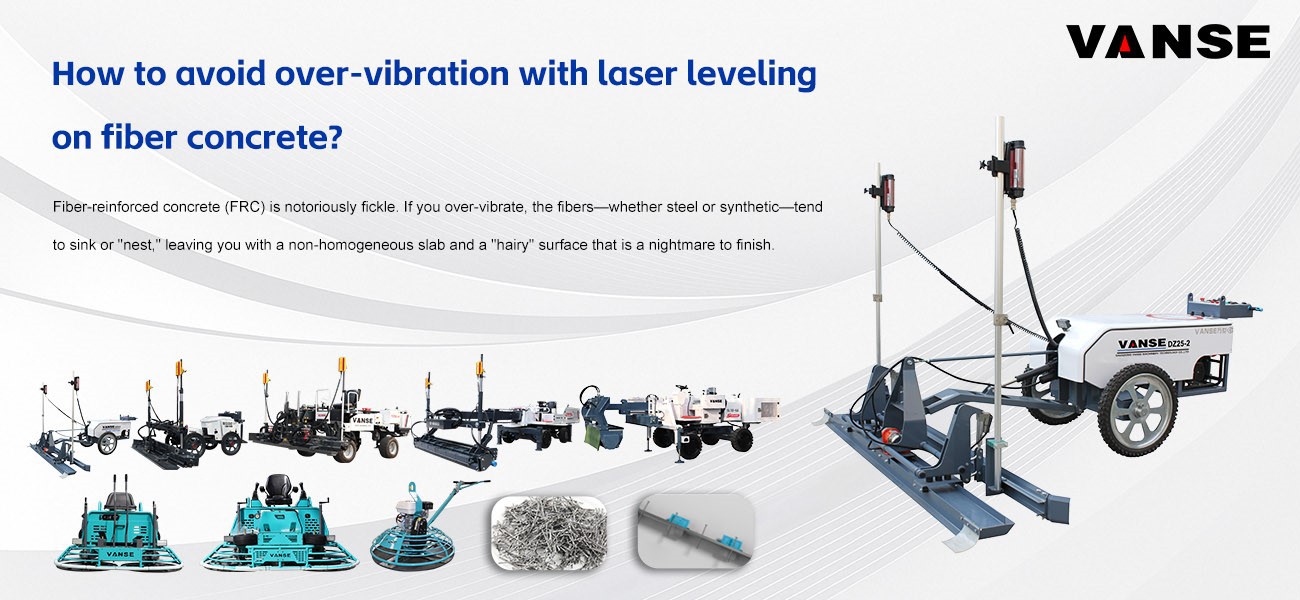
Fiber-reinforced concrete (FRC) is notoriously fickle. If you over-vibrate, the fibers-whether steel or synthetic-tend to sink or "nest," leaving you with a non-homogeneous slab and a "hairy" surface that is a nightmare to finish.
With a laser leveling, the goal is to keep the fibers suspended in the paste while achieving your ±3mm tolerance. Here is how to dial in your machine:
1. Match Vibrator Frequency to Slump
Over-vibration usually happens when the centrifugal force is too high for the concrete's consistency.
The Rule of Thumb: For high-fiber mixes, you generally want high frequency but low amplitude.
Adjustment: Most laser leveling (like Vanse) allow you to adjust the hydraulic flow to the vibrator motor. If you see "fat" (excessive cream/paste) rising more than 2mm–3mm above the fibers, slow the vibrator RPM down immediately.
2. Monitor leveling Head Speed (The "Advance" Rate)
If the machine moves too slowly while the vibrator is screaming, you are effectively "drilling" the fibers down into the subgrade.
The Sweet Spot: Maintain a consistent forward (or pulling) speed. If you have to stop the machine for any reason, shut off the vibrator immediately. Leaving a vibrating leveling head stationary for even 5 seconds will create a permanent "soft spot" or depression in a fiber floor.
3. Check the "Vibrator Drop" Height
The vibrator should not be buried in the concrete.
Positioning: The vibrator plate should just "kiss" the surface of the concrete as the auger levels it.
The Sink Effect: If the vibrator is set too low, it pushes the larger aggregate and fibers down, leaving only weak laitance on top. This leads to surface scaling later in the floor's life.
4. Manage the "Fiber Ball" Risk
Fibers can sometimes clump (balling) before they even hit the leveling.
Auger Interaction: Ensure your auger is set to the correct height (3mm to 5mm above finished grade). The auger’s job is to "cut" the excess; if it’s too low, it will snag fibers and drag them, creating tears in the surface.
Avoid "Double-leveling": With fiber, try to get it right in one pass. Re-vibrating the same area almost guarantees the fibers will settle too deep.
5. Use a "Cloud" or Offset Receiver Setting
Because fibers can make the mix "stiffer," the leveling head might "ride up" on the material.
The Fix: Don't increase vibration to force it down. Instead, adjust your Laser Offset. If the machine is riding high, lower the laser receivers by 1MM or 2MM to compensate for the material's resistance without over-working the paste.
Summary Checklist for Fiber Concrete
| Variable | Adjustment for Fiber | Goal |
| Vibrator RPM | Reduce by 15-20% | Prevent fiber sinking |
| Travel Speed | Faster / Consistent | Prevent "hot spots" |
| Auger Height | Slightly Higher | Avoid snagging/tearing |
| Slump | Maintain 100mm – 125mm | Ensure flow without segregation |
Pro Tip: Have a "muck man" with a come-along tool standing by to watch the auger. If he sees a "beard" of fibers building up on the plow, you need to stop and clean the head, or it will ruin your FF numbers.
Would you like a guide on how to properly "dry-shake" hardener over a fiber-reinforced floor without creating delamination? Contact us NOW
Note: The parameters provided in this document are for reference only and are not mandatory. Due to differences in technical characteristics between different brands and models of laser levelers, please consult the manufacturer for a suitable solution before actual operation. This reference document assumes no responsibility for any issues arising from failure to follow the manufacturer's instructions.
Thanks to All the Friends Who Support and Trust Shandong Vanse Machinery Technology Co., Ltd.
If you want to know more about Shandong Vanse Machinery Technology Co., Ltd. or have any questions, please feel free to contact us:
Our Factory
Shandong Vanse Machinery Technology Co., Ltd.








Share this article

About the Author: Shandong Vanse Machinery Technology Co., Ltd.
Shandong Vanse Machinery Technology Co., Ltd. is a high-tech manufacturer specializing in concrete construction machinery, including laser screeds and related equipment. The company integrates R&D, production, and global sales, with products exported to over 60 countries and widely used in infrastructure projects worldwide.
Previous Post
Next Post
Related Articles
You Might Also Like
List of Common Quality Defects and Countermeasures in Super Flat Floor Construction
In super flat floor construction, due to the extremely high requirements for flatness (FF) and levelness (FL) (usually requiring FF 100 / FL 50 or higher according to ACI standards), any minor operational error can lead to quality defects. The following is a list of common quality defects and their countermeasures in super flat floor construction: This is the most critical quality issue for super-flat floors. Unstable installation of side forms (channel steel) or errors in elevation control. Laser Leveling signal interference or inaccurate sensor calibration. Excessive fluctuations in concrete slump, leading to uneven shrinkage during the hardening process. High-precision formwork: Use high-rigidity channel steel and use a total station and level to re-measure, controlling the error within ± 1mm. Digital monitoring: Use an F-Number measuring instrument (such as a Dipstick) for real-time monitoring during construction. Material consistency: Strictly control the slump of concrete delivered to the site; the fluctuation range should be within ± 20mm. Excessive water-cement ratio. Delayed saw cutting, leading to concentrated release of internal stress. Inadequate curing, resulting in rapid evaporation of surface moisture. Optimize the mix design: Increase aggregate size, reduce cement paste volume, and add shrinkage-reducing admixtures. Timely saw cutting: Use a "early-age saw cutting machine" (Soff-Cut) immediately after the concrete reaches initial setting strength (usually within 4-12 hours). Strengthen curing: Immediately after finishing the surface, spray a high-concentration curing agent, or cover with a film for water curing for at least 7 days. Excessive bleeding during the Leveling process, resulting in a high water-cement ratio on the surface. Premature or uneven application of wear-resistant material. High humidity in the construction environment or construction during rainy periods. Bleeding treatment: Use a rubber squeegee to promptly remove surface bleeding water; do not sprinkle dry cement on the undried surface. Staged application: The wear-resistant material should be applied in two stages; apply 2/3 first, and then apply the remaining portion after the first application has absorbed moisture. Mechanical finishing: Adjust the blade angle and rotation speed of the ride-on power trowel according to the concrete setting degree. The dowel bars are not installed vertically, leading to restricted expansion and contraction of the slabs and differential settlement. The construction interval between adjacent slabs is too long. Dowel bar sleeves: Use high-precision dowel bar supports and ensure the sleeves are properly installed, allowing for horizontal movement of the slabs but restricting vertical movement. Edge reinforcement: Use rigid joint protectors (such as Armor Joint) at the joints to prevent edge spalling under heavy loads. Inconsistent polishing frequency of the polishing machine, leading to localized overheating and discoloration. Uneven application of curing agent. Standardized operation: Standardize the polishing machine's movement path and pressure settings. Controlled curing: Ensure the curing film is applied evenly and adheres properly to prevent color differences caused by localized condensation. Common quality defects Key Control Points Poor flatness Template rigidity + Laser precision calibration Cracking Early saw cutting + Strict water-cement ratio Surface disintegration (sanding) Bleeding water treatment + Wear-resistant materials applied in two stages Uneven joints Dowel bar accuracy + Steel edge protection Would you like me to provide you with a more detailed checklist for "construction joint treatment" or "laser leveling machine operation procedures"? Contact us NOW Note: The parameters provided in this document are for reference only and are not mandatory. Due to differences in technical characteristics between different brands and models of laser levelers, please consult the manufacturer for a suitable solution before actual operation. This reference document assumes no responsibility for any issues arising from failure to follow the manufacturer's instructions.The equipment adaptability transformation of concrete laser leveling machines in agricultural modernization
Applying concrete laser leveling to agricultural modernization is a typical innovative idea of "cross-border technology application". The core idea is to make targeted modifications to high-precision and high-efficiency civil engineering construction equipment to meet the specific scene requirements in agricultural production. The following is a detailed analysis of the equipment adaptability transformation of concrete laser leveling machines in agricultural modernization: The original advantages of the laser leveling are precisely what modern agriculture is pursuing: Extremely high flatness accuracy (±3mm/3m) : Lays the foundation for the construction of high-standard farmland, irrigation uniformity, and mechanized sowing/harvesting. High-efficiency and large-scale operation: The daily operation area can reach several thousand to tens of thousands of square meters, far exceeding manual labor or traditional machinery. Automated construction: Relying on laser transmitters and receivers, the height of the scraper is automatically controlled, reducing the reliance on the operator's experience and ensuring uniform quality. Integrated concrete vibration and leveling: Its powerful vibration system is inspiring for soil compaction and leveling. Core challenge: The original equipment was used for concrete with poor fluidity, while the soil was loose, had variable viscosity, and contained impurities such as crop roots and stems. Key points of the renovation Scraper system: Replace the metal scraper with an adjustable hydraulic scraper or plowshare type soil insertion component, which can automatically adjust the Angle and depth according to soil resistance. Vibration system: Eliminate high-frequency vibration rods and replace them with heavy-duty compaction rollers or vibration compaction plates. It is used to moderately compact the soil after leveling (to the agronomic requirement of compactness) to prevent excessive looseness from causing moisture loss or sowing too deep. Material handling: Add a rotating rake or a straw chopper and spiller at the front end to first deal with surface debris to ensure the quality of leveling. The core challenge: Although the farmland terrain has been initially leveled, it is still more complex than the building foundation and may have problems such as uneven humidity and local softness (risk of machine sinking). Key points of the renovation Track modification: Use widened or lengthened rubber or steel tracks to reduce the ground contact pressure and adapt to soft fields. Four-wheel drive and differential system: Ensure passability and traction in muddy conditions. Lightweight design: Under the premise of ensuring structural strength, the overall weight of the machine should be reduced as much as possible to minimize the compaction of deep soil (avoiding the formation of a plow bottom layer). The core challenge: Farmland leveling is not an absolute level. It often requires micro-terrain shaping, such as maintaining a certain slope for drainage or conducting ridge and trench construction. Key points of the renovation GNSS (Beidou /GPS) RTK high-precision positioning system integration: To replace or complement laser systems. GNSS is more suitable for large fields and unobstructed environments. It can be directly constructed according to the Digital elevation model (DEM) to achieve precise slope control (such as an accurate slope of 0.1%). 3D design model import: Connect with the agricultural Internet of Things and smart agriculture platforms, directly read the field design drawings (such as the integrated 3D models of grid fields, ditches, and ridges), and achieve "construction according to the drawings". Multi-sensor fusion: Add soil moisture and compactness sensors to provide real-time feedback and adjust the compaction force. Core idea: Transform the leveler into a "multi-functional fine farmland preparation platform". Key points of the renovation Quick connection system: Different working heads can be quickly replaced. Typical attachment module Laser scraper: used for the final fine leveling. Ridge forming machine: Used for ridging and bed making. Furrow opener: Synchronously excavates field ditches or drainage ditches. Pre-sowing compaction wheel: Specialized compaction. Integrated fertilization/sowing device: Deep application of base fertilizer or sowing of grass seeds can be carried out simultaneously with leveling. High-standard farmland construction: Rapidly complete large-scale land leveling to meet the requirements of "square fields, interconnected canals, linked roads, irrigation in drought and drainage in flood", with precision far exceeding that of traditional laser land levelers. Rice-growing area grid field transformation: Merge small plots of land into large grids, precisely control the height difference of the field surface, significantly save water, increase production, and facilitate mechanization. Large-scale farms (corn, wheat, soybeans) : Meticulous land preparation before sowing creates the best surface conditions for subsequent precise sowing, uniform germination, and efficient harvesting. Facility agriculture base: It is used for the fine preparation of soil bed surfaces inside multi-span greenhouses and large solar greenhouses. Saline-alkali land/tidal flat improvement: After completing chemical and hydraulic improvements, precise leveling is carried out to suppress salt return and facilitate uniform salt washing and farming. Construction of sports fields and ecological lawns: such as football fields, golf courses, and soil base bed construction for ecological restoration projects. High cost: The initial investment is much higher than that of traditional agricultural flatland machinery, making it more suitable for large farms, cooperatives or specialized agricultural service companies. Technical complexity: It requires a composite team with knowledge of mechanics, hydraulics, laser /GNSS and agronomy to operate and maintain. Soil type adaptability: On extremely heavy clay or sandy soils, special attachments and parameter adjustments may be required. The integration of agronomy and engineering: Flatness is not the sole indicator. Agronomic requirements such as soil tillage layer structure, organic matter protection, and microbial environment must be comprehensively considered. Excessive compaction should not be pursued for the sake of flatness. The future direction of transformation will be "intelligent farmland robots" : All-electric and new energy: Reducing emissions and noise, suitable for facility agriculture. AI visual assistance: Identify and avoid field obstacles, and automatically handle special areas. Cloud collaboration and digital twin: Real-time upload of operation data and comparison with the digital model of farmland to optimize the next operation plan. Fully autonomous unmanned operation: Under preset boundaries and conditions, it realizes continuous and automated land preparation operations at night. In summary, the agricultural adaptability transformation of concrete laser leveling machines is essentially introducing the "precision manufacturing" concept from civil engineering to the front end of agricultural production. It is not a simple copy but a systems engineering project that deeply integrates mechanical engineering, information technology and agronomy. Its successful application will significantly enhance land utilization rate, water resource efficiency and agricultural mechanization level, and it is a powerful tool for promoting agricultural modernization towards "precision" and "intelligence". For a country like China where per capita cultivated land resources are tight, the innovative application of such technologies holds significant strategic importance. Note: The parameters provided in this document are for reference only and are not mandatory. Due to differences in technical characteristics between different brands and models of laser levelers, please consult the manufacturer for a suitable solution before actual operation. This reference document assumes no responsibility for any issues arising from failure to follow the manufacturer's instructions.How to prevent flatness problems on concrete pavement?
To prevent the problem of flatness of concrete pavement, it is necessary to strictly control the quality in various links such as construction preparation, concrete pouring, pavement paving and subsequent maintenance. The specific measures are as follows: – Do a good job of roadbed treatment: The roadbed is the foundation of the road surface and must be guaranteed to be solid, stable and uniform. Before construction, the original ground should be carefully cleaned, weeds, tree roots, garbage and other debris should be removed, and the soft soil, silt and other unfavorable geological areas should be replaced and reinforced. Fill and compact the roadbed according to the design requirements, control the moisture content of the fill, fill and compact in layers, ensure that the compaction meets the standard, and avoid uneven settlement of the roadbed in the later stage and affect the flatness of the road surface. – Precise measurement and layout: Use high-precision measuring instruments, such as total stations, levels, etc., to accurately measure and lay out the center line, side line, elevation, etc. of the road surface. During the construction process, the measurement control points should be reviewed regularly to ensure the accuracy of the measurement data. At the same time, according to the measurement results, set the road template or the guide line of the paver to provide an accurate benchmark for road construction. – Check construction equipment: Ensure that the performance of construction equipment such as concrete mixing equipment, transport vehicles, pavers, and rollers is good and can operate normally. Carry out regular maintenance and maintenance of the equipment, and conduct a comprehensive inspection and commissioning of the equipment before construction. For example, check whether the screed of the paver is flat, whether the vibrating device is working properly, whether the roller wheel of the roller is evenly worn, etc., to ensure that the equipment operates stably during the construction process and avoid problems with the flatness of the road surface due to equipment failure. – Control concrete mix ratio: According to the road design requirements and construction conditions, determine the reasonable concrete mix ratio through experiments. Strictly control the quality and amount of raw materials such as cement, sand and gravel, water, and admixtures to ensure that the workability, strength, and durability of the concrete meet the requirements. In particular, attention should be paid to controlling the slump of concrete. The slump should not be too large or too small. If it is too large, it will easily cause concrete segregation and surface water seepage, affecting the smoothness of the road surface; if it is too small, it will make it difficult to spread and vibrate the concrete. – Ensure the quality of concrete mixing: Use a forced mixer to mix to ensure that the concrete is mixed evenly. Strictly control the mixing time. Determine the appropriate mixing time according to the mix ratio of concrete and the performance of the mixer. Generally, it should not be less than 90 seconds to ensure that the various components of the concrete are fully mixed to avoid uneven distribution of cement slurry and stone clumping, which will affect the working performance of the concrete and the smoothness of the road surface. – Reasonably arrange concrete transportation: Choose appropriate transportation vehicles to ensure that concrete does not segregate or leak during transportation. According to the distance and traffic conditions of the construction site, reasonably arrange the number of transportation vehicles and transportation routes to ensure that concrete can be supplied to the construction site in time, avoid waiting for too long during transportation, resulting in excessive slump loss, and affecting the quality of concrete spreading and vibration. – Standardize paving operation: When using a paver for concrete paving, adjust the working parameters of the paver, such as the elevation angle of the screed, vibration frequency, paving speed, etc. The paver should move forward at a uniform speed, and the speed is generally controlled at 2-3m/min to avoid too fast or too slow speed. During the paving process, a special person should be arranged to follow the machine and deal with the leakage and uneven parts on both sides of the paver in time. If manual paving is used, the paving thickness and surface flatness must be strictly controlled. Use tools such as scrapers and shovels to roughly flatten the concrete, and then vibrate it with a vibrating beam or a flat vibrator. – Strengthen vibration control: Vibration is a key link to ensure the density and flatness of concrete. According to the slump and paving thickness of the concrete, choose the appropriate vibration equipment and vibration method. Generally, a combination of an inserted vibrator and an attached vibrator is used for vibration. The inserted vibrator should be inserted vertically into the concrete, and the vibration points should be evenly distributed. The spacing should not be too large, generally about 1.5 times the radius of the vibrator. The vibration time is based on the concrete surface no longer having bubbles, slurry and sinking, generally 20-30 seconds. The attached vibrator should be installed on the formwork to make the concrete dense by vibrating the formwork. During the vibration process, the vibrator should be prevented from colliding with the formwork, steel bars and force transmission rods, so as not to affect the flatness and structural dimensions of the road surface. – Do a good job of finishing: After the concrete is vibrated, the finishing operation should be carried out in time. The finishing is generally done in two times. The first finishing is done after the concrete surface absorbs water. A wooden trowel is used to scrape the surface slurry, gravel, etc. to make the road surface flat. The second finishing is done before the concrete is initially set. An iron trowel is used for fine finishing to make the road surface flatter and smoother. At the same time, attention should be paid to controlling the strength and number of finishing to avoid excessive finishing, which may lead to excessive thickness of cement slurry on the surface, cracks, peeling, etc. – Standard roughening treatment: After finishing, roughening should be done in time to increase the roughness of the road surface and improve driving safety. The depth and spacing of roughening should be uniform. Generally, the depth of roughening is 2-3mm and the spacing is 2-4cm. Roughening can be done with tools such as a roughening machine or a broom. The roughening direction should be consistent with the driving direction of the road surface to ensure uniform and beautiful roughening quality. – Timely maintenance of the road surface: After the concrete road surface is poured, it should be maintained within 12 hours. The maintenance method can be to cover with moisturizing materials such as geotextiles and straw mats, and regularly sprinkle water to keep it moist, or spray curing agents for maintenance. The maintenance time is generally not less than 7 days. For high-strength concrete or concrete constructed in high temperature and dry environments, the maintenance time should be appropriately extended. During the maintenance period, it is necessary to ensure that the concrete surface is always moist to avoid shrinkage cracks caused by water loss in the concrete, which will affect the flatness of the road surface. – Strict traffic control: During the maintenance of the concrete pavement, strict traffic control must be carried out, and all vehicles and pedestrians are prohibited from passing on the road surface until the concrete reaches the design strength. Before the road surface is opened to traffic, the road surface must be inspected and accepted to ensure that the various indicators such as the flatness and strength of the road surface meet the design requirements. At the same time, obvious warning signs should be set up on the road surface to guide vehicles and pedestrians to bypass the construction area to avoid damage to the road surface that has not been fully formed. ARMOUR JOINT CONCRETE LASER LEVELING MACHINE LIGHT TOWER POWER TROWEL STEEL FIBER TRACKED MINI DUMPER