Technical Knowledge
How to use vibratory leveling to assist concrete laser leveling machine in small areas
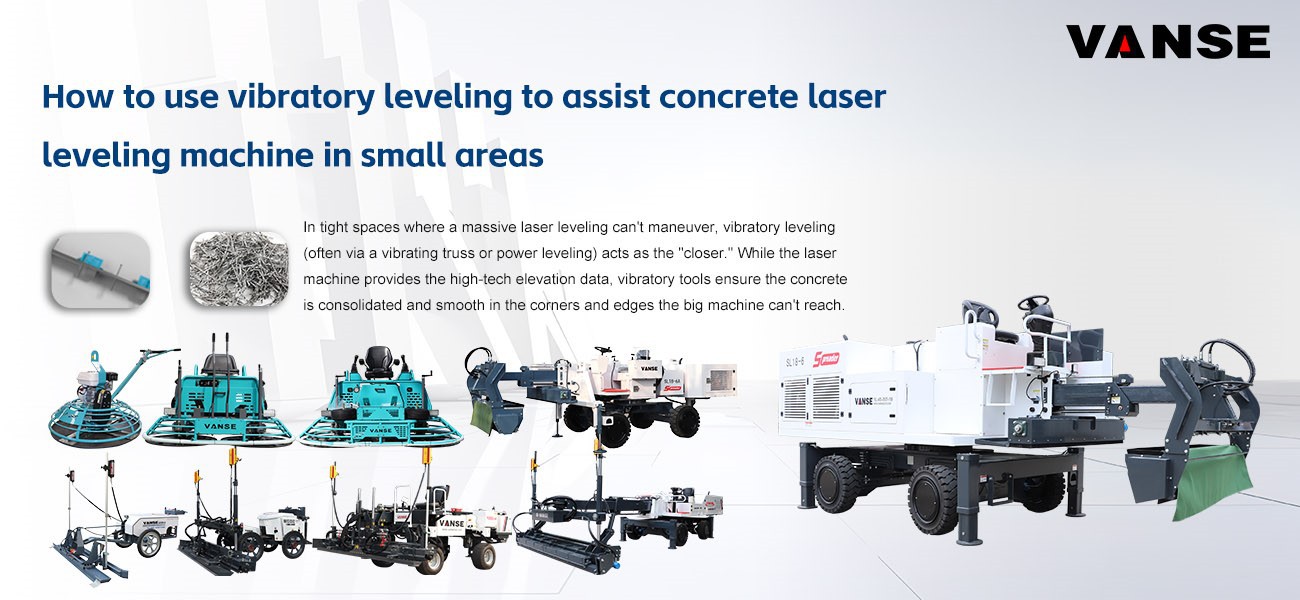
In tight spaces where a massive laser leveling can't maneuver, vibratory leveling (often via a vibrating truss or power leveling) acts as the "closer." While the laser machine provides the high-tech elevation data, vibratory tools ensure the concrete is consolidated and smooth in the corners and edges the big machine can't reach.
Here is how to effectively integrate the two for a seamless, flat finish.
1. Establishing the "Laser Baseline"
Before the vibratory equipment touches the wet concrete, the laser leveling machine must establish the grade.
Benchmark Sync: Ensure your handheld laser receiver (used for the vibratory leveling) is calibrated to the exact same benchmark as the laser leveling machine. Even a 3mm discrepancy will create a visible "lip" where the two areas meet.
The Overlap Zone: Always have the laser machine pass slightly into the "small area" or perimeter. This creates a leveled "pad" of concrete that your vibratory leveling can use as a guide.
2. Setting Perimeter Forms or "Wet leveling"
In small areas, the vibratory leveling needs physical points of reference since it lacks the automatic hydraulic adjustments of the laser machine.
Wet leveling: Use the laser machine to strike off a strip of concrete. Use this leveled strip as one "rail" for your vibratory leveling to ride on.
Handheld Laser Receivers: Mount a receiver to the pole of your vibratory leveling. As you pull the leveling, the "beep" or visual indicator tells you if you are pushing too hard (too low) or riding too high.
3. Techniques for Consolidation
Vibration is key for small areas because concrete near forms and corners tends to "honeycomb" (trap air).
The Leading Edge: Keep a small "roll" of concrete (about about 2cm to 5cm high) in front of the vibratory blade. This head of pressure ensures that as the vibration liquefies the concrete, it fills all voids and matches the height set by the laser.
Speed Control: Move the vibratory leveling at a slow, consistent pace-roughly 1m per minute. Moving too fast leaves "waves"; moving too slow sinks the aggregate too deep, leaving a weak, cream-heavy surface.
Best Practices for Seamless Integration
| Task | Laser Machine Role | Vibratory leveling Role |
| Main Slab | Handles 90% of the volume and leveling. | Follows behind to "knit" edges. |
| Edges/Columns | Cannot reach; stays 0.5m away. | Primary tool for leveling and consolidation. |
| Grade Check | Automatic/Constant. | Manual check via handheld laser rod. |
| Finish | High-speed strike-off. | Final "cream" pull for easy power troweling. |
Common Mistake: "Over-Vibration"
In small areas, it’s tempting to hover the vibratory leveling in one spot to "make it flat." Don't. This causes the heavy aggregate to sink and the water/laitance to rise, which leads to surface scaling later. If the grade is wrong, add or remove concrete manually, then做 one final pass with the vibratory tool.
Would you like me to find a specific checklist for calibrating handheld laser receivers to match your main laser leveling? Contact us NOW
Note: The parameters provided in this document are for reference only and are not mandatory. Due to differences in technical characteristics between different brands and models of laser levelers, please consult the manufacturer for a suitable solution before actual operation. This reference document assumes no responsibility for any issues arising from failure to follow the manufacturer's instructions.
Thanks to All the Friends Who Support and Trust Shandong Vanse Machinery Technology Co., Ltd.
If you want to know more about Shandong Vanse Machinery Technology Co., Ltd. or have any questions, please feel free to contact us:
Our Factory
Shandong Vanse Machinery Technology Co., Ltd.








Share this article

About the Author: Shandong Vanse Machinery Technology Co., Ltd.
Shandong Vanse Machinery Technology Co., Ltd. is a high-tech manufacturer specializing in concrete construction machinery, including laser screeds and related equipment. The company integrates R&D, production, and global sales, with products exported to over 60 countries and widely used in infrastructure projects worldwide.
Previous Post
Next Post
Related Articles
You Might Also Like
VANSE Machinery warmly reminds you what aspects you should pay attention to when purchasing a car-mounted laser leveling machine
With the continuous increase of domestic labor costs, engineering construction enterprises are increasingly demanding laser machinery with high efficiency, short construction period and low cost. The car-mounted laser leveling machine is convenient and quick to operate, suitable for different engineering needs, and has become the mainstream nowadays. The VANSE brand YZ25-4 four-wheel concrete laser leveling machines produced by Shandong VANSE Machinery are convenient and quick to operate, suitable for large-area paving, and have better compaction effects. Pay attention to the following aspects when purchasing a car-mounted laser leveling machine: 01 Look at the model: it is mainly selected and determined based on the construction site and area. 02 Look at the effect of the machine. 03 Leveling speed 04 Leveling accuracy requirements 05 Look at the manufacturer: the strength of the manufacturer directly affects the quality of the equipment. 06 Look at the price: If the price of a machine is too lower than the average price of the industry, buyers should be alerted. Under the condition of not achieving large-scale production, too low price does not mean low profit, but low cost, and low cost will directly affect the life and use effect of machinery, and even implies that enterprises There will not be too much investment in after-sales and R&D. Don't just look at the price because you don't know much about the technology. In the end, the gain outweighs the loss and you have to buy it again. Not only wasted money, but also delayed their own production. 07 Look at safety: when choosing a laser leveling machine, the braking performance and operation safety of the laser leveling machine should also be fully considered. The parts of VANSE mechanical laser leveling machine are all produced by large-scale manufacturers in advanced countries such as Germany and the United States. The production process is strictly in accordance with national standards, enterprise standards, and quality control assurance systems to ensure that product quality meets or exceeds enterprise standards and related According to the requirements of national standards, it has won the trust and praise of users for its excellent quality, excellent performance and superior cost performance. Shandong VANSE Machinery series products have been widely used in factories, with customers all over the country, inside and outside the Great Wall, and have been recognized by many engineering project partners and customers such as workshops, underground garages, floors, access bridges, square floors, logistics and warehousing.Concrete laser leveling machine operating procedures and precautions
The operating procedures and precautions for the concrete laser leveling are as follows: 1. Operation process Preparation before construction Before carrying out concrete laser leveling machine construction, corresponding preparations need to be made. First, check that all parts of the leveler are intact and make sure the machine is in good working order. Secondly, determine the materials and tools required for construction, such as concrete, water, cement and other materials, as well as mixers, transport trucks, vibrators and other tools. Finally, determine the specific location and scope of the construction, and measure and stake out according to the design requirements. Concrete ingredients According to the construction requirements, the concrete ingredients are mixed together in a certain proportion. During the batching process, attention needs to be paid to the quality and proportion of materials to ensure that the strength and stability of the concrete meet the requirements. At the same time, attention needs to be paid to the mixing time and mixing speed to ensure that the concrete is fully mixed evenly. Laying steel mesh Before laying the steel mesh, the specifications, quantity and location of the steel bars need to be determined, and processed and tied according to the design requirements. When laying the steel mesh, attention needs to be paid to the flatness and stability of the steel mesh to ensure that it can withstand the weight of the concrete and the external forces during the construction process. Laser leveling machine construction Before the construction of the laser leveling machine, various parameters of the machine need to be adjusted, such as scraper height, vibration frequency, leveling head angle, etc. During the construction process, it is necessary to control the traveling speed and direction of the laser leveling to ensure that the leveling can evenly scrape the concrete. At the same time, it is necessary to observe the flatness and thickness of the concrete and adjust the parameters and operating methods of the leveler in a timely manner. Follow-up processing After the laser leveling machine construction is completed, follow-up processing is required. First, trim and clean the completed concrete surface to remove surface impurities and uneven parts. Secondly, maintain and protect the concrete surface, such as covering it with plastic film or spraying curing agent. Finally, the waste during the construction process is cleaned and processed to ensure the cleanliness and environmental protection of the construction site. 2. Precautions Operators must undergo professional training and qualification before they can operate the concrete laser leveling. Unlicensed operation is strictly prohibited. Safety warning signs must be set up at the construction site, and full-time safety officers must be assigned to be responsible for on-site safety management. Operators must understand the principles, structure, performance and operation methods of concrete laser levelings, and master the necessary maintenance knowledge. When using a concrete laser leveling, you must wear labor protection supplies, such as safety helmets, gloves, work clothes, etc. Before using the concrete laser leveling machine, you must check whether all parts of the machine are intact. If there is any damage or failure, it must be repaired or replaced in time. When using a concrete laser leveling, the construction must be carried out in accordance with the design requirements, and the construction parameters or operating methods must not be changed at will. When using the concrete laser leveling machine, the construction site must be kept clean and standardized, and debris or garbage must not be piled up randomly. When using the concrete laser leveling machine, you must pay attention to the safe use of electricity and do not pull cables or wires at will. When using a concrete laser leveling machine, maintenance must be carried out in accordance with the machine maintenance requirements, such as regular oil replacement, machine body cleaning, etc. When using a concrete laser leveling machine, you must pay attention to the care and maintenance of the machine, such as regularly checking the lubricating oil, cleaning the air filter, etc. When using the concrete laser leveling machine, care must be taken to avoid collision or damage to the machine. If the machine is found to have abnormal noise or vibration, it should be stopped in time for inspection. When using a concrete laser leveling machine, care must be taken to protect the machine's electronic components and sensors and other sensitive components. If damage or failure is found, it should be repaired or replaced in time. When using a concrete laser leveling, attention must be paid to controlling the construction temperature and humidity. If the temperature is too high or too low, it will affect the strength and quality of the concrete. When using a concrete laser leveling, attention must be paid to controlling the slump of the concrete to ensure good fluidity and easy construction of the concrete. When using a concrete laser leveling, attention must be paid to controlling the mix ratio and quality stability of the concrete to ensure that the construction quality meets the design requirements. When using a concrete laser leveling, attention must be paid to controlling the energy consumption and usage costs of the equipment to reduce construction costs and improve economic benefits.