Technical Knowledge
Which concrete cutting machines are suitable for making joint cuts on ultra-flat floors without damaging the flatness?
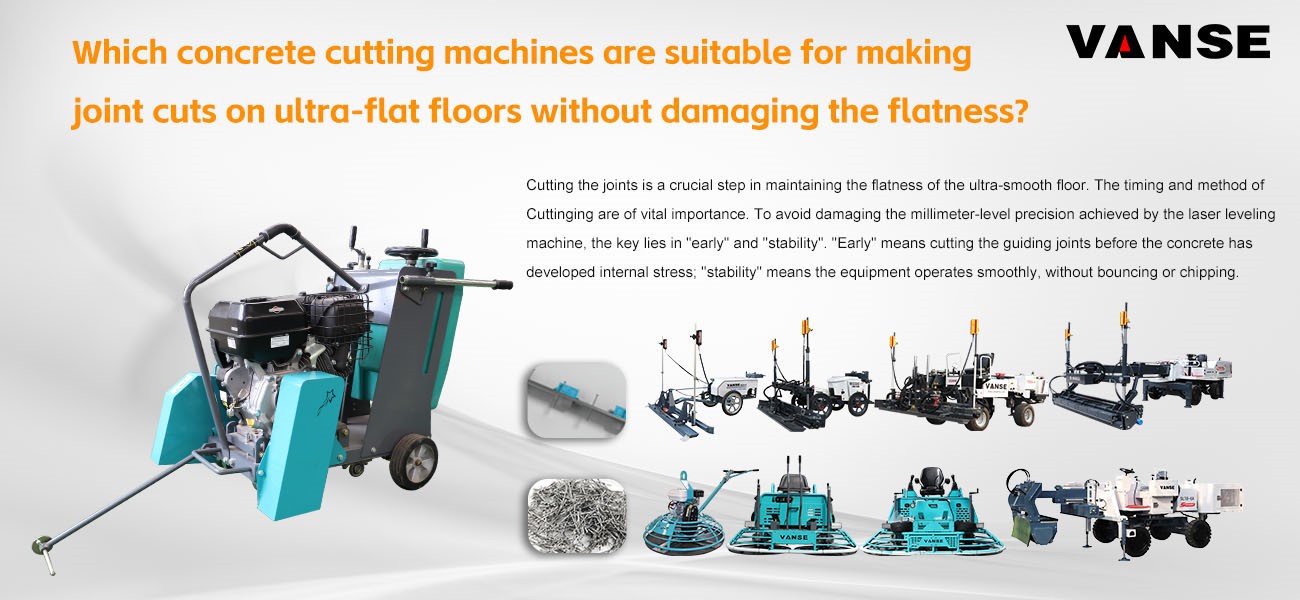
Cutting the joints is a crucial step in maintaining the flatness of the ultra-smooth floor. The timing and method of Cuttinging are of vital importance. To avoid damaging the millimeter-level precision achieved by the laser leveling machine, the key lies in "early" and "stability". "Early" means cutting the guiding joints before the concrete has developed internal stress; "stability" means the equipment operates smoothly, without bouncing or chipping.
Based on this principle, there are mainly two types of equipment available on the market that are suitable for cutting joints in ultra-smooth floors. The core difference between them lies in the time window for cutting.
⏱️ Key choice: Early entry Cutting vs. Traditional slit Cutting
To make it easier for you to compare, I have listed their features as follows:
| Comparison dimension | Early-Entry Cutting | Conventional Cutting |
| The timing of the cut | Within 1-4 hours after the concrete has been polished (commonly known as the "initial setting" stage) | After 6-12 hours or longer of concrete curing (usually overnight waiting) |
| Core Strengths | Prevent cracks from forming at their source: Cut the joints before the concrete begins to contract, guiding the cracks to develop in a regular pattern. This is the best way to protect the flatness of the super-level floor. | High flexibility: Suitable for all types of concrete, including hardened floors. |
| Smooth cuts: Special blades and patented sliding plates are used, resulting in almost no chipping during cutting, and the joints are aesthetically pleasing. | Adjustable depth and width: Capable of cutting deeper and wider joints. | |
| Potential risks | The time window is narrow, and high requirements are placed on construction organization. Special cutting blades must be equipped. | May cause random cracks: If the cutting is done too late, the internal stress of the concrete may have already caused micro-cracks or warping on the floor before the joint is made, thus damaging the flatness. |
🛠️ How to choose the equipment that suits your project?
The key to the decision lies in your ultimate pursuit of flatness and the scheduling of the project.
Preferred solution: Early Cutting
If your project aims for a super-flat floor with FF/FL 35 or above, or if the floor will be used in high-shelf warehouses or precision instrument workshops, then the early Cutting is the only recommended option. It actively guides the cracks before stress is formed, maximizing the protection of the perfect foundation created by the laser leveling machine.
Alternative solution: Traditional precision joint Cutting
If your project requires a slightly lower level of flatness (such as for ordinary commercial floors), or if you missed the early Cutting window due to construction schedule reasons, then choosing a high-precision, smooth-running traditional joint Cutting is necessary. The key lies in the stability of the equipment.
⚙️ Key detail: Blades are as important as technology.
No matter which equipment you choose, there are two points to keep in mind:
Special blades: For the initial cutting, you must use the blades specifically designed for this purpose. The blade head connection and formula are specially tailored for un-hardened concrete, which can prevent the blade head from falling off and ensure the cutting quality.
Smooth operation: The weight balance of the equipment and the design of the blade guard (such as whether it has a stabilizing slide) will directly affect the stability during cutting, and thereby influence the final flatness.
I hope the above information can help you make a clearer choice. If you want to know more about how to select the appropriate blade type based on the specific concrete mix ratio (such as whether fibers are added), I can help you organize more detailed information for you. Contact us NOW
Note: The parameters provided in this document are for reference only and are not mandatory. Due to differences in technical characteristics between different brands and models of laser levelers, please consult the manufacturer for a suitable solution before actual operation. This reference document assumes no responsibility for any issues arising from failure to follow the manufacturer's instructions.
Thanks to All the Friends Who Support and Trust Shandong Vanse Machinery Technology Co., Ltd.
If you want to know more about Shandong Vanse Machinery Technology Co., Ltd. or have any questions, please feel free to contact us:
Our Factory
Shandong Vanse Machinery Technology Co., Ltd.








Share this article

About the Author: Shandong Vanse Machinery Technology Co., Ltd.
Shandong Vanse Machinery Technology Co., Ltd. is a high-tech manufacturer specializing in concrete construction machinery, including laser screeds and related equipment. The company integrates R&D, production, and global sales, with products exported to over 60 countries and widely used in infrastructure projects worldwide.
Previous Post
Next Post
Related Articles
You Might Also Like
Advantages of using concrete laser leveling machine in floor construction
The building floor construction industry is currently developing rapidly, and the use of construction machinery such as laser leveling machines is becoming more and more frequent. So, why do we recommend this equipment among many engineering machinery? In fact, there are certain reasons. Next, let's take a look at the introduction of the following article! Shandong Vanse laser leveling machine has several advantages over traditional laser leveling machines for building floor construction: Traditional construction technology has a large number of people, and requires templates (channel steel), dotting, and paving. It requires about 20 people. The construction area is 700 square meters per day. The total number of people using concrete laser leveling machines is more than half of that of traditional technology. It can be operated by one person. The construction area is 2500 square meters-3500 square meters per day, which greatly reduces labor costs. Traditional leveling technology requires templates to control the elevation of the ground and pull control lines. The elevation error is large. The levelness and flatness of the entire floor cannot be guaranteed. The laser point transmitter is used, which is suitable for one-time paving of large areas. There is a laser measurement and control system to control the elevation in real time. There is no need to pull the wire for leveling, and there is no need to support the side plate in the middle to control the ground elevation. This avoids the elevation error caused by the vibration of the template (channel steel) during the construction process, and also reduces the elevation error caused by traditional manual block support. Traditional construction technology, one day of formwork, one day of pouring, can only be skipped one by one, which has great limitations, cannot be operated continuously, and has poor integrity, which is easy to cause cumulative errors in construction joints. The laser leveling machine has higher efficiency and integrity for one-time overall paving of large areas of floor. The completion of the entire floor makes the ground integrity better, which is completely impossible for traditional construction. 4. The ground is more dense and uniform: The high-frequency vibrator of 4000 times per minute allows the leveling head vibrator to produce uniform high-frequency vibration, making the concrete floor denser and more uniform. As a leader in concrete laser leveling machine design, laser leveling machine can realize large-area construction. By solving the concrete surface layer in one go, all "common quality problems" caused by secondary practices are completely eliminated. We will continue to provide customers with reliable products and more complete services.What is the lifespan of a concrete laser leveling machine
The lifespan of a concrete laser leveling machine (laser leveling) is not a simple number of years, as it depends heavily on usage intensity, maintenance, model/brand, and technological evolution. Think of it more like a heavy-duty construction vehicle (e.g., an excavator) rather than a consumer electronic device. Here's a detailed breakdown of factors and a realistic lifespan framework: High-Use Contractor: A company using the machine on large projects 200+ days a year will accumulate wear much faster than a rental yard that leases it intermittently. Cubic Meters/Yardage: The total volume of concrete placed is the true measure of "mileage." A well-maintained machine from a major brand is engineered for tens of millions of cubic meters over its life. Rigorous Adherence to Schedule: Following the manufacturer's maintenance schedule for engine (diesel or gasoline), hydraulics, vibrator systems, and the laser transmitter is paramount. Cleanliness & Storage: Washing down the machine after each use to prevent concrete buildup (which can seize moving parts) and storing it under cover dramatically extends its life. Operator Skill: A skilled operator who avoids unnecessary stress and impacts will cause less wear and tear. This is a unique factor. The mechanical parts of a laser leveling can last for decades. However, the control system and laser technology may become outdated. Upgrades (like newer 3D GPS machine control systems) are often available, allowing an older machine's "brain" to be updated, extending its useful economic life. Economic Lifespan (Primary, High-Production Use): 10 – 20 years. This is the period where the machine is a frontline, daily production tool. After this, while it may still run, it might be less efficient, require more frequent repairs, or be technologically outdated compared to newer models. Physical/Mechanical Lifespan (Total Service Life): 20+ years, potentially 25-30+ years with excellent care. There are many first-generation laser leveling from the 1990s still in operation today, often on smaller projects or as backup machines. They become "classic workhorses." Components that typically need attention or replacement long before the machine frame is retired: Engines and Hydraulic Pumps/Motors: Can be rebuilt or replaced. Vibrator Systems: High-wear items that require regular rebuilding. Wear Parts on the leveling Head: Paddles, strike-off plates, and skis are consumable. Hoses, Seals, and Bearings: Regular replacement items. Laser Receiver and Transmitter: Can be damaged (e.g., dropped), but are also upgraded over time. Like a Semi-Truck: With dedicated daily use and heavy loads, it has a prime economic life of about 10-15 years. With superb maintenance, it can stay on the road for 20+ years, though not as the primary fleet vehicle. Resale/Rental Value: Well-maintained machines from major brands hold their value remarkably well. A 10-year-old Somero S-840, for example, can still command a significant price on the used market. 15+ years of highly productive, frontline service. A total service life of 25+ years, after which it may serve as a reliable backup or be sold on the secondary market where it will continue to operate for years more. The key to maximizing lifespan is proactive maintenance, skilled operation, and timely technological upgrades. Note: The parameters provided in this document are for reference only and are not mandatory. Due to differences in technical characteristics between different brands and models of laser levelers, please consult the manufacturer for a suitable solution before actual operation. This reference document assumes no responsibility for any issues arising from failure to follow the manufacturer's instructions.Self-healing structure is self-waterproof
In the field of construction engineering, leakage has always been a core threat to structural safety and functional experience – moisture in basements leads to moldy decoration, roof seepage erodes steel bars, and wall leakage affects living comfort, and it will also accelerate the carbonation of concrete and the aging of the structure. Traditional waterproofing techniques (membranes, coatings) rely on external additional layers, which are prone to failure due to material aging, construction hollowing, and temperature difference deformation. Although ordinary self-waterproofing structures enhance their impermeability by optimizing the density of concrete, they are difficult to deal with micro-cracks caused by temperature stress and load fluctuations in the later stage. Self-healing structural self-waterproofing technology, with its innovative mechanism of "actively repairing micro-cracks", has achieved a leap from "passive anti-seepage" to "active self-healing", and has become a core waterproofing solution for high-end buildings and special projects. This article, based on the technical practices of the three major brands, Pengneichuan (Penetron), Sika, and liwei, systematically analyzes the technical key points, brand differentiation solutions, and engineering application norms of self-healing structure self-waterproofing. 1. Concept: Self-healing structural self-waterproofing is based on the "material improvement – construction control – structure optimization" of ordinary structural self-waterproofing. By adding self-healing functional components (such as active crystallization agents, capsule repair agents, microbial agents, etc.), after the concrete generates micro-cracks with a width of ≤0.3mm, it can be triggered by moisture, air or chemical conditions. A technical system for independently completing crack filling and restoring impermeability performance. 2. Core logic: "Hazard Prediction – Proactive Response – Performance Reset" (1) Hidden danger prediction: During the service of buildings, due to temperature changes (thermal expansion and contraction), load fluctuations (dynamic load impact), and dry-wet cycles, 0.1-0.3mm micro-cracks are bound to occur (the crack resistance of ordinary concrete is limited, and such cracks are hard to avoid), and cracks are the main channels for water seepage. (2) Active response: The "self-healing components" pre-installed inside the concrete (such as Pengnei Chuan's active crystalline particles and Sika's capsule repair agent) are activated when cracks occur – either reacting with water to form a gel, or breaking to release the repair agent, or being metabolized by microorganisms to produce crystals; (3) Performance reset: Self-healing products fill the cracks and re-form a dense impermeable barrier, restoring the original impermeability of the concrete. This technology is particularly suitable for scenarios with extremely high requirements for waterproofing reliability and durability, such as subway tunnels, nuclear power plants, water conservancy projects, and basements of super high-rise buildings. The implementation of self-healing structure self-waterproofing should revolve around "self-healing material selection – construction adaptation – performance verification", and the core technical links should comply with the "Technical Code for Self-Healing of Concrete Structures" (CECS 378-2021) and relevant national standards: The performance key of self-healing waterproof concrete lies in the "self-healing functional components". Currently, the mainstream technical routes are divided into three categories, and the appropriate solution should be selected according to the engineering scenario: Self-healing technology route Internal admixture self-healing agent Microbial self-healing Fiber-reinforced self-healing In addition, the base concrete should meet the following requirements: strength grade ≥C35, impermeability grade ≥P8, and the admixtures should be Grade I fly ash (with a content of 15%-20%) or mineral powder (with a content of 25%-30%) to enhance the density of the concrete and the compatibility with self-healing components. The construction of self-healing concrete should, on the basis of the self-waterproofing of ordinary structures, strengthen the "uniformity of self-healing components" and "crack induction control", with key control points: (1) Mixing and pouring: For capsule-type self-healing agents, the "post-mixing method" (adding them in the last 30 seconds of concrete mixing) should be adopted to prevent capsule rupture. Microbial agents need to be added simultaneously with the aggregates, and the stirring time should be extended to 120-150 seconds to ensure the uniform distribution of the agents. The thickness of the layered pouring should be no more than 400mm, and the spacing of the vibration rods should be no more than 350mm to prevent the aggregation or damage of self-healing components. (2) Curing and crack induction: Within 24 hours after pouring, adopt "water storage + film covering" curing (humidity ≥90%, temperature ≥15℃), and extend the curing period to 21 days – sufficient moisture can activate self-healing components (such as microbial metabolism, expansive agent reaction); For large-volume concrete, "induction joints" (with a spacing of 8-10m and a depth of 50-80mm) should be reserved on the surface to guide the formation of cracks at the preset positions, facilitating the concentrated repair of self-healing components. (3) Construction joint treatment: In addition to the conventional waterstop steel plate, a "self-healing interface agent" (such as microbial agent slurry, with a application rate of 0.3kg/㎡) should be applied to the interface of the construction joint to enhance the self-healing ability of the new and old concrete bonding surface and prevent interface leakage. (1) Moisture guidance structure: Set up "micro-seepage water channels" (10-15mm in width and 0.5% in slope) on the basement floor and roof slabs. When micro-cracks occur, guide the moisture to contact the self-healing components, accelerating the repair reaction. (2) Monitoring and supplementary repair nodes: Pre-embed "crack monitoring sensors" (with an accuracy of 0.01mm) at key locations such as tunnels and water pools to monitor the crack width in real time. If the crack exceeds the self-healing range (> 0.3mm), self-healing slurry (such as microbial agent slurry) can be injected through the pre-embedded grouting pipe to achieve artificial auxiliary repair. (3) Node reinforcement: The part where the pipe passes through the wall plate adopts "self-healing waterproof sleeve" (the inner wall of the sleeve is coated with permeable crystalline paint, and the gap is filled with expansive self-healing sealant), providing dual protection for the impermeability of the node. From the three dimensions of anti-seepage, repair and lifespan, the self-waterproofing advantages of the structure are significant. The specific comparison is as follows: Comparison dimension Traditional waterproofing (membrane/coating Ordinary structure self-waterproofing Self-healing structure is self-waterproof Crack treatment capacity The crack cannot be repaired and leakage is prone to occur at the crack Relying on the inherent density of concrete, micro-cracks are prone to develop into leakage channels Actively repair micro-cracks of ≤0.3mm to prevent leakage from spreading Service life 5 to 10 years (material aging) 30 to 40 years (cumulative failure due to micro-cracks) Have the same lifespan as the building (≥50 years, with continuous self-healing function) Environmental adaptability It is prone to aging at high or low temperatures and has poor resistance to acids and alkalis It has good weather resistance, but its resistance to chemical erosion is limited Acid and alkali resistant (microbial type), high and low temperature resistant (-30℃ to 80℃) Later maintenance cost The maintenance cost is approximately 60% of the initial cost every 10 years Grouting repair is required every 20 years, with a cost of approximately 30% of the initial No regular maintenance is required. Only in extreme cases is auxiliary repair needed Applicable scenarios Roofs and bathrooms of civil buildings General basements and factory buildings Subways, nuclear power plants, water conservancy hubs, super high-rise buildings At present, the mainstream technology can only repair micro-cracks with a width of no more than 0.3mm. If the crack width is greater than 0.3mm (such as structural cracks caused by loads), epoxy resin grouting and sealing should be used first, and then the micro-branch cracks should be repaired by self-healing components. The self-healing function cannot be relied on completely. It is necessary to add a "Self-healing performance special Test" : ① Artificial jointing test (prefabricate 0.2-0.3mm cracks on concrete test blocks, and test the permeability after 28 days of water storage, which should be ≤0.01L/m² · h); ② On-site core sampling inspection (drill a core sample of Φ100mm and observe the crack healing condition. The healing rate should be ≥80%). Although the initial material cost is 15% to 20% higher than that of ordinary self-waterproofing structures, the total life cycle cost is lower. Calculated based on a 70-year building lifespan, ordinary self-waterproofing structures require 2 to 3 repairs, and the total cost is approximately 1.8 times that of self-healing types. At present, in civil buildings, some high-end residential basements and roofs have adopted a composite solution of "microbial self-healing + penetrating crystallization", and its cost performance is gradually improving. (1) Metro tunnel: Use "capsule-type self-healing agent + fiber reinforced" waterproof concrete (C40/P10), with a self-healing agent dosage of 1.0kg/m³ and a fiber dosage of 1.2kg/m³. During construction, the reserved spacing of the induction joints is 8 meters, and the curing period is 21 days. One year after the opening to traffic, the micro-crack healing rate of the tunnel lining reached 92%, and there was no leakage. (2) Water conservancy water pool: "Microbial self-healing concrete" (C35/P12) is adopted, with a microbial agent concentration of 10⁹ CFU/mL and a nutrient carrier dosage of 2.0kg/m³. Through the monitoring of pre-embedded sensors, the 0.2mm crack was completely healed within six months, and the permeability coefficient dropped below 1×10⁻¹¹ m/s. When applying self-healing structural self-waterproofing to old buildings, it is necessary to first carry out the process through three steps: "crack detection – interface treatment – self-healing enhancement". (1) Crack detection: Use an ultrasonic detector to scan the walls and floor slabs, mark the location and width of the cracks. For cracks larger than 0.3mm, grouting and sealing are carried out first. (2) Interface treatment: Chisel off the original concrete surface layer (with a depth of 30-50mm), and apply a "self-healing interface agent" (such as a mixture of silica fume and microbial agent slurry). (3) Construction of self-healing reinforcing layer: Pour 50-80mm thick self-healing fine aggregate concrete (C35/P8, mixed with 0.8kg/m³ expansive self-healing agent), and conduct a water-tightness test after 14 days of curing to ensure there is no leakage. The following acceptance items should be added in accordance with the "Technical Code for Self-Healing of Concrete Structures" (CECS 378-2021) : (1) Detection of self-healing component dosage: The sampling and weighing method is adopted to ensure that the dosage of self-healing agent and bacterial agent meets the design requirements (deviation ≤±5%). (2) On-site self-healing performance testing: Pre-fabricate 0.2mm cracks on the structural surface. Observe no leakage after 24 hours of water storage. After 28 days, test the crack healing rate to be ≥80%. (3) Long-term monitoring data: The embedded sensors need to provide a report on the change in crack width within six months to ensure that no new cracks occur and the old ones continue to heal. The self-healing structural self-waterproofing technology, through an innovative mechanism of "actively repairing micro-cracks", addresses the pain points of traditional waterproofing, such as "easy failure", and ordinary structural self-waterproofing, such as "difficult crack resistance". It is particularly suitable for engineering scenarios with extremely high requirements for waterproofing reliability and durability. With the decline in material costs and the maturation of technology, it will gradually be popularized in civil buildings in the future. Note: The parameters provided in this document are for reference only and are not mandatory. Due to differences in technical characteristics between different brands and models of laser levelers, please consult the manufacturer for a suitable solution before actual operation. This reference document assumes no responsibility for any issues arising from failure to follow the manufacturer's instructions.