Technical Knowledge
What are the compatibility requirements between concrete topping spreaders and different concrete surface textures
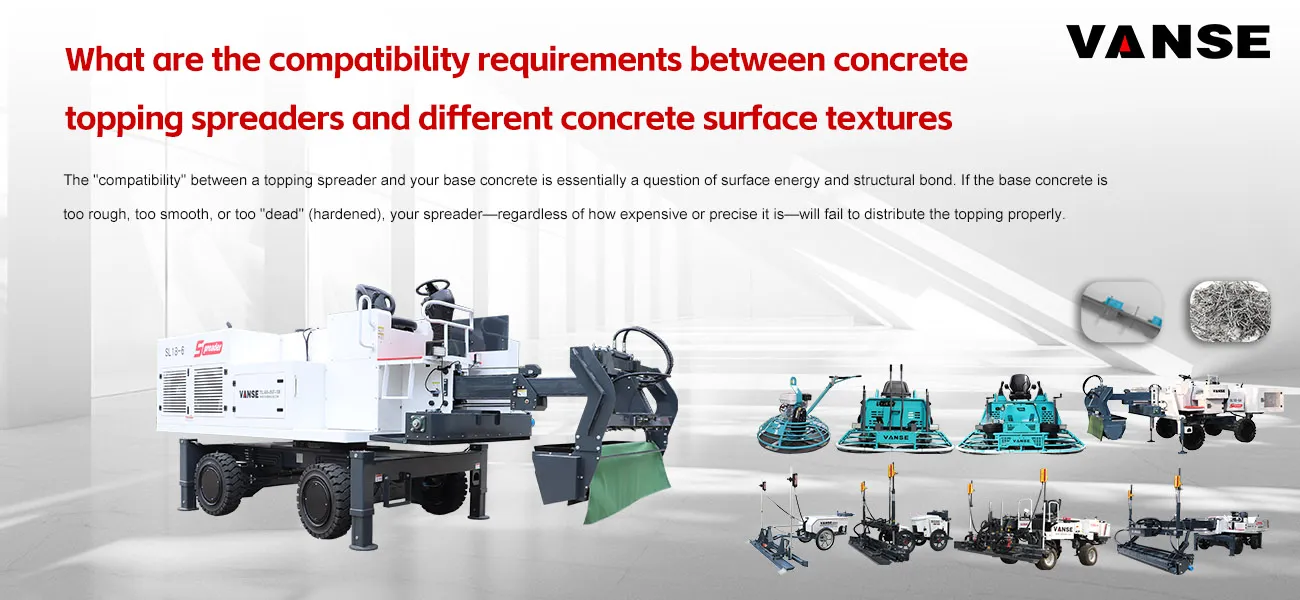
The "compatibility" between a topping spreader and your base concrete is essentially a question of surface energy and structural bond. If the base concrete is too rough, too smooth, or too "dead" (hardened), your spreader-regardless of how expensive or precise it is-will fail to distribute the topping properly.
Here is how to match your spreader setup to the surface texture of the base slab.
1. The "Open-Faced" Surface (Standard Laser Leveling)
The Texture: A fresh, laser-Levelinged surface is smooth but "open," meaning it still has plenty of exposed paste and moisture.
Compatibility: This is the "Goldilocks" zone for spreaders.
Spreader Adjustment: You can use high-speed rotary spreaders (the ones that throw material using centrifugal force). Because the surface is open, the topping will immediately "drink" the bleed water and bond instantly.
Best Practice: Do not wait too long. If the slab surface begins to "crust" (harden), the topping will just sit on top, leading to delamination later.
2. The "Closed-Faced" Surface (Power-Floated Base)
The Texture: A slab that has already been power-floated once is "closed"-the pores are sealed.
Compatibility: This is difficult for standard spreaders.
The Challenge: If you try to spread dry-shake on a closed surface, it won't hydrate. The powder will act like a "slip layer" (like ball bearings), causing your finishing machines to slide around, or worse, the topping will never bond.
Spreader Adjustment: Use a gravity-drop spreader (not a rotary thrower). You need a very precise, uniform layer. You must also follow the spreader with a trowel-based re-opening pass to break the surface tension and force the topping into the slab.
3. The Rough/Textured Surface (Broom or Raked Finish)
The Texture: Often seen in exterior slabs or ramps.
Compatibility: Highly incompatible with standard dry-shake spreaders.
The Problem: The peaks of the broom finish will strip the topping off the spreader, causing "streaking" or "clumping."
Spreader Adjustment: If you must apply topping to a rough surface, you cannot use a mechanical spreader effectively. You are better off using manual broadcasting techniques or a high-pressure pneumatic blower that can "blast" the powder into the deep valleys of the texture.
4. Summary Table: Spreader VS Surface Texture
| Base Surface Texture | Spreader Compatibility | Recommended Spreader Type | Key Risk |
| Fresh/Levelinged (Open) | Excellent | Rotary Spreader | Over-spreading (waste) |
| Smooth/Power-Floated | Moderate | Gravity-Drop Spreader | Delamination (lack of bond) |
| Broom/Rough Finish | Poor | Manual/Pneumatic Only | Uneven coverage/streaking |
| Cured/Hardened | Incompatible | N/A | Total failure (no bond) |
5. Critical Factors for Compatibility
The Moisture Variable
The compatibility isn't just about the physical texture; it’s about bleed water. * If your surface texture is "open," it has high moisture availability. You need a fast spreader speed to keep up with the hydration.
If your surface texture is "closed," it has low moisture availability. You must reduce the spreader speed and immediately follow with a mechanical disc-trowel to "work" the topping into the slab.
The "Sinking" Effect
If you are spreading on a base that is still very soft (wet), your spreader must use flotation tires or wide tracks.
If the spreader sinks into the texture (ruts), it creates physical troughs. The material will naturally accumulate in these troughs, creating a non-uniform floor.
Compatibility Fix: Always ensure the spreader is calibrated for the weight-bearing capacity of the specific mix design you are using.
The "Texture-Bridge" Rule
A good rule of thumb: The amplitude of your surface texture must be less than the particle size of your topping. If you have a coarse broom finish (deep valleys) and you use a fine-powder pigment, the pigment will vanish into the valleys and won't be visible on the peaks. In this case, you need a larger aggregate size in your topping mix to "bridge" the texture.
Would you like me to explain how to conduct a "Pull-off Test" to verify if your topping has successfully bonded to a specific surface texture? Contact us NOW
Note: The parameters provided in this document are for reference only and are not mandatory. Due to differences in technical characteristics between different brands and models of laser levelers, please consult the manufacturer for a suitable solution before actual operation. This reference document assumes no responsibility for any issues arising from failure to follow the manufacturer's instructions.
Thanks to All the Friends Who Support and Trust Shandong Vanse Machinery Technology Co., Ltd.
If you want to know more about Shandong Vanse Machinery Technology Co., Ltd. or have any questions, please feel free to contact us:
Our Factory
Shandong Vanse Machinery Technology Co., Ltd.








Share this article

About the Author: Shandong Vanse Machinery Technology Co., Ltd.
Shandong Vanse Machinery Technology Co., Ltd. is a high-tech manufacturer specializing in concrete construction machinery, including laser screeds and related equipment. The company integrates R&D, production, and global sales, with products exported to over 60 countries and widely used in infrastructure projects worldwide.
Previous Post
Next Post
Related Articles
You Might Also Like
Can concrete topping spreaders handle different types of additives (e.g., color pigments, anti-slip agents) for floor projects
Yes, they absolutely can, but with a few technical "fine print" warnings. While these machines are designed for dry-shake hardeners (which are essentially a pre-mixed blend of cement, sand, and additives), you can certainly use them to distribute specific components like pigments or anti-slip agents-provided you respect the machine's mechanical limits. Here is how concrete topping spreaders handle various additives and the adjustments you need to make. Most "color" in industrial floors isn't pure pigment; it's a Color Hardener (pigment + cement + fine aggregate). The Spreader's Role: It is the only way to get a perfectly uniform color. Hand-tossing color usually results in "leopard spots." The Risk: Pure, raw pigment is often too fine (like flour). If you put pure pigment in a spreader, it may "bridge" (clump together) in the hopper and refuse to fall through the rotor. The Fix: Ensure the pigment is part of a engineered dry-shake mix. If you must use pure pigment, it should be blended with a carrier (like fine sand) to give it enough "weight" to flow through the machine. For loading docks or wet processing areas, you might spread Silicon Carbide or Aluminum Oxide. Handling: These materials are much denser and "grittier" than standard hardeners. Machine Wear: These are essentially sandpaper for your equipment. If you are running high volumes of anti-slip agents, you will notice accelerated wear on the rubber seals and the discharge rotor. Distribution: Because these grains are heavy, they drop very fast. You usually need to tighten the discharge gap on the spreader to prevent "dumping" too much material in one spot. Additive Type Material Examples Spreader Compatibility Key Challenge Metallic Aggregates Iron filings, steel grit Excellent High weight; requires heavy-duty motors. Anti-Slip Silicon Carbide, Quartz Good Highly abrasive; wears down internal parts. Reflective Glass beads, "Sparkle" grain Moderate Very fragile; can "crush" in the rotor. Pure Pigment Iron oxide powders Difficult Clumping and "dusting" (blown away by wind). If you are switching from a high-visibility color (like "Safety Red") to a standard grey hardener, a simple shake-out isn't enough. The Danger: Residual pigment trapped in the rotor corners will "bleed" into the next project for the first 100 feet. The Fix: Use a shop-vac and a stiff brush to clean the internal discharge vanes. Some operators run a "sacrificial" 25 kg bag of plain sand through the machine to scrub the pigment out before starting the next color. Additives like pure pigments are extremely hygroscopic (they suck moisture out of the air). If you leave specialized additives in the hopper during a lunch break or a rain delay, they can "cake" onto the rotor. The Rule: Only load what you are about to spread immediately. Not all additives weigh the same. 1 Liter of Steel Aggregate weighs much more than 1 Liter of Glass Beads. The Test: Before starting the actual floor, run a "10-foot test" on a piece of plastic or a dry section of the slab. Weigh the material dropped to ensure your kg/㎡ (or lb/ft^2) matches the project spec. Integrated Blends: Yes, flawlessly. This is what they are built for. Raw Abrasives: Yes, but expect higher maintenance on the machine. Fine Powders: No, unless blended with a carrier to improve flow. Pro Tip: When spreading reflective beads or very fine anti-slip grains, lower the discharge height of the spreader head as much as possible. Even a light breeze in a warehouse can blow 20% of your expensive additives away before they even hit the wet concrete. Would you like me to find the recommended "Drop Rates" (kg/㎡) for standard VS heavy-duty industrial wear layers? Contact us NOW Note: The parameters provided in this document are for reference only and are not mandatory. Due to differences in technical characteristics between different brands and models of laser levelers, please consult the manufacturer for a suitable solution before actual operation. This reference document assumes no responsibility for any issues arising from failure to follow the manufacturer's instructions.What are the construction options for a concrete laser leveling machine?
The construction plan for a concrete laser leveling machine must be tailored to the project type (e.g., industrial plant, underground garage, large plaza, etc.), concrete grade, and site conditions. The core design principle is "standardized processes and controllable precision." The following is a general plan framework and examples of typical scenarios: Floor Flatness Error: ≤3mm/2m (core indicator for laser leveling); Concrete Density: ≥98% (avoiding sanding and hollowing); Construction Schedule: Planned based on a "500-800㎡/shift" (per machine). Stages Key Work Areas Core Requirements 1. Construction Preparation ① Base Preparation: Compaction (compaction degree ≥ 95%), debris removal, and watering (no water accumulation); Base leveling error ≤ 5mm/2m; Laser signal unobstructed (avoid metal and strong light). ② Laser System Commissioning: Transmitter calibration (horizontal error ≤ 0.1mm/m), receiver sensitivity test; ③ Material Preparation: Concrete (slump 120-160mm, initial setting ≥ 4h), geotextile/plastic film curing 2. Concrete Pouring ① Spreading: Use a tanker or concrete spreader to spread the material evenly, 30-50mm above the design elevation (allowing for leveling margin); Material spreading speed matches leveling speed (no accumulation or material shortages); Bin seams align with subsequent expansion joints. ② Combination Casting: For large areas, divide the concrete into 6-8m wide compartments (with temporary dividers) to prevent cracking after initial setting. 3. Laser Leveling ① Equipment Movement: Drive at a constant speed (0.8-1.2m/min), following a "horizontal back-and-forth" pattern with staggered overlaps; Real-time monitoring of the laser receiver (steady green indicates normal operation); immediate shutdown and calibration if deviation exceeds 2mm. ② Vibration Control: Insert the vibrator ≥ 50mm (penetrating the current paving layer) to ensure the connection between the upper and lower layers. 4. Finishing ① Rough Finishing: After the leveling passes, manually use a scraper to assist with leveling (to address any minor vibration leaks or unevenness). Timing of fine cutting is critical: premature cutting can lead to sanding, while delayed cutting may prevent surface air bubbles. ② Fine Finishing: After the concrete surface has cleared of water seepage (no noticeable indentations when pressed with a finger), use a trowel (with a disc) to smooth the surface 2-3 times. 5. Curing ① Covering: Cover with geotextile/plastic film within 1-2 hours of completion (before initial setting). No personnel or material stacking is permitted during the curing period; avoid freeze-thaw cycles in winter. ② Moisturizing: Water the surface every 2 hours in summer (to keep the film moist), and cover with a thermal blanket in winter (curing temperature ≥ 5°C). ③ Curing Time: ≥ 7 days (≥ 14 days for C30 and above concrete). 6. Expansion Joint Cutting ① Timing: 24-48 hours after pouring (surface hardness reaches 1.2 MPa, and no visible marks are visible when scratched with a fingernail). Clean the seams after cutting and apply sealant later to prevent water seepage. ② Specifications: Joint depth = 1/3-1/4 of the floor thickness, spacing ≤ 6 meters (required for areas over 36 square meters), joint width 5-8 mm. Key Differentiations: Concrete Grade: C35/C40 (one grade higher than standard flooring) is used, with polypropylene anti-cracking fiber (0.9 kg/m³) added to reduce thermal cracking. Laser System: Due to obstruction by pillars in the garage, a "multi-transmitter zoned coverage" system (one transmitter every 15-20 meters) is used to avoid signal blind spots. Surface Optimization: After finishing, diamond wear-resistant aggregate (5-6 kg/m²) is applied, followed by finishing with a high-speed trowel to improve surface hardness (Mohs hardness ≥ 6). Key Differentiators: Base Reinforcement: 300mm thick graded sand and gravel with a 150mm thick C25 cushion layer (50% thicker than standard flooring) ensures a load capacity of ≥5t/m2; Leveling Parameters: Vibration frequency is adjusted to 60-70Hz (compared to 50Hz for standard flooring) and travel speed is reduced to 0.6-0.8m/min to enhance concrete density; Post-treatment: After curing, a sealant and curing agent treatment (penetration depth ≥5mm) is applied to improve the floor's compressive strength (≥80MPa) and impermeability. Key Differentiations: Optimized Compartmentalization: Compartments are divided into 10m x 10m squares (common flooring requires 6-8m). Expansion joints (filled with foam board) are provided to relieve thermal stress. Concrete Control: Low-heat cement (heat of hydration ≤ 270kJ/kg) is used, and a retarder is added in summer (extending the initial setting time to 6-8 hours) to prevent cracking due to temperature differences. Laser Calibration: Transmitter levelness is rechecked every 2 hours (common flooring requires 4 hours). Because the plaza is unobstructed, a wind shield is required to prevent strong winds from interfering with the signal. Staffing: Each machine is equipped with one operator (certified) + two fabricators + two finishers + one laser monitor. Equipment Inspection Checklist: Before starting the machine, check the laser transmitter battery, vibrator wear, and tire pressure (tolerance ≤ 0.1 MPa). Emergency Plan: If the initial setting of the concrete is too rapid, immediately activate the backup leveling. If the laser signal is lost, switch to manual mode (using the adjacent leveled surface as a reference). Note: The parameters provided in this document are for reference only and are not mandatory. Due to differences in technical characteristics between different brands and models of laser levelers, please consult the manufacturer for a suitable solution before actual operation. This reference document assumes no responsibility for any issues arising from failure to follow the manufacturer's instructions.How do I ensure the FF/FL numbers I achieve at 72 hours don’t drop significantly after six months?
That is an excellent and crucial question. The significant drop in FF/FL numbers over time is a common and costly problem in concrete slab construction, primarily due to Curling and Drying Shrinkage. Initial F-number testing is specifically required by ASTM E1155 and ACI 117 to be done within 72 hours to measure the contractor's work before these long-term effects take hold. It is not uncommon for initial FF/FL values to decrease by 20% to 40%â€"and sometimes as much as 70%â€"over the first six to twelve months if proper preventative measures are not taken. Here is a breakdown of the primary factors that cause this drop and the steps you must take to maintain your initial high numbers. The main cause of long-term FF/FL degradation is Curling. Curling occurs when the top surface of the concrete slab dries and shrinks faster than the bottom surface. This differential volume change causes the edges and corners of the slab panels (especially at joints) to lift upwards. The upward lift changes the original profile, introducing localized hills and valleys. This directly and negatively impacts the FL (Levelness) and, more critically for a high-flatness floor, the FF (Flatness). Preventing the drop requires meticulous attention to the design, mix, subgrade, and post-pour protection. The amount of water and cementitious material in the mix is the single biggest factor in long-term shrinkage. Minimize Water Content: Use the lowest practical mixing water content to achieve the required slump (workability). High water content is the primary driver of drying shrinkage. Maximize Aggregate Content: Use the largest practical maximum size and/or highest practical coarse aggregate content. The aggregate acts as a restraint against shrinkage. Use Shrinkage-Reducing Admixtures (SRAs): Specify SRAs in the mix to chemically reduce the potential for drying shrinkage. Control Cementitious Material: Avoid using higher-than-necessary cementitious materials, as this increases the paste volume, which increases shrinkage. Properly designed joints and reinforcement manage where and how shrinkage-induced stresses are released. Optimum Joint Spacing: Follow the rule-of-thumb that joint spacing (in feet) should not exceed 24 to 30 times the slab thickness (in inches). For example, a 6-inch slab should have joints no more than 12-15 feet apart. Tighter spacing reduces the accumulated shrinkage stress in each panel. Slab Thickness: Thicker slabs (e.g., 8-10 inches) curl less than thinner slabs (e.g., 4-6 inches) because the weight of the slab helps resist the upward lift. Top Reinforcement: Place steel reinforcement (rebar or welded wire mesh) in the upper one-third of the slab (e.g., about 2 inches below the surface) and perpendicular to the joints. This restrains the top surface from excessive shrinkage and curling. Load Transfer Devices: Use diamond dowels or plate dowels at all construction and contraction joints. These devices transfer vertical loads between panels while allowing for horizontal shrinkage, preventing vertical movement (faulting) that kills the FL number. The base beneath the slab dictates the moisture differential. Absorptive vs. Impermeable Subgrade: Placing concrete directly on a moistened, absorptive subgrade (like a crushed stone base) helps draw water from the bottom of the slab, reducing the moisture differential that causes curling. Vapor Barrier/Retarder: If a vapor barrier/retarder is specified, it must be robust. However, because it prevents moisture loss from the bottom, it can increase the potential for curling by trapping all drying to the top surface. In this case, the other design factors (especially reinforcement and mix) become even more critical. If used, ensure the subgrade is fully protected, and follow ACI guidelines for material selection. This is the most critical step immediately after placement. The goal is to ensure slow, uniform hydration. Moist Curing: Apply a curing compound (ASTM C309) or use wet-curing methods (e.g., wet burlap, polyethylene sheeting) immediately after final finishing. Protect from Wind and Sun: Erect temporary windbreaks and sunshades to prevent rapid evaporation from the surface, which leads to plastic shrinkage cracking and significant curling. Maintain Curing for 7+ Days: The concrete must be protected from drying for at least 7 days to achieve adequate strength and minimal long-term shrinkage. By rigorously controlling the concrete mix, slab design (especially joints and reinforcement), and post-placement curing, you significantly mitigate the forces of shrinkage and curling that cause your exceptional 72-hour FF/FL numbers to deteriorate. Note: The parameters provided in this document are for reference only and are not mandatory. Due to differences in technical characteristics between different brands and models of laser levelers, please consult the manufacturer for a suitable solution before actual operation. This reference document assumes no responsibility for any issues arising from failure to follow the manufacturer's instructions.