Technical Knowledge
Experience in adjusting the operating parameters of the power trowel machine (such as rotational speed and blade Angle) for different concrete mix ratios and additives
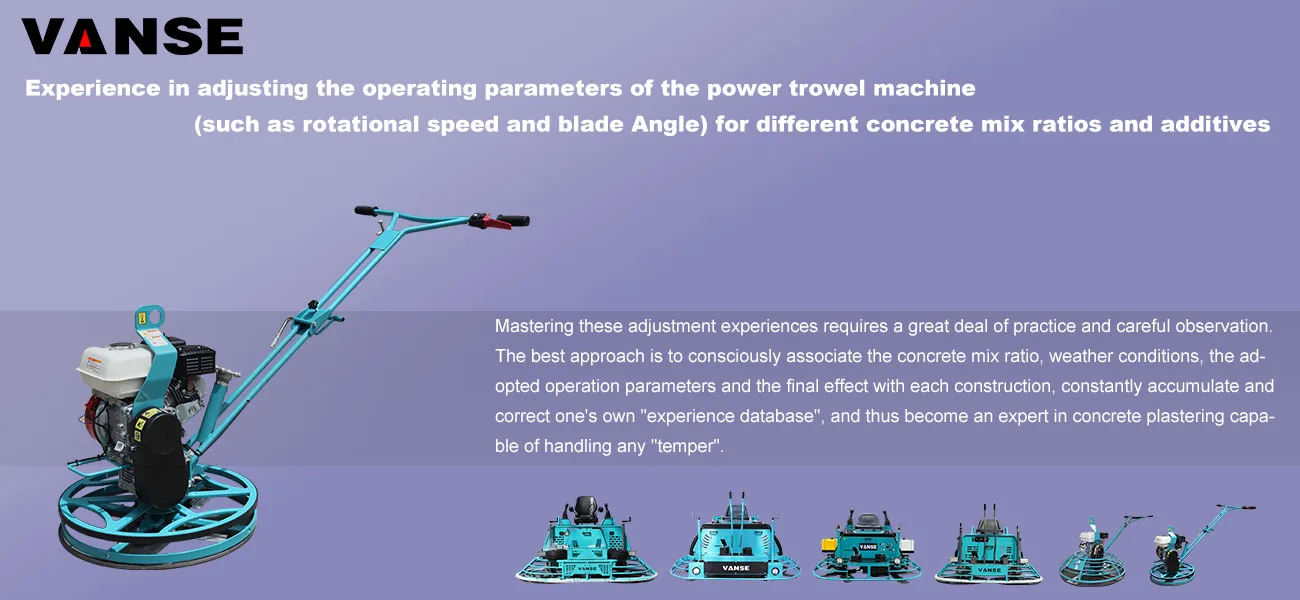
Adjusting the operating parameters of the power trowel machine for different concrete ratios and additives is a key technology for achieving high-grade floor quality (such as super-flat floors and wear-resistant floors).
The following are the experiences and guidelines for adjusting the operating parameters of the power trowel machine according to the characteristics of different concretes:
The core principles for adjusting the operating parameters of a polishing machine
Understanding the interaction: The "temperament" of concrete (setting speed, hardness, bleeding) determines how the power trowel should "treat" it.
Observation is more important than presetting: Parameters have no fixed values, and the only criterion is the state of the concrete surface. An excellent operator is one who "watches the work" during construction rather than mechanically timing.
Step by step: From low speed to high speed, from large angles to small angles, gradually apply pressure and improve precision.
Ⅰ. Adjust the strategy based on the concrete mix ratio and the type of additives
1. High-grade/low water-binder ratio concrete (C40 and above, often used for wear-resistant floors)
Characteristics: High cement content, dense slurry, fast setting speed, high early strength, and low bleeding.
Operational challenge: The operation window period is short, making it easy to miss the best polishing opportunity. The surface is prone to rapid hardening and it is difficult to extract slurry.
Adjustment strategy
Rotational speed
The first pass (disc slurry lifting) : It should be done a little earlier and at a medium to low speed (about 60-80 RPM). Because the slurry is thick, sufficient force is needed to bring it to the surface, but if the rotational speed is too high, it will curl the slurry and roughen the surface.
Second and third coats (power trowel polishing) : After the surface is slightly dry, immediately change the power trowel and use medium-high speed (about 90-120 RPM). High speed helps to make the surface very dense and bright. Once you notice a significant increase in machine resistance and the surface starts to feel "rough", it indicates that the final setting is approaching and you need to stop immediately.
Blade Angle
The first power trowel: The Angle can be slightly level (about 3-5°), mainly for leveling and avoiding too deep a cut.
Subsequent power trowel: As the surface hardness increases, gradually raise the blade Angle (about 5-10°), and use the sharp edge of the blade to perform a "cutting" type of polishing to achieve an extremely high gloss.
Core experience: "Racing against time". Personnel and equipment must be ready. Once the concrete meets the conditions for machine operation, continuous work should be carried out immediately until completion.
2. Concrete mixed with retarders (for large-scale pouring or in high-temperature weather)
Characteristics: The initial and final setting times are significantly prolonged. The surface remains in a "soft" state for a long time, but the interior is slowly setting.
Operational challenges: Prone to premature operation, which can damage the surface structure; The long waiting time affects the construction efficiency. It may be accompanied by bleeding.
Adjustment strategy
Rotational speed
First round (disc) : You must wait! Until the depth of the foot depression is less than 5mm. Use a low speed (about 50-70 RPM) to lift the slurry smoothly, as the surface support force is still insufficient.
Subsequent polishing: The interval between each application is quite long, requiring great patience. Always use medium and low speeds to avoid surface "wavy" or "curled skin" caused by excessive speed.
Blade Angle
Throughout the entire process, always maintain a relatively small Angle (approximately 0-5°). Because concrete is soft, if the Angle is too large, it will overly erode the surface and form grooves.
Core experience: "Patience". Never be in a hurry to use the computer. If there is bleeding on the surface, it should be scraped off with water first or wait for it to evaporate. The operation mainly involves "gentle kneading".
3. Concrete mixed with early strength agents (in low-temperature environments or under tight construction schedules)
Characteristics: Fast setting speed and rapid strength growth.
Operational challenge: The operational window period is extremely short, almost an "accelerated version" of high-grade concrete, making it easier to miss the opportunity.
Adjustment strategy
Rotational speed
All rounds: The pace should be fast. The disc and the first power trowel operation can be combined or carried out quickly and continuously. The rotational speed can be medium to high (80-100 RPM) to complete compaction and smoothness within a limited time.
Blade Angle
The blade Angle can be raised relatively quickly. When applying the second coat of gloss, a relatively large Angle (about 7-10°) can be adopted to seize the final opportunity for pressing.
Core experience: "Prediction and connection". The operator must constantly observe the surface changes. After the disc operation, the power trowel operation should be seamlessly connected. Machines can't stop. When people rest, the machines don't.
4. Concrete with high fly ash or mineral powder content (green and environmentally friendly proportioning)
Characteristics: The early strength is relatively low, and the setting speed is slightly slower, but the later strength is high, and the surface is easier to smooth.
Operational challenges: Low surface strength in the early stage and prone to damage; However, the slurry has good lubricity and is prone to excessive polishing, which can lead to bleeding.
Adjustment strategy
Rotational speed
First pass (disc) : The waiting time is similar to or slightly longer than that of ordinary concrete. Lift the slurry smoothly at medium speed (about 70-90 RPM).
Subsequent polishing: Due to its excellent lubricity and wear resistance, it can be polished multiple times at medium speed, making it easy
Ⅱ. Summary Table for Adjusting Operating Parameters of the power trowel Machine
| Concrete type | Disk stage rotational speed | The rotational speed of the power trowel stage | Suggested blade Angle | Core operational philosophy |
| High grade/low water-binder ratio | Medium and low speed (60-80 | Medium and high speeds (90-120) | From flat (3-5°) to steep (5-10°) | Race against time and increase pressure step by step |
| Add retarder | Low speed (50-70 | Medium and low speed (70-90) | Always maintain a small Angle (0-5°) | Wait patiently and operate gently |
| Adulterated with early strength agents | Medium and high speeds (80-100) | Medium and high speeds (90-110 | Quickly increase the Angle (7-10°) | Predictive connection, quick and decisive |
| High-admixture | Medium speed (70-90) | Medium speed (80-100) | Medium Angle (5-8° | Gentle multiple times, taking advantage of the characteristics |
Note: The unit of rotational speed is RPM (revolutions per minute), which is an empirical reference value. The specific speed should be subject to the machine model and on-site conditions.
Ⅲ. General Golden Rule and Diagnostic Techniques
The "Better late than early" rule: No matter what the ratio is, it is better to apply the gloss on the machine a little later than a little earlier. The machine may be strenuous at night, but in the morning it will completely damage the surface structure and cannot be remedied.
Footprint Method for timing:
Disc operation: Footprint depth is approximately 3 to 5 mm.
The first power trowel: The depth of the footprint is approximately 1-2 mm.
Final polished: The footprints are extremely shallow or non-existent, and the foot feel is hard.
Listen to its sound, observe its trace
Too high rotational speed/too early timing: The machine makes a dull sound, has high resistance, and there are "slurry" or "scratches" marks on the back of the blade.
Too low speed/too late timing: The machine jumps severely, the blade "floats" on the surface and cannot be eaten, leaving white scratches without luster.
The Angle and rotational speed are optimally matched: the machine operates smoothly, with uniform sound, and the blade leaves a uniform, bright, and traceless surface after passing through.
Conclusion
Mastering these adjustment experiences requires a great deal of practice and careful observation. The best approach is to consciously associate the concrete mix ratio, weather conditions, the adopted operation parameters and the final effect with each construction, constantly accumulate and correct one's own "experience database", and thus become an expert in concrete plastering capable of handling any "temper".
Note: The parameters provided in this document are for reference only and are not mandatory. Due to differences in technical characteristics between different brands and models of laser levelers, please consult the manufacturer for a suitable solution before actual operation. This reference document assumes no responsibility for any issues arising from failure to follow the manufacturer's instructions.
Thanks to All the Friends Who Support and Trust Shandong Vanse Machinery Technology Co., Ltd.
If you want to know more about Shandong Vanse Machinery Technology Co., Ltd. or have any questions, please feel free to contact us:
Our Factory
Shandong Vanse Machinery Technology Co., Ltd.








Share this article

About the Author: Shandong Vanse Machinery Technology Co., Ltd.
Shandong Vanse Machinery Technology Co., Ltd. is a high-tech manufacturer specializing in concrete construction machinery, including laser screeds and related equipment. The company integrates R&D, production, and global sales, with products exported to over 60 countries and widely used in infrastructure projects worldwide.
Previous Post
Next Post
Related Articles
You Might Also Like
About the summer maintenance of laser leveling machine
As we all know, summer is the time of year when the temperature is particularly high. Like winter, laser leveling machines are used in harsh environments. If the maintenance is not in place, coupled with the high temperature, the laser leveling machine is likely to have various problems. Therefore, when using the laser leveling machine in summer, special attention should be paid to the maintenance and maintenance. So how should the laser leveling machine be maintained and maintained in summer? 1. In summer construction, the engine should be prevented from overheating first. Under normal circumstances, the engine temperature should not exceed 95°. If the temperature is too high, a relatively cool area should be selected for shutdown and cooling. At the same time, the engine hood can be lifted for ventilation and heat dissipation. 2. The cooling water volume should be checked in time. When the water radiator reaches 100°, do not rush to add cooling water. Instead, the engine should be shut down immediately to cool down the engine at idle speed, and then add coolant. 3. The construction temperature is high in summer. Check the tire pressure and tire temperature of the laser leveler frequently. If the tire temperature is too high, stop the machine in time and place it in a cool place to cool down. Remember to use the wrong method of deflation or pouring cold water to cool down. 4. Check the liquid level of the laser leveler battery frequently, add distilled water in time, dredge the vents, pay attention to the density of the electrolyte, and maintain a good charging state. 5. Prevent the laser leveler engine from deflagration. Before entering the summer, the carbon deposits in the combustion chamber, valve top and other parts should be thoroughly removed to maintain good heat dissipation and normal compression ratio; and check and adjust the fuel supply advance angle to prevent engine deflagration. 6. Check the temperature of the hydraulic oil and hydraulic transmission oil frequently. If the temperature is too high, stop the machine for rest. Do not exceed high temperature operation. 1. Quality. When choosing a laser leveler, you should pay attention to the quality. If the quality of the laser leveler is not good, problems may occur during work, which may delay the construction period and the loss is immeasurable. 2. Operation effect. When purchasing a laser leveler, you should conduct an on-site inspection. If it is inconvenient, you can ask the manufacturer to provide some photos for reference. 3. After-sales service. When purchasing a laser leveler, you should also pay attention to the after-sales service. When purchasing a laser leveler, you should identify regular and professional manufacturers, and verify the manufacturer's technical capabilities and after-sales service. Only regular manufacturers can guarantee the performance of the machine, solve problems in time when the machine has problems, and extend its service life. It can be seen that when using equipment in extreme weather, you must pay special attention to its maintenance content, so as to ensure the smooth operation of the equipment. After reading the above article, I hope that everyone will pay attention to the above points when maintaining the laser leveler in the future. Thank you for your reading and support.How to ensure the construction quality of laser leveling machine during construction?
Designed for small commercial, upper deck, and residential projects—-the WALK-BEHIND concrete laser leveling provides you and your customers with high quality, professionally produced floors at a fraction of the cost of conventional methods. DZ30-2 CONSTRUCTION SITE DZ30-2 CONSTRUCTION SITE DZ30-2 CONSTRUCTION SITE DZ30-2 CONSTRUCTION SITE The methods for laser leveling machines to ensure construction quality during construction include: 1. **Precise laser control system**: – Use high-precision laser transmitters and receivers to ensure flatness and elevation control during construction. 2. **Automated operation**: – Use the automated control system of the laser leveling machine to adjust the height and angle of the leveling head in real time to adapt to different construction conditions. 3. **High-quality construction materials**: – Select appropriate concrete mix ratios and aggregates to ensure the fluidity and plasticity of concrete and reduce cracks and unevenness. 4. **Professionally trained operators**: – Ensure that operators receive professional training, are familiar with the operation and maintenance of the equipment, and understand the key points of quality control during construction. 5. **Real-time monitoring and adjustment**: – Use monitoring equipment to monitor the laying of concrete in real time during construction, and adjust the working parameters of the laser leveling machine in time. 6. **Strict construction plan and process**: – Develop a detailed construction plan and process, arrange the construction sequence reasonably, and avoid cross-construction and construction interruption. 7. **Environmental adaptability**: – Adjust equipment settings according to the characteristics of the construction environment, such as taking corresponding measures under high temperature or high humidity conditions. 8. **Post-construction maintenance management**: – Perform maintenance in time after construction, such as covering and moistening maintenance, to ensure that the concrete reaches the designed strength. 9. **Quality inspection and acceptance**: – Use professional tools to test flatness, levelness and strength to ensure that the construction quality meets the standards. 10. **Risk management**: – Identify possible risk factors during the construction process and formulate corresponding prevention and response measures. 11. **Technology upgrade and maintenance**: – Regularly upgrade and maintain the laser leveling machine to ensure that the equipment is in the best working condition. 12. **Construction data recording and analysis**: – Record key data during the construction process, such as concrete temperature, pouring speed, etc., and analyze the data to optimize the construction plan. Through the above measures, the laser leveling machine can ensure construction quality during the construction process, reduce rework and maintenance costs, and improve the overall quality and efficiency of the project.On-site Remediation Plan for Color Difference or Strength Variation Caused by Uneven Broadcasting
It is a nightmare scenario: you finish a high-spec industrial floor, but as it dries, you see it-patchy dark spots, light "chalky" areas, and localized "dusting." This is usually called mottling or color variation, and it's almost always caused by the "human element" during manual broadcasting of dry-shake hardener. If you are facing a "leopard-print" floor or inconsistent surface strength, here is the professional On-site Remediation Plan, along with the Vanse technical workflow to ensure it never happens again. Before you fix it, you need to know why it failed. Uneven Broadcasting: Manual throwing from a bucket creates "thick" and "thin" zones. Timing Issues: Some areas were "over-troweled" while still wet, while others were finished too late. The Vanse Prevention Tip: The best remediation is prevention. Using the Vanse Automatic Topping Spreader instead of manual labor ensures a 100% uniform grams-per-square-meter application. By linking the spreader's output to the machine's speed, you eliminate the "human error" that causes color shifts and weak spots. If the strength variation is severe (the surface is "powdering"), you have to remove the weak layer. The Process: Use a planetary floor grinder with 30/40 grit metal-bond diamonds to strip away the inconsistent "skin." The Vanse Tool for the Job: In cases where deep remediation is needed, use a Vanse Concrete Cutting Machine (Floor Saw) to create clean, straight boundaries around the affected area if a partial re-pour is required. This ensures the "patch" doesn't spall or crack at the edges. Once the surface is opened up, you need to fix the strength variation. The Process: Apply a high-quality Lithium or Sodium Silicate Densifier. This penetrates the concrete, reacts with the free lime, and creates a uniform, hard-shell finish across both the "weak" and "strong" zones. Blending the Color: Use a tinted sealer or a "color-matched" penetrant during the densification process to mask the mottling and create a visually consistent finish. After densifying, you need to "seal" the surface mechanically. The Process: Transition to a Vanse Ride-on Power Trowel. With its high-torque engine and precision pitch control, you can "burnish" the densified surface. The heavy compaction of the Vanse rotors helps to blend the color and close the pores, resulting in a dense, dust-free, and uniform finish. Global buyers are moving away from manual methods because the cost of remediation is 3x higher than the cost of doing it right the first time. Here is the Vanse "Gold Standard" Workflow to avoid color and strength issues: Uniform Placement: Use a Vanse Concrete Distributor or a Mini Dumper to place the base slab. This ensures the water-cement ratio is consistent across the entire bay, preventing "wet spots" that cause color variation. Consolidated Leveling: Use a Vanse Concrete Laser Leveling Machine . Its high-frequency vibration consolidates the slab from the bottom up, ensuring a uniform "paste" is available to bond with the hardener. Mechanical Spreading: The Vanse Automatic Topping Spreader is your insurance policy. It applies the hardener in a single, even pass immediately behind the laser leveling, guaranteeing uniform strength and color. Precision Finishing: The Vanse Power Trowel provides the final compaction, "locking in" the color and density. Look, we've all been there-trying to "save money" by using manual labor for broadcasting, only to spend three times that amount on grinding and densifiers later. If you want to bid on FM1/FM2 high-spec projects, you need the precision of a Vanse fleet (www.vansemac.com). Stop fixing floors and start finishing them. Visit Vanse Machinery today to see how our Topping Spreaders and Laser leveling can guarantee your color and strength consistency on every pour. Note: The parameters provided in this document are for reference only and are not mandatory. Due to differences in technical characteristics between different brands and models of laser levelers, please consult the manufacturer for a suitable solution before actual operation. This reference document assumes no responsibility for any issues arising from failure to follow the manufacturer's instructions.