Technical Knowledge
Maintenance and Troubleshooting of Concrete Laser Leveling Machines
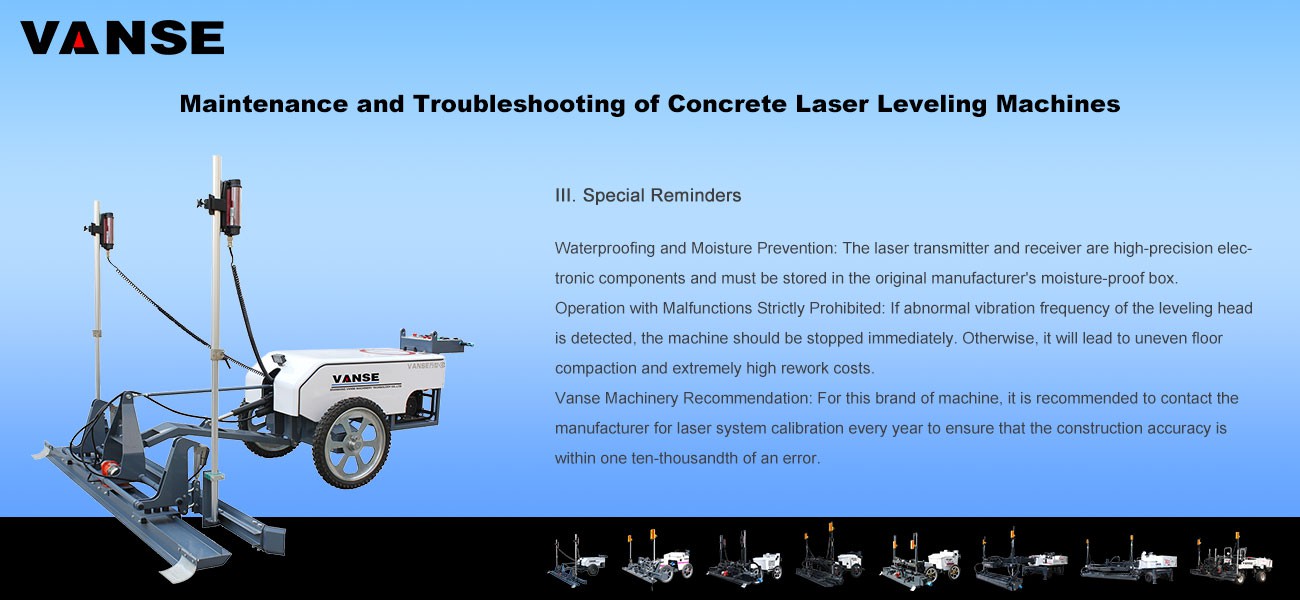
As high-precision construction equipment, the maintenance and troubleshooting of concrete laser Leveling machines are crucial for ensuring floor flatness. Based on the operating standards of leading industry brands such as Vanse, the following is a detailed maintenance schedule and troubleshooting guide:
I. Maintenance Schedule
| Cycle | Key Inspection Items | Specific Procedures: |
| After each construction session | Full Machine Cleaning | The machine body, leveling head, and vibrating plate must be thoroughly rinsed with a high-pressure water gun before the concrete hardens; concrete adhesion is strictly prohibited. |
| Daily (before commencement) | Hydraulics and Lubrication | Check hydraulic oil level, engine oil level, and coolant level. Check if all moving joints require grease. |
| Weekly | Laser System | Check the stability of the laser transmitter tripod and the accuracy of the handheld receiver; clean the laser receiver lens (with a soft cloth). |
| Monthly (50-100 hours) | Fastening and Filtration | Tighten the chassis and leveling head bolts; check/clean the air filter; check for leaks in the hydraulic lines. |
| Quarterly (300 hours) | Oil Change | Change the engine oil and filter (replace within the first 50 hours of operation for new machines); check the hydraulic oil quality (whether it has emulsified). |
II. Common Troubleshooting Guide
1. Unstable or Lost Laser Signal
Symptom: The automatic lifting and lowering of the leveling head malfunctions, and the display alarm indicates no laser signal.
Troubleshooting Steps:
External Interference: Check if there are vehicles, pillars, or construction workers obstructing the laser transmitter.
Dirty Receiver: Check if there are concrete droplets on the laser receiver window mounted on the machine body. Wipe it with a non-woven cloth.
Excessive Vibration: Check if the laser transmitter tripod is placed on a stable surface to avoid interference from nearby heavy vehicles.
Battery Power: Check if the transmitter's power is reduced due to low battery power.
2. Unevenness of Ground After Leveling
Symptom: After the machine passes over the surface, wavy lines or significant height deviations appear.
Troubleshooting Steps:
Elevation Verification: Recalibrate the reference elevations of the laser transmitter and handheld receiver.
Leveling Head Angle: Check if the vibrating plate angle has shifted due to impact; it needs to be adjusted back to the standard horizontal position.
Leveling Head Angle: Check if the vibrating plate angle has shifted due to impact; it needs to be adjusted back to the standard horizontal position.
Concrete Slump: Check the concrete's consistency. If the concrete is too dry, the machine vibration will not adequately lift the slurry; if it is too thin, it is prone to collapse.
3. Weak Drive or Hydraulic System
Symptoms: Slow machine movement, sluggish steering, or slow lifting and lowering of the leveling head.
Troubleshooting Steps:
Insufficient Hydraulic Oil: Check the hydraulic oil level in the tank and replenish to the standard mark.
Clogged Filter: A clogged hydraulic return filter can cause excessive back pressure and requires replacement.
Loose Belt: Check if the hydraulic pump belt driven by the engine is slipping.
4. Engine Starting Difficulty/Automatic Shutdown
Symptoms: The starter motor makes noise but the engine fails to start, or the engine suddenly shuts off during operation.
Troubleshooting Steps:
Fuel System: Check the fuel tank for water and ensure the fuel filter is not clogged with low-quality diesel fuel.
Electrical Issues: Check the battery terminals for looseness or corrosion/oxidation.
III. Special Reminders
Waterproofing and Moisture Prevention: The laser transmitter and receiver are high-precision electronic components and must be stored in the original manufacturer's moisture-proof box. Operation with Malfunctions Strictly Prohibited: If abnormal vibration frequency of the leveling head is detected, the machine should be stopped immediately. Otherwise, it will lead to uneven floor compaction and extremely high rework costs.
Vanse Machinery Recommendation: For this brand of machine, it is recommended to contact the manufacturer for laser system calibration every year to ensure that the construction accuracy is within one ten-thousandth of an error.
Note: The parameters provided in this document are for reference only and are not mandatory. Due to differences in technical characteristics between different brands and models of laser levelers, please consult the manufacturer for a suitable solution before actual operation. This reference document assumes no responsibility for any issues arising from failure to follow the manufacturer's instructions.
Thanks to All the Friends Who Support and Trust Shandong Vanse Machinery Technology Co., Ltd.
If you want to know more about Shandong Vanse Machinery Technology Co., Ltd. or have any questions, please feel free to contact us:
Our Factory
Shandong Vanse Machinery Technology Co., Ltd.








Share this article

About the Author: Shandong Vanse Machinery Technology Co., Ltd.
Shandong Vanse Machinery Technology Co., Ltd. is a high-tech manufacturer specializing in concrete construction machinery, including laser screeds and related equipment. The company integrates R&D, production, and global sales, with products exported to over 60 countries and widely used in infrastructure projects worldwide.
Previous Post
Next Post
Related Articles
You Might Also Like
How can we promote market expansion and diversified applications of concrete laser leveling machines?
To promote market expansion and diversified applications of concrete laser leveling, we must focus on the three core principles of "technology adapting to specific scenarios, demand-driven market development, and ecosystem-lowering barriers to entry." We must build a path forward from four dimensions: technological iteration, deep application development, market cultivation, and ecosystem collaboration. This can be implemented through the following strategies: The core bottleneck of concrete laser leveling is that general-purpose models are difficult to adapt to specific application scenarios. Technical customization and functional expansion are necessary to cover more construction scenarios: For small/special-shaped applications: Develop lightweight, splittable models (such as portable devices that can be disassembled into 2-3 modules) suitable for construction in small spaces such as indoor floors, villa courtyards, and narrow alleyways. This addresses the limitations of traditional large equipment, which often require limited access and maneuverability. This also reduces unit costs (targeting 1/3-1/2 of those of large equipment), attracting small and medium-sized construction teams. For special material applications: Develop specialized models suitable for steel fiber reinforced concrete, permeable concrete, and lightweight concrete. For example, by adjusting the vibration frequency (for steel fiber reinforced concrete, reducing the frequency to avoid aggregate breakage) and optimizing the distribution structure (for permeable concrete, reducing aggregate compression), these machines address the pain points of low leveling accuracy and material segregation in special material construction, allowing them to enter niche markets such as municipal permeable pavement and industrial wear-resistant flooring. Targeting extreme environments: Developing models suitable for high temperatures (above 50°C), low temperatures (below -20°C), and high altitudes (above 3,000 meters). By optimizing the hydraulic system's heat resistance, upgrading the battery's low-temperature endurance (e.g., using a low-temperature battery capable of starting at -40°C), and adjusting the laser sensor's anti-interference algorithm (to adapt to strong ultraviolet rays at high altitudes), we aim to expand into markets such as western infrastructure and northern winter construction. Integrated "leveling + inspection + repair" functionality: A real-time flatness detection module (e.g., laser rangefinder + data analyzer) is installed on the equipment to directly generate a flatness report after construction. For small defects, a small repair nozzle (capable of spraying concrete repair agent) is provided to achieve a closed loop of "construction – quality inspection – micro-repair," enhancing competitiveness in high-precision applications such as electronics factories and laboratory floors. Linking upstream and downstream process equipment: Developing intelligent interfaces that connect with concrete pumps and automatic finishing machines. Using the Internet of Things, coordinated control of "delivery volume – leveling speed – finishing timing" is achieved (e.g., the pump automatically adjusts feed rate based on the progress of the finishing machine). This creates a "fully automated production line" and attracts large construction groups (e.g., China Construction and China Railway). Currently, laser leveling machines are primarily used in industrial plants and large plazas. Through "demand exploration and case studies," they need to penetrate more industries. Target industries Core Demand Pain Points Targeted Solutions Municipal engineering Tight construction schedules (e.g., road reconstruction), complex environments (e.g., numerous underground pipelines) Developed "quick assembly and disassembly + narrow-width operation" models (such as the 1.2m narrow-width leveling head), suitable for municipal roadside and sidewalk construction; equipped with an underground pipeline positioning module (integrated with municipal BIM models) to avoid pipeline damage. Agricultural facilities Low cost and corrosion resistance (e.g., greenhouse floors) Introduced an economical carbon steel model (reducing material costs by 30%) with an anti-corrosion coating; optimized leveling accuracy (meeting the needs of agricultural machinery, with an error of ≤5mm/3m), entering the construction of modern agricultural parks. Transportation hubs High loads (e.g., airport runways, high-speed rail stations), high precision Developed a "heavy-duty" model (with a 50% increase in vibrating force to ensure concrete density); and utilized a dual laser system (primary laser + backup laser) to prevent single failures from impacting construction, meeting the high reliability requirements of transportation projects. Prefabricated buildings High precision requirements for the connection between prefabricated components and on-site floors Developed an integrated "precast component leveling + on-site leveling" model. Laser scanning of precast component elevations automatically adjusts leveling parameters to ensure an error of ≤2mm at joints, making it suitable for floor construction in prefabricated factories and residential buildings. First-tier Cities/Eastern Coastal Areas: Focusing on "high precision and intelligence" needs, promote high-end models equipped with 5G remote control and digital twins, focusing on "efficiency + quality" (e.g., electronics factories and high-end commercial buildings), and build brand awareness through case studies (e.g., the Shanghai Disneyland floor and Shenzhen Airport T3 Terminal). Central and Western Regions/Third- and Fourth-tier Cities: Focusing on "cost-effectiveness and practicality," launch economical models (with a 20%-30% price reduction), simplify non-core functions (e.g., retaining foundation leveling and vibration, eliminating cloud management), and offer "rent-to-buy" services (lowering the initial investment threshold) to meet the needs of infrastructure construction in the central and western regions (e.g., county-level industrial parks and rural road paving). Users (especially small and medium-sized construction teams) face challenges with high procurement costs, difficult operation, and expensive maintenance. They need to lower barriers to entry through "financial support + training services + after-sales optimization": Financial Instrument Innovation: We collaborate with banks and leasing platforms to launch solutions such as "financial leasing" (30% down payment, 2-3 year installments), "rent-to-buy" (monthly rental as low as 1.5% of the total equipment price), and "old equipment replacement" (discounts on old traditional leveling equipment) to alleviate funding pressures for small and medium-sized teams. Bulk Purchase Discounts: For large clients such as construction groups and local municipal investment companies, we offer "bulk purchase + customized services" (such as adjusting machine parameters according to project requirements), offering a 10%-15% bulk discount and bundled maintenance services (such as two years of free maintenance) to increase repeat purchase rates among large clients. Intelligent Operation: Developed a "foolproof" control system, presetting core parameters (such as leveling thickness and vibration frequency) for scenario modes like "Municipal Road" and "Factory Floor." Operators simply select the scenario and start the equipment, requiring no specialized skills (reducing training time from 7 days to 1 day). Established a training system: Collaborated with local housing and construction departments and vocational colleges to offer "free operator training + certification" services (such as issuing a "Laser leveling Operator Certificate"). Furthermore, short video tutorials (such as the "One-Minute Startup Guide" on Douyin and Kuaishou) and an online simulation app were developed to reduce learning costs. Localized Service Network: Regional Service Centers will be established in key regions (such as the Yangtze River Delta, Pearl River Delta, and Chengdu-Chongqing), staffed with maintenance engineers and spare parts warehouses. We promise a "2-hour response and 24-hour on-site service" (within 48 hours in remote areas), addressing the pain points of slow after-sales service and spare parts shortages. Intelligent Operation and Maintenance Services: Equipment will be equipped with a "remote diagnostic module" that uses AI algorithms to monitor the status of key components (such as hydraulic pumps and laser sensors) in real time, providing early warning of faults (e.g., "Hydraulic oil temperature is too high, recommended replacement within 3 days") and automatically sending notifications of nearby repair locations to minimize downtime. A single company cannot drive market adoption. It is necessary to collaborate with industry chain partners, leverage policy initiatives, and establish industry standards to create synergistic effects: Upstream: Collaborate with concrete admixture companies (such as water-reducing agent manufacturers) and sensor companies (such as lidar manufacturers) to jointly develop "equipment + material" adaptation solutions (e.g., matching specific water-reducing agent formulas with equipment vibration frequency to improve leveling results), thereby reducing user trial-and-error costs. Downstream: Collaborate with architectural design firms and supervisory agencies to incorporate laser leveling construction techniques into design specifications (e.g., specifying in construction drawings that "laser leveling technology is used, with a flatness error of ≤3mm/3m"), guiding construction adoption through design. Simultaneously, collaborate with real estate developers and municipal engineering general contractors to create "demonstration projects" (e.g., using laser leveling in a residential community to demonstrate the advantages of "no sanding and cracking"), fostering word-of-mouth communication. Industry Exhibition Promotion: Dedicated zones will be set up at major exhibitions such as Bauma China and the China Construction Expo, offering live demonstrations of various construction scenarios (e.g., narrow-width models operating in simulated tunnels, heavy-duty models operating on simulated airport runways) to visually showcase the equipment's advantages. Customer Case Studies: "Customer Story" content will be produced and disseminated in industry media (such as Construction Machinery Magazine) and on short video platforms (Facebook, YouTube, Instagram, Douyin, and Video Accounts) to enhance the trust of potential users. Through these strategies, we will achieve "technology adaptation to specific scenarios, lowering service barriers, and expanding the ecosystem's impact," transforming concrete laser leveling from a niche device to a standard feature in floor construction across all industries, ultimately achieving breakthroughs in both market size and application scenarios. Note: The parameters provided in this document are for reference only and are not mandatory. Due to differences in technical characteristics between different brands and models of laser levelers, please consult the manufacturer for a suitable solution before actual operation. This reference document assumes no responsibility for any issues arising from failure to follow the manufacturer's instructions.How to use concrete vibratory leveling to assist laser leveling in small-area super flat floor construction
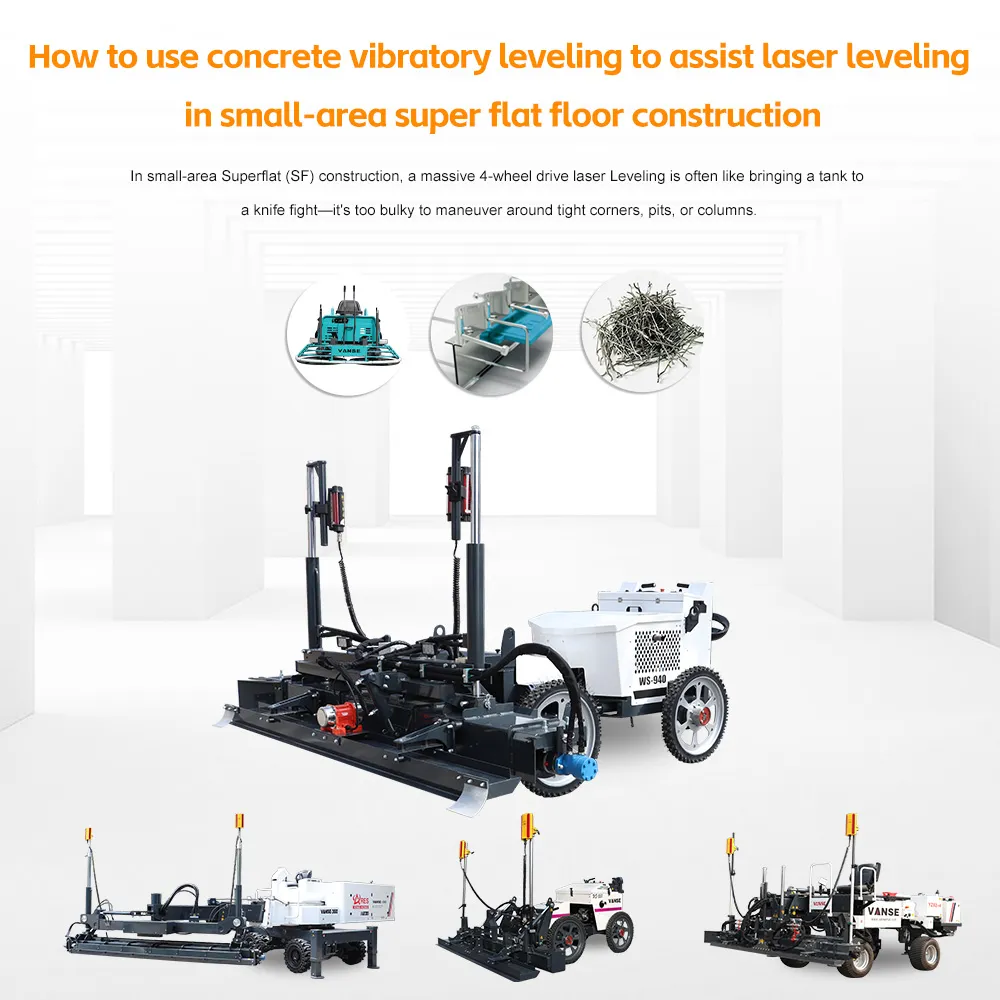
In small-area Superflat (SF) construction, a massive 4-wheel drive laser Leveling is often like bringing a tank to a knife fight-it's too bulky to maneuver around tight corners, pits, or columns. To achieve Superflat tolerances in these spaces, contractors use a "Hybrid Approach": combining the precision of a Laser Reference System with the agility of Vibratory Leveling (hand-held or truss Levelings). Here is how to use vibratory leveling to assist the laser process for high-precision results. In small areas, you don't use a laser Leveling machine; you use laser receivers mounted on a vibratory Leveling pole. The Equipment: A handheld vibratory Leveling (like a "Magic Leveling" or a small "LevelingBot") equipped with a laser receiver. The Process: The laser transmitter (rotary laser) sends a beam across the room. The receiver on the vibratory Leveling gives the operator real-time "High/Low/Level" feedback via LEDs or an audible tone. The Benefit: This ensures that even in a 10' x 10' corner, your Levelness (FL) matches the rest of the 50,000 sq. ft. warehouse perfectly. To hit FF (Flatness) numbers above 50 in small areas, the vibratory Leveling is just the first step. You must follow this sequence: The vibratory Leveling is pulled across the concrete. The vibration "liquefies" the top 1/2 inch of the slab, bringing enough paste (cream) to the surface to seal the face while the laser receiver ensures the height is correct. Warning: Do not "over-vibrate." If you stay in one spot too long, the aggregate will sink, leaving a "soup" of weak paste that will shrink and crack later. This is where Superflat floors are actually made. Immediately after the vibratory Leveling passes, use a 10-foot Highway Straightedge (also called a Bump Cutter). The Action: Run the straightedge at a 45-degree angle to the direction of the Levelinging. The Result: The vibratory Leveling sets the height (FL), but the straightedge cuts the "micro-waves" left by the vibration, ensuring extreme Flatness (FF). Tool Role in Superflat Limitation Laser Transmitter Provides the "Source of Truth" (The Plane). Cannot fix a bumpy surface on its own. Vibratory Leveling Consolidates concrete and sets FL (Levelness). Often leaves small "rhythmic waves." Highway Straightedge Refines FF (Flatness) by cutting/filling. Requires a skilled operator and physical labor. Maneuverability: You can work around floor drains, electrical conduits, and stub-ups that a large laser Leveling would destroy. Lower Risk of "Cold Joints": In tight spaces, big machines often have to wait for manual edges to catch up. Handheld vibratory leveling allows for a continuous, "wet-on-wet" pour. Edge Precision: Laser Levelings sometimes "dip" at the start or end of a pass. Manual vibratory leveling allows for a slower, more controlled approach at the formwork edges. Laser Calibration: In small areas, the laser transmitter must be set to its highest rotation speed (usually 600–1100 RPM). This provides more frequent data "hits" to the receiver on the vibratory Leveling as it moves. Slump Consistency: If the concrete slump varies by even 1 inch (e.g., from a 5-inch slump to a 6-inch slump), the vibratory Leveling will "sink" differently. For Superflat results, the concrete must be identical truck-to-truck. Head-to-Head Overlap: When using a handheld vibratory Leveling, ensure each pass overlaps the previous one by 20–30%. This "erases" the line between passes. Would you like a list of the specific F-number tolerances required for "Category 1" VNA (Very Narrow Aisle) floors versus standard warehouse floors? Contact us NOW Note: The parameters provided in this document are for reference only and are not mandatory. Due to differences in technical characteristics between different brands and models of laser levelers, please consult the manufacturer for a suitable solution before actual operation. This reference document assumes no responsibility for any issues arising from failure to follow the manufacturer's instructions.Precision Setting Techniques for Concrete Laser Leveling Machines in Super-Flat Floor Construction
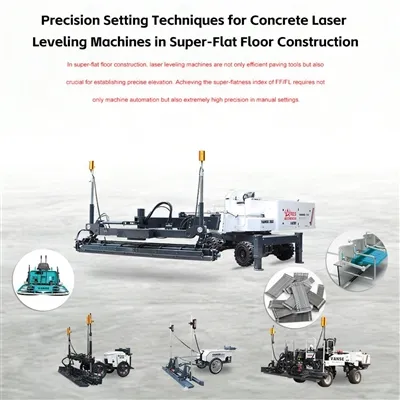
In super-flat floor construction, laser leveling machines are not only efficient paving tools but also crucial for establishing precise elevation. Achieving the super-flatness index of FF/FL requires not only machine automation but also extremely high precision in manual settings. The following are precision setting and operation techniques for laser leveling machines to achieve super-flatness: Avoid interference sources: The transmitter must be installed outside the concrete paving area and away from crane vibrations, passing vehicles, and airflow interference (the support structure needs to be reinforced in windy conditions). Height coverage: Ensure that the transmitter's signal plane covers the entire work area and is not obstructed by on-site columns or equipment. Dual transmitter verification: For extra-large areas, it is recommended to set up two transmitters for mutual verification to ensure that signal attenuation or drift during long-distance transmission is detected in a timely manner. Before the start of each shift, the physical elevation of the top of the formwork must be compared with the signal elevation of the laser transmitter using the same handheld laser receiver rod. Error limit: The error between the measured elevation of the formwork and the laser signal elevation must be controlled within ±1 mm. Technique: Adjust the sensitivity of the hydraulic sensor based on the concrete slump. If the concrete is stiffer, the sensitivity should be appropriately reduced to prevent the leveling head from frequently bouncing due to resistance; if the concrete is thinner, increase the sensitivity to ensure immediate correction of small height differences. Screw Feeder Setting: The lower edge of the screw feeder should be slightly higher than the design elevation (approximately 3-5 mm), using the rear vibrating beam to compact the material to the design position. Material Excess: Always maintain a suitable amount (approximately 2-5 cm) of concrete accumulation in front of the leveling head. Too little material will result in "empty scraping," and too much material will create pushing waves. Operation: Each paving pass should overlap the previously completed pass by 200-300 mm. Technique: Set the hydraulic control on the overlapping side to "manual" and the non-overlapping side to "automatic". This allows the screed to use the completed pavement as a reference, ensuring consistent elevation at the joint and eliminating noticeable "joint ridges". At the end of each paving pass (when the machine retracts its arm), the travel speed should be slightly reduced to prevent the suction created when the screed lifts from pulling up the concrete and causing low spots at the edges. Factors Factors affecting accuracy Troubleshooting Techniques: Wind speed Wind can cause the laser beam to shake. Use windproof supports or add a filtering function to the laser receiver. Concrete slump The consistency (dryness/wetness) of each batch of material varies. Assign a dedicated person to monitor at the discharge point and strictly prohibit spreading material with a slump error exceeding ±20 mm. Tire pressure The amount of tire deflection changes. Check the tire pressure of the leveling machine before starting work each day to ensure symmetry and consistent pressure on both sides. The **first pass with a long-handled straightedge (Highway Straightedge)** after the laser Leveling is completed is crucial: Operation: While the concrete is still plastic, the operator should use an aluminum alloy straightedge of more than 3 meters in length, following the Leveling machine and performing reciprocating leveling perpendicular to the paving direction. Purpose: To eliminate the small marks left by the laser Leveling when changing lines or turning. Note: The parameters provided in this document are for reference only and are not mandatory. Due to differences in technical characteristics between different brands and models of laser levelers, please consult the manufacturer for a suitable solution before actual operation. This reference document assumes no responsibility for any issues arising from failure to follow the manufacturer's instructions.