Technical Knowledge
Efficiency Advantages of Spreaders in Dry-Spread Hardener Floor Construction
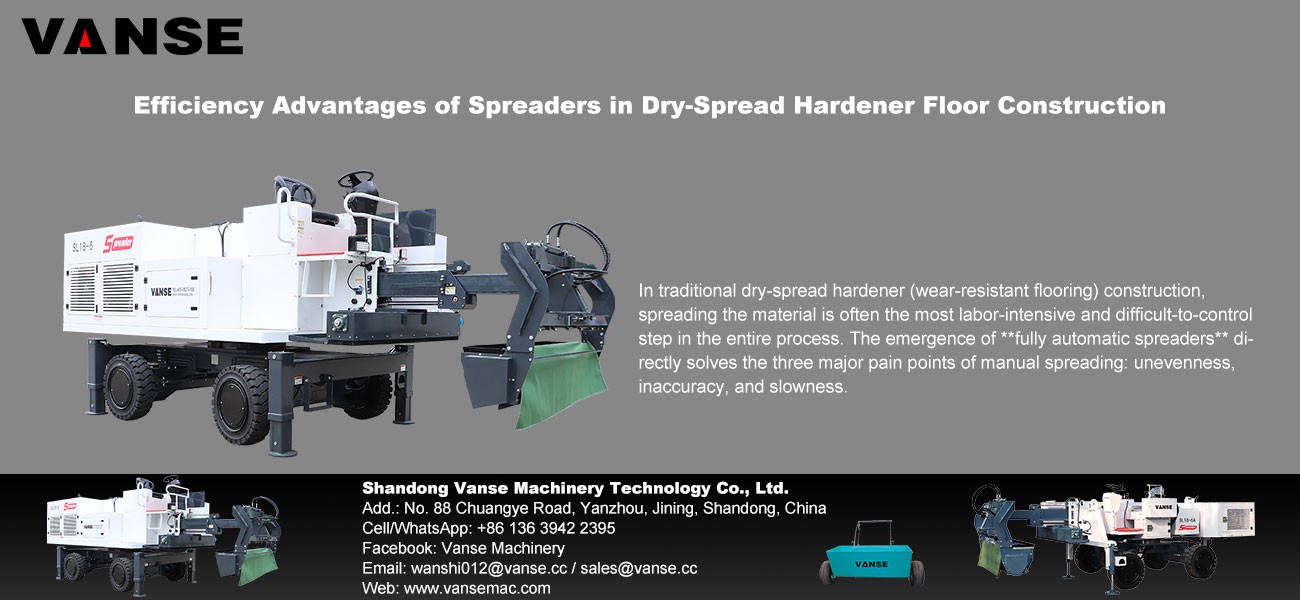
In traditional dry-spread hardener (wear-resistant flooring) construction, spreading the material is often the most labor-intensive and difficult-to-control step in the entire process. The emergence of **fully automatic spreaders** directly solves the three major pain points of manual spreading: unevenness, inaccuracy, and slowness.
The following is an analysis of the core efficiency advantages of spreaders in ultra-large area floor construction:
1. Extremely High Precision Spreading and Material Savings
Manual material spreading typically involves shoveling or manually pushing materials, which easily leads to material accumulation or missed areas.
Quantitative Spreading: Automatic spreading machines can be computer-controlled, achieving precise spreading with an error of less than ±5% per square meter. For example, if the design requirement is 5 kg/m², the machine can maintain a constant output throughout the process.
Reduced Material Waste: Compared to the dust and waste caused by manual spreading, automatic spreading machines can save approximately 10%-15% of material costs.
2. A Leap in Construction Efficiency
In the construction of large logistics centers, the time window is the lifeline.
Working Width and Speed: A large automatic material spreader typically has a working width of 2-4 meters, with adjustable travel speed. A single machine can achieve a daily construction capacity of 3000-5000 square meters, which is unattainable by traditional manual labor teams.
Simultaneous Paving: Many advanced material spreaders can be mounted on the rear of laser screeds, enabling simultaneous "screing-spreading" and merging the two processes into one.
3. Significantly Improved Overall Ground Performance
Uneven Penetration Depth: The machine-applied material is extremely even, resulting in a tighter bond between the hardener and the concrete substrate. The absence of localized accumulation avoids color variations and peeling caused by uneven thickness later on.
Low Dust and Environmentally Friendly Construction: Modern automatic material spreaders often employ enclosed hoppers and near-ground distribution designs, greatly reducing on-site dust pollution. This not only protects worker health but also meets the construction requirements of precision factories.
Comparison of the efficiency of automated material spreading vs. manual material spreading
| Indicators | Manual spreading | Automatic material spreader | Efficiency Improvement/Benefits |
| Fabric uniformity | Poor (highly human error) | High efficiency (digitally controlled) | Quality Stability Improvement by 90% |
| Daily work area | 800-1000 ㎡ (work team) | 3000-5000 ㎡ | Efficiency Increase by 3-5 Times |
| Material utilization rate | High loss (dust/excessive thickness) | Precise and cost-effective | Cost Reduction by 10%+ |
| Labor intensity | Extremely high (heavy manual labor) | Low cost (requires only one operator) | Savings on Labor Costs by 60% |
4. Synergistic Effect with Nano-hardener Application
As you previously mentioned regarding nano-hardeners, if an automatic spreader is used to create a good base during the first dry-applied layer of abrasion-resistant material, the surface density will be very even. This provides a perfect substrate for the subsequent spraying of the nano-penetrating hardener, allowing the nanoparticles to penetrate deeper and react more fully, ultimately achieving a true "mirror-like" hardening effect.
Note: The parameters provided in this document are for reference only and are not mandatory. Due to differences in technical characteristics between different brands and models of laser levelers, please consult the manufacturer for a suitable solution before actual operation. This reference document assumes no responsibility for any issues arising from failure to follow the manufacturer's instructions.
Thanks to All the Friends Who Support and Trust Shandong Vanse Machinery Technology Co., Ltd.
If you want to know more about Shandong Vanse Machinery Technology Co., Ltd. or have any questions, please feel free to contact us:
Our Factory
Shandong Vanse Machinery Technology Co., Ltd.








Share this article

About the Author: Shandong Vanse Machinery Technology Co., Ltd.
Shandong Vanse Machinery Technology Co., Ltd. is a high-tech manufacturer specializing in concrete construction machinery, including laser screeds and related equipment. The company integrates R&D, production, and global sales, with products exported to over 60 countries and widely used in infrastructure projects worldwide.
Previous Post
Next Post
Related Articles
You Might Also Like
How to measure the compaction effect of concrete power trowel?
– Measurement tools and methods: Use a 2m ruler and a feeler gauge to measure the flatness of the concrete surface. Place the 2m ruler on the concrete surface and use the feeler gauge to measure the gap between the ruler and the ground. The smaller the gap, the higher the ground flatness and the better the compaction effect of the trowel. For example, in the construction of high-precision industrial plant floors, the flatness deviation is required to be within 2-3mm, which requires the trowel to have good compaction performance to meet this standard. – Industry standards and requirements of actual application scenarios: Different application scenarios have different requirements for flatness. For general outdoor road surfaces, the allowable flatness deviation may be 5-10mm; while for indoor high-end shopping malls, exhibition hall floors, etc., the requirements may be higher, and the deviation is usually 1-3mm. If the flatness of the ground after compaction by the trowel can meet the requirements of the corresponding scene, it means that the compaction effect is good. – Test method: The density can be indirectly reflected by surface hardness test. Use a rebound hammer to test the concrete surface. The higher the rebound value, the harder the concrete surface is and the higher its density may be. In addition, the core sampling method can also be used to observe the internal structure of the concrete core sample. If the core sample has small pores and a dense structure, it means that the compaction effect of the trowel machine is good. – Influence on concrete durability: Good density can improve the durability of concrete. A concrete surface with good compaction effect can effectively resist the erosion of external environmental factors (such as moisture, chemicals, etc.) and reduce the occurrence of cracks. For example, on the concrete surface of hydraulic structures, high density can prevent water penetration and extend the service life of the building. – Visual evaluation and standards: Observe the uniformity of the trowel marks on the concrete surface with the naked eye. Uniform trowel marks indicate that the pressure applied by the trowel machine to the ground during work is uniform and the compaction effect is good. If the surface is obviously uneven, wavy, or partially troweled, it means that there is a problem in the compaction process. – Correlation with compaction quality: The uniformity of the trowel marks reflects the stability and uniformity of the contact between the trowel blade and the ground during the compaction process. Stable and uniform contact can ensure that the concrete particles are evenly distributed under pressure, thereby improving the compaction quality. For example, in the construction of a large area of parking lot floor, uniform trowel marks can make the ground look smoother and more beautiful, and also mean a good compaction effect. – Laboratory testing and field evaluation: In the laboratory, standard concrete test blocks can be made, one part is compacted by the trowel machine, and the other part is not treated, and their compressive strength is tested under the same curing conditions. On site, it can be evaluated by testing the actual bearing capacity of the concrete structure. If the strength growth of the concrete compacted by the trowel machine meets the expected design requirements, or even exceeds that of the untreated concrete, it means that the compaction effect of the trowel machine helps to improve the strength of the concrete. – Importance to building structure safety: Concrete strength is an important indicator of building structure safety. Good compaction effect can make the internal structure of concrete denser, effectively improve the strength of concrete, and thus ensure the safety of the building structure. For example, in the concrete construction of key parts such as the foundation, beams and columns of a building, the compaction effect of the trowel plays a vital role in the long-term stability of the structure.How to maintain the laser leveling machine
Laser leveling machine is a kind of equipment that uses laser as the reference plane and controls the leveling head in real time to achieve high-precision and fast leveling of concrete. The price of laser leveling machine equipment is relatively high, so we should pay attention to the maintenance of laser leveling machine equipment to extend the service life of laser leveling machine. In normal times, we should not only try to reduce the influence of harmful factors, but also ensure the normal working load when using laser leveling machine. The following best laser leveling machine manufacturers will explain to you how to maintain laser leveling machine. Mechanical impurities generally refer to non-metallic materials such as dust and soil, and some metal chips and wear products generated by engineering machinery during use. Once these impurities enter the interior of the machine and reach the mating surface of the laser leveling machine, the harm is very great. Not only will the relative movement be blocked and the wear of parts will be accelerated, but also the mating surface will be scratched, the lubricating oil film will be destroyed, and the temperature of the parts will rise and the lubricating oil will deteriorate. According to measurements, when the mechanical impurities in lubrication increase to 0.15%, the wear rate of the first piston ring of the engine will be 2.5 times greater than the normal value; when the rolling shaft enters with impurity particles, its life will be reduced by 80%-90%. Therefore, for engineering machinery working in harsh environments and complex conditions, first, high-quality, matching parts and lubricating oils and greases should be used to block the source of harmful impurities; second, mechanical protection work at the work site should be done well to ensure that the corresponding mechanisms can work normally and prevent various impurities from entering the machine. For faulty machinery, try to repair it at a regular repair site. When repairing on site, protective measures should also be taken to prevent the parts replaced during on-site repairs from being contaminated by dust and other impurities before entering the machine. The phenomenon of metal surface being damaged by chemical or electrochemical reactions with the surrounding medium is called corrosion. This corrosion not only affects the normal operation of the mechanical surface equipment, but also corrodes the parts inside the machine. For example, rainwater and chemicals in the air enter the interior of the machine through the external channels and gaps of mechanical parts, corrode the interior of the mechanical parts, accelerate mechanical wear, and increase the failure of the laser leveler. Because this corrosion effect is sometimes invisible and intangible, it is easy to be ignored, so it is more harmful. In use, management and operation personnel should take effective measures to reduce the impact of chemical corrosion on the machine according to the local weather conditions and air pollution conditions at that time. The focus is to prevent the invasion of rainwater and chemical components in the air into the machine and minimize rain operations. The size and nature of the working load of the laser leveler have an important influence on the loss process of the machine. Generally speaking, the wear of parts increases proportionally with the increase of load. When the load borne by the parts is higher than the average design load, its wear will be aggravated. In addition, when other conditions are the same, the wear under stable load is less than that under dynamic load, with fewer failures and lower life. Tests show that the wear of the cylinder of the engine will increase by 2 times when it works under unstable load compared with that under stable load. The engine working under normal load has a lower failure rate and a longer life. On the contrary, the failure rate of overloaded engines increases significantly, and the life span will be reduced compared to the design indicators. The wear of machines that are often in a wide range of load changes is greater than that of laser levelers that work continuously and stably. During work, the temperature of each component has its own normal range. For example, the temperature of general cooling water is 80-90℃, and the temperature of hydraulic oil in the hydraulic transmission system is 30-60℃. If it is lower than or higher than this range, it will accelerate the wear of parts, cause the lubricating oil to deteriorate, and cause changes in material properties. Experiments show that the main drive gears and bearings of various construction machinery running in lubricating oil at -5℃ will have 10-12 times more wear than running in lubricating oil at 3℃. However, when the temperature is too high, it will accelerate the deterioration of the lubricating oil. For example, when the oil temperature exceeds 55-60℃, the oxidation rate of the oil will double for every 5℃ increase in oil temperature. For this reason, during the use of construction machinery, first, it is necessary to prevent overload operation at low temperature, ensure the normal operation of the low-speed preheating stage, and make the machine reach the specified temperature before driving or working. Do not ignore its important role because there is no problem at that time; second, to prevent the machine from running at high temperature, the values on various temperature gauges should be checked frequently during the operation of the machine, and the machine should be stopped immediately for inspection if a problem is found, and the fault should be eliminated in time. For those who cannot find the cause for a while, the machine must not be allowed to work with the disease without treatment. In normal work, pay attention to checking the working condition of the cooling system. For water-cooled machinery, it must be checked and cooling water must be added before work every day; for air-cooled machinery, the dust on the air-cooling system must also be cleaned regularly to ensure that the heat dissipation air duct is unobstructed. The above content is the usual use and maintenance method of the laser leveling machine. I hope it will be helpful for everyone to maintain the laser leveling machine. If you still don't understand anything, or have any questions about the laser leveling machine, please call us for consultation.Main methods for leveling concrete pavement
– Working principle: The laser concrete leveler uses the laser beam emitted by the laser transmitter as the reference plane, receives the laser signal through the laser receiver, and automatically controls the scraper height of the leveler. During the leveling process, the scraper of the leveler is raised and lowered according to the height of the laser reference plane to accurately level the concrete, which can effectively control the flatness and levelness of the road surface. – Operation points: First, the laser transmitter should be reasonably arranged at the construction site to ensure that the laser beam it emits can cover the entire construction area and is not blocked by obstacles. Then, the operator drives the leveler at a constant speed on the concrete, and the machine will automatically adjust the scraper height according to the laser signal to level the concrete. During the construction process, pay attention to the working status of the laser receiver and the leveling effect of the machine. If there is any abnormality, stop the machine in time for inspection and adjustment. At the same time, for corners that are difficult for the leveler to reach, manual assistance is still required. – Working principle: The paver evenly distributes concrete on the roadbed through the spiral distributor, and uses the vibrator to compact the concrete, forming a preliminary flat road surface during the process. – Operation points: Before construction, the paver parameters, such as the spiral distributor height, vibration frequency and amplitude, need to be adjusted according to the width and thickness of the road surface. During construction, the paver should be kept moving at a constant speed to ensure that the concrete paving thickness is uniform, thus laying the foundation for subsequent road leveling work. – Working principle: The vibration beam relies on its own vibration to squeeze and compact the aggregate particles in the concrete, and vibrate the cement mortar on the surface, so as to further level the road surface and improve the density. – Operation points: When using, the vibration beam needs to move slowly along the concrete road surface, and the vibration frequency and walking speed should be reasonably adjusted according to the slump of the concrete and the road surface conditions. For local uneven areas, the vibration beam can be manually assisted to carry out key treatment. – Working principle: The disc or blade of the trowel squeezes and smears the concrete surface when rotating, making the surface smoother and more compact, and improving the density and wear resistance. – Operation points: The surface should be troweled after the water on the concrete surface is slightly dry, and the appropriate trowel operation speed should be selected according to the coagulation of the concrete. For large-area pavement, a driving trowel can be used to improve efficiency, and narrow areas such as corners can be carefully processed with a hand-held trowel. – Working principle: Construction workers use wooden trowels, iron trowels and other tools to carefully trim the pavement with experience and feel, and deal with local uneven areas that are difficult for equipment to take care of. – Operation points: Mainly fine-tune the corners of the pavement, around the construction joints, and the traces left by the equipment, requiring construction workers to be skilled and able to accurately judge and deal with uneven areas to achieve higher flatness requirements.