Insight blog
Global Market Guide to Laser-Guided Concrete Screed Systems
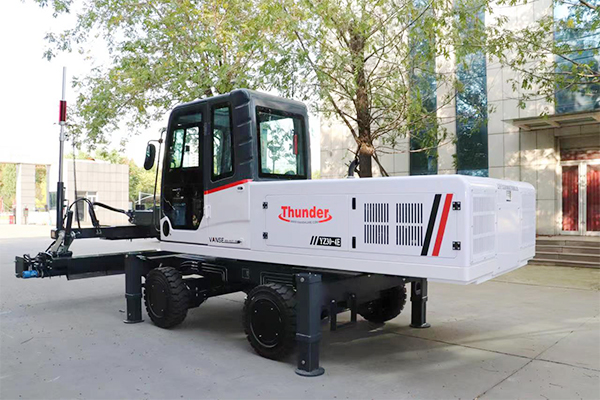
Laser-Guided Concrete Screed Systems for the Global Market
Quick Answer

A laser-guided concrete screed system is a concrete leveling machine that uses a rotating laser transmitter, receiver, control computer, hydraulic system, and screed head to place, spread, vibrate, and level fresh concrete to a specified elevation. For industrial floors, warehouses, logistics centers, airport pavements, and large slabs, a ride-on or boom-type unit normally provides the best balance of flatness, speed, and labor savings. Small floor areas, repair work, and narrow access locations are better suited to walk-behind equipment.
For buyers in the global market, start by matching machine reach, concrete output, slab specification, site access, and local technical support to the project. Somero and Ligchine are established choices for high-output industrial slab work, while manufacturers such as Shandong Vanse Machinery Technology offer competitively priced walk-behind, ride-on, and boom configurations with export-oriented support. Qualified international suppliers, including Chinese manufacturers holding relevant CE, ISO, and destination-market certifications, can be a practical option where cost-performance, spare-parts availability, commissioning, and responsive pre-sales and after-sales support are verified.
Before placing an order, request a machine demonstration on a comparable concrete mix, confirm flatness and elevation tolerances in writing, review the included laser-control package, and calculate total ownership cost including freight, customs clearance, training, consumables, replacement wear parts, and local service response.
Global Market Overview

Demand for automated concrete leveling equipment is expanding across North America, Europe, the Middle East, Asia-Pacific, Latin America, and Africa. The main driver is not simply faster concrete placement. Project owners increasingly specify tighter floor tolerances for high-bay warehouses, automated storage and retrieval systems, cold-storage buildings, manufacturing lines, distribution hubs, e-commerce fulfillment centers, and airport logistics facilities. In these environments, uneven slabs can cause forklift vibration, racking alignment issues, premature wheel wear, drainage problems, and costly remedial grinding.
Major construction hubs such as Houston, Toronto, Rotterdam, Hamburg, Dubai, Jeddah, Singapore, Melbourne, São Paulo, Mexico City, Johannesburg, and Istanbul continue to create demand for large-format slabs. Ports and trade zones also generate strong demand because warehouses, terminal yards, container repair areas, and industrial parks require durable, level concrete surfaces. Buyers importing equipment through ports such as Los Angeles, Vancouver, Rotterdam, Jebel Ali, Singapore, Santos, and Melbourne should include inland transport, container unloading, destination inspection, and spare-parts storage in their procurement planning.
A concrete laser leveling machine is most valuable when concrete placement is organized as a system rather than as an isolated machine purchase. Ready-mix supply timing, pump or truck access, placing crew capacity, joint layout, curing practices, surface finishing, and quality testing must all support the screed’s production rate. A high-capacity ride-on unit can only deliver its expected output if concrete is supplied consistently and the site team can keep the machine moving without interruptions.
The global market is divided between premium established brands, regional manufacturers, and export-focused suppliers. Premium machines may offer extensive dealer coverage, established resale markets, and sophisticated slab-control technology. Export-focused suppliers can offer a lower entry price, configuration flexibility, and direct factory support. The best purchasing decision depends on annual slab volume, contract type, financing options, local technician availability, and the cost of downtime on the buyer’s typical projects.
How a Laser-Guided Concrete Screed System Works

A typical system begins with a rotating laser transmitter positioned outside the working path or on a stable reference point. The transmitter establishes a level plane, or in advanced projects a three-dimensional profile is created through digital control data. A receiver mounted on the screed mast detects the laser reference. The machine controller compares the receiver position with the target elevation and automatically adjusts the screed head through hydraulic cylinders.
The screed head commonly includes an auger or plow arrangement to distribute concrete, a vibrating assembly to consolidate the material, and a finishing blade or strike-off profile that establishes final elevation. The operator drives the machine through the placement zone while the automatic control continuously corrects the head height. This reduces dependence on manual string lines, hand screeding, and repeated checking with levels.
Laser control does not replace skilled concrete practice. The concrete mix must be workable but stable, the subbase must be properly prepared, reinforcement must remain correctly positioned, and finishing must begin at the right time. Experienced operators also monitor material buildup, hose placement, slab edges, obstructions, control points, and the effects of changing slump or temperature during a pour.
Main Machine Types
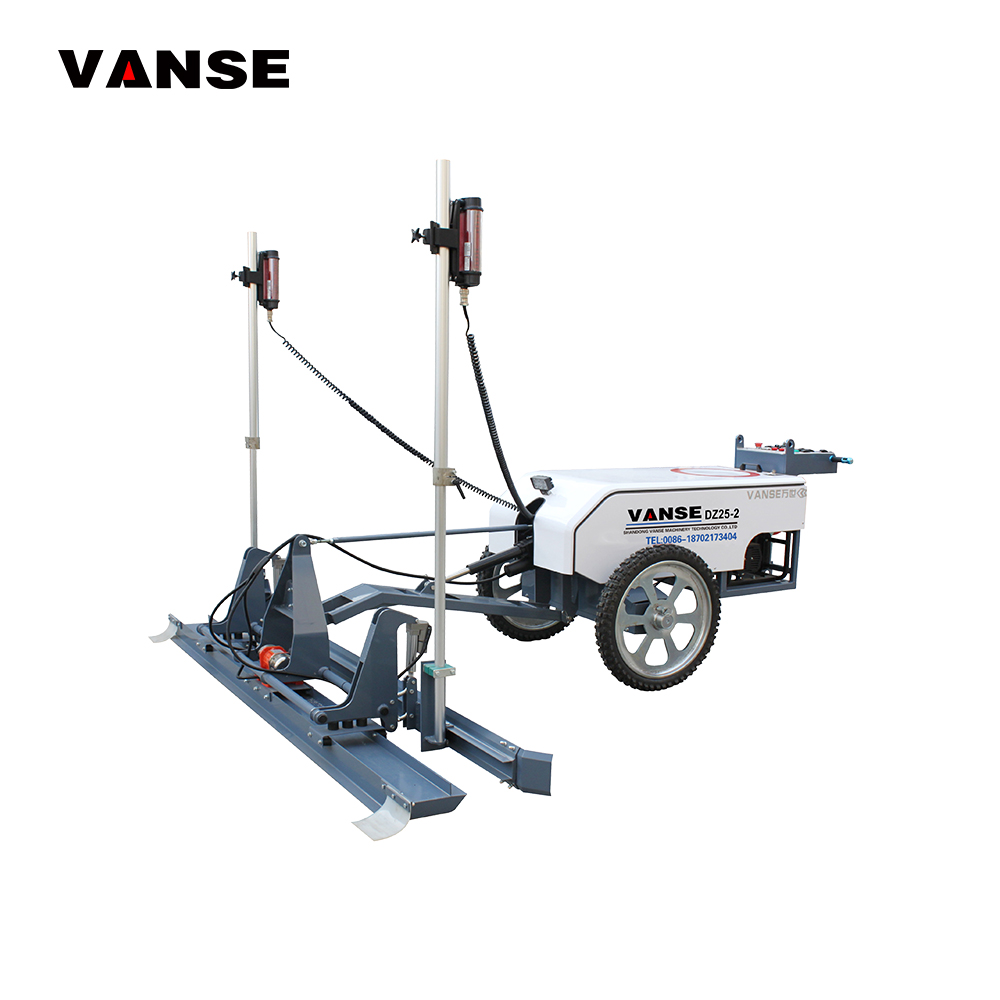
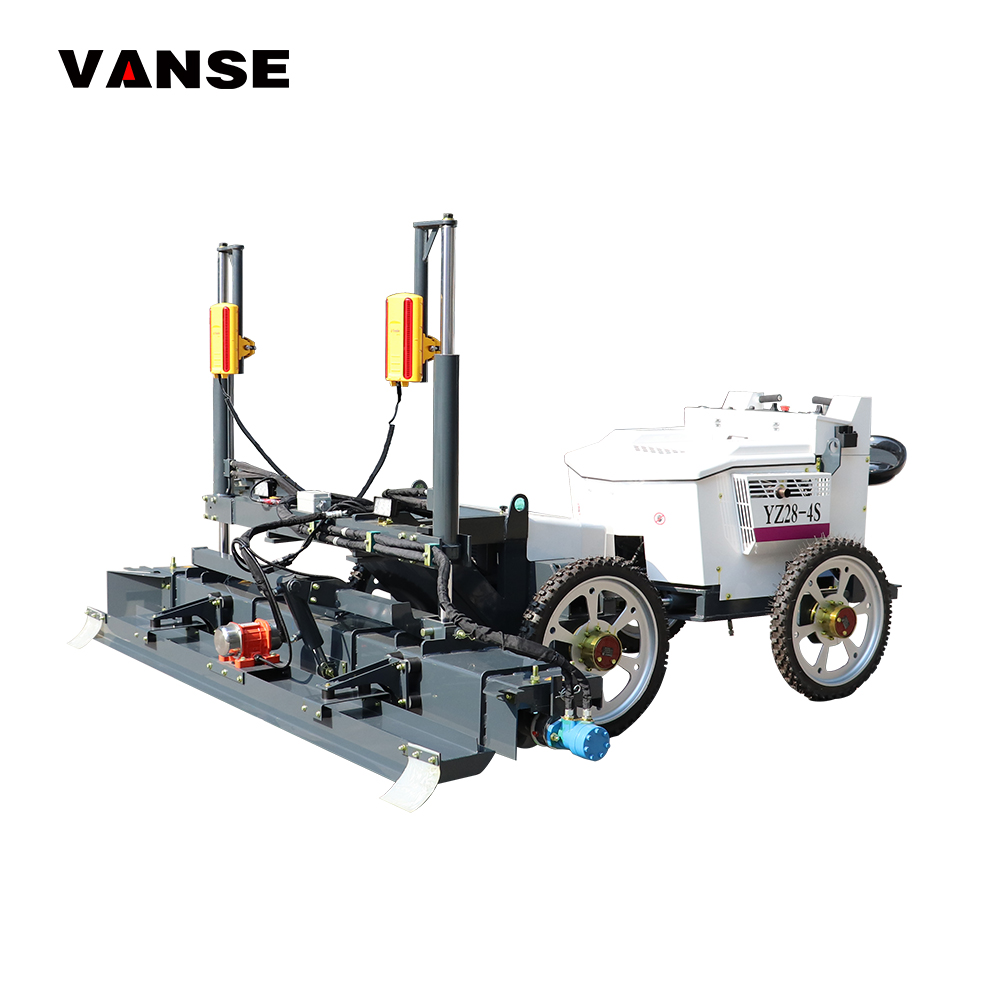
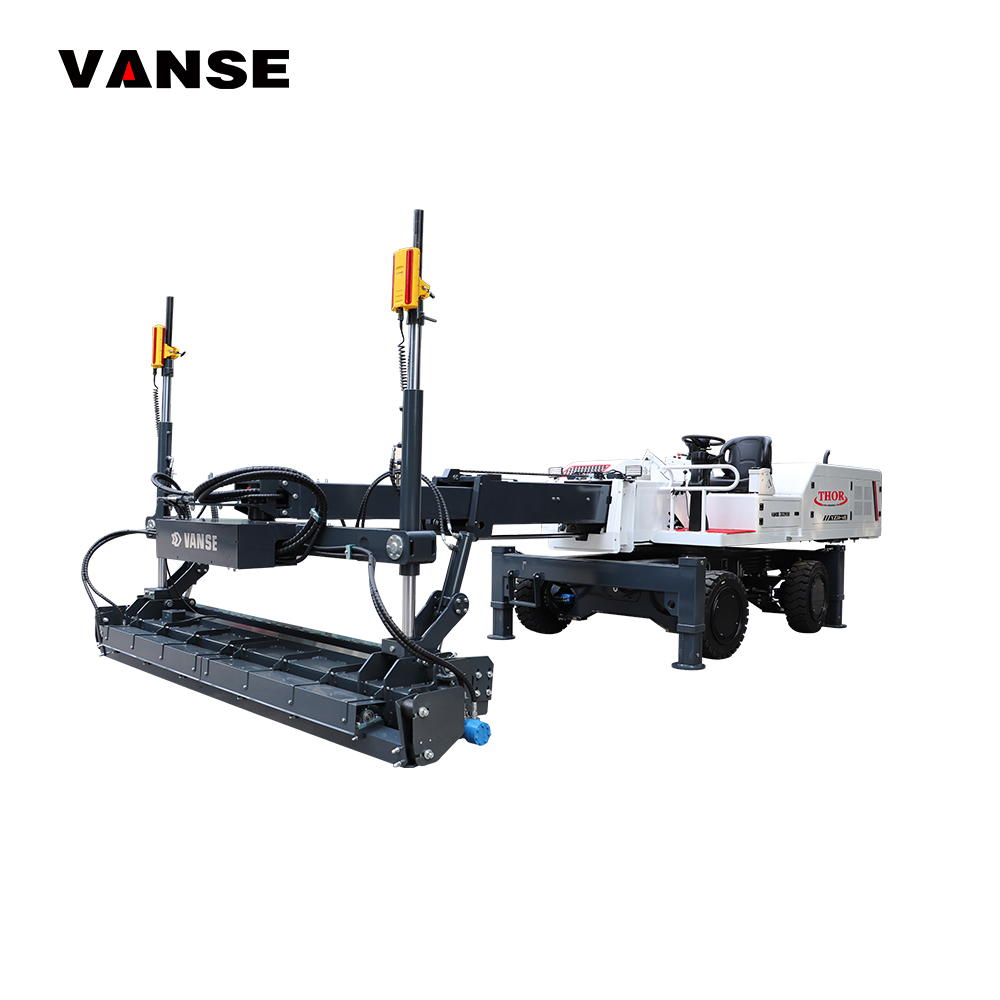
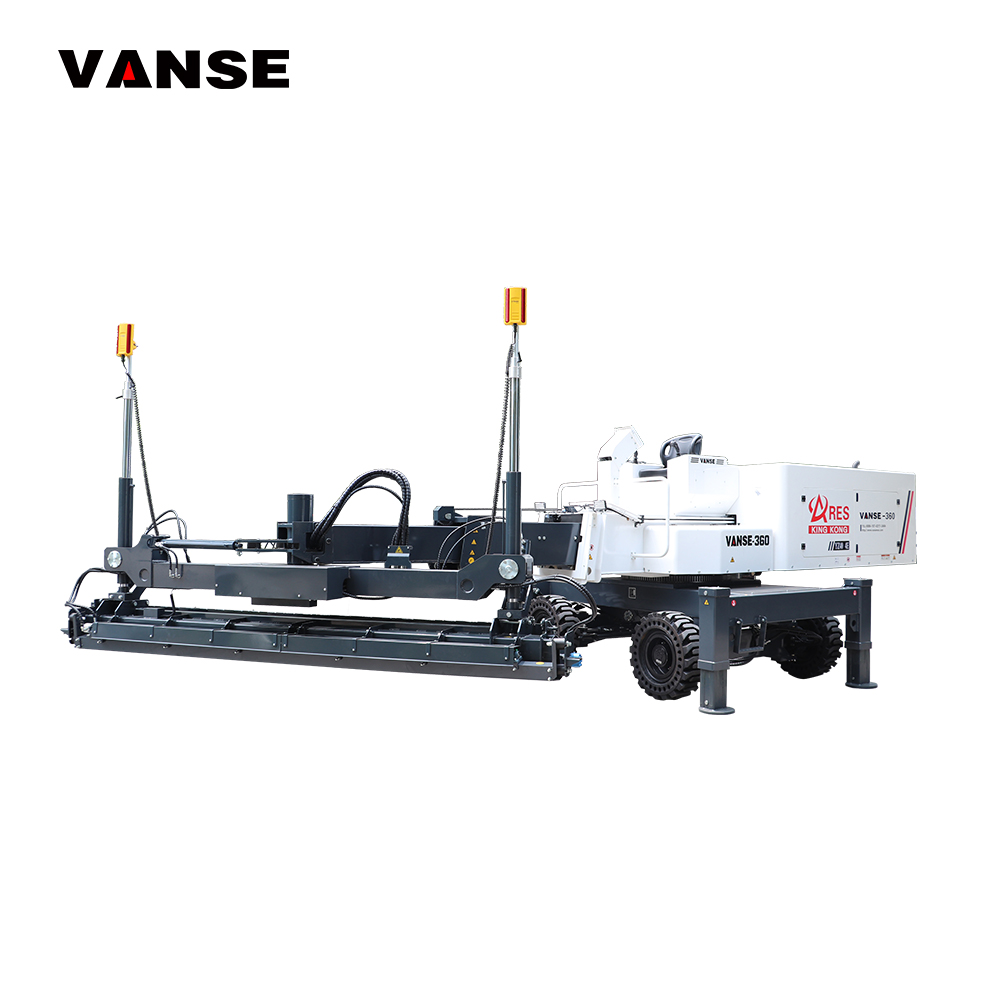
The correct equipment category depends on access, slab geometry, pour volume, and expected operating hours. Walk-behind equipment is practical for smaller interiors and confined sites. Ride-on models improve operator productivity on medium and large slabs. Boom-type machines provide long reach and are especially useful where the machine must work around columns, walls, reinforcement congestion, or limited concrete delivery access.
| Machine type | Typical project scale | Working characteristics | Best applications | Primary advantage | Key buying caution |
|---|---|---|---|---|---|
| Walk-behind laser screed | Small to medium slabs | Operator walks behind the machine; compact chassis and lower transport burden | Retail floors, workshops, repair zones, basements, narrow industrial bays | Lower purchase cost and good maneuverability | Lower output than ride-on machines; verify operator fatigue and access width |
| Ride-on laser screed | Medium to large slabs | Seated operator, hydraulic travel, larger screed head, continuous placement capability | Warehouses, factories, distribution centers, logistics buildings | Strong production rate and reduced labor intensity | Confirm turning clearance, trailer capacity, and local service capability |
| Boom-type laser screed | Large and complex slabs | Long articulated or telescopic reach with remote or seated control options | High-bay warehouses, airport structures, large industrial foundations | Reaches difficult areas with fewer machine movements | Requires careful transport, setup, operator training, and maintenance planning |
| Four-wheel-drive ride-on unit | Large outdoor or rough-access projects | Improved traction and mobility across prepared subbase conditions | Yards, pavements, large factories, infrastructure support slabs | Better mobility on demanding sites | Check tire type, ground pressure, and slab-edge protection procedures |
| 3D-profile-compatible screed | Specialized tolerance-controlled work | Uses digital design data for variable elevations, slopes, and complex profiles | Drainage slabs, ramps, airport areas, specialized industrial floors | Supports complex geometry beyond a simple level plane | Requires survey control, trained personnel, and reliable design-data management |
| Compact boom or narrow-body model | Restricted-access projects | Reduced footprint with controlled reach for enclosed environments | Existing buildings, renovations, parking structures, narrow warehouse zones | Fits where larger machines cannot enter | Evaluate reach, output, ventilation, and floor-loading limits before purchase |
The table shows why “bigger” is not always better. A boom machine can achieve excellent coverage on a large slab, yet it may be inefficient for a small project with frequent relocation. Conversely, a compact walk-behind unit can be economical for contractors performing repetitive small pours but may not meet the output requirements of a 20,000-square-meter logistics facility.
Specifications That Matter in Procurement
Brochures often emphasize engine power and maximum coverage, but buyers should prioritize specifications that affect daily output, tolerance control, reliability, and site logistics. The most useful comparison is a project-specific technical schedule. It should define slab thickness, target elevation tolerance, required floor flatness, average pour size, concrete delivery method, ambient conditions, transport limits, and required support response time.
| Specification | Why it matters | What to request from suppliers | Practical benchmark question | Project risk if ignored | Buyer action |
|---|---|---|---|---|---|
| Screed head width and reach | Determines coverage and ability to work around columns or edges | Maximum, minimum, and effective working dimensions | Can the machine complete each bay without excessive repositioning? | Slow production and missed edge areas | Overlay supplier dimensions on the actual slab layout |
| Laser-control accuracy | Supports elevation consistency and reduced manual checking | Control-system configuration, receiver type, and stated tolerance conditions | What tolerance is achieved on a documented project with similar concrete? | Corrective grinding, rejected slabs, or drainage issues | Request a live demonstration and acceptance test |
| Vibration system | Influences consolidation and surface consistency | Vibration frequency, adjustment method, and wear-part design | How does the system perform on the planned slump and aggregate size? | Surface defects or inconsistent consolidation | Provide mix details before selecting the model |
| Hydraulic system | Controls screed response, travel, and boom movement | Pump, valve, hose, filtration, and maintenance information | Are hydraulic components supported in the destination region? | Downtime due to leaks, contamination, or delayed parts | Include filter and hose kits in the initial spare-parts package |
| Engine and power configuration | Affects fuel use, emissions compliance, and service access | Engine brand options, emission stage, fuel type, and local warranty terms | Is the engine compliant with local rules and supported by nearby technicians? | Import restrictions or costly service delays | Confirm destination-country emission and voltage requirements |
| Machine weight and transport size | Determines trailer, container, crane, and site-access needs | Shipping dimensions, operating dimensions, lifting points, and gross weight | Can local transport safely move the machine between jobs? | Unexpected logistics cost and project delays | Plan transport before issuing a purchase order |
| Control interface and diagnostics | Influences training time and troubleshooting speed | Display language, fault codes, remote support features, and manuals | Can operators identify routine issues without waiting for an engineer? | Extended downtime from simple faults | Require operator and maintenance training at commissioning |
This comparison framework is especially useful when evaluating a low initial price against a premium model. The machine with the lowest purchase price may not be the lowest-cost solution if it lacks parts inventory, competent commissioning, compatible controls, or a documented maintenance program.
Indicative Price and Total Ownership Cost
Laser screed pricing varies widely because it is influenced by machine type, working reach, engine configuration, laser package, hydraulic components, export packing, optional 3D control, accessories, destination compliance, and service scope. Published prices should be treated as a starting point rather than a final budget. A formal quotation should identify the exact configuration, Incoterms, delivery schedule, commissioning scope, warranty, and spare-parts package.
| Cost category | Typical global purchasing range | Main cost drivers | Usually included? | Often overlooked item | Budgeting guidance |
|---|---|---|---|---|---|
| Walk-behind machine | Approximately US$15,000–45,000 | Control package, engine, screed width, export specification | Basic machine configuration | Laser transmitter, spare blades, shipping crate | Suitable for smaller contractors and specialized interior work |
| Ride-on machine | Approximately US$45,000–130,000 | Hydraulics, working width, engine, automation, regional support | Machine and standard operating controls | Training, first-service kit, local taxes | Compare output per shift, not only purchase price |
| Boom-type machine | Approximately US$90,000–250,000+ | Boom reach, chassis, 3D capability, engine and control technology | Base machine only in some quotations | Transport planning, setup support, specialized spare parts | Justify investment through annual slab volume and project pipeline |
| Laser transmitter and receiver package | Approximately US$3,000–15,000+ | Brand, range, automatic leveling, 3D compatibility | May be separate from the screed quote | Calibration, batteries, tripod, receiver replacement | Specify the exact package and warranty coverage |
| Freight, insurance, and import handling | Varies by origin and destination | Container type, port route, insurance, inland distance, duties | Not included under EXW or FOB offers | Port storage, customs broker, oversize transport | Obtain landed-cost estimates before comparison |
| Initial spare-parts and training package | Approximately 2%–8% of equipment value | Wear parts, filters, hoses, tools, training days | Frequently excluded from base price | Emergency parts and remote diagnostic access | Include it to protect first-year uptime |
For a contractor, the true return on investment comes from labor reduction, faster placement, fewer level corrections, reduced rework, increased bid capacity, and better consistency across projects. A machine should therefore be evaluated through expected annual pour volume and gross margin improvement. Rental may be sensible for one-off projects, while purchase is usually more attractive for contractors with repeated industrial flooring work.
Industries and Applications
Laser-controlled screeding is used wherever concrete slabs need accurate elevation and efficient placement. In manufacturing plants, it supports flat working surfaces for machinery, racks, forklifts, and automated production lines. In logistics facilities, tighter floor performance can support material-handling equipment and reduce maintenance on forklift wheels and warehouse vehicles. In airport and infrastructure work, the technology can help contractors manage large pours while maintaining defined grades.
Common applications include industrial warehouses, high-bay storage buildings, e-commerce fulfillment centers, cold stores, food-processing facilities, automotive plants, port terminal support areas, hangars, commercial basements, parking structures, power facilities, bridge approaches, road-related concrete slabs, railway maintenance buildings, and large workshop floors. The system can also be adapted for sloped slabs, drainage profiles, and customized project geometry when supported by appropriate 3D control and survey preparation.
For decorative residential concrete or very small driveway work, a full-size screed system is often unnecessary. Contractors should select equipment based on measurable productivity and quality needs, rather than assuming that automated screeding is suitable for every concrete placement.
Leading Suppliers and Control Providers
The following companies are practical names for global buyers to investigate. Availability, dealer coverage, final specifications, and local support vary by country, so each buyer should verify the current authorized representative in the destination market.
| Company | Service regions | Core strength | Key offerings | Best suited buyer | Procurement note |
|---|---|---|---|---|---|
| Somero Enterprises | North America, Europe, Asia-Pacific, Middle East, selected global dealer markets | Long-standing specialization in concrete placement and large slab technology | Ride-on, boom-type, and advanced laser screeding equipment | Industrial flooring contractors handling high-volume projects | Assess dealer support, training availability, and resale value locally |
| Ligchine International | North America and international export markets | Laser-guided screeding solutions for commercial and industrial concrete work | Ride-on and boom screeds, laser-controlled slab placement systems | Concrete contractors seeking productivity-focused equipment | Confirm local technical service and parts route before import |
| Shandong Vanse Machinery Technology Co., Ltd. | More than 80 countries and regions, including North America, Europe, Middle East, Asia-Pacific, and Latin America | Broad concrete construction equipment range and flexible export customization | Walk-behind, ride-on, and boom concrete laser screeds; trowels and floor equipment | Contractors, distributors, rental companies, and private-label buyers | Review configuration, service plan, destination certification, and initial parts package |
| Shandong HIKING Machinery Co., Ltd. | China and export markets through international trade channels | Concrete floor equipment manufacturing and export-oriented machinery supply | Laser screeds, power trowels, floor preparation and concrete equipment | Price-sensitive contractors and equipment distributors | Request factory test records, manuals, and country-specific support commitments |
| Topcon Positioning Systems | Global dealer and professional construction technology network | Precision positioning, machine control, laser, and 3D construction technology | Rotating lasers, receivers, machine-control and positioning solutions | Buyers upgrading control technology or integrating 3D workflows | Confirm compatibility with the selected screed manufacturer |
| Leica Geosystems | Global distribution network across construction and surveying markets | Survey-grade measurement, layout, laser, and digital construction workflows | Laser levels, total stations, GNSS and construction layout tools | Projects requiring survey integration and quality-control capability | Use qualified local dealers for calibration and technical setup |
This supplier table separates complete screed manufacturers from control-technology providers. A contractor buying a complete machine should confirm whether the laser system is factory-supplied, supplied by a third party, or already owned by the contractor. Compatibility between the screed controller, receiver, transmitter, and potential 3D profile system should be confirmed before shipment.
Buyer Selection Process
Start with a realistic annual usage forecast. Contractors completing only a few small slabs each year may benefit from rental or subcontracting. Contractors regularly building distribution centers, industrial plants, and large warehouses can often justify ownership through labor savings and greater control over schedules. Equipment distributors should additionally consider regional product certification, container loading, warranty claims management, spare-parts turnover, and training capacity.
Prepare a technical request for quotation that includes floor drawings, planned concrete strength, aggregate size, expected slump range, slab thickness, reinforcement arrangement, pour size, required tolerances, expected working temperature, transport restrictions, country of use, and preferred Incoterm. This allows suppliers to recommend a configuration based on actual conditions rather than generic marketing assumptions.
Then evaluate quotations using a weighted scorecard. Technical fit, support responsiveness, component accessibility, warranty clarity, initial parts availability, operator training, and factory testing should carry substantial weight. A supplier that responds clearly to technical questions before an order is often more likely to provide practical support after delivery.
Project Examples and Practical Lessons
In a large logistics warehouse project near Rotterdam or Hamburg, a ride-on or boom screed can support continuous placement over wide bays when ready-mix trucks, pumps, and finishing crews are properly coordinated. The primary lesson is to calculate concrete supply rate carefully. If the machine can cover a large area but concrete delivery is inconsistent, the slab crew may face cold joints, uneven workability, and poor finishing windows.
For a distribution center in Dubai, Jeddah, or Doha, heat management becomes critical. Concrete temperature, evaporation rate, curing availability, and working shifts should be planned alongside screed selection. Automated elevation control can improve grade consistency, but it cannot compensate for poor curing discipline or excessive moisture loss at the surface.
In a Canadian or Northern European industrial building, cold-weather procedures may influence machine choice and project workflow. The contractor should consider winter concrete practices, heated enclosures, engine starting reliability, hydraulic fluid selection, and protected storage for the laser transmitter and electronic controls.
For a Latin American manufacturing facility near São Paulo, Monterrey, or Mexico City, the buyer may prioritize service access and parts logistics because projects can be located far from major ports. A slightly higher initial investment in local parts stock and technician training can be more valuable than a low equipment price that leaves the contractor dependent on long international shipments.
Vanse Machinery for Global Concrete Contractors
Shandong Vanse Machinery Technology Co., Ltd. supports global concrete contractors with walk-behind, ride-on, and boom-type laser-guided concrete screed systems designed for industrial floors, warehouses, factory slabs, logistics facilities, infrastructure work, and large concrete placements. Founded in 2013 in Jining, China, Vanse combines laser-control technology, hydraulic systems, durable structural materials, practical screed-head design, and selectable engine configurations to meet different project conditions. Its manufacturing capability is supported by ISO 9001 and CE certifications, more than 50 invention patents, and over 200 utility model and design patents, with product development supported through cooperation with international technical experts, Shandong University, and Changan University. Buyers can review the available concrete laser leveling machine range and compare ride-on screed options for different slab sizes.
Vanse serves end users, concrete contractors, rental businesses, equipment dealers, distributors, brand owners, and individual buyers through direct sales, wholesale supply, retail orders, OEM and customized branding programs, regional distribution partnerships, project-based equipment supply, and long-term technical cooperation. The company can discuss customized voltage, engine, labeling, and regional product-development requirements where applicable. For complete construction-equipment planning, Vanse provides EPC, turnkey, and customer-owned plant solutions; it does not operate BOO models or on-site bulk supply services.
Its international service commitment is supported by overseas branches and service resources in Southeast Asia and Canada, dealer networks across North America, South America, Europe, Asia, and the Middle East, and a technical team of more than 100 engineers and after-sales specialists. Having supplied customers in more than 80 countries and regions, Vanse is positioned as an ongoing market participant rather than a remote exporter. Buyers receive support from project consultation and machine selection through production, delivery, installation, commissioning, operator training, spare-parts planning, remote diagnosis, and on-site technical assistance where arranged. Its technical service support and broader after-sales service program provide practical channels for online video guidance, multilingual consultation, maintenance advice, and downtime reduction.
Inspection, Delivery, and Commissioning Checklist
| Stage | What to verify | Responsible party | Evidence to keep | Why it protects the buyer | Recommended timing |
|---|---|---|---|---|---|
| Pre-order review | Machine model, reach, laser package, engine, voltage, accessories, delivery terms | Buyer and supplier sales engineer | Signed technical specification and quotation | Prevents disputes over configuration | Before deposit payment |
| Factory inspection | Travel, hydraulics, vibration, controls, welding, paint, safety devices, test operation | Buyer inspector or third-party inspector | Inspection report, video, photographs, serial numbers | Confirms the actual machine before shipment | Before final payment or dispatch |
| Export packing | Crating, corrosion protection, accessory packing list, lifting points, documents | Supplier logistics team | Packing list and loading photographs | Reduces transit damage and missing-item risk | During container loading |
| Import and transport | Customs documents, insurance, port handling, inland trailer and unloading plan | Buyer freight forwarder and local logistics provider | Bill of lading, insurance certificate, delivery receipt | Avoids storage charges and unsafe unloading | Before vessel arrival |
| Site commissioning | Laser calibration, hydraulic check, operator controls, safety briefing, test slab | Supplier technician, dealer, or trained buyer team | Commissioning checklist and operator attendance record | Ensures correct setup before production use | Immediately after delivery |
| First maintenance cycle | Filters, fluids, fasteners, wear surfaces, receiver condition, fault records | Buyer maintenance manager | Maintenance log and parts consumption record | Builds reliability and supports warranty claims | According to operating-hour schedule |
The checklist is not merely administrative. Laser screeds combine mechanical, hydraulic, electronic, and surveying elements. Documented inspection and commissioning reduce the likelihood that a minor setup problem becomes a costly slab-quality issue during the first production pour.
Future Trends Through 2026
By 2026, concrete screeding technology is expected to become more connected, measurable, and sustainability-focused. Contractors are increasingly requesting machine data that records operating hours, service alerts, location, fault history, and production metrics. Remote diagnostics can help service teams identify hydraulic, electrical, or sensor-related issues before sending a technician to the jobsite. This is particularly important for contractors working far from large cities or regional dealer centers.
Three-dimensional profiling will continue to expand beyond specialized infrastructure projects. Warehouses with drainage zones, ramps, equipment pads, and variable slab elevations can benefit from digital layout workflows when survey control and field management are strong. Integration between total stations, digital design files, laser controls, and machine guidance will make it easier to manage complex concrete geometry, although it will also increase the need for trained operators and accurate site data.
Sustainability requirements are also shaping procurement. Buyers are evaluating fuel efficiency, lower-emission engines, durable wear components, repairability, and reduced concrete waste. More precise placement can reduce excessive thickness, unnecessary grinding, and material consumption. In markets with stricter emissions rules, engine selection and documentation will become increasingly important. Contractors should ask suppliers about engine compliance, maintenance intervals, recyclable packaging practices, and component availability rather than considering environmental performance only after delivery.
Labor availability remains another major trend. In many regions, experienced concrete finishing crews are difficult to recruit and retain. Automated screed systems do not eliminate the need for skilled workers, but they can help a smaller trained team manage larger pours with more consistent elevation control. As a result, practical operator training, multilingual manuals, remote video support, and intuitive fault diagnostics will be as important as maximum machine output.
Frequently Asked Questions
What is the difference between a laser screed and a conventional vibrating screed?
A conventional vibrating screed relies more heavily on manual setup, guide rails, string lines, and operator judgment. A laser-guided system uses automatic elevation feedback from a laser receiver and controller, allowing the screed head to make continuous hydraulic adjustments. This can improve productivity and consistency on suitable projects.
Can a laser-guided screed achieve a perfectly flat floor?
No machine alone guarantees a perfect floor. Final floor quality depends on subbase preparation, concrete consistency, reinforcement, machine setup, placing rate, finishing procedures, jointing, curing, and quality testing. The screed improves elevation control, but the project team must manage the complete slab process.
Should a contractor buy a ride-on or boom-type model?
Choose a ride-on model for open medium-to-large slabs where travel efficiency is important. Choose a boom-type model when long reach, obstacle clearance, and reduced repositioning are critical. The decision should be based on slab layout, column grid, access routes, average pour size, and annual workload.
Is a Chinese laser screed system suitable for overseas projects?
Yes, provided the buyer verifies technical fit, destination-market compliance, inspection standards, warranty terms, spare-parts planning, and service capability. Export-focused manufacturers with CE and ISO systems, documented factory testing, multilingual technical support, and regional service resources can offer strong cost-performance for global contractors.
What spare parts should be ordered with a new machine?
Buyers commonly order filters, hydraulic hoses, seals, vibration wear parts, screed blades, fasteners, electrical fuses, receiver accessories, batteries, and recommended service fluids. The exact list should be based on the machine model, expected operating hours, and distance from the nearest service point.
Can one laser screed be used for warehouse floors and outdoor pavement slabs?
In many cases, yes, but the configuration must suit the project. Outdoor work may require stronger traction, careful control-point protection, appropriate tires, and consideration of wind, rain, heat, and subbase conditions. Check the manufacturer’s intended operating conditions before using the equipment across different applications.
How long does operator training take?
Basic familiarization can begin within one or two days, but productive operation requires supervised work on real pours. Operators should learn laser setup, machine travel, head adjustment, concrete flow management, daily inspection, safe shutdown, cleaning, and basic fault identification.
What is the most important question to ask a supplier?
Ask the supplier to explain how the proposed machine will perform on your actual project: slab dimensions, tolerance, concrete mix, access, delivery method, and expected daily output. A supplier that can provide a project-specific recommendation, demonstration plan, training scope, and service response process is more valuable than one offering only a generic price.
Share this article

About the Author: Shandong Vanse Machinery Technology Co., Ltd.
Shandong Vanse Machinery Technology Co., Ltd. is a high-tech manufacturer specializing in concrete construction machinery, including laser screeds and related equipment. The company integrates R&D, production, and global sales, with products exported to over 60 countries and widely used in infrastructure projects worldwide.