Technical Knowledge
How to avoid concrete surface delamination
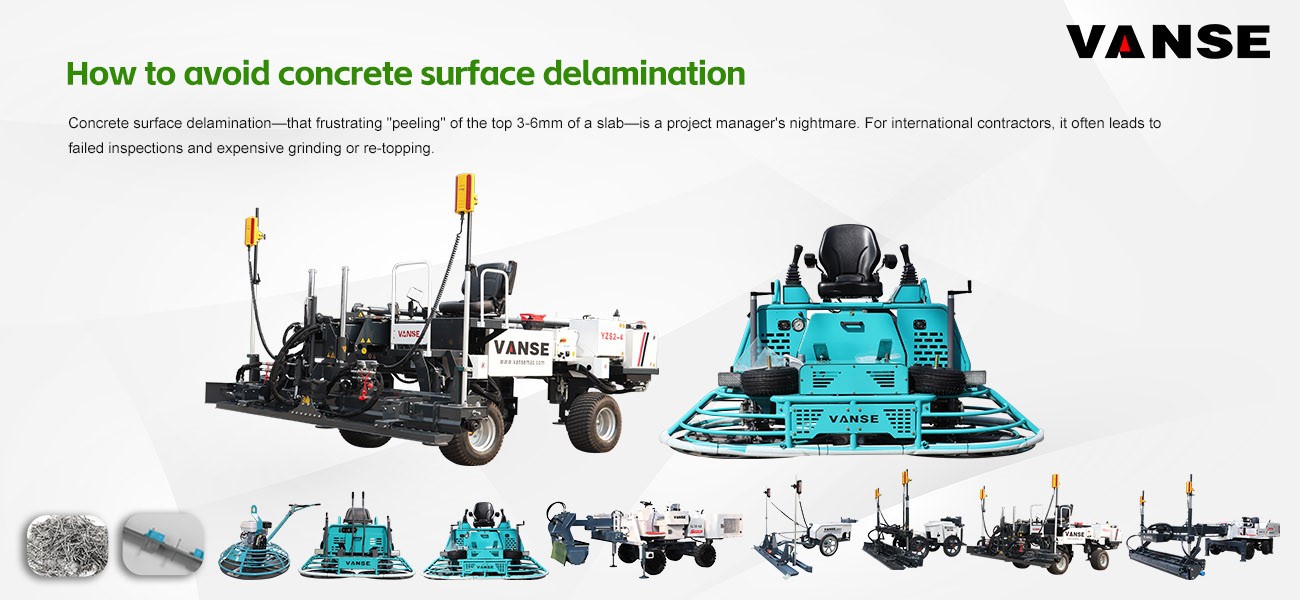
Concrete surface delamination-that frustrating "peeling" of the top 3-6mm of a slab-is a project manager's nightmare. For international contractors, it often leads to failed inspections and expensive grinding or re-topping.
In the industry, we know the main culprit: trapped bleed water or air. If you seal the surface too early, you create a hollow "blister" that eventually snaps off. To avoid this, you need a workflow that prioritizes timing and uniform compaction.
Here is how to eliminate delamination risks using a professional-grade fleet from Vanse Machinery.
1. Uniform Placement: The "Foundation" of Prevention
Delamination often starts with inconsistent concrete placement. If one part of the bay is thicker or wetter than the next, the bleed water will rise at different rates.
The Vanse Workflow: Instead of dumping large, uneven piles that create "wet spots," use a Vanse Concrete Distributor to ensure an even ribbon of material.
2. Consolidated Leveling: Eliminating Air Pockets
If the slab isn't consolidated from the bottom up, air pockets can migrate to the surface during finishing, leading to "blisters."
The Vanse Workflow: A Vanse Concrete Laser Leveling Machine (like the YZ28-4S or the telescopic YZ30-4E) doesn't just "scrape" the top; it uses high-frequency vibration (up to 4000rpm) to liquefy and consolidate the entire depth of the slab in one pass. This forces out excess air and ensures the bleed water rises naturally and evenly across the entire floor.
3. Integrated Hardening: Bonding the "Skin"
Many delamination issues occur because manual dry-shake hardener is applied unevenly, preventing a proper bond with the base slab.
The Vanse Workflow: Use the Vanse Automatic Topping Spreader. By mechanically applying the hardener immediately after the laser leveling pass, you ensure the material integrates perfectly with the wet paste. This creates a monolithic bond that won't "peel" under heavy forklift traffic.
4. Master the Timing: The Power Trowel Rule
The most common cause of delamination is premature troweling. If you start "burning" the floor while bleed water is still rising, you are guaranteed to have peeling issues.
The Vanse Workflow: When you use a high-performance Vanse VS1046 Ride-on Power Trowel, you have the torque and weight to wait for the "Goldilocks" window. Because Vanse machines are so efficient, you don't have to rush the first pass. You can wait for the bleed water to fully evaporate, then use the precision pitch control to densify the surface without trapping moisture underneath.
5. Stress Relief: Precision Joint Cutting
Sometimes "peeling" happens near the edges of joints due to localized stress or "spalling."
The Vanse Workflow: As soon as the floor is hard enough to walk on, use a Vanse Concrete Cutting Machine (Floor Saw). A clean, straight cut ensures that the slab can "breathe" and move during the curing process, preventing the edges from lifting or delaminating during the critical first 48 hours.
Comparison: Why Pro Equipment Prevents Failures
| Technical Cause of Peeling | Prevention Strategy | Vanse Advantage |
| Inconsistent Placement | Controlled, even distribution. | Concrete Distributor & Mini Dumper |
| Trapped Air/Water | Bottom-up consolidation. | High-Frequency Laser Leveling Machine |
| Poor Hardener Bond | Mechanical, even application. | Automatic Topping Spreader |
| Premature Sealing | High-torque finishing at the right time. | VS836 / VS1046 Power Trowel |
| Edge Stress | Early, clean joint execution. | Stable Concrete Cutting Machine |
Final Thought
Avoiding delamination is all about respecting the concrete's timeline. You can't force the water to stop rising, but you can use equipment that works with the material. By combining the placement precision of the Mini Dumper, the leveling power of the Laser leveling, and the finishing torque of the Power Trowel, you ensure a floor that is as durable as it is flat.
Don't risk your reputation on a "peeling" floor. Explore the full professional lineup at www.vansemac.com and build it right the first time.
Note: The parameters provided in this document are for reference only and are not mandatory. Due to differences in technical characteristics between different brands and models of laser levelers, please consult the manufacturer for a suitable solution before actual operation. This reference document assumes no responsibility for any issues arising from failure to follow the manufacturer's instructions.
Thanks to All the Friends Who Support and Trust Shandong Vanse Machinery Technology Co., Ltd.
If you want to know more about Shandong Vanse Machinery Technology Co., Ltd. or have any questions, please feel free to contact us:
Our Factory
Shandong Vanse Machinery Technology Co., Ltd.








Share this article

About the Author: Shandong Vanse Machinery Technology Co., Ltd.
Shandong Vanse Machinery Technology Co., Ltd. is a high-tech manufacturer specializing in concrete construction machinery, including laser screeds and related equipment. The company integrates R&D, production, and global sales, with products exported to over 60 countries and widely used in infrastructure projects worldwide.
Previous Post
Next Post
Related Articles
You Might Also Like
The advantages of laser leveling machine are revealed, don’t be convinced!
In the past, when creating super-flat ground, the traditional cement concrete paving and leveling method was generally used. Most of the time, the cement concrete was roughly leveled manually using shovels, rake and other tools, and then the cement concrete vibrating beams, roller bars and scrapers were used for repeated leveling. Leveling, except for the poor flatness in this method, completely relies on manual operation and consumes a lot of labor costs. With the advancement of the times, laser leveling machines are becoming more and more common in super-flat floor construction. It is a device that uses laser as the reference plane and controls the leveling head in real time to achieve high-precision and rapid leveling of concrete. What exactly is it? What are the advantages that make it so popular? 1. Laser leveling machine reduces labor costs and doubles efficiency Traditional construction techniques require a large number of people, and require support of formwork (channel steel), dotting, and paving, and require about 20 manpower. The total number of people using the concrete laser leveling machine is more than half that of the traditional process. It can be operated by a single person, and the daily construction area is also greatly increased, which greatly reduces the labor cost. 2. Laser leveling machine laser point alignment, high precision and low error Traditional leveling technology requires support templates to control the elevation of the ground and pull control lines. The elevation error is large, and the levelness and smoothness of the entire floor cannot be guaranteed. The use of laser point transmitters is suitable for one-time paving of large areas. There is a laser measurement and control system that controls the elevation in real time. No pulling wires are required for leveling, and there is no need for support and side plates in the middle to control the ground elevation. This avoids the elevation error caused by the vibration of the formwork (channel steel) during the construction process, and also reduces the elevation error caused by traditional manual block formwork. 3. The ground flatness and integrity are better With traditional construction techniques, formwork is set up one day and watering is done the other day. The construction can only be carried out piece by piece. It has great limitations and cannot be operated continuously. Moreover, the integrity is not good and it is easy to cause accumulated errors in the construction joints. The concrete laser leveling machine can pave a large area of floor in one go, with higher efficiency and integrity. The completion of the entire floor makes the ground more integrated, which is completely impossible with traditional construction. 4. The ground is denser and more uniform, which improves the overall construction quality. The high-frequency vibrator per minute allows the leveling head vibrator to produce uniform high-frequency vibration, making the concrete floor denser and more uniform. It is said that laser levelings are a means of reducing enterprise construction costs. In fact, these are not the only reasons why enterprises choose concrete laser levelings. As the requirements for ground smoothness and levelness in modern logistics, workshops, supermarkets, etc. continue to increase, laser leveling machines are becoming more and more widely used to ensure construction quality and improve work efficiency, so it is the best choice. Got it!What the special precautions should be taken when using laser leveling machines on different ground materials?
– Material inspection: Make sure that the mix ratio of concrete meets the construction requirements. For laser leveling machine construction, the slump of concrete is generally recommended to be between 12 and 18 cm, so that the concrete has good fluidity and is convenient for the leveling machine to operate. For example, in the construction of large factory floors, the slump of concrete should be tested in advance to avoid affecting the leveling effect due to inappropriate slump. – Base treatment: The ground base needs to be solid and flat. If there are uneven areas on the base, the thickness of the concrete will be uneven, affecting the final flatness of the ground. Therefore, before construction, the base should be cleaned and repaired, debris, dust, etc. should be removed, and potholes should be filled. – Vibration link: After the concrete is laid, before using the laser leveling machine, you can use a vibrating rod for preliminary vibration to make the concrete more compact. But pay attention to the vibration time and depth to avoid excessive vibration causing concrete segregation. During the vibration process, it should be coordinated with the construction sequence of the laser leveling machine. Generally, the leveling operation should be carried out as soon as possible after vibration. – Leveling operation: When the laser leveling machine is used for concrete floor construction, the parameters of the equipment should be adjusted according to the design elevation and slope requirements of the ground. During the construction process, the walking speed of the machine should be uniform, avoiding too fast or too slow. Too fast speed may cause insufficient flatness of the ground, and too slow speed will affect the construction efficiency. At the same time, pay attention to the height and angle of the scraper to ensure that the concrete surface is flat and smooth. – Moisturizing maintenance: After the concrete is leveled, moisturizing maintenance should be carried out in time. Plastic film, straw mats, etc. can be covered on the surface to prevent the concrete from cracking due to excessive evaporation of water. The maintenance time is generally not less than 7 days. In hot weather or dry environment, the maintenance time should be appropriately extended. – Temperature control: The temperature of asphalt material is crucial to the construction quality. During construction, the temperature of hot-mix asphalt mixture should meet the requirements of construction specifications. Generally, the exit temperature of ordinary asphalt mixture is between 140 and 165℃. If the temperature is too low, the asphalt mixture will become viscous, which is not conducive to the construction of the leveling machine; if the temperature is too high, it will accelerate the aging of asphalt. – Base treatment: Similar to concrete floors, the base of asphalt floors also needs to be solid and flat. At the same time, the base must be kept dry, because if there is moisture in the base, after the asphalt is paved, the evaporation of moisture will cause hollowing and cracking problems in the asphalt pavement. – Paving uniformity: During the asphalt paving process, the asphalt mixture must be spread evenly. When the laser leveling machine is in operation, pay attention to controlling the pressure of the scraper to avoid excessive pressure that causes excessive extrusion of the asphalt mixture, affecting its density and surface flatness. – Joint treatment: In asphalt floor construction, joint treatment is a key link. When using a laser leveling machine for multi-width paving, the longitudinal joints between the two widths must be handled well. Generally, the hot joint method can be used, that is, a certain width (generally 10-20cm) of the first paved asphalt mixture is left unrolled for the time being, as the reference surface for the later paving part, and then the joint is leveled with a leveler so that the two asphalt pavements can be well connected. – Compactness inspection: After the asphalt floor construction is completed, the compaction of the ground should be checked. Nuclear density meters and other equipment can be used for testing to ensure that the compaction meets the design requirements. If the compaction is not enough, the asphalt floor will cause rutting and other diseases during use. – Stone selection and processing: Select stones with uniform size specifications and good flatness. Before paving, the back of the stone should be cleaned to remove dust, impurities, etc., and appropriate back coating can be performed to enhance the bonding between the stone and the base. – Base preparation: The base needs to have sufficient strength and stability, and cement mortar is generally used as the base material. The flatness error of the base layer should be controlled within a small range to provide a good foundation for stone laying. – Laying accuracy: When using a laser leveler to assist in laying stones, the laying height and levelness of the stones should be accurately controlled. Since the stone itself is heavy, the leveler should be careful to avoid collision with the stone during operation to prevent the stone from breaking or shifting. For large-sized stones, multiple people may be required to cooperate in the construction and use the leveler for fine-tuning. – Use of bonding materials: When laying stones, the bonding materials (such as cement mortar or special stone glue) should be applied evenly and the thickness should be moderate. The laser leveler can be used to check the flatness of the stone after laying. For uneven stones, adjustments can be made before the bonding materials solidify. – Cleaning and protection: After the construction is completed, the stains and bonding material residues on the stone surface should be cleaned in time. And the stone surface can be protected, such as applying protective agents, to prevent the stone from being polluted and eroded, and extend the service life of the stone floor.Introducing laser leveling machines to solve the difficulties in shale gas platform construction
As far as the concrete structure of shale gas platform is concerned, its construction requirements are generally relatively high, and the construction period is relatively long. With the continuous expansion of shale gas drilling platforms, the requirements for drilling rig foundation and platform flatness are constantly raised, and the drawbacks of traditional construction methods are gradually emerging. In order to reduce the labor intensity and improve the flatness of concrete, the application of laser levelling machine in shale gas platform construction has gradually become an inevitable trend. The following is a brief analysis of the specific application of laser leveling machine in shale gas platforms. 1. Analysis of shale gas platform construction status With the continuous acceleration of natural gas development speed, shale gas development gradually to the factory development, the platform area is also expanding, the drilling depth is also increasing, and the requirements for the flatness and construction cycle of the concrete floor are becoming higher and higher. The conventional construction method is to divide the warehouse according to the working width of the vibratory beam 6-7m, divide the whole site into 7-13 pieces in the width direction, support the mold or set up the guide rail on both sides of each piece, pour concrete and smooth the vibratory beam, such method needs to set up the template or adjust the elevation of the guide rail many times. Within the working range of the vibratory beam, the place where the concrete is not hollow and not full cannot vibrate, and small pit functions are more likely to be formed by bleeding and sinking during the later maintenance. Water accumulation occurs in rainy days after the completion of the site, which seriously affects the placement and production and use of shale gas production and transportation equipment in the later stage. Therefore, the conventional method can not meet the requirements of the flatness of the shale gas platform. 2. The feasibility of the application of laser leveling machine ▶ The leveling machine is small in size, light in weight, not high in road capacity, convenient and fast in transportation; ▶ The leveling machine has high degree of automation, low failure rate, simple operation and easy to learn, and low requirements for operators; ▶ The leveling machine has simple structure, low procurement cost, low use cost, and little loss due to weather and other reasons; ▶ The single leveling width of the laser leveling machine can reach 2~3m, the paving speed can reach 4~5m/min, the area of 500 square meters can be completed per hour, and the area of 4000 square meters can be completed every day. It can be seen that the construction speed is fast, and the efficiency is more than 3 times that of the conventional construction method, especially suitable for the shale gas platform construction period is high. Concrete surface construction with simple surface shape and large working surface; The laser leveling machine provides laser signal through a fixed transmitter, which can completely cover the whole scene. The receiver receives the signal in time, and the computer automatically calculates the design elevation according to the current position of the leveling machine, and issues adjustment instructions to the whole plate up to 10 times per second, eliminating the influence of uneven field base and greatly improving the smoothness of the concrete. Compared with the ground constructed by the laser leveling machine and the conventional method, 22 points were detected (one point every 5mx4m), and the average flatness was 1.3mm and 4.1mm, respectively. It can be seen that the leveling quality of the laser leveling machine is more than 3 times that of the conventional method. ▶ Due to the good platform visibility conditions, there is no need to change the position of the laser transmitter during the construction process of the laser levelling machine, which can reduce unnecessary processes and reduce errors caused by operational errors. In the construction process of concrete, it is not necessary to separate the bin support mold, only at the edge of the site support mold can reduce the support modulus of more than 74%. After leveling, the addition of a single disc hand-held polishing machine, double disc driving polishing machine and cutting machine can make the heavy manual labor into mechanical paving, vibrating, leveling, pulp lifting, plastering, which can reduce the operator by 30% compared with the conventional construction method, and save 2 to 3 yuan /㎡ than the conventional process. In summary, the laser levelling machine has fast speed, high efficiency and obvious economic benefits, which is suitable for the characteristics of shale gas platform, and it is very necessary and feasible to construct concrete in large areas in mountainous areas. At present, many pilot application results have confirmed that the use of laser levelling machine is not only feasible but also very necessary in the large-scale concrete construction of shale gas platform. On the one hand, the application of laser levelling machine can improve the flatness of the platform, on the other hand, it can also improve the construction efficiency, shorten the construction period and reduce the cost, compared with the conventional construction method, the benefits brought by this construction method are beyond doubt.