Technical Knowledge
Does the automatic elevation adjustment function of the intelligent concrete laser leveling have a high error rate in actual construction?
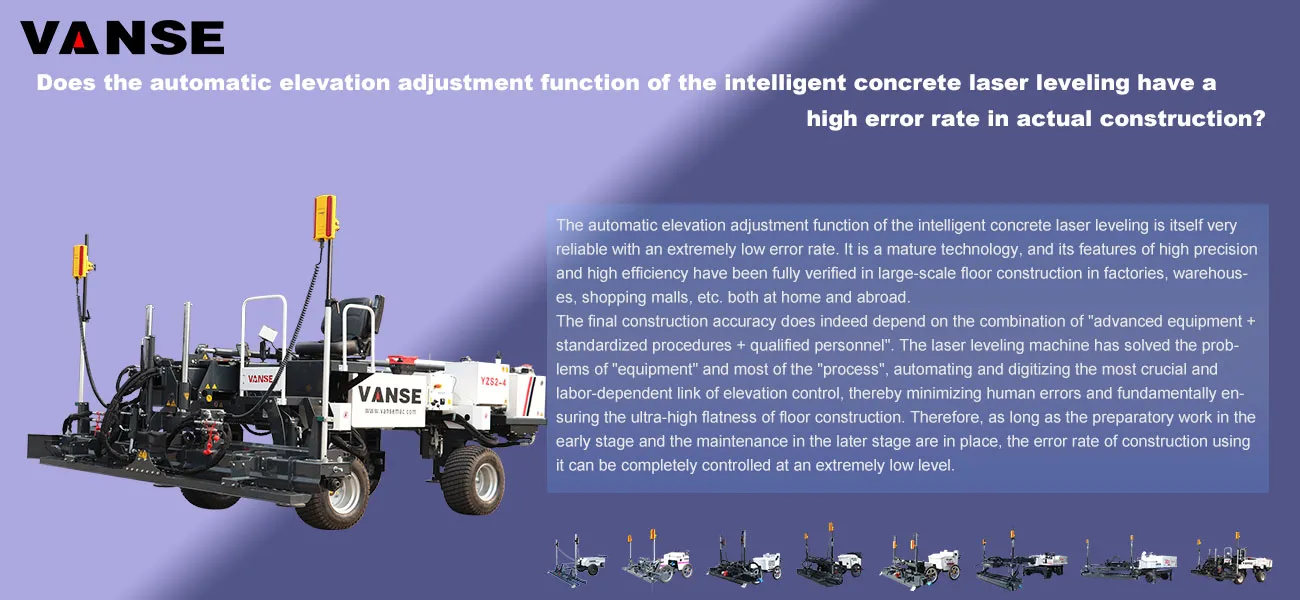
The simple and straightforward answer is: The automatic elevation adjustment function of the intelligent concrete laser leveling has an extremely low error rate in actual construction, and its precision and efficiency are far beyond those of traditional manual methods.
Below, I will explain in detail why its error rate is low and in what circumstances errors might occur.
Why can its error rate be so low?
The high precision of the intelligent laser leveling mainly relies on the closed-loop control composed of its three major systems:
High-precision reference System – "Eye"
Laser emitter: A fixed laser emitter is set up in the center of the construction area, which will form an absolutely horizontal laser reference plane covering the entire working surface. The precision of this laser plane is extremely high, typically reaching ±1.0mm/10m or even higher.
Compared with the traditional approach: It has replaced the visual and human errors caused by relying on manual threading, rulers, etc. in the traditional way.
Intelligent Control System – "Brain"
Laser receiver: The mast on the leveling is equipped with a laser receiver to capture laser signals in real time.
The controller: The receiver transmits the signal to the on-board computer (PLC), which calculates in real time the precise height difference between the current bottom of the scraper of the leveling and the laser reference surface.
Compared with the traditional way: This "brain" replaces the experience and judgment of the master, eliminating human uncertainty.
Hydraulic actuator system – "Hands and Feet"
Hydraulic cylinder: According to the instructions of the "brain", the hydraulic system will instantly (with a response time measured in milliseconds) drive the lifting cylinders at both ends of the flattening head, keeping the scraper precisely at the height set by the laser reference.
Compared with the traditional method: No matter how the foundation undulates (such as being soft or hard below), the leveling head can automatically adjust and maintain a constant elevation, while manual operation will be "deceived" by the unevenness of the foundation, resulting in an uneven ground in the end.
This "eye-brain-hand" system works in coordination to form a real-time, closed-loop automatic control system, thus ensuring the ultimate accuracy of the elevation.
The specific precision performance in actual construction
Elevation accuracy: Under normal operation, the intelligent laser leveling can control the flatness of the floor within ±3mm/3m. For large-area integral floors, the overall elevation error can be easily controlled within ±5mm. Some high-end models can even perform better under ideal conditions.
Construction efficiency: Its efficiency is 10 to 20 times that of manual labor, significantly shortening the construction period.
Ground quality: As high-frequency vibration and leveling are carried out simultaneously, the density of the concrete is uniform, which can effectively avoid problems such as hollowing and peeling.
Under what circumstances will errors occur? (Analysis of Error Sources
Although the machine itself is of extremely high precision, the principle of "garbage in, garbage out" still applies. The errors in actual construction mainly stem from factors outside the machine rather than the failure of the machine's own automatic adjustment function.
| Source of error | Explanation | How to avoid |
| 1. Incorrect benchmark setting | The laser emitter itself was not leveled or was set up unstably and knocked over. This is the most fatal mistake, which can cause the entire working surface to tilt or go wrong. | After erection, conduct a double inspection to ensure its stability and accuracy within the allowable range. |
| 2. Improper handling at the grassroots level | The flatness of the foundation (crushed stone cushion layer) is too poor, and the height fluctuation is too large. Although the leveling can adjust automatically, extreme drops may exceed its adjustment range or cause uneven concrete thickness. | Strictly control the laying and compaction flatness of the base layer. |
| 3. Concrete batching and paving | Unstable slump of concrete (sometimes dry and sometimes thin), uneven particle size of aggregates, or excessive differences in initial flatness during paving will all bring difficulties to fine leveling. | Ensure the stability of concrete quality. When spreading, it should be roughly uniform, and there should be no piles of materials that are too high or too low. |
| 4. Operator skills | The operator's lack of proficiency and improper planning of the walking path have led to leakage vibration or height differences at the junctions. | Employ experienced operators and receive professional training. |
| 5. Later Maintenance and load | If people or equipment are placed on the concrete before it reaches sufficient strength, or if it is improperly maintained (such as losing water too quickly), causing uneven shrinkage and cracking, it will damage the already formed flatness. | Strictly carry out post-maintenance and prohibit loading until the strength is reached. |
Conclusion
The automatic elevation adjustment function of the intelligent concrete laser leveling is itself very reliable with an extremely low error rate. It is a mature technology, and its features of high precision and high efficiency have been fully verified in large-scale floor construction in factories, warehouses, shopping malls, etc. both at home and abroad.
The final construction accuracy does indeed depend on the combination of "advanced equipment + standardized procedures + qualified personnel". The laser leveling machine has solved the problems of "equipment" and most of the "process", automating and digitizing the most crucial and labor-dependent link of elevation control, thereby minimizing human errors and fundamentally ensuring the ultra-high flatness of floor construction. Therefore, as long as the preparatory work in the early stage and the maintenance in the later stage are in place, the error rate of construction using it can be completely controlled at an extremely low level.
Note: The parameters provided in this document are for reference only and are not mandatory. Due to differences in technical characteristics between different brands and models of laser levelers, please consult the manufacturer for a suitable solution before actual operation. This reference document assumes no responsibility for any issues arising from failure to follow the manufacturer's instructions.
Thanks to All the Friends Who Support and Trust Shandong Vanse Machinery Technology Co., Ltd.
If you want to know more about Shandong Vanse Machinery Technology Co., Ltd. or have any questions, please feel free to contact us:
Our Factory
Shandong Vanse Machinery Technology Co., Ltd.








Share this article

About the Author: Shandong Vanse Machinery Technology Co., Ltd.
Shandong Vanse Machinery Technology Co., Ltd. is a high-tech manufacturer specializing in concrete construction machinery, including laser screeds and related equipment. The company integrates R&D, production, and global sales, with products exported to over 60 countries and widely used in infrastructure projects worldwide.
Previous Post
Next Post
Related Articles
You Might Also Like
Is the operation of the ride-on concrete laser leveling difficult?
Overall, the operation difficulty of the ride-on concrete laser leveling is of the type that is "easy to get started with but requires practice to master". For experienced mechanical operators, mastering basic operations is not difficult. However, to achieve the level of efficient and high-quality construction, systematic training and a certain accumulation of on-site experience are required. Now let's break down its operational difficulty in detail from different perspectives: High degree of automation: This is the core reason. The main job of the operator is no longer to manually control the flatness and elevation of the ground, but rather: Management boundary: Control the movement of machines within the boundaries of the construction area. Control speed: Adjust the forward/backward speed and make fine adjustments according to the concrete paving situation (such as more or less material). Observation and monitoring: Monitor whether the laser signal is normal, whether the machine is operating well, and the supply situation of concrete. The true "leveling" work is automatically completed by the machine: the laser receiver captures the laser plane signal, the control system calculates the height of the scraper in real time, and automatically adjusts it through the hydraulic system to ensure that it always remains at the set elevation. The operation controls are intuitive: The controls in the cab are usually simple and clear, mainly including Steering wheel or joystick: used to control the direction of travel (forward, backward, turning). Throttle/Speed control: Controls the driving speed. Scraper lifting control: Used when starting construction and leaving the construction area. Emergency stop switch: For use in emergency situations. Some advanced models may also have vibrator intensity adjustment, etc To truly complete construction independently and with high quality, operators need to master the following knowledge and skills, which require learning and practice: The installation of the laser emitter: This is the source of precision. The operator must know how to correctly select the position, level the laser emitter, and set the correct slope (if necessary). If the setup is unstable, everything will be lost. Calibration and inspection of the machine: Before starting work every day, it is necessary to check whether the laser receiver, control system and hydraulic system are working properly in accordance with the regulations and carry out necessary calibrations. This is directly related to the construction accuracy. The judgment of concrete properties: It is necessary to know how to judge the slump (dryness and thinness) of concrete. The concrete is too dry, causing high resistance for the machine's movement and making it prone to leaving marks. If it is too thin, it will affect the final strength and make it difficult to level. The machine speed and vibration frequency need to be adjusted according to the actual situation. The cultivation of "material sense" : This is the core experience. The operator needs to learn to observe the amount of concrete ahead and plan the walking path in advance to ensure that there is an appropriate amount of concrete in front of the scraper, neither too much nor too little. Excessive materials need to be removed with manual assistance, while insufficient materials need to be replenished in a timely manner.Dealing with unexpected situations: For instance, sudden loss of laser signals (blocked by people or equipment), foreign objects on the ground, interruption of concrete supply, etc., all require operators to handle them calmly and correctly. Planning of walking routes: How to plan the leveling sequence to be the most efficient and avoid repeated rolling on the already leveled area.Coordination with other trades: The coordination and cooperation with personnel such as concrete mixer trucks, pump trucks, formwork support workers, and riveters are of vital importance. Manufacturer training (most recommended) : When purchasing new equipment, the brand usually provides very detailed and systematic operation and maintenance training. This is the fastest and most formal way to learn. Master-apprentice: In construction teams, learning from experienced master workers is the most common way. One can start with auxiliary work and gradually get the hang of it. Watch teaching videos: Nowadays, there are many operation videos released by brands and construction teams online, which can help you understand the operation process and skills intuitively. Read the instruction manual: The operation manual and maintenance manual of the equipment contain all the basic knowledge and safety regulations. They must be read carefully. For beginners: If they have operating experience with other construction machinery (such as excavators and loaders), the transition will be very fast. If not, through 1-2 weeks of systematic study and on-board practice, one can fully master the basic operations and start independently completing some floor construction tasks with relatively low requirements. For experienced masters: Their value does not lie in "being able to drive", but in their ability to handle all kinds of complex working conditions, ensuring that they can deliver extremely flat floors in any situation, and with the highest efficiency and the least material consumption. So, if you are considering taking up this profession, there is no need to worry too much about its operational difficulty. It is a technical job that requires the accumulation of experience through learning and practice, but it is by no means unattainable. Once mastered, it becomes a very valuable skill. Note: The parameters provided in this document are for reference only and are not mandatory. Due to differences in technical characteristics between different brands and models of laser levelers, please consult the manufacturer for a suitable solution before actual operation. This reference document assumes no responsibility for any issues arising from failure to follow the manufacturer's instructions.What materials are suitable for concrete laser leveling machines?
Concrete laser leveling: suitable materials and applications ★1★ Introduction to compact soil laser leveling machine The concrete laser leveling is a high-efficiency, high-precision concrete construction equipment that is widely used in the construction of floors, roads, bridges and other fields. This equipment achieves high-precision positioning and leveling through laser technology, which can greatly improve the quality and efficiency of concrete construction. ★2★ Concrete material properties Concrete is a composite material widely used in construction projects. It is mainly composed of aggregates, cement, water and other additives. The hardening process of concrete involves factors such as hydration reaction and temperature changes, and it requires a certain amount of time and appropriate maintenance to reach the design strength. Due to the diversity of concrete materials, different types and proportions of mixers have different characteristics and application ranges. ★3★ Working principle of concrete laser leveling machine The working principle of the compacted soil laser leveling machine mainly uses laser technology for high-precision positioning and measurement. By installing a laser transmitter and receiver on the equipment, the concrete laser leveling can form a laser beam in the construction area, and monitor and control the height and level of the laser beam in real time through sensors and control systems. During the leveling process, the equipment will automatically adjust the walking track and concrete paving thickness to ensure the flatness and compactness of the floor. ★4★ Applicable material range of concrete laser leveling machine Concrete laser leveling machines are suitable for many types of concrete materials, including but not limited to the following: 1. Ordinary concrete: suitable for concrete construction in general construction projects, such as floors, roads, etc. 2. High-strength concrete: suitable for structures with high strength requirements, such as bridges, high-rise buildings, etc. 3. Durable concrete: Suitable for projects with high durability requirements, such as nuclear power plants, tunnels, etc. 4. Special function concrete: such as thermal insulation concrete, refractory concrete, etc., suitable for projects with specific functions. It should be noted that for different types of concrete materials, appropriate mix design and construction process adjustments need to be carried out according to their characteristics and requirements to ensure Construction Quality. ★5★ Application of concrete laser leveling machine in different scenarios The application of concrete laser leveling machines in different scenarios includes the following aspects: 1. Floor construction: Suitable for floor construction in industrial plants, warehouses, parking lots, shopping malls, etc., which can improve the flatness and durability of the floor. 2. Road construction: It is suitable for the construction of urban roads, highway bridges and other road projects. It can improve the smoothness and durability of the road and reduce maintenance costs. 3. Bridge construction: It is suitable for construction on the surface of bridges, which can improve the flatness and durability of the bridge and extend the service life of the bridge. 4. Airport runway construction: Suitable for the construction of airport runways, it can improve the flatness and durability of the runway and ensure flight safety. 5. Special projects: Suitable for the construction of special projects with extremely high safety requirements such as nuclear power plants, tunnels, and oil depots. ★6★ Advantages and limitations of concrete laser leveling machine The advantages of the compacted soil laser leveler mainly include high precision, high efficiency, and high degree of automation, which can greatly improve construction quality and efficiency, and reduce labor costs and material waste. However, there are also some limitations to the compacted soil laser leveling, such as the higher skill level requirements for operators, additional processing and adjustments that may be required for construction with complex shapes and special requirements, and in addition, the purchase and maintenance costs of the equipment. It also requires reasonable economic considerations. ★7★ Operation and maintenance of concrete laser leveling machine Operating a concrete laser leveling requires professional training and practical experience. Operators need to master the performance and working principles of the equipment and strictly abide by operating procedures and safety regulations. During use, the equipment must be inspected and maintained regularly to ensure the normal operation and service life of the equipment. At the same time, for different types of concrete materials and construction scenarios, corresponding adjustments and treatments are required to ensure construction quality. ★8★ Market Prospects and Investment Value Analysis With the continuous expansion of the scale of construction projects and the continuous improvement of construction requirements, the market demand for concrete laser leveling machines is also gradually increasing. In the next few years, with the continuous advancement of technology and the expansion of application fields, there is still a lot of room for improvement in the accuracy, efficiency and service life of concrete laser levelings. Therefore, for investors with a long-term perspective, concrete laser leveling machines are a potential investment area. However, it should be noted that the investment cost of equipment is relatively high, and adequate preparation and planning are required economically. At the same time, market competition is becoming increasingly fierce, and it is necessary to strengthen technological innovation and service quality improvement to maintain competitive advantages.How to reduce the construction cost of concrete laser leveling machine in special environment?
When working in special environments, such as extreme climate conditions, complex terrain, or special ground materials, concrete laser levelers may face higher construction costs. The following is a detailed analysis of how to reduce construction costs in these special environments. As an efficient construction equipment, concrete laser levelers can provide high-quality ground leveling services in various environments. However, working in special environments often requires additional cost investment to cope with these challenges. This article will explore strategies to reduce construction costs in these environments. Before Construction, It Is First Necessary To Identify And Evaluate The Possible Impact Of Special Environments On Construction: – **Environmental Factor Analysis: Analyze The Climate, Terrain, Geology And Other Conditions In Special Environments. – **Risk Assessment: Assess The Risks That These Factors May Bring To Construction Costs, Progress And Safety. According to the characteristics of special environments, the equipment is adaptively modified: – **Protective measures: Add necessary protective measures to the equipment, such as rain protection, sand protection, corrosion protection, etc. – **Performance adjustment: Adjust the performance of the equipment to adapt to the construction requirements in special environments. For special environments, optimize the construction plan to reduce costs: – **Construction method selection: Select the construction method that best suits the special environment to reduce construction difficulty and cost. – **Construction process adjustment: Adjust the construction process according to environmental characteristics to improve construction efficiency. Select suitable construction materials and optimize transportation methods: – **Material adaptability: Select concrete materials that adapt to special environments to reduce material loss. – **Transportation method: Optimize material transportation methods to reduce transportation costs and time. Conduct operation training for construction personnel in special environments and strengthen management: – **Professional training: Conduct operation training for operators in special environments to improve operation skills. – **Personnel management: Strengthen personnel management and improve teamwork efficiency. Strengthen equipment maintenance and care to reduce failure rates: – **Regular maintenance: In special environments, equipment is more likely to fail and requires more frequent maintenance. – **On-site maintenance: Improve on-site maintenance capabilities and respond quickly to equipment failures. During the construction process, monitor costs in real time and take control measures: – **Cost monitoring: monitor construction costs in real time and promptly identify the risk of cost overruns. – **Cost control measures: take effective cost control measures, such as optimizing resource allocation and reducing waste. Ensure construction safety and reduce additional costs caused by safety accidents: – **Safety measures: take necessary safety measures, such as safety training, on-site monitoring, etc. – **Environmental protection: comply with environmental protection regulations and avoid costs caused by environmental problems. Provide post-construction service and support to reduce later maintenance costs: – **After-sales service: provide timely after-sales service to solve problems that may arise after construction. – **Technical support: provide technical support to help customers with equipment maintenance and troubleshooting. Use technological innovation to reduce construction costs in special environments: – **New technology application: explore and apply new technologies, such as automation and intelligent construction technology. – **R&D investment: increase R&D investment to develop construction equipment and processes that adapt to special environments. Reducing the construction cost of concrete laser leveling machines in special environments requires comprehensive consideration of multiple aspects, including environmental identification and assessment, equipment adaptability modification, construction plan optimization, construction material selection and transportation, construction personnel training and management, construction equipment maintenance and care, cost control during construction, construction safety and environmental protection, post-construction services and support, and technological innovation and application. Through the implementation of these measures, construction costs can be effectively reduced while ensuring construction quality and safety.