Technical Knowledge
How to deal with the ground after the construction of a concrete laser leveler?
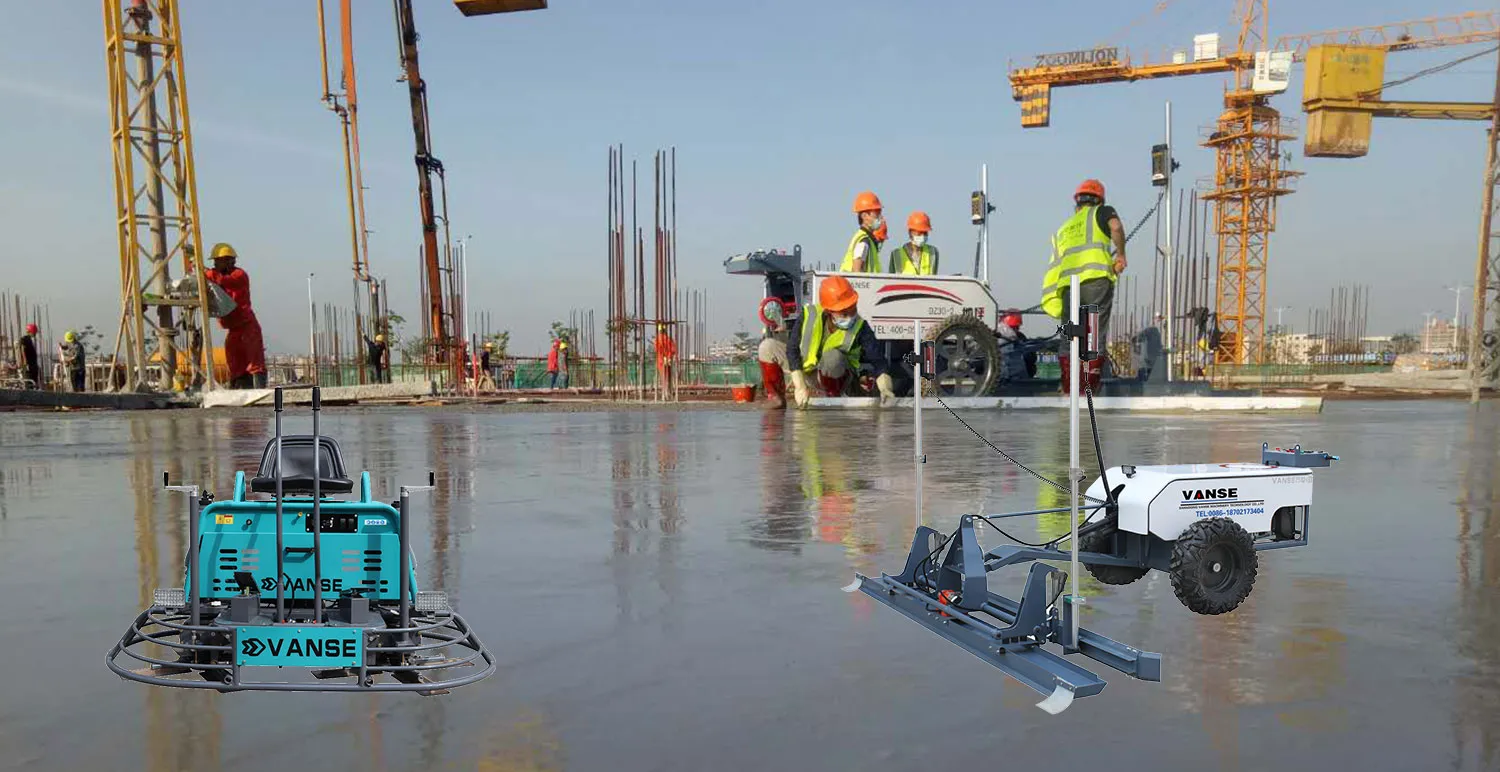
The ground treatment after the construction of the concrete laser leveling machine is an important part of ensuring the quality of the floor. The following are the specific treatment methods
Polishing and finishing
– Polishing :
When the poured and leveled concrete reaches the initial setting, the ground polishing process begins. First, use a single-disc polishing machine and a trowel disc to cross-break the slurry and trowel to ensure the flatness control of the machine operation process. Then, use a 3-meter scraper to rotate 360° to level the surface layer to achieve full control of flatness. After the first disc cross-trowel, professional technicians use a 3-meter scraper to fully level the compacted concrete surface layer.
– Finishing :
As the disc trowels, the machine uses a blade to smooth it. According to the speed of the strength increase, when the concrete theoretically reaches the final setting, the mechanical vertical knife method is used, combined with the machine speed and blade angle, to perform the final finishing on the surface layer.
Maintenance
– Moisturizing maintenance:
After the floor is finished, use a maintenance blanket or a special maintenance non-woven fabric to cover it and water it to keep it moist. Concrete needs to be cured 12 hours after pouring. It can be covered with plastic cloth, watered, or sprayed for maintenance. The curing should be carried out for at least 7 days.
– Temperature control:
Ensure that the temperature difference between the inside and outside of the concrete is less than 25℃, assign a special person to watch over it, ensure that the concrete surface is clean and watered in place.
Finished product protection
– Cover protection:
If the upper construction continues on the finished floor, it is necessary to strengthen the protection of the finished product. The paper fiberboard can be used to cover the entire system to protect the concrete surface.
– Protective measures:
When dismantling the shelf, you can use a protective bamboo fence to cover the entire range of the dismantled shelf, and throw the dismantled steel pipes and fasteners on the bamboo fence to prevent the steel pipes and fasteners from directly hitting the "clear water concrete" floor (ground).
Other treatments
– Anti-pollution treatment:
If there are anti-pollution requirements for the finished floor (ground) surface, a special concrete sealing wax can be applied to the finished surface to form a surface wax coating to prevent pollution from damaging the floor (ground) surface.
– Expansion joint cutting:
After the concrete is finally set, the expansion joint is cut according to the design requirements to prevent the ground from cracking.
Thanks to All the Friends Who Support and Trust Shandong Vanse Machinery Technology Co., Ltd.
If you want to know more about Shandong Vanse Machinery Technology Co., Ltd. or have any questions, please feel free to contact us:
Our Factory
Shandong Vanse Machinery Technology Co., Ltd.








Share this article

About the Author: Shandong Vanse Machinery Technology Co., Ltd.
Shandong Vanse Machinery Technology Co., Ltd. is a high-tech manufacturer specializing in concrete construction machinery, including laser screeds and related equipment. The company integrates R&D, production, and global sales, with products exported to over 60 countries and widely used in infrastructure projects worldwide.
Previous Post
Next Post
Related Articles
You Might Also Like
How to maintain and service a riding power trowel?
Body cleaning: After each use of the trowel, the dust, concrete residue and other debris on the body should be cleaned in time. You can use a damp cloth to wipe the surface of the body, but be careful to avoid water entering key parts such as the engine. For stubborn stains, you can use a mild detergent to clean them. Clean the trowel and spatula: If the concrete remaining on the trowel and spatula is not cleaned in time, it will affect the effect of the next use. You can use special tools such as scrapers to remove the solidified concrete residues, and then rinse with clean water. Check screws and nuts: Regularly check whether the screws and nuts of various parts of the trowel are loose. Focus on checking the installation screws of the trowel and spatula, as well as the fasteners of the various connecting parts of the body. If looseness is found, tighten it in time with appropriate tools. Replace the engine oil and oil filter: Regularly replace the engine oil and oil filter according to the engine's working hours or the manufacturer's recommendations. Generally speaking, the engine oil needs to be replaced every 50-100 hours of work. When replacing the engine oil, choose a high-quality engine oil that is suitable for the engine model. Check the air filter: The air filter is essential for the normal operation of the engine. Regularly check whether the air filter is blocked. If the filter element is found to be dirty, it should be cleaned or replaced in time. Usually, it needs to be checked every 20-30 hours of work. Spark plug maintenance: Regularly check the electrode wear and carbon deposits of the spark plug. If the electrode is severely worn or there is too much carbon deposits, it will affect the engine's ignition performance. Generally, the spark plug can be cleaned every 100-200 hours of work, or replaced according to the actual wear of the spark plug. Trowel maintenance: Regularly check the degree of wear of the tiller. When the blade wear of the spatula exceeds a certain limit (such as 2-3 mm), the spatula should be replaced in time. At the same time, during use, the spatula can be properly lubricated to reduce wear. Pad maintenance: Check the flatness and balance of the pad. If the pad is deformed, it will affect the polishing effect and needs to be corrected or replaced in time. At the same time, pay attention to whether the connection part of the pad is loose or worn. Tire maintenance: Check the tire pressure regularly to ensure that the tire pressure meets the requirements. Generally, the tire pressure of the driving trowel is maintained at about 2-3 atmospheres. At the same time, check the wear of the tire. If the tire is found to be damaged or bulging, the tire should be replaced in time. Steering system and transmission system maintenance: Regularly check the flexibility and accuracy of the steering system, and lubricate the steering shaft, steering knuckle and other components. For the transmission system, check the tightness of the transmission chain or belt. If it is too loose or too tight, it needs to be adjusted. And check the wear of the chain or belt, if necessary, it should be replaced in time. Cleaning and drying: Before storing the trowel for a long time, the machine should be thoroughly cleaned, including the machine body, trowel plate, spatula and other parts. Make sure the surface of the machine is dry to avoid rust. The machine can be placed in a well-ventilated place for natural drying. Rust-proof treatment: Anti-rust treatment is performed on the metal parts of the machine. A layer of anti-rust oil can be applied on the metal surface, especially on the spatula, trowel plate, screws and other parts that are prone to rust. Battery maintenance (if it is an electric trowel): For electric driving trowels, pay attention to the maintenance of the battery during long-term storage. Store the battery after fully charging it, and charge and discharge the battery once every period of time (such as one month) to maintain the battery activity. At the same time, the battery should be stored in a dry and cool place to avoid moisture or overheating. Storage environment: Choose a suitable storage environment, preferably a dry, ventilated indoor space that avoids direct sunlight. If stored outdoors, use facilities such as awnings to prevent the machine from being eroded by rain and exposed to the sun.How to improve the construction accuracy of concrete laser leveling machine?
▪▪▪▷▷▷ Introduction With the continuous development of the modern construction industry, the requirements for ground construction accuracy are becoming higher and higher. As an advanced ground construction equipment, the concrete laser leveling plays an important role in improving construction accuracy. However, during the actual construction process, the construction accuracy of the concrete laser leveling may be affected by various factors. Therefore, how to improve the construction accuracy of concrete laser leveling machines has become the focus of current research. ▪▪▪▷▷▷ Factors affecting the construction accuracy of concrete laser leveling machine 1. Equipment factors: Factors such as the manufacturing accuracy, installation accuracy of the equipment itself, and wear and tear during use will all affect the construction accuracy of the leveler. 2. Environmental factors: Environmental factors such as temperature, humidity, and wind speed at the construction site will affect the working results of the leveler. 3. Operational factors: Factors such as the operator's skill level and operating habits will also affect the construction accuracy of the leveler. ▪▪▪▷▷▷ Specific measures to improve the construction accuracy of concrete laser leveling machines 1. Equipment selection and configuration Choosing high-precision, high-quality concrete laser leveling equipment is the key to improving construction accuracy. When purchasing equipment, you should fully consider the manufacturing accuracy, stability, durability and other factors of the equipment, and choose brands and models with good after-sales service and technical support. In addition, the accessories and tools of the snow leveling machine should be properly matched according to the specific construction needs and site conditions to ensure that the equipment can perform optimally during the construction process. 2. Equipment installation and debugging Correct equipment installation and debugging are crucial to improving the construction accuracy of the leveling. During the installation process, you should carefully follow the installation guidelines and specifications provided by the equipment manufacturer to ensure that the installation position and accuracy of each component of the equipment meet the requirements. During the debugging process, all functions of the leveling machine should be comprehensively inspected and tested to ensure that the equipment can operate stably and accurately during the operation. 3. Environmental factor control Corresponding measures should be taken to control environmental factors at the construction site. For example, when operating in high or low temperature environments, the operating time should be adjusted according to the requirements of the equipment or insulation measures should be taken to prevent the equipment from affecting the construction accuracy due to changes in ambient temperature. When operating under conditions of high wind speed, wind blocking facilities should be installed or the operation strategy should be adjusted to reduce the impact of wind speed on the operation effect of the leveler. 4. Improve operational skills Improving the skill level of operators is an effective way to improve the construction accuracy of concrete laser leveling machines. Regular training and assessment should be carried out to make operators familiar with the performance characteristics, operation essentials and maintenance knowledge of the equipment. At the same time, the safety awareness and responsibility awareness of operators should also be cultivated to ensure that they can operate in strict accordance with specifications and requirements during the construction process. 5.Construction process monitoring and adjustment During the construction process, the operating status of the leveling machine should be monitored and adjusted in real time. By using advanced monitoring equipment and technical means, the operating data and quality information of the leveling machine should be obtained in real time, so that problems can be discovered and solved in a timely manner. In the case of deviations or non-compliance with requirements, the parameters and operation strategies of the leveling machine should be adjusted in a timely manner to ensure that the construction accuracy meets the requirements. 6. Maintenance and troubleshooting Regular maintenance and troubleshooting of the concrete laser leveling is an important guarantee for improving construction accuracy. The equipment should be cleaned, lubricated, tightened and other maintenance work should be carried out regularly in accordance with the equipment manufacturer's requirements and maintenance plans to ensure that the equipment In good working order. At the same time, a complete troubleshooting mechanism should be established to analyze and deal with faults and problems in a timely manner to avoid equipment failure that affects construction accuracy. ▪▪▪▷▷▷ Case analysis Taking a large commercial complex as an example, this project requires high ground construction accuracy during the construction process. To ensure construction accuracy and quality, the project team took the following measures: 1. Select high-precision, high-quality concrete laser leveling equipment and carry out strict installation and debugging work. 2. Take corresponding control measures for environmental factors at the construction site, such as high temperature, wind speed, etc., to ensure that the equipment operates in a suitable environment. 3. Conduct systematic training and assessment of operators to improve their skill level and safety awareness. 4. Implement real-time monitoring and adjustment strategies during the construction process to ensure that the working status of the leveling is always at its best. Through the application of the above measures, the project successfully improved the construction accuracy of the concrete laser leveling and ensured the safety of ground construction. quality and efficiency ▪▪▪▷▷▷ Conclusion and outlook Improving the construction accuracy of warm concrete laser levelings requires starting from many aspects, including equipment selection and configuration, equipment installation and debugging, environmental factor control, operating skill improvement, construction process monitoring and adjustment, and maintenance and troubleshooting. wait. By taking comprehensive measures, the construction accuracy and operating performance of the leveling can be effectively improved to meet the modern construction industry's requirements for ground construction accuracy. Looking to the future, with the continuous advancement and innovation of science and technology, the construction accuracy of concrete laser leveling machines will be further improved. For example, by introducing more advanced control systems and sensor technologies, more precise control of the leveling machine's operating process can be achieved; by developing new materials and technical means, the wear resistance, stability and service life of the leveling machine can be further improved. wait. At the same time, it is also necessary to strengthen the training and education of operators to improve their skill level and safety awareness to adapt to the higher requirements for ground construction accuracy in the future construction industry.Safety measures in concrete floor construction
Safety measures in concrete floor construction Concrete floor construction is a complex project involving many links, among which safety issues are particularly critical. From safety preparation before construction to management of the construction site, to the operation of mechanical equipment, personal protection and equipment, high-altitude operations and protection, electrical safety and fire prevention, as well as emergency handling and rescue, each link is directly related to the life safety of construction personnel and the smooth progress of the project. Therefore, this article will focus on these aspects and discuss in detail the safety measures in concrete floor construction: 1. Safety preparation before construction Safety preparation before construction is the basis for ensuring the smooth progress of concrete floor construction. First of all, the construction unit should formulate a detailed safety construction plan, clarify the safety construction goals, responsible persons and safety measures, and conduct safety technical briefings for construction personnel so that they can fully understand the safety risks and countermeasures that may be encountered during construction. Secondly, a comprehensive inspection should be carried out on the construction site to eliminate safety hazards, such as checking whether the construction power lines are intact and whether the mechanical equipment is operating normally. At the same time, according to the needs of the construction, the construction area should be reasonably arranged, and obvious safety warning signs should be set up to ensure that construction personnel can clearly identify dangerous areas. 2. Construction site management Construction site management is an important link to ensure the safety of concrete floor construction. The construction unit should establish a sound construction site management system and clarify various safety management regulations, such as prohibiting smoking at the construction site and prohibiting the random discarding of construction waste. At the same time, a dedicated person should be set up to be responsible for on-site safety management, regularly inspect the construction site, and promptly correct violations. In addition, the construction site should be kept clean and orderly, and construction materials and equipment should be stored in categories to avoid confusion and misoperation. 3. Safety of mechanical equipment operation Concrete floor construction involves a large number of mechanical equipment, such as mixers, rollers, pumping equipment, etc. In order to ensure the safety of mechanical equipment operation, first of all, it should be ensured that the operator has the corresponding operating qualifications and skills, and is familiar with the working principle and operating procedures of mechanical equipment. Secondly, mechanical equipment should be regularly maintained to ensure that it is in good working condition. At the same time, when operating mechanical equipment, it should be strictly carried out in accordance with the operating procedures, and overload operation or illegal operation is prohibited. 4. Personal protection and equipment Construction workers in concrete floor construction need to wear appropriate personal protective equipment to reduce the risk of injury. First of all, construction workers should wear basic protective equipment such as safety helmets, safety shoes and protective glasses. To deal with possible injuries such as falling objects and splashes. Secondly, depending on the construction environment, construction workers should also wear specific protective equipment such as dustproof mouthpieces and anti-noise earplugs to deal with occupational hazards such as dust and noise. In addition, construction units should regularly check and replace personal protective equipment to ensure that it is always in an effective state. 5. High-altitude work and protection In the construction of concrete floors, high-altitude work is inevitable. In order to ensure the safety of high-altitude work, construction units should set up special safety nets, safety fibers and other protective facilities to prevent construction workers from falling and causing accidents. At the same time, construction workers should wear safety belts when working at heights, and ensure that the connection between the safety belts and the fixed points is firm and reliable. In addition, construction units should also regularly inspect the high-altitude work areas to eliminate potential safety hazards in a timely manner. 6. Electrical safety and fire prevention Electrical safety and fire prevention are safety issues that require special attention in the construction of concrete floors. Construction units should strictly abide by the relevant national regulations on electrical safety and fire prevention to ensure that the electrical equipment and lines at the construction site are safe and reliable. At the same time, the construction site should be equipped with a sufficient number of fire-fighting equipment and facilities, such as fire extinguishers, fire hydrants, etc., to deal with possible fire accidents. In addition, construction workers should master basic firefighting knowledge and skills, and be able to quickly take effective countermeasures when a fire occurs. 7. Emergency handling and rescue Although we can take various preventive measures to reduce the safety risks in concrete floor construction, accidents may still occur. Therefore, it is crucial to establish a sound emergency handling and rescue mechanism. The construction unit should formulate a detailed emergency plan to clarify the response measures and rescue procedures for various accidents. At the same time, emergency drills should be organized regularly to improve the emergency handling capabilities and rescue skills of construction personnel. In the event of an accident, the construction unit should immediately activate the emergency plan and quickly organize rescue forces to deal with it, minimizing the losses caused by the accident. In summary, safety measures in concrete floor construction involve many aspects, which require the joint efforts of construction units and construction personnel. By strengthening pre-construction safety preparation, construction site management, mechanical equipment operation safety, personal protection and equipment, high-altitude operations and protection, electrical safety and fire prevention, and emergency handling and rescue, we can effectively reduce the safety risks in concrete floor construction and ensure the life safety of construction personnel and the smooth progress of the project. At the same time, construction units and construction personnel should continue to learn new knowledge and master new technologies to adapt to the ever-changing safety needs and challenges in concrete floor construction.