Technical Knowledge
What is the leveling accuracy of concrete laser leveling machine?
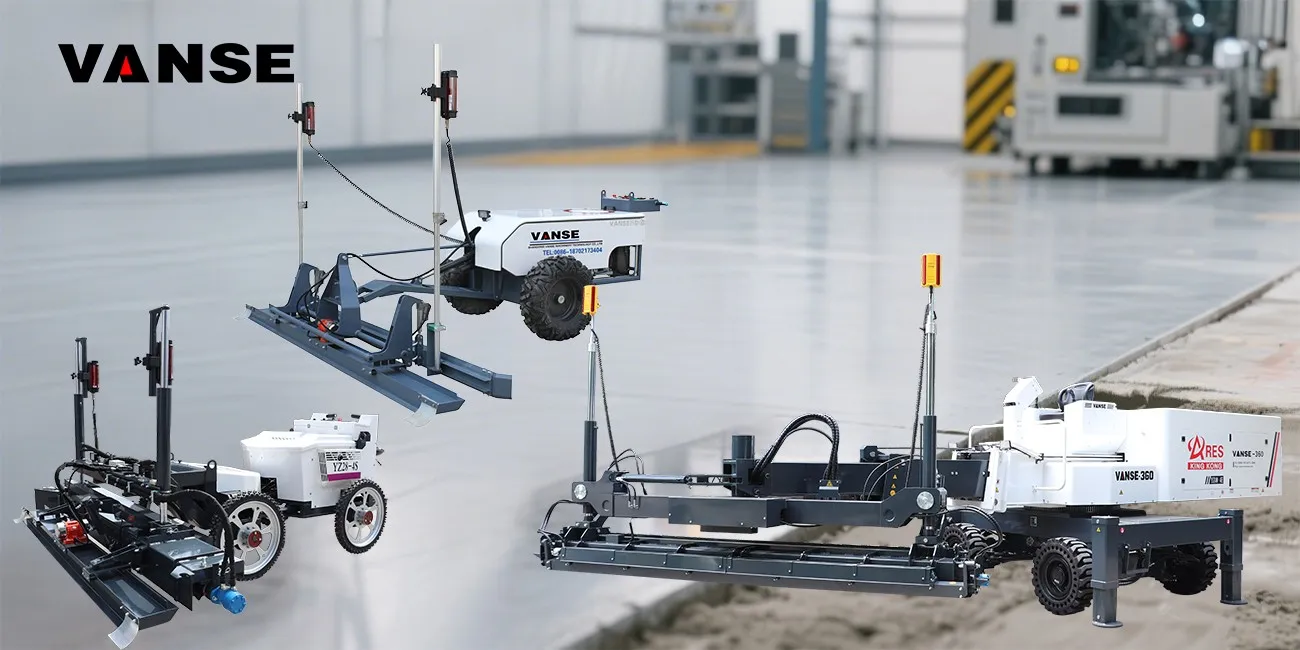
The leveling accuracy of the concrete laser leveling machine varies depending on the equipment performance and construction requirements, and has a high standard in the industry. In actual construction, its leveling accuracy can usually reach a high level.
1. Industry accuracy standard:
Concrete floor measurement generally adopts the F numerical standard, FF represents flatness, and FL represents height difference. FF≥100, FL≥100 (about 3m±1.5mm height difference) is a special floor (super flat floor); FF≥50, FL≥50 (about 3m±3mm height difference) is a class I floor; FF≥35, FL≥30 is a class II floor; FF≥25, FL≥20 (about 3m±6mm height difference) is a class III floor. Generally, those with higher ground requirements have FF≥50, and general floors are usually between FF20/FL15 (about 3m±7.5mm height difference).
2. Manshi equipment precision: Equipped with automatic leveling system and laser receiving device, it can achieve high-precision control. For example, some models are compatible with 3D contour system, which can accurately control complex terrain, and also have functions such as "one-key leveling", "fast fine-tuning of receiver height", and "anti-slip system" to ensure construction accuracy. The equipment's leveling accuracy can reach a high level, which can meet the needs of scenes with high requirements for flatness. The error is within 3mm, which meets or even exceeds the accuracy standards of some industries. Some models such as YZ30-4E can have higher leveling accuracy.
Click the below to jump immediately!!!


CONCRETE LASER LEVELING MACHINE



SLIPFORM MACHINE


TOPPING SPREADER

TRACKED MINI DUMPER
Thanks to All the Friends Who Support and Trust Shandong Vanse Machinery Technology Co., Ltd.
If you want to know more about Shandong Vanse Machinery Technology Co., Ltd. or have any questions, please feel free to contact us:
Our Factory
Shandong Vanse Machinery Technology Co., Ltd.








Share this article

About the Author: Shandong Vanse Machinery Technology Co., Ltd.
Shandong Vanse Machinery Technology Co., Ltd. is a high-tech manufacturer specializing in concrete construction machinery, including laser screeds and related equipment. The company integrates R&D, production, and global sales, with products exported to over 60 countries and widely used in infrastructure projects worldwide.
Previous Post
Next Post
Related Articles
You Might Also Like
How to improve construction efficiency of large-area floor concrete laser leveling machine leveling construction method?
– Before construction, plan the order of concrete pouring and leveling according to factors such as the size, shape and entrance and exit locations of the site. For example, for a large rectangular floor, you can adopt a construction sequence that gradually advances from one end to the other, or use block construction, skip-bin construction and other methods. This can avoid confusion and cross-operation during the construction process and improve construction efficiency. – At the same time, it is necessary to coordinate the links of concrete supply, distribution and leveling. Ensure that concrete can be supplied continuously and the distribution speed matches the working speed of the leveling machine. For example, when the concrete supply is sufficient, arrange a suitable number of distribution equipment (such as concrete distributor or loader) in front of each laser leveling machine so that the distribution can keep up with the progress of the leveling machine in time and reduce the waiting time of the leveling machine. – Strengthen communication and collaboration between construction teams. Operators, quality inspectors and concrete suppliers should maintain close contact and communicate construction progress and problems in a timely manner through communication tools such as walkie-talkies. For example, when there is a short delay in the supply of concrete, the leveling machine operator can adjust the working speed in advance or pause at a suitable position, waiting for the concrete supply to resume before continuing the construction quickly. – Make overall arrangements for construction equipment. In the process of concrete pouring and leveling, a variety of equipment is involved, such as concrete mixers, concrete spreaders, laser levelers, etc. Reasonable arrangement of the entry and exit time of these equipment, as well as the conversion and coordination between equipment, can effectively reduce the idle time of equipment and improve the overall utilization rate of equipment. For example, when a laser leveling machine completes the leveling work of an area, another concrete spreader can quickly enter the area to spread the next layer of concrete, achieving seamless connection. – Choose a high-performance concrete laser leveling machine. Advanced leveling machines have higher working efficiency. For example, some large laser leveling machines have a leveling head width of up to 3-5 meters and a working speed of up to 20-30 square meters per minute. Compared with traditional small equipment, they can complete large-area leveling work in a short time. – Regularly maintain and service the leveler to ensure that the equipment is in the best working condition. Check and replace worn parts such as scrapers, vibrators, etc. to ensure the working accuracy and stability of the equipment. For example, regularly clean the laser receiver and transmitter of the leveler so that it can accurately receive and transmit laser signals to improve the accuracy and speed of leveling. – Provide professional training for leveler operators to improve their operating proficiency and skill level. Operators should be familiar with the various functions and operating methods of the leveler and be able to quickly adjust the working parameters of the equipment according to different construction conditions (such as concrete slump, site slope, etc.). For example, skilled operators can accurately control the scraper height and vibration frequency of the leveler according to the changes in the laser signal, while ensuring the construction quality and improving work efficiency. – Cultivate the safety awareness and emergency handling capabilities of operators. During the construction process, they can promptly discover and handle equipment failures, safety hazards and other problems to avoid construction delays caused by these problems. For example, when a leveler has a minor fault, the operator can quickly determine the cause of the fault and perform simple repairs or take temporary measures to restore the equipment to normal operation as soon as possible. – Use a high-precision laser control system to achieve automatic leveling. The laser transmitter emits a stable laser plane, and the laser receiver of the leveler can receive the laser signal in real time and transmit the signal to the control system. The control system automatically adjusts the working parts of the leveler to make the leveling work more accurate and efficient. Compared with the traditional manual leveling method, it greatly saves time and manpower. – Combined with laser scanning technology, the site can be quickly scanned before construction to obtain the terrain data of the site. Based on these data, the construction plan can be planned in advance, such as determining the thickness of the concrete and the working route of the leveler, so as to improve the construction efficiency. For example, in the construction of sites with complex terrain, the terrain data obtained by laser scanning can enable the construction team to make targeted construction preparations and avoid repeated adjustments during the construction process. – Use auxiliary equipment such as concrete spreading machines to improve the efficiency and uniformity of concrete spreading. The spreading machine can quickly and evenly distribute concrete in the site, providing good working conditions for the laser leveling machine. Compared with the traditional manual spreading method, it is not only faster, but also can ensure the consistency of the thickness of the spreading material, and reduce the adjustment time of the leveling machine during the work process. – Equipped with an intelligent monitoring system to monitor the construction process in real time. Through the sensors and cameras installed on the equipment, the monitoring system can obtain information such as construction progress, equipment status, construction quality, etc., and transmit this information to the control center or the manager's mobile device. In this way, managers can find problems in time and make adjustments to ensure efficient construction.Construction conditions of concrete laser leveling machine under different environmental conditions
The impact and adaptability of the concrete laser leveling machine on the environment and its use under different climate conditions are as follows: 1. Impact on the environment The impact of concrete laser leveling machines on the environment is mainly reflected in the following aspects: Reduce dust and noise Compared with traditional concrete leveling methods, concrete laser leveling machines use advanced laser measurement and control technology to accurately control the leveling thickness and slope, reducing the waste of concrete materials and dust. At the same time, due to the use of a low-noise engine, the machine makes relatively little noise and has less impact on the surrounding environment and residents. High efficiency and water saving The concrete laser leveling uses advanced water-saving technology during the construction process, which can effectively reduce water usage. At the same time, the machine can also recycle waste water and sewage, further reducing water consumption. Improve construction efficiency Compared with traditional concrete leveling methods, concrete laser leveling machines have the characteristics of automation, intelligence and high precision, which can greatly improve construction efficiency. At the same time, the construction speed of the machine can also be adjusted as needed to adapt to different construction needs. 2. Adaptability to the environment The concrete laser leveling machine has strong adaptability to the environment and can be used for construction in different climate conditions. Specifically, the adaptability of the machine is reflected in the following aspects: Adapt to different climate conditions The concrete laser leveling machine adopts advanced dust-proof, rain-proof, wind-proof and other measures, and can carry out construction under different climate conditions. At the same time, the machine is also equipped with a heating device and a heat preservation device, which can operate normally in low-temperature environments, improving the adaptability and reliability of the machine. Adapt to different terrain and geological conditions The concrete laser leveling machine adopts advanced mechanical and hydraulic control systems, which can accurately control the leveling thickness and slope, and adapt to different terrain and geological conditions. At the same time, the machine is also equipped with a variety of different attachments such as working heads and scrapers, which can be selected for different construction needs. Adaptable to different materials and concrete mix ratios The concrete laser leveling machine adopts advanced laser measurement and control technology, which can accurately control the leveling thickness and slope, and adapt to different materials and concrete mix ratios. At the same time, the machine can also be adjusted and modified as needed to adapt to different construction needs and material properties. 3. Effects of use under different climate conditions The use effects of concrete laser leveling machines under different climate conditions are as follows: Under high temperature conditions Under high temperature conditions, concrete laser levelinging machines need to strengthen dust-proof, rain-proof, wind-proof and other measures to ensure the normal operation and construction effect of the machine. At the same time, high temperature will also accelerate the solidification speed of concrete. Construction time and concrete mix ratio need to be reasonably arranged to ensure construction quality and use effect. Under low temperature conditions Under low temperature conditions, the concrete laser leveling needs to strengthen heating and insulation measures to ensure the normal operation and construction effect of the machine. At the same time, low temperature will also affect the initial setting time and strength growth rate of concrete. Construction time and concrete mix ratio need to be reasonably arranged to ensure construction quality and use effect. Under humid conditions Under humid conditions, the concrete laser leveling needs to strengthen moisture-proof, waterproof and other measures to ensure the normal operation and construction effect of the machine. At the same time, moisture will also affect the solidification speed and strength growth rate of concrete. Construction time and concrete mix ratio need to be reasonably arranged to ensure construction quality and use effect. Under windy and sandy conditions Under windy and sandy conditions, the concrete laser leveling needs to strengthen dust-proof, wind-proof and other measures to ensure the normal operation and construction effect of the machine. At the same time, wind and sand will also affect the accuracy and stability of the laser measurement and control system. It is necessary to strengthen the maintenance and upkeep of the equipment to ensure the accuracy and effectiveness of the equipment. In short, the concrete laser leveling machine performs well in terms of environmental impact and adaptability and its use in different climate conditions. It has the characteristics of high efficiency, precision and intelligence, and can greatly improve construction efficiency and quality. Under different climate conditions, as long as appropriate measures and technical means are taken, the machine can still operate normally and achieve good results.Analysis of the Causes & Treatment Measures for Black Smoke Emitted by the Power Trowel during operation
Black smoke emitted by a Power Trowel during operation is a typical malfunction phenomenon. The fundamental cause lies in incomplete fuel combustion, which leads to the direct discharge of tiny carbon particles. The following is a detailed analysis of the causes and handling measures, listed in the common order of investigation. Cause analysis: Engine combustion requires sufficient air. When the air filter is severely clogged with dust and debris, the intake volume is insufficient, resulting in the fuel injected into the cylinder not being able to mix with enough air, causing a "rich fuel" state. Unburned carbon particles then form black smoke. Handling measures Stop the machine immediately for inspection. Remove the air filter element. For paper filter elements, check by shining a flashlight. If the light transmission is poor or the surface is covered with dust, they need to be replaced. For sponge filter elements, they can be thoroughly cleaned with neutral detergent, completely dried, and then a few drops of engine oil should be added and kneaded evenly before being reinstalled. Note: In construction sites with a lot of dust, the air filter should be cleaned every day or every shift. Cause analysis: Excessive fuel supply or poor fuel quality. Handling measures Check the fuel: Use fresh and clean standard-grade gasoline. Inferior or deteriorated gasoline will affect combustion. Check the oil level: Pull out the oil dipstick and check if the oil level is between the upper and lower limits. Excessive oil filling will increase the pressure in the crankcase, causing the oil to seep into the combustion chamber and participate in combustion, generating blue-black smoke. Check the dampers: The dampers are used to thicken the mixed gas during cold machine startup. If the machine remains in the off state during hot operation or normal operation, it will cause the mixture to be too rich and black smoke to be emitted. Please ensure that after the machine is started and preheated, the choke door is fully opened to the "Running" position. Clean or inspect the carburetor: If all the above three points are normal, the problem is likely to lie with the carburetor itself. Excessive mixture: If the oil level in the float chamber inside the carburetor is too high, the main orifice is worn or blocked, or the needle valve is stuck, it can all lead to excessive fuel injection. Handling: The carburetor needs to be disassembled. Thoroughly clean all oil passages and measuring holes with carburetor cleaner. This is a highly technical operation. It is recommended that it be carried out by professional maintenance personnel or that the carburetor assembly be replaced directly. Cause analysis: Ignition system failure leads to incomplete combustion. Handling measures Check the spark plugs Remove the spark plug and observe the electrode part. If the carbon deposits are severe and appear black and velvety, it indicates poor combustion. Clean the carbon deposits with spark plug cleaner or a wire brush. Use a feeler gauge to check and adjust the electrode gap to the range specified in the equipment manual (usually 0.6-0.8mm). If the ceramic part of the spark plug is cracked or the electrode is severely eroded, please replace it with a new one directly. Cause analysis: When the concrete material is too soft, the operator presses down too deeply, or the flattening head is stuck by foreign objects, the engine will be forced to output more power due to a sharp increase in load. The control system will automatically thicken the mixture, and at this time, black smoke may be emitted briefly. Handling measures Master the correct construction timing: Start the smoothing operation when the concrete reaches the initial setting state (when a person stands on it and sinks by about 5-10mm). Standard operation: According to the hardening condition of the concrete, gradually switch from high speed and large Angle to low speed and small Angle to avoid excessive downward pressure in the initial stage. Safety Notice: All inspections and repairs must be carried out after the engine has been completely turned off and cooled down. Preventive maintenance recommendations Regular maintenance: Replace the air filter, engine oil, spark plugs and fuel filter strictly in accordance with the user manual. Use high-quality oils: Use clean gasoline and engine oil of the recommended grade. Form good habits: Conduct a simple visual inspection before each operation, pay attention to the engine sound during operation, and stop the machine immediately if any abnormality is found. By following the principle of starting from the simple to the complex for investigation, most black smoke problems can be solved by cleaning the air filter and checking the choke. Note: The parameters provided in this document are for reference only and are not mandatory. Due to differences in technical characteristics between different brands and models of laser levelers, please consult the manufacturer for a suitable solution before actual operation. This reference document assumes no responsibility for any issues arising from failure to follow the manufacturer's instructions.