Technical Knowledge
The correct methods and protective measures for long-term storage of concrete laser leveling (such as placing them on a flat ground, dry and well-ventilated)
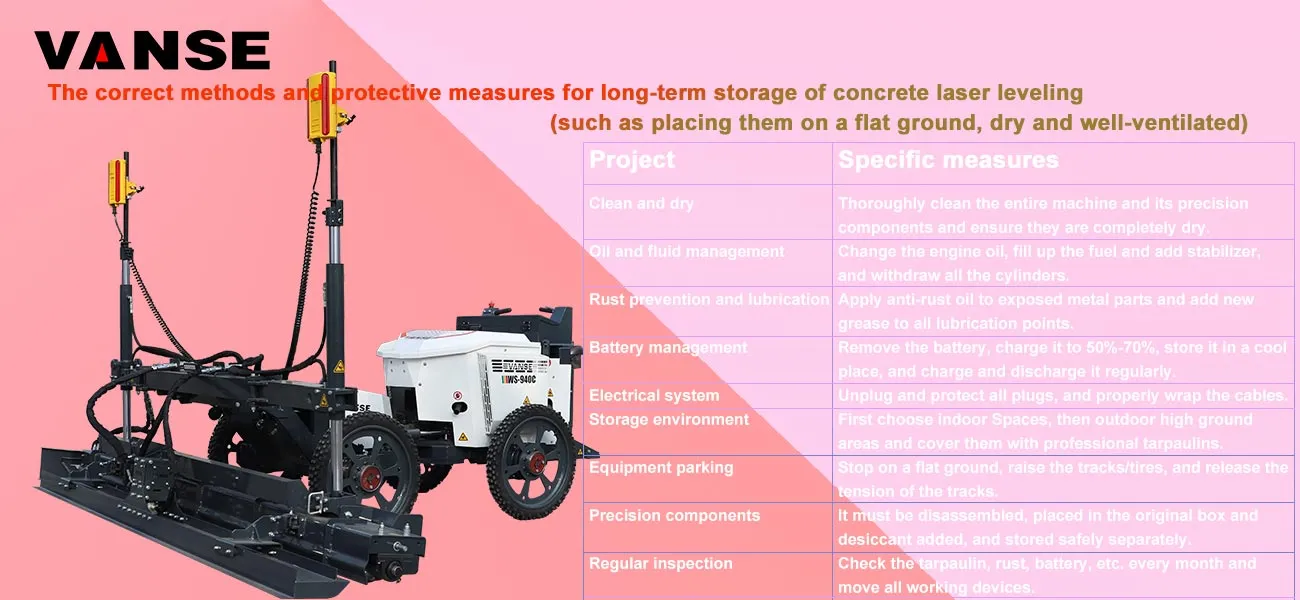
Let's delve into the correct methods and protective measures for long-term storage of concrete laser leveling machines (especially their precision components), such as across projects, during winter or the rainy season. This is a crucial topic. Proper storage can greatly prevent equipment from malfunctioning when it is used next time, save maintenance costs and extend its service life.
Core principles: Moisture-proof, dust-proof, rust-proof, and anti-aging
Ⅰ. Comprehensive Preparations Before Storage (Key Steps)
Before driving the equipment into the warehouse, a thorough "physical examination" and "maintenance" must be carried out.
1. Thoroughly clean and dry
Overall machine cleaning: Use a high-pressure water gun or steam cleaner to thoroughly remove all concrete slurry, oil stains and dust from the machine body. Focus on cleaning the accumulated materials around the tracks, scrapers and vibrators.
Specialized cleaning of precision components
Laser emitter/receiver: Use lens paper and blow balloons to carefully clean all lens and sensor surfaces to ensure there are no stains.
Sensors and circuits: Clean the elevation sensors, tilt sensors, etc. at all parts.
Thorough drying: After cleaning, park the equipment in a well-ventilated area to ensure that all components, especially electrical interfaces and precision parts, are completely dry. Compressed air can be used to dry the moisture in the gaps.
2. Comprehensive oil maintenance and rust prevention treatment
Engine: Replace the engine oil and oil filter. Inject a small amount of engine oil into the cylinder and evenly distribute it by turning the crankshaft to prevent rusting inside.
Fuel system: Fill the fuel tank to the brim to prevent water droplets from condensing on the inner walls of the tank and causing rust. At the same time, add fuel stabilizers to prevent diesel from deteriorating and forming gum during long-term storage.
Hydraulic system
Check the oil level and quality of the hydraulic oil, and replace it if necessary.
Start the machine and retract all the hydraulic cylinders (such as the lifting cylinder and the leveling cylinder) to the shortest stroke state (that is, retract the piston rod into the cylinder). This is because the exposed surface of the piston rod is the most prone to rust.
Lubrication and rust prevention
Apply an adequate amount of grease to all lubrication points (such as pins and bearings), and squeeze out the old and potentially contaminated grease to form a new protective layer.
For exposed metal surfaces, such as the base plate of the scraper and the housing of the vibrator, a thin layer of anti-rust oil or grease can be applied.
3. Battery and electrical system treatment
Remove the batteries: It is strongly recommended to remove the batteries of the leveling and the laser emitter.
Battery storage: Store the battery in a cool, dry and well-ventilated place. The ideal temperature is between 0°C and 25°C.
Battery charging: Charge the battery to about 50%-70% of its capacity and store it. Perform a complete charge and discharge cycle every 1-2 months to maintain its activity and prevent permanent damage caused by "undercharging".
Electrical interface: Unplug all sensor plugs, spray them with electronic contact cleaner, then cover them with dust caps or wrap them with insulating tape.
Ⅱ. Site Selection and Equipment Placement for long-term Storage
1. Ideal storage environment
Indoor priority: The best choice is a dry, well-ventilated and dust-free indoor warehouse. It can prevent exposure to the sun, rain, sudden temperature changes and dust invasion.
Outdoor storage (if unavoidable)
Terrain: A high, flat, solid and well-drained area must be selected to prevent the equipment from deforming due to ground subsidence or being soaked by water accumulation.
Covering: Use professional waterproof and dustproof tarpaulins for covering. Avoid using ordinary plastic sheeting, as plastic sheeting is not breathable and water vapor is likely to condense inside, accelerating rusting. Make sure the tarpaulin is securely tied up to withstand strong winds.
2. The correct parking posture of the equipment
Park on a flat ground: Ensure that all tracks or tires of the equipment are steadily on the ground to release the stress on the frame.
Raise the tracks/tires: Place wooden boards or rubber pads under the tracks or tires to isolate them from the wet ground and slightly release the track tension (refer to the equipment manual) to reduce rubber aging and the pressure on the load-bearing wheels.
Ⅲ. Special storage measures for Precision Components
This is of Paramount importance in protecting the "brain and eyes" of the device.
Laser emitter, receiver, control box
It must be disassembled and put back into its original dedicated transport box.
Place desiccants inside the box and replace them regularly.
Store the boxes on the shelves or in safety cabinets in the warehouse, ensuring a stable temperature and humidity environment and keeping them away from any possible risks of heavy objects falling or colliding.
Sensors and cables
All sensors should be removed from the machine, cleaned and then placed in the drying oven as well.
The cable should be coiled loosely (with a diameter of no less than 30 centimeters). It is strictly prohibited to fold it tightly or bend it excessively. It should be bound with cable ties. Hang or lay it flat on the shelf to avoid pressure.
Ⅳ. Regular inspection and maintenance during storage
Long-term storage does not mean a one-time solution; regular inspections must be carried out.
Monthly inspection:
Check whether the tarpaulin is intact and if there is any leakage.
Check if there is any new rust on the surface of the equipment.
Check the tire/track pressure and replenish it if necessary.
Perform charge and discharge maintenance on the battery.
Manually rotate the tracks or move each working device several times to change the force application points of the hydraulic cylinder and bearings, preventing the seals and bearings from deforming due to long-term pressure at a single position.
Summary: Long-term storage checklist
| Project | Specific measures |
| Clean and dry | Thoroughly clean the entire machine and its precision components and ensure they are completely dry. |
| Oil and fluid management | Change the engine oil, fill up the fuel and add stabilizer, and withdraw all the cylinders. |
| Rust prevention and lubrication | Apply anti-rust oil to exposed metal parts and add new grease to all lubrication points. |
| Battery management | Remove the battery, charge it to 50%-70%, store it in a cool place, and charge and discharge it regularly. |
| Electrical system | Unplug and protect all plugs, and properly wrap the cables. |
| Storage environment | First choose indoor Spaces, then outdoor high ground areas and cover them with professional tarpaulins. |
| Equipment parking | Stop on a flat ground, raise the tracks/tires, and release the tension of the tracks. |
| Precision components | It must be disassembled, placed in the original box and desiccant added, and stored safely separately. |
| Regular inspection | Check the tarpaulin, rust, battery, etc. every month and move all working devices. |
By following the above methods and measures, your concrete laser leveling can safely get through any long idle period. When it starts up at the next construction site, it can quickly return to its best condition and continue to create a smooth and mirror-like high-quality floor for you.
Note: The parameters provided in this document are for reference only and are not mandatory. Due to differences in technical characteristics between different brands and models of laser levelers, please consult the manufacturer for a suitable solution before actual operation. This reference document assumes no responsibility for any issues arising from failure to follow the manufacturer's instructions.
Thanks to All the Friends Who Support and Trust Shandong Vanse Machinery Technology Co., Ltd.
If you want to know more about Shandong Vanse Machinery Technology Co., Ltd. or have any questions, please feel free to contact us:
Our Factory
Shandong Vanse Machinery Technology Co., Ltd.








Share this article

About the Author: Shandong Vanse Machinery Technology Co., Ltd.
Shandong Vanse Machinery Technology Co., Ltd. is a high-tech manufacturer specializing in concrete construction machinery, including laser screeds and related equipment. The company integrates R&D, production, and global sales, with products exported to over 60 countries and widely used in infrastructure projects worldwide.
Previous Post
Next Post
Related Articles
You Might Also Like
Concrete Knowledge
This paper introduces in detail what strength levels of concrete, what are the requirements of concrete for water quality, what factors the durability of concrete is related to, and how concrete is maintained. Why should concrete be graded in intensity? To ask why concrete should be graded in strength, you should first know what the strength level of concrete is. The concrete strength level is artificially divided according to the value of the concrete cube's anti-pressure strength, which is the characteristic strength of concrete. According to the current relevant standards and specifications, the concrete cube pressure strength is a standard size of 150mm of the edge of the standard size of the cube test piece sproducing according to the standard method, the temperature consistent with the ISO test method is 20 pc 2 degrees C, humidity is more than 95% of the standard maintenance room, maintenance to 28d age. The pressure strength of the concrete cube measured according to the standard test method. According to the relevant standards, building material strength grade should be expressed by the name of the material plus its strength standard value. Therefore, the concrete strength grade is divided into the standard valueofs of the symbol C (short for the English concrete Concrete) and the pressure strength of the cube behind it: C10, C15, C20, C25, C30, C35, C40, C45, C50, C55, C60, C65, C70, C75, C80. Because the general engineering of different parts of the concrete load is not the same, some large, some small, can not fully use a strength grade of concrete. For the heavy pressure of the site, it is necessary to use high-strength grade concrete, for the low pressure of the site, the use of low- strength grade of concrete, therefore, the concrete is divided into different strength levels to meet the needs of different projects, through the design and calculation of selection. Why does concrete specify 28d strength as the standard strength? Concrete is based on the cement bonding action, gradually hardening, and improve the strength of pressure. Because the cement stiffness is not done at once, but gradually perfected over time. Under normal maintenance conditions, the first seven days of pressure resistance increased faster, between 7d and 14d growth slightly slower, and after 28d, the intensity growth is relatively slow. In other words, after 28d the pressure strength is the standard strength, as the standard for design and construction inspection quality. Obviously, if the strength of less than 28d as the standard strength, will make the concrete performance can not be fully exploited. If the strength of greater than 28d as the standard strength, although the performance of concrete can be fully developed, but because of the time to reach the standard strength is too long, affecting the construction progress. Concrete level leveling on concrete working Why does concrete had request standard of water? Industrial wastewater containing fat, vegetable oil, sugar, acid and so on can not be used to mix concrete. Because the water containing impurities will reduce the cement bonding force, so that the strength of the concrete decreased, so can not use mineral water contains a large number of salts, so that cement can not be very resistant to water erosion. For the chemical composition of mineral water, must meet the indicators set by the family, or compared with ordinary drinking fresh water test, see the intensity does not decrease before use. As for the general tap water and drinkable water, can be used to mix concrete. Concrete level leveling on concrete working Why are concrete blocks in groups of three? Concrete test block is the standard to measure the strength of concrete components, that is, the strength of the test block is destroyed by pressure, as the strength of the component can have. Therefore, in addition to the test block should be made according to the component, the test block must also have a certain number. Because although we try to make the concrete of the test block and the concrete of the component is the same, but after all, there are some differences, if only a test block to identify the strength of the component, it is difficult to be reliable. So in three groups, the strength of the three test blocks is used as the strength of the three test blocks (in special cases, some values need to be removed), that is, the strength of the component symup. Next artical we will go on share concrete knowledge etc, please follow our Youtube or Facebook to get more~During concrete pavement construction, what is the effect of slump on pavement strength?
🎈Changes in water-cement ratio: Slump mainly affects pavement strength by affecting the water-cement ratio of concrete. Generally speaking, the larger the slump, the more water is used in concrete. According to the theory of concrete strength, under the condition of certain cement type and dosage, the larger the water-cement ratio, the lower the strength of concrete after hardening. This is because excessive water will form more pores and channels during the hardening process of concrete, and the pores left after the evaporation of water will reduce the density of concrete, thereby reducing the strength of concrete. For example, when the slump increases by 20-30mm from the appropriate value, the water-cement ratio may increase by 0.05-0.1, and the 28-day compressive strength of the pavement may decrease by 10%-20%. 🎈Cement slurry distribution: The appropriate slump can make the cement slurry evenly distributed in the concrete, wrapped on the surface of the aggregate, play a good bonding role, make the internal structure of the concrete dense, and thus ensure the strength of the pavement. If the slump is too small, the concrete is too dry and hard, and the cement paste is difficult to evenly wrap the aggregate, which will lead to more uncemented aggregate particles in the concrete, forming a weak link and reducing the overall strength of the road surface. On the contrary, if the slump is too large, the cement paste will sink due to its own weight, resulting in uneven distribution inside the concrete, resulting in relatively less cement paste in the upper part of the concrete and lower strength, while the lower part may be segregated due to excessive cement paste, which also affects the strength of the road surface. 🎈Aggregate interface bonding: The interfacial bonding strength between aggregate and cement paste in concrete is crucial to the overall strength of concrete. When the slump is appropriate, the cement paste can fully contact and bond well with the aggregate surface. When the slump is not appropriate, such as too large, the cement paste layer around the aggregate will be too thick. During the hardening process of concrete, due to the large shrinkage of the cement paste, micro cracks are easily generated at the interface between the aggregate and the cement paste, weakening the interfacial bonding strength, thereby reducing the strength of the road surface; and if the slump is too small, the cement paste cannot wet the aggregate surface well, which will also lead to poor interfacial bonding and affect the strength of the road surface. In concrete pavement construction, the slump should be strictly controlled, and concrete with appropriate slump should be selected according to construction conditions and design requirements to ensure that the pavement strength meets the design standards.How to evaluate the reliability of concrete laser leveling machine?
In the field of modern concrete construction, concrete laser leveling machine (concrete laser leveling machine or concrete laser leveler) has become the preferred equipment for many large projects due to its high efficiency and precision. With the continuous increase in the industry's requirements for construction quality and efficiency, as well as the continuous development of industries such as infrastructure construction and real estate, the market demand for concrete laser leveling machines is growing. According to relevant reports, the global concrete laser leveling machine market size is expected to reach US$1.76 billion in 2025, with an annual growth rate of approximately 11.4%. In this context, it is particularly important to evaluate the reliability of concrete laser leveling machines, which is not only related to construction quality, but also closely related to the cost and progress of the project. Leveling accuracy is the core performance indicator of concrete laser leveling machines, which directly determines the flatness of the concrete surface after construction. In projects such as airport runways and precision electronic factories that require extremely high ground flatness, high-precision laser leveling machines are indispensable. Some of the internationally renowned brands use advanced 3D laser scanning technology to achieve a flatness accuracy of ±2 mm. Some leading domestic companies, such as Shandong Vanse Machinery Technology Co., Ltd., currently have product accuracy of ±2 mm, of which the WS940C/YZ30-4E uses 3D laser scanning technology. When evaluating the leveling accuracy, you can view the technical parameter description of the equipment and refer to the test data of actual construction cases. At the same time, pay attention to the stability of the laser system. Stable laser signal transmission can ensure continuous and accurate leveling operations. For example, in the floor construction of large shopping malls, the use of high-precision laser leveling machines can ensure that the floor will not cause uneven laying of floor tiles or inconvenience for pedestrians due to flatness problems during long-term use. Work efficiency directly affects the construction progress and cost of the project. Taking the common large-scale industrial plant construction as an example, the traditional manual leveling method not only consumes a lot of manpower, but also has a slow construction speed, while the concrete laser leveling machine shows significant advantages. The concrete laser paving and leveling machine can complete 3,000 square meters of work per day and 350 square meters per hour (depending on the type of machine, the construction area completed varies), greatly shortening the construction cycle. When evaluating work efficiency, it is necessary to comprehensively consider parameters such as the equipment's travel speed, vibration frequency, and scraping width. At the same time, combined with the actual construction environment, such as site size and concrete supply, it is necessary to determine whether the equipment can maintain efficient operation under different working conditions. For example, in the construction of a narrow underground parking lot, the mobility and flexible operation of the equipment have a greater impact on work efficiency. As the "eye" of the concrete laser leveling machine, the stability of the laser system is crucial. A stable laser system can ensure that the equipment continues to provide an accurate elevation benchmark during long-term operation. Some high-end laser leveling machines are equipped with a dual-axis automatic compensation system, which can effectively reduce the interference of the laser signal caused by uneven ground or equipment vibration. When evaluating the stability of the laser system, the performance of the equipment under different ground conditions can be observed, such as whether the laser system can quickly adjust and maintain stable elevation control when constructing on a foundation with large undulations. At the same time, understand the protection level and anti-interference ability of the laser transmitter, as well as whether it has an automatic calibration function. For example, in a dusty construction site, a laser transmitter with a good dustproof design can better maintain signal stability and ensure the accuracy of the leveling operation. Reasonable structural design is the basis for ensuring the stable operation and durability of the concrete laser leveling machine. The overall structure of the equipment should fully consider the stress conditions during operation to ensure that key components such as the frame and vibrating device have sufficient strength and rigidity. Taking the driving laser leveling machine as an example, its frame structure needs to bear the weight of the equipment itself, the weight of the operator, and the vibration impact during operation. Therefore, it is mostly welded with high-strength steel and optimized to disperse stress and prevent deformation or breakage. In addition, the layout of the equipment should be easy to operate and maintain, and the connection and transmission methods between the components should be simple and reliable. For example, some advanced laser leveling machines adopt a modular design, integrating components with different functions into independent modules, which is convenient for quick replacement of faulty modules during maintenance and shortening downtime. The manufacturing process is directly related to the quality and reliability of the equipment. During the manufacturing process of high-quality concrete laser leveling machines, extremely high processing accuracy is required for parts. Taking the scraper of the leveling machine as an example, the surface flatness and straightness errors must be controlled within a very small range to ensure uniformity and high precision when leveling concrete. At the same time, advanced welding technology and surface treatment technology are also the key to improving equipment quality. For example, the use of robot welding technology can ensure uniform and firm welds and improve the stability of welding quality; hot-dip galvanizing or painting of key components can effectively enhance the anti-corrosion ability of the equipment and extend its service life. When evaluating the manufacturing process level, you can check the production qualifications and quality certification system of the equipment manufacturer, as well as understand its reputation and performance in the industry. For example, manufacturers with ISO quality management system certification usually follow stricter quality control standards during the production process. The durability of key components of concrete laser leveling machines, such as engines, hydraulic systems, electrical components, etc., directly affects the overall service life of the equipment. Take the engine as an example. Under the condition of continuous long-term operation, high-quality engines can maintain stable power output, and have good heat dissipation performance and low failure rate. Some laser leveling machines that use well-known brand engines can run for thousands of hours without failure under harsh working conditions after rigorous durability testing. When evaluating the durability of key components, you can check the brand, model and related technical parameters of the components to understand their reputation and actual application cases in the market. At the same time, pay attention to the warranty period of the components provided by the manufacturer. A longer warranty period usually means confidence in the quality of the components. For example, if the oil pump, oil cylinder and other components in the hydraulic system are made of high-quality materials and advanced manufacturing processes, leakage and wear can be effectively reduced, and the reliability and durability of the system can be improved. Equipment that is easy to maintain can reduce the cost of use and improve the availability of the equipment. The concrete laser leveling machine should have a design that is convenient for inspection, cleaning and replacement of parts. For example, the engine hood of the equipment should be easy to open, so as to facilitate daily inspection of oil level, air filter and other components; the installation position of key components should be easy to operate, such as the filter element of the hydraulic system, which should be designed in a position that is easy to disassemble and replace. In addition, the manufacturer should provide a detailed maintenance manual to clarify the maintenance cycle, maintenance items and operation methods, and provide original parts support in a timely manner. Some advanced laser leveling machines are also equipped with a fault diagnosis system that can quickly locate the fault point and provide accurate maintenance instructions for maintenance personnel. For example, when the electrical system of the equipment fails, the fault diagnosis system can prompt the specific fault code through the indicator light or display screen to help maintenance personnel quickly troubleshoot the problem and shorten the maintenance time. By investigating the actual performance of concrete laser leveling machines under different working conditions, we can more intuitively understand its reliability. In the construction of large storage centers, due to the large ground area and high flatness requirements, the laser leveling machine needs to work continuously for a long time, which is a great test for the stability and durability of the equipment. In the construction of some outdoor parking lots with complex terrain, the equipment not only has to deal with the ups and downs of the ground, but may also face the influence of bad weather. At this time, the adaptability and reliability of the equipment are particularly important. By collecting construction feedback from similar projects, we can fully understand the advantages and disadvantages of the equipment under different working conditions. User feedback and word of mouth are important bases for evaluating the reliability of concrete laser leveling machines. In industry forums, social media groups and professional equipment evaluation websites, a large number of users' evaluations of laser leveling machines of different brands and models can be collected. For example, after using a certain brand of laser leveling machine for a period of time, some users reported that the laser system of the equipment had a problem of reduced accuracy after half a year of use, while other users praised a certain equipment for its simple operation and convenient maintenance, and stable performance in multiple projects. In addition, you can communicate with construction companies and engineering contractors who have actually used the equipment to understand the problems they encountered during long-term use and their evaluation of the overall performance of the equipment. By comprehensively analyzing a large number of user feedback, we can have a more accurate understanding of the reliability of concrete laser leveling machines of different brands and models, and provide a strong reference for equipment selection. Click the below to jump immediately!!! ARMOUR JOINT CONCRETE LASER LEVELING MACHINE LIGHT TOWER POWER TROWEL SLIPFORM MACHINE STEEL FIBER TOPPING SPREADER TRACKED MINI DUMPER