Technical Knowledge
The impact of the maturity of the rental market on the sales strategies of power trowels and the business models of manufacturers
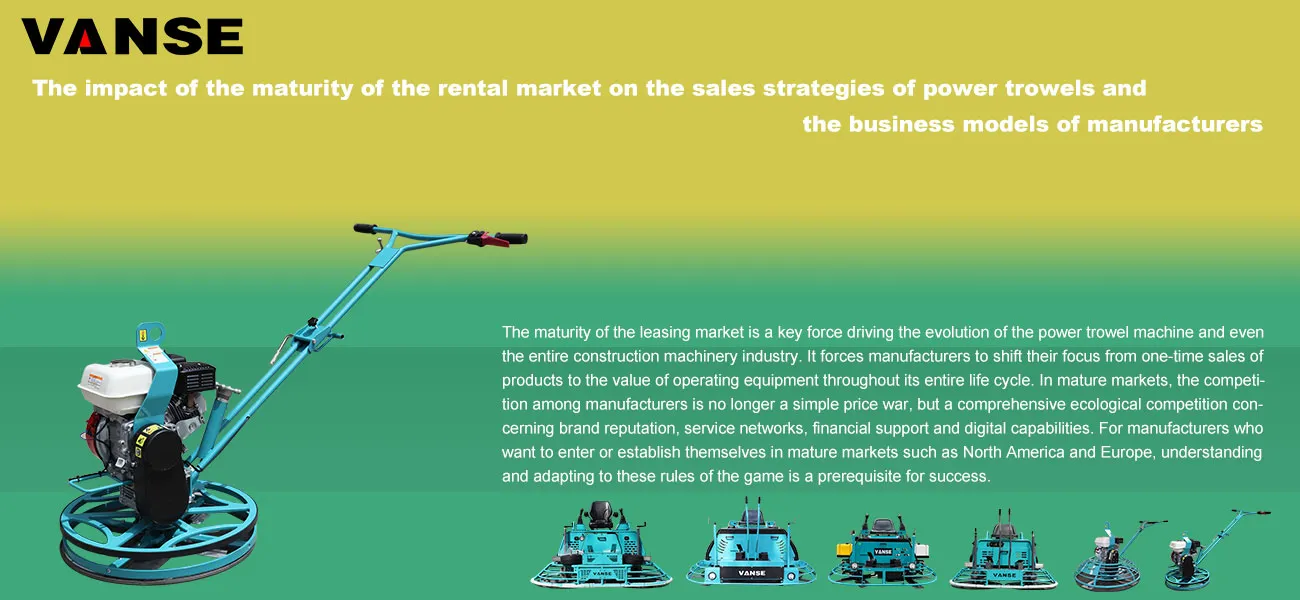
The maturity of the leasing market is a core variable influencing the construction machinery industry, especially for equipment like power trowels. It will have a fundamental impact on the sales strategies and business models of manufacturers.
Let's explore this influence in detail in two parts below.
Ⅰ. Impact on Sales Strategies
The maturity of the rental market directly changes who the manufacturers' "customers" are and how they deal with them.
1. Low-maturity rental markets (such as China in the past and some emerging Asian markets at present)
Target customers: mainly end users, such as construction team leaders, individual contractors, and small and medium-sized construction companies.
Core of sales strategy
Price-driven: Customers are extremely sensitive to prices, and their purchase decisions are mainly based on the initial purchase cost.
Function and durability promotion: Emphasize the basic functions, power and "durability" of the product, as the equipment is used and maintained by the owner themselves, and what they care about is "how long it can be used without recouping the cost".
Channel penetration: Relying on a wide network of distributors to cover scattered end customers, providing timely in-stock purchases and basic after-sales services.
Marketing methods: mainly offline stores, industry exhibitions, and referrals from acquaintances.
2. Highly mature rental markets (such as North America and Western Europe)
Target customers: Professional leasing companies have become core major customers (such as United Leasing, Solar Belt Leasing, etc.), as well as large contractors.
Core of sales strategy
Value and total cost of ownership driven: Price is no longer the only factor. Leasing companies are more concerned about the total cost of ownership, including:
Reliability & Attendance Rate: Does the machine rarely break down? Because idle machines mean a loss of rent.
Maintenance convenience & Service Cost: Is it easy to maintain on a daily basis? Are the components cheap and readily available?
Residual value: How much can the equipment still be sold for after several years of use? This is directly related to the asset return of the leasing company.
Standardization and universality: Leasing companies hope that for products of the same brand or even the same platform, their operation methods, maintenance procedures and components can be as universal as possible to reduce training costs and inventory pressure.
Direct sales to major clients and customization: Manufacturers will establish dedicated major client teams to directly connect with large leasing companies, and even provide customized products based on their specific needs (such as special color markings, software interfaces, and security configurations).
Data and service support: Remote data monitoring (optional) is provided to assist leasing companies in managing equipment fleets, predicting maintenance times, and optimizing equipment deployment
Ⅱ. Impact on the Business Model of Manufacturers
The maturity of the rental market has not only changed "what to sell" and "to whom to sell", but also profoundly promoted the transformation of manufacturers' "who I am".
1. Business model in a low-maturity market
Core model: Production, manufacturing and sales
The core of a manufacturer is to produce a product and then sell it. The business chain is basically over at this point.
The profits mainly come from the sales of new machines.
After-sales service is a cost center, and its main purpose is to support sales and prevent customer complaints.
2. Business models in highly mature markets
The rise of the rental market has forced manufacturers to transform from mere "equipment manufacturers" to "comprehensive solution providers".
Model Evolution One: From selling products to operating assets
Manufacturers have realized that their equipment is the "asset" that leasing companies use to make money. Therefore, they need to ensure that this asset can operate efficiently and economically throughout its entire life cycle.
This has given rise to an extreme pursuit of reliability, durability and residual value management. Manufacturers will proactively release residual value reports and design products that are easy to refurbish to maintain their brand's value in the second-hand market.
Model Evolution Two: Financial Services Become a key pillar
Financial companies affiliated with or cooperating with manufacturers have become crucial. They offer to leasing companies:
Flexible financial leasing solutions help it expand its fleet.
Credit support helps its customers (end tenants) rent equipment more easily.
This is not only a tool to boost sales, but also a source of profit in itself.
Model Evolution Three: The proportion of after-market and service revenue has increased
The new machine sales market fluctuates with the economic cycle, but the large fleet of existing equipment brings stable after-market income.
Manufacturers actively sell original factory parts, repair services, extended warranties and maintenance contracts. The profit margins of these businesses are usually higher than those of new machine sales.
Services have transformed from a "cost center" to a "profit center".
Model Evolution Four: Exploration of Datafication and Service Orientation
By installing sensors on the equipment, manufacturers can offer:
Remote diagnosis and predictive maintenance can notify the leasing company in advance that the equipment may need repair, reducing unexpected downtime.
Fleet management report helps leasing companies understand equipment utilization rate, fuel consumption, working hours, etc., and optimize business decisions.
This initiated an upgrade in the business model from "selling hardware" to "selling hardware + services + data".
Model Evolution Five: Entering the second-hand equipment and leasing business
Some powerful manufacturers (such as Caterpillar) establish official certification and resale channels for used equipment, which helps control residual value and provides customers with full life-cycle options.
A few manufacturers may even directly enter the market, operate their own leasing businesses, compete or cooperate with downstream customers, and gain a deeper understanding of market demands.
Summary comparison table
| Dimension | A low-maturity rental market | A highly mature rental market |
| Core customers | Scattered end users | Large leasing companies, major contractors |
| Competitive focus | Price, basic functions | TCO (Total Cost of Ownership), reliability, residual value |
| Product Strategy | It meets basic needs with a wide variety of models | Platform-based, standardized and customizable |
| Sales relationship | One-time transaction, through the distributor | Strategic cooperation, direct management of major clients |
| Source of profit | It mainly relies on the sales of new models | New machine sales + after-market services + financial services |
| Service role | Cost center, supporting sales | Profit center, independent business segment |
| Business model | Equipment manufacturer | Provider of equipment asset management and solutions |
Conclusion
The maturity of the leasing market is a key force driving the evolution of the power trowel machine and even the entire construction machinery industry. It forces manufacturers to shift their focus from one-time sales of products to the value of operating equipment throughout its entire life cycle. In mature markets, the competition among manufacturers is no longer a simple price war, but a comprehensive ecological competition concerning brand reputation, service networks, financial support and digital capabilities. For manufacturers who want to enter or establish themselves in mature markets such as North America and Europe, understanding and adapting to these rules of the game is a prerequisite for success.
Note: The parameters provided in this document are for reference only and are not mandatory. Due to differences in technical characteristics between different brands and models of laser levelers, please consult the manufacturer for a suitable solution before actual operation. This reference document assumes no responsibility for any issues arising from failure to follow the manufacturer's instructions.
Thanks to All the Friends Who Support and Trust Shandong Vanse Machinery Technology Co., Ltd.
If you want to know more about Shandong Vanse Machinery Technology Co., Ltd. or have any questions, please feel free to contact us:
Our Factory
Shandong Vanse Machinery Technology Co., Ltd.








Share this article

About the Author: Shandong Vanse Machinery Technology Co., Ltd.
Shandong Vanse Machinery Technology Co., Ltd. is a high-tech manufacturer specializing in concrete construction machinery, including laser screeds and related equipment. The company integrates R&D, production, and global sales, with products exported to over 60 countries and widely used in infrastructure projects worldwide.
Previous Post
Next Post
Related Articles
You Might Also Like
What are the common causes and troubleshooting methods for concrete laser leveling machines?
– Laser Beam Unstable: Check that the laser transmitter and receiver are clean and correctly aligned, clean the lens and reflector, clean the dust and dirt. – The device cannot be calibrated horizontally: Make sure the device is placed on a flat ground and the reference point is set correctly. – Flating head slides by itself: Clean the surface of the valve group, remove the hydraulic lock to check whether there is dirt inside, check whether the seal ring is damaged and replace it. – The lifting cylinder is not sensitive: Remove the proportional valve core and clean up the dirt, check whether the valve core is operating normally, and remove air in the oil pipe. – Vibration or noise abnormality: Turn off the equipment to check for loose or damaged parts, fasten screws or replace damaged parts. – The device does not start: Check whether the power supply and cable connection are normal to ensure that the power supply is normal. – Flating head lifting motor cannot be operated manually: Check the control box relay and plug, motor or controller. – Flating head cannot work automatically: Replace the automatic manual switch or inclination sensor. – Flating head slides by itself: Clean the surface of the valve group, remove the hydraulic lock to check whether there is dirt inside, check whether the seal ring is damaged and replace it. – The lifting cylinder is not sensitive: Remove the proportional valve core and clean up the dirt, check whether the valve core is operating normally, and remove air in the oil pipe. – Construction accuracy decreases: Regular cleaning and maintenance of lenses or sensors. – The upper and lower rollers of the leveler do not run: Check whether the chain is off, check whether the motor activation button or contactor is faulty, and check whether the motor line is normal. – Flooring materials are left and right, and the feeding is unstable: Check whether the twisting dragon and the correction roller are parallel and adjust the material.What are the precautions for the safe operation procedures of concrete laser leveling machines?
The core of the safe operating procedures for concrete laser leveling machines is "personnel protection, equipment control, environmental avoidance, and emergency response." Focus on the following four key areas to ensure human and machine safety and construction compliance: Operators must undergo professional training and be familiar with the equipment's structure (laser system, hydraulic system, vibrating mechanism) and operating buttons. Operating the equipment without a license is strictly prohibited. Support personnel must understand the equipment's operating range and avoid entering hazardous areas. All personnel must wear hard hats and non-slip, insulated shoes during operation. When working with concrete, wear waterproof gloves. When cleaning the equipment, wear protective clothing to prevent burns from cement slurry splashes. It is strictly forbidden to adjust the laser transmitter/receiver while the machine is operating (this requires shutting down the machine and disconnecting the power supply). Avoid direct laser light into your eyes (the strong light may cause blindness). Do not stand under the scraper or vibrator or inside the machine's tracks/tires to prevent hydraulic system failure from causing components to fall or the machine to overturn. Do not be distracted during operation (e.g., answering or making phone calls). Two people working together must maintain communication (using hand gestures or a walkie-talkie) to avoid accidental collisions. Inspection Area Inspection Items and Standards Purpose Laser System The transmitter/receiver is fully charged, calibrated correctly, and free of signal interference. Avoid elevation errors and equipment misjudgment Hydraulic System The oil pipes are leak-free and the hydraulic oil level is within the upper and lower limits. Prevent hydraulic failure (such as scraper jamming) Power and Transmission The engine oil and coolant levels are normal, and the tires/tracks are undamaged. Ensure stable equipment operation Safety Devices The emergency stop button (red) is responsive, and the warning lights and horn are functioning properly. Enable rapid shutdown in emergencies After starting the equipment, allow it to idle for 1-2 minutes to confirm that the vibrator and scraper are operating smoothly without unusual noise or jamming before entering the work area. Strictly control the travel speed to 0.5-1.5 m/min. Reduce speed when turning (≤ 0.5 m/min) to avoid rollover caused by high-speed turns. Overloading is strictly prohibited (e.g., concrete pile thickness exceeds the maximum handling capacity of the equipment) to prevent motor overload and scraper deformation. Do not operate on rainy days or when the base is flooded. This can reflect the laser signal (causing elevation errors) and potentially short-circuit the equipment's electrical system. Avoid areas with strong electromagnetic interference (such as those near large transformers or welding machines) to prevent laser signal interference and equipment loss of control. For nighttime operations, ensure adequate lighting (≥50 lux) and display warning signs around the laser transmitter to prevent collisions. Warning tape or guardrails must be installed at the edges of the work area. Especially when working at height (such as pouring floors), edge protection (such as scaffolding) must be checked to prevent equipment from slipping or falling. The laser transmitter must be mounted on a stable, unobstructed support (≥1.5m in height) and supervised by a designated person. Unauthorized movement is prohibited. In the event of an emergency (such as laser signal interruption, unusual equipment noise, or hydraulic leakage), immediately press the emergency stop button, disconnect the power supply, and troubleshoot the problem. Do not operate with the equipment in a faulty state. If equipment overturns and causes injury, evacuate personnel to a safe area, call emergency services (such as 120), secure the scene, and report the incident to the responsible person. After completing the operation, first shut down the laser system, then the power supply, and use a high-pressure water jet to clean any remaining concrete (do not use water directly on electrical components). The equipment must be parked away from slopes and edges, with the handbrake engaged and triangular wood placed to prevent rolling. The laser transmitter and receiver must be stored in a moisture-proof box to prevent damage. All operations must comply with the "Technical Regulations for Safety in the Use of Construction Machinery" (JGJ 33) and the "Concrete Structure Construction Quality Acceptance Code" (GB 50204). Regular (every three months) professional verification of the equipment's safety devices and laser accuracy should be performed to ensure long-term compliance. Note: The parameters provided in this document are for reference only and are not mandatory. Due to differences in technical characteristics between different brands and models of laser levelers, please consult the manufacturer for a suitable solution before actual operation. This reference document assumes no responsibility for any issues arising from failure to follow the manufacturer's instructions.What are the key differences between manual leveling and laser leveling for large-scale concrete floor projects
In the world of large-scale industrial flooring, the jump from manual to laser leveling isn't just an upgrade in speed-it's a fundamental shift in how the concrete's structural integrity and surface geometry are managed. While manual leveling relies on the "eye" and physical strength of the crew, laser leveling relies on active hydraulic feedback loops. Feature Manual Leveling (Hand leveling) Laser Leveling (Automated leveling) Precision ±6mm to ±12mm (Typical) ±3mm or better FF 50+) Daily Output 500 – 1,000 ㎡ 2,000 – 5,000+ ㎡ Consistency Highly dependent on crew fatigue High; machine doesn't "get tired" Slump Tolerance Requires higher slump (wetter) Handles low slump (stiffer) mixes Labor Density Large crew required for pulling Smaller crew; specialized operators Manual leveling uses "wet pads" or form-to-form leveling. Because humans pull the leveling board, they naturally create "waves" as they step and reset. Manual: Prone to "birdbaths" (low spots) and "humps" because the reference point (the form or a previously leveled section) is static. Laser: The laser leveling receives a signal 10 times per second. The onboard computer adjusts the hydraulic cylinders in real-time to ensure the plow and vibrator stay at the exact elevation, regardless of the chassis moving over uneven subgrade. This is a critical, often overlooked difference. Manual: To make hand-pulling physically possible, crews often request a higher slump (more water). More water increases the risk of shrinkage, curling, and cracking. Laser: Laser leveling have the power to strike off low-slump, stiff concrete. This results in a much stronger slab with higher density and significantly less shrinkage over time. Manual: Large projects must be broken into many small "strips" or "checkerboard" pours because the crew can only handle so much area at once. This creates more construction joints, which are the weakest points of a floor. Laser: Allows for "Large Area Pours." You can pour massive sections in a single day, drastically reducing the number of joints. Fewer joints mean lower maintenance costs for the facility owner (especially in warehouses with high forklift traffic). Manual leveling often relies on a "vibratory leveling" or just the strike-off action. Laser leveling utilize a high-frequency vibrator head integrated into the leveling boom. This ensures that the aggregate is consolidated uniformly throughout the entire depth of the slab, not just the surface. This creates a more durable "wear layer" for the final power trowel finish. Choose Manual if: You are working in tight spaces with many penetrations (pipes/drains), or the total area is under 300 ㎡ where the mobilization cost of a laser leveling is too high. Choose Laser if: You are hitting FF (Flatness) or FL (Levelness) specifications, or if the project exceeds 1,000 ㎡. The efficiency gains usually pay for the machine rental in saved labor hours alone. Would you like me to break down the cost-per-square-foot difference between these two methods for a typical warehouse project? Contact us NOW Note: The parameters provided in this document are for reference only and are not mandatory. Due to differences in technical characteristics between different brands and models of laser levelers, please consult the manufacturer for a suitable solution before actual operation. This reference document assumes no responsibility for any issues arising from failure to follow the manufacturer's instructions.