Technical Knowledge
The proper maintenance schedule for the hydraulic systems of the concrete laser leveling machine
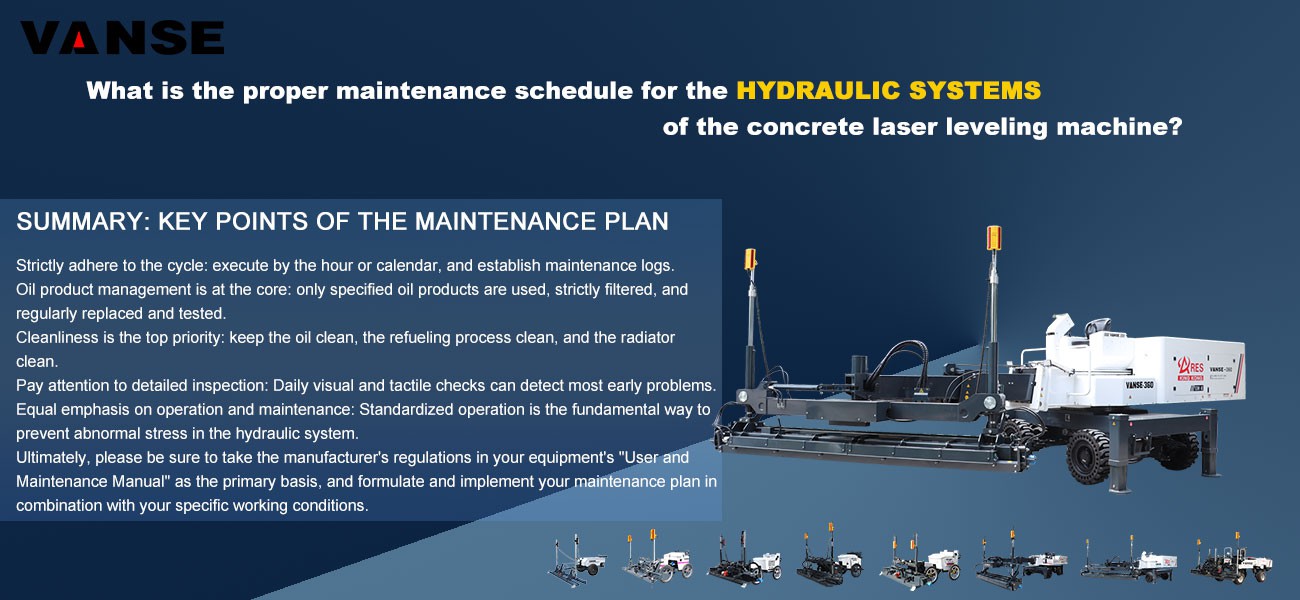
The hydraulic system of the concrete laser leveling is its "heart" and "muscle", responsible for driving all key actions such as the lifting, vibration, movement of the leveling head and the extension and retraction of the boom. A scientific and rigorous maintenance plan for the hydraulic system is the core to ensuring the reliability, accuracy and long service life of the equipment.
The following is a well-structured and highly operational correct maintenance plan for the hydraulic system of a concrete laser leveling:
Core concept: Prevention first, keep clean
More than 70% of the faults in the hydraulic system are caused by oil contamination (particles, water, air) and excessively high oil temperature. Therefore, the maintenance plan should revolve around "keeping the oil clean and cool".
Ⅰ. Daily Maintenance (Before/After Each shift's Work)
Pre-work inspection
Oil level check: When the equipment is parked on a level ground and all oil cylinders are retracted, check the oil level gauge of the hydraulic oil tank to ensure that the oil level is between the upper and lower limits marked. Low oil level can cause the pump to run dry, the system to overheat and components to be damaged.
Visual inspection
Leakage inspection: Quickly inspect the oil pump, valve block, cylinder piston rod, all pipe joints and hose surfaces for visible oil leakage or dripping.
Pipeline inspection: Check for any abnormal bulges, wear, cracks or friction with adjacent components in the hydraulic hose.
Start preheating: In cold weather, after starting the engine, it should be run at medium to low speed without load for 3 to 5 minutes to allow the hydraulic oil to circulate and heat up, improve fluidity, and prevent dry grinding of components.
Post-assignment inspection
Cleaning and inspection: After the operation, check whether the oil filling port of the hydraulic oil tank, the vent valve (breather), and the surface of the hydraulic components are contaminated by cement mortar. Clean them in time to prevent contaminants from entering the system.
Temperature perception: Before shutting down, use the back of your hand to sense whether the temperature of the fuel tank and the main valve blocks is abnormally hot to the touch (usually not exceeding 80℃). Continuous high temperatures will accelerate the oxidation and deterioration of the oil.
Ⅱ. Regular Preventive Maintenance (by working hours or calendar time)
This is the main body of the maintenance plan. It must be carried out strictly in accordance with the intervals in the manufacturer's manual and detailed records must be made.
| Maintain the project | Period/Frequency | Specific operations and standards |
| Hydraulic oil replacement | First replacement: 200 to 500 hours after a new machine or major overhaul. | 1. Change the oil while it's still hot: Perform this when the equipment has just been shut down and the oil temperature is still hot. |
| Regular replacement: Every 1,000 to 2,000 working hours or once a year (whichever comes first). | 2. Thorough empting: Drain the old oil from the fuel tank and oil lines. If necessary, flush with fresh oil. | |
| The cycle needs to be shortened under harsh working conditions. | 3. Clean the fuel tank: Use a non-fibrous cloth to clean the inner wall of the fuel tank and the magnetic drain plug. | |
| 4. Strict oiling: Add new hydraulic oil of the specified grade and viscosity level to the prescribed oil level through a high-precision filter. | ||
| Replacement of the oil suction/return oil filter element | Every 500 hours or simultaneously with each oil change. | When replacing, pay attention to cleaning the area around the filter element seat to prevent dirt from falling in. |
| 2. Never reuse the filter element after cleaning it. | ||
| High-pressure pipeline filter (if any) | Alarm according to the clogging indicator on the filter, or as stipulated in the manual (usually synchronized with the oil change cycle). | Timely replacement and checking the type of residue on the filter element can help determine the internal wear condition of the system (for example, if there is a lot of metal shavings, there may be abnormal wear of components). |
| Hydraulic oil quality testing | Every 6 months to 1 year (applicable to high-value or high-intensity usage equipment). | Samples are sent to a professional laboratory for oil spectral analysis to detect water content, contamination degree, acid value and metal wear particles. This is the most effective means of predictive maintenance, which can detect potential faults in advance. |
| System tightening and inspection | Monthly or every 250 hours. | 1. Inspect and tighten all pipe joints, flanges and valve block installation bolts (in accordance with torque requirements). |
| 2. Check all the piston rods of the oil cylinders for any scratches, rust or bends. Minor scratches should be repaired immediately with an oilstone. | ||
| 3. Check the pre-charge pressure of the accumulator (if any). | ||
| Cooling system cleaning | Weekly or depending on the cleanliness of the environment. | Clean the fins of the hydraulic oil radiator to ensure there is no blockage from dust, willow catkins, cement powder, etc., to guarantee the heat dissipation efficiency. This is the key to controlling the oil temperature. |
Ⅲ. Good Habits in Operation (Avoiding Active Harm)
Overloading is strictly prohibited: Avoid the leveling machine operating at its maximum load for a long time, as this will cause excessive system pressure and a sharp increase in oil temperature.
Avoid shock: Operate the control handle smoothly to reduce the shock load on the hydraulic system.
Cylinder protection: During operation, pay attention to protecting the piston rod to avoid direct impact or scratches from concrete or crushed stones.
Proper parking: When parked for a long time, all cylinders (especially the exposed piston rods) should be retracted to reduce corrosion and deformation.
Ⅳ. Special Working Conditions and Long-term Storage and Maintenance
Extreme environment
High-temperature environment: Enhance the cleaning of the radiator. Consider using hydraulic oil with higher viscosity (as recommended in the manual), and add auxiliary cooling if necessary.
High humidity/water environment: Strengthen the inspection of oil level and water content in oil products, and keep the vent valve of the oil tank dry. The replacement cycle of the filter element can be shortened.
In extremely cold environments: Use low pour point hydraulic oil. The equipment should be parked in a warm warehouse and fully preheated before startup.
Long-term storage (>1 month)
Park the equipment in a dry room and completely retract all the oil cylinders.
Fill the fuel tank to the brim to reduce the formation of condensation on the inner walls.
Start the engine every month and let the hydraulic system run idle for 10 to 15 minutes to lubricate all components and remove moisture.
Ⅴ. Principles of Fault Early Warning and Handling
Common warning signals
Slow and weak operation: It may be due to low oil level, pump wear, or malfunction of the main relief valve.
Abnormal system noise (pump beeping) : It may be due to clogged oil suction filter element, excessively high oil viscosity, pump suction or cavitation.
Abnormal increase in oil temperature: cooler blockage, severe internal leakage, improper oil level, and the set value of the relief valve being too high.
Cylinder crawling or shaking: Air inside the system, leakage from the cylinder, or oil contamination causing the valve core to get stuck.
Processing principle
Stop the machine immediately for inspection: If any of the above abnormalities occur, stop the machine immediately and start checking from the simplest aspects such as oil level, filter element, and leakage.
Eliminate operating while faulty: Hydraulic system failures can deteriorate in a chain reaction, and minor issues can quickly turn into major overhauls.
Professional maintenance: Complex operations such as pressure adjustment and disassembly of pumps and valves should be carried out by professional maintenance personnel. Before disassembling any hydraulic components, the system pressure must be completely released.
Summary: Key points of the maintenance plan
Strictly adhere to the cycle: execute by the hour or calendar, and establish maintenance logs.
Oil product management is at the core: only specified oil products are used, strictly filtered, and regularly replaced and tested.
Cleanliness is the top priority: keep the oil clean, the refueling process clean, and the radiator clean.
Pay attention to detailed inspection: Daily visual and tactile checks can detect most early problems.
Equal emphasis on operation and maintenance: Standardized operation is the fundamental way to prevent abnormal stress in the hydraulic system.
Ultimately, please be sure to take the manufacturer's regulations in your equipment's "User and Maintenance Manual" as the primary basis, and formulate and implement your maintenance plan in combination with your specific working conditions.
Note: The parameters provided in this document are for reference only and are not mandatory. Due to differences in technical characteristics between different brands and models of laser levelers, please consult the manufacturer for a suitable solution before actual operation. This reference document assumes no responsibility for any issues arising from failure to follow the manufacturer's instructions.
Thanks to All the Friends Who Support and Trust Shandong Vanse Machinery Technology Co., Ltd.
If you want to know more about Shandong Vanse Machinery Technology Co., Ltd. or have any questions, please feel free to contact us:
Our Factory
Shandong Vanse Machinery Technology Co., Ltd.








Share this article

About the Author: Shandong Vanse Machinery Technology Co., Ltd.
Shandong Vanse Machinery Technology Co., Ltd. is a high-tech manufacturer specializing in concrete construction machinery, including laser screeds and related equipment. The company integrates R&D, production, and global sales, with products exported to over 60 countries and widely used in infrastructure projects worldwide.
Previous Post
Next Post
Related Articles
You Might Also Like
What is the future development direction of concrete laser leveling machine?
Concrete laser leveling machine is a high-tech equipment commonly used in construction engineering. It uses laser technology to achieve automatic leveling and leveling of concrete. In the future, the development direction of concrete laser leveling machine includes the following aspects: Improve construction efficiency With the acceleration of the urbanization process, the requirements for the construction period of building construction are becoming more and more stringent. The concrete laser leveling machine has played an important role in shortening the construction period and improving construction efficiency. In the future, by further optimizing the equipment structure and control system, the construction efficiency of the concrete laser leveling machine will be further improved to better meet the construction schedule requirements. Realize intelligent construction With the continuous development of technologies such as artificial intelligence and the Internet of Things, concrete laser leveling machines will gradually have more intelligent functions. For example, by combining with building information modeling (BIM) technology, real-time monitoring and data management of the construction process can be realized, the construction process can be further optimized, and construction quality and efficiency can be improved. At the same time, through the combination with intelligent equipment such as robots and drones, more automatic and intelligent construction methods can be realized, human intervention can be reduced, and construction costs can be reduced. Multifunctional development At present, the concrete laser leveling machine is mainly used for leveling and leveling concrete, but it will have more functions in the future. For example, by adding additional equipment, operations such as automatic concrete distribution, finishing, and compaction can be realized, realizing one-stop concrete construction. In addition, with appropriate sensors and testing equipment, quality testing such as concrete strength testing and crack testing can be carried out, providing a more comprehensive guarantee for construction quality. Expand the scope of application At present, the concrete laser leveling machine is mainly used in the construction of concrete structures such as buildings, bridges, and tunnels, but its application range will be expanded to more fields in the future. For example, in road construction, operations such as automatic leveling and compaction of the road surface can be realized; in the field of agriculture, operations such as leveling and compaction of farmland can be realized to improve the efficiency and quality of agricultural production. In short, the future concrete laser leveling machine will develop in a more efficient, intelligent, and multi-functional direction, providing more high-quality, efficient, and intelligent solutions for construction. With the continuous advancement of technology and the expansion of the scope of application, concrete laser leveling machines will play an important role in more fields and make greater contributions to the modernization of the construction industry.What Impact Does The Maintenance Of Concrete Laser Leveling Have On Construction?
What impact does the maintenance of concrete laser leveling have on construction? Concrete laser leveling machine is an indispensable key equipment in modern construction. It plays an important role in concrete leveling operations with its high precision and high efficiency. However, any equipment needs to be properly maintained to ensure stable performance, extended service life, and maximum effectiveness during the construction process. This article will deeply explore the impact of concrete laser leveling maintenance on construction efficiency, quality, machine life, construction safety and cost-effectiveness, and propose some maintenance recommendations. 1. Overview of maintenance of leveling machine The maintenance of concrete laser leveling machine is a comprehensive work, covering many aspects such as cleaning, inspection, adjustment, lubrication and replacement of wearing parts of the equipment. These tasks are not only to ensure the normal operation of the equipment, but also to improve construction efficiency, ensure construction quality, extend the service life of the equipment and ensure construction safety. Maintenance work is usually performed before and after the equipment is used, including daily maintenance and periodic maintenance. Routine maintenance mainly involves cleaning and inspecting the equipment to ensure its appearance is clean and free of debris, and checking whether all components are intact and tight. Regular maintenance requires more in-depth inspection and adjustment of the equipment, such as changing lubricating oil, cleaning filters, checking transmission components, etc. 2. Impact on construction efficiency and quality The maintenance of the Thermosol Laser Leveler has a direct impact on the construction efficiency and quality. First, if the equipment is not properly maintained, it may cause malfunctions or performance degradation during operation, thereby affecting the construction progress. For example, if sludge accumulates on the underside of the walking track of the leveling machine, it will not only affect the walking speed, but also cause the leveling accuracy to decrease. Secondly, improper maintenance may also have a negative impact on the quality of construction. The main function of the concrete laser leveler is to ensure the flatness and compactness of the concrete surface. If the equipment performance is unstable or malfunctions, it will directly lead to poor leveling results and affect the quality of the project. Therefore, regular maintenance of the concrete laser leveling to ensure that it is in optimal working condition is of great significance to improving construction efficiency and quality. 3. Extend the service life of the machine As a high-precision, high-load equipment, the service life of the concrete laser leveling is closely related to daily maintenance. By regularly lubrication, cleaning and inspection of equipment, potential problems can be discovered and solved in time, preventing small problems from gradually deteriorating into big problems, thereby extending the service life of the equipment. In addition, correct maintenance can also slow down the wear rate of equipment. For example, regular replacement of hydraulic oil and filter elements can prevent oil contamination and increased wear; lubrication and maintenance of bearings can reduce friction and wear. These measures can effectively extend the service life of the concrete laser leveling and save the company the cost of replacing equipment. 4. Ensure construction safety and stability Construction safety is an important link that cannot be ignored during the construction process. The maintenance of concrete laser leveling machines is of great significance to ensure construction safety. First of all, the stability and reliability of equipment directly affect the safety of construction workers. If the equipment is faulty or performs erratically, there may be an increased risk of injury to the operator. Secondly, maintenance can also ensure that the safety devices and protective facilities of the equipment are in good condition. For example, the equipment's emergency braking devices and protective devices require regular inspection and maintenance to ensure normal operation in emergencies and protect the safety of operators. Therefore, by strengthening the maintenance of concrete laser leveling machines, safety hazards can be discovered and eliminated in time to ensure the safety and stability of the construction process. 5. Maintenance cost-effectiveness Although maintenance work requires a certain cost, including investment in manpower, material resources, etc., these investments are negligible compared with the benefits brought. First of all, maintenance can extend the service life of the equipment and reduce the risk of equipment scrapping. And bring replacement costs. Secondly, maintenance can improve construction efficiency and quality, and reduce economic losses caused by construction delays and quality problems. In addition, maintenance can also reduce equipment failure rates and reduce repair costs. Therefore, in the long run, maintenance of concrete laser leveling machines is a cost-effective investment. 6. Maintenance recommendations For the maintenance of concrete laser leveling machines, the following are some recommended measures: ☑ Develop a detailed maintenance plan, clarify the content and cycle of each work, and ensure the comprehensiveness and timeliness of maintenance work. ☑ Strengthen the training and management of operators, improve their maintenance awareness and skill level, and ensure that they can correctly perform daily and regular maintenance of equipment. ☑ Conduct comprehensive inspections and assessments of equipment on a regular basis to discover and solve potential problems in a timely manner to prevent small problems from gradually deteriorating into big problems. ☑ Choose appropriate maintenance tools and materials to ensure the quality and effect of maintenance work. ☑ Establish maintenance files to record the maintenance status and historical data of the equipment to provide a reference for subsequent management and maintenance of the equipment. In summary, the maintenance of concrete laser leveling machines has an important impact on construction efficiency, quality, machine life, construction safety and cost-effectiveness. By strengthening maintenance work, we can ensure the stable operation and efficient use of equipment, providing a strong guarantee for the smooth progress of the construction process. At the same time, this is also one of the important ways to improve the economic efficiency and market competitiveness of enterprises.Can the construction effect of the small concrete laser leveling in confined Spaces be comparable to that of large equipment?
Overall, in confined Spaces, the construction effect of small concrete laser leveling machines can not only rival that of large-scale equipment, but in some aspects even far exceed it. However, in open and large areas, large-scale equipment has an absolute advantage in terms of efficiency and continuity. Their comparison is not simply "good or bad", but "applicable or not applicable". Now let's make a detailed comparison from several dimensions: In confined Spaces with narrow doorways, indoor areas, obstacles, and dense pipelines, large equipment may not be able to enter at all or may feel very awkward to use. At such times, the effect of small-sized machines lies in the difference between "from nothing to something" and "professional precision", naturally outperforming them. Comparison dimension Small concrete laser leveling machine Large-scale concrete laser leveling machine Adaptability in confined Spaces ★ ★ ★ ★ ★ (Absolute Advantage) ★ ☆ ☆ ☆ ☆ (Obvious disadvantage) The body is compact (with a width that can be as narrow as within 1 meter) and can pass through standard door openings. The body is huge and cannot enter narrow Spaces. It has a small turning radius, is highly maneuverable and flexible, and can be flexibly applied in complex areas. A spacious area is required for movement and turning. It can be used in floors, basements, renovation projects, etc. where large equipment cannot enter. It is only applicable to large areas, barrier-free or minimally obstructed venues. Construction effect (flatness/density) ★ ★ ★ ★ ☆ (Excellent) ★ ★ ★ ★ ★ (Ultimate) It also adopts a laser measurement and control system, which can automatically control the elevation and has an extremely high flatness (up to ±2mm/2m feet). The laser control system is equally precise. Compaction is achieved through high-frequency vibrators or vibration plates, with good results. The large-scale vibration system and large-sized scraper can cover a larger area at one time, with better overall continuity and almost no construction seams. • Disadvantage: Due to the segmented construction, special attention needs to be paid to the joints of the panels. Improper handling may cause slight height differences. Its strength lies in achieving the ultimate flatness of "seamless connection" over a large area. Construction efficiency ★ ★ ★ ☆ ☆ (Good) ★ ★ ★ ★ ★ (Extremely High) In confined Spaces, its efficiency is much higher than that of manual labor, making it the best alternative to human labor. In open Spaces, its efficiency is unparalleled, with a daily coverage area of up to several thousand square meters. However, due to the need for block construction, the overall efficiency is affected by the division of blocks and the moving time. One-time continuous operation reduces pauses and seam treatment time. • Suitable for: small-area, multi-block, and discontinuous construction. • Suitable for: super-large area projects such as factories, warehouses, and large squares. Economy ★ ★ ★ ★ ☆ (Better) ★ ★ ★ ☆ ☆ (Higher) The cost of purchasing or leasing equipment is lower. The equipment is expensive and the rental cost is high. It is convenient for transportation, consumes less fuel and has a low overall usage cost. It requires large transport vehicles and has high fuel consumption. It requires fewer operators (usually 1-2 people). • Usually, a more professional operation team is required. Dependence on labor force ★ ★ ★ ★ ☆ (Significantly reduced) ★ ★ ★ ★ ★ (almost replaced) It has achieved mechanized and intelligent construction in confined Spaces, liberating workers from heavy physical labor, and quality is guaranteed by equipment. In large-scale construction, it has almost completely replaced traditional manual labor, achieving a leap in efficiency and quality. Interior engineering: Floor construction for residential buildings, shops, office buildings and hospital wards. Renovation of old buildings: Areas such as lobbies, stairwells, and basements where large equipment cannot enter. Complex layout space: There are a large number of equipment foundations and columns inside the factory building, and construction needs to be carried out around the columns. Small-scale projects: entrance ramps for parking lots, small warehouses, maintenance workshops, etc. Projects with limited budgets or without the need for large-scale equipment. Super-large single-story construction area: logistics warehouses, large industrial plants, airport halls, commercial plazas. For sites with extreme requirements for overall flatness, it is hoped that the number of construction joints can be as few as possible. Projects with extremely tight schedules that require maximizing the daily paving area. Returning to your question: Can the construction effect of small concrete laser leveling in confined Spaces be comparable to that of large equipment? The answer is: Yes, and even better. In terms of the two core indicators of flatness and density, as long as the operation is proper, small-sized machines, with their equally precise laser control systems, can fully achieve quality standards comparable to those of large-sized machines. In terms of "constructability" in confined Spaces, small-sized machines are the only feasible mechanized solution, and their effectiveness is incomparable to that of traditional manual labor. At this point, they have no competitors. Therefore, please do not view minicomputers as "downsized versions" or "cheap substitutes" of large machines, but rather as professional solutions tailored for specific working conditions (narrow and complex Spaces). When making a choice, you should make the most suitable one based on your specific construction environment, area and budget. Note: The parameters provided in this document are for reference only and are not mandatory. Due to differences in technical characteristics between different brands and models of laser levelers, please consult the manufacturer for a suitable solution before actual operation. This reference document assumes no responsibility for any issues arising from failure to follow the manufacturer's instructions.