Technical Knowledge
Key Control Points for Concrete Initial Setting Time During Power Trowel Construction
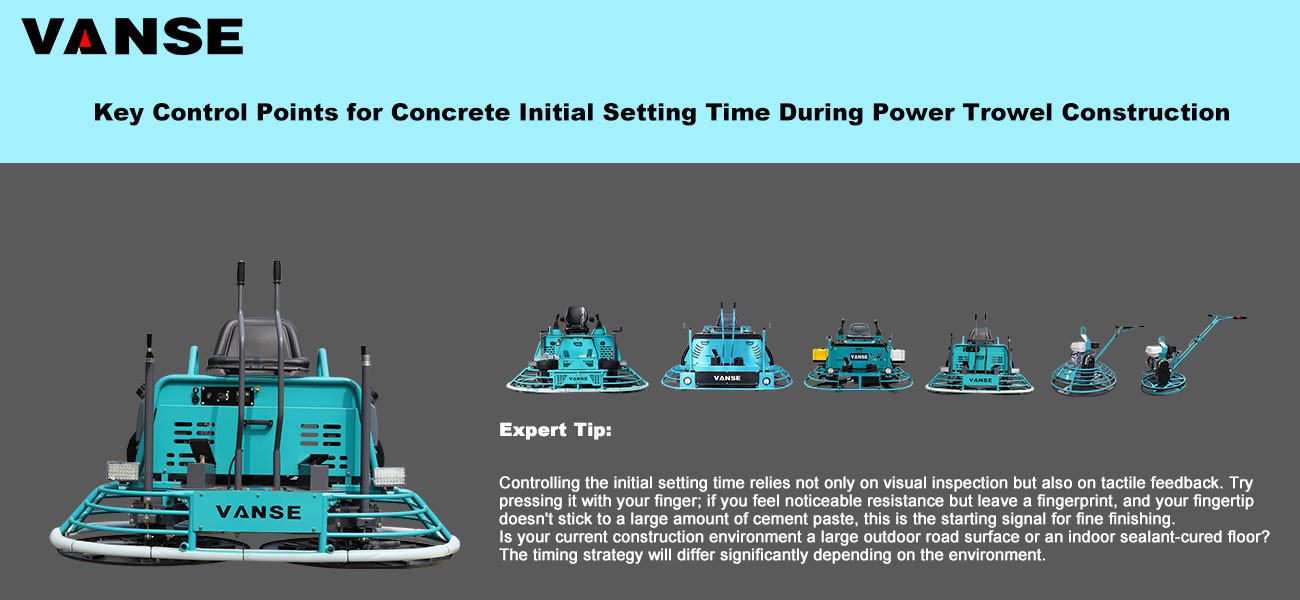
In power trowel construction, the **initial setting time** of concrete is the "golden window" that determines the quality of the floor. If the machine enters the site too early, it will sink into the concrete and damage the smoothness; if it enters too late, the surface will be too hard to lift the mortar, resulting in sanding or hollow areas.
The following are the key control points for controlling the initial setting time and the timing of entry:
1. Footprint Depth Judgment Method (The Most Practical On-Site Standard)
This is the most commonly used and intuitive judgment method by construction workers.
Timing of Entry: When a person steps on the concrete surface and the footprint depth is between 3mm and 5mm, it is the optimal time for the power trowel to extract the slurry.
Too Early: If the footprint exceeds 10mm, the machine will slip, sink, and may even stir up the aggregate.
Too Late: If the footprint is less than 2mm, the surface has already formed a film, making it impossible to extract the slurry, and the blades will wear out rapidly.
2. Dynamic Monitoring of Environmental Factors
Initial setting time is not a fixed value and is significantly affected by the following three factors:
Ambient Temperature:** For every 10°C increase in temperature, the initial setting time may shorten by more than one hour. During summer construction, the frequency of inspections must be increased.
Wind Speed:** Through drafts or strong outdoor winds accelerate surface moisture evaporation, leading to a "false setting" phenomenon (the surface is dry, but the interior is still soft). Operating a power trowel under these conditions can easily cause cracking.
Humidity:** Moisture loss is rapid in low humidity conditions; the use of sprays or retarders should be considered.
3. Key Points for Handling Bleeding
Strictly Prohibit Work on Wet Materials: Before initial setting, concrete will bleed water. The power trowel should only be used after the bleeding has largely disappeared, or after excess water has been removed using a rubber hose and scraper.
Risk: Forcing a power trowel to finish the concrete when there is significant standing water will force the water into the concrete surface, leading to delamination or peeling later on.
4. Coordination during the power trowel operation phase
Controlling the initial setting time is actually to connect the following three stages:
| Stages: | Operating Instructions: | Objective: |
| Floating Stage | **Use the slurry-lifting disc or combination blades laid flat and run at low speed.** | To compress large aggregates, refine them into a fine slurry, and eliminate mold marks. |
| Resting Stage | **After slurry lifting, wait 15-30 minutes (depending on the hardening speed).** | To further degas the surface and increase density. |
| Finishing Stage | **Replace with the finishing blades, gradually increase the blade angle, and run at high speed.** | To compact the surface layer and create a mirror-like effect. |
5. Preventing "Machine Burnout" and "Hollow Zones"
Preventing Machine Burnout: If initial setting is too rapid (e.g., due to the addition of accelerators), the number of power trowels must be increased, implementing a "machine-on-demand" system.
Pay Attention to Temperature Differences: During winter construction, if indoor heating is used, uneven heating of the floor can cause some areas to set extremely quickly while others set very slowly. Operators must manually assess the hardening degree of different areas.
Expert Tip:
Controlling the initial setting time relies not only on visual inspection but also on tactile feedback. Try pressing it with your finger; if you feel noticeable resistance but leave a fingerprint, and your fingertip doesn't stick to a large amount of cement paste, this is the starting signal for fine finishing.
Is your current construction environment a large outdoor road surface or an indoor sealant-cured floor? The timing strategy will differ significantly depending on the environment.
Note: The parameters provided in this document are for reference only and are not mandatory. Due to differences in technical characteristics between different brands and models of laser levelers, please consult the manufacturer for a suitable solution before actual operation. This reference document assumes no responsibility for any issues arising from failure to follow the manufacturer's instructions.
Thanks to All the Friends Who Support and Trust Shandong Vanse Machinery Technology Co., Ltd.
If you want to know more about Shandong Vanse Machinery Technology Co., Ltd. or have any questions, please feel free to contact us:
Our Factory
Shandong Vanse Machinery Technology Co., Ltd.








Share this article

About the Author: Shandong Vanse Machinery Technology Co., Ltd.
Shandong Vanse Machinery Technology Co., Ltd. is a high-tech manufacturer specializing in concrete construction machinery, including laser screeds and related equipment. The company integrates R&D, production, and global sales, with products exported to over 60 countries and widely used in infrastructure projects worldwide.
Previous Post
Next Post
Related Articles
You Might Also Like
What factors should be considered when purchasing a concrete power trowel?
– Site size – For large-scale concrete construction sites, such as large industrial plants, warehouses, parking lots, etc., it is recommended to choose a ride-on trowel. The ride-on trowel has high working efficiency and can complete large-scale troweling work in a short time. For example, for the floor construction of a logistics warehouse with an area of more than 1,000 square meters, a ride-on trowel can quickly perform rough and fine grinding, effectively saving time and manpower. – For small-area indoor floors or local repair work, a walk-behind or handheld trowel is more suitable. For scenes such as home indoor floor decoration and small store floor repair, the walk-behind trowel is flexible to operate and can easily operate in narrow spaces and corners. – Ground flatness requirements – If the flatness and finish of the ground are extremely high, such as the floor of a high-end shopping mall, the clean workshop of an electronics factory, etc., a double-disc trowel needs to be considered. The double-disc trowel can better ensure the flatness of the ground. Its two trowel discs work at the same time, which can reduce the height difference of the ground and make the ground achieve a mirror-like effect. – For general ground, such as outdoor roads in ordinary houses, simple activity venues, etc., a single-disc trowel can meet basic troweling needs. – Electric trowel – Advantages: The electric trowel has the characteristics of low noise and no pollution, which is suitable for use indoors or in places with high requirements for environmental noise. Moreover, the operation of the electric trowel is relatively simple, and it is convenient to start and stop. You only need to turn on or off the power. – Disadvantages: The working range of the electric trowel is limited by the length of the power cord. If the construction site is large, the socket position may need to be changed frequently. In addition, the power of the electric trowel is relatively weak. When facing thicker or harder concrete, it may be insufficient. – Gasoline trowel – Advantages: The gasoline trowel has strong power, is suitable for various types of concrete, is not limited by the site power supply, and has good maneuverability. It can be freely moved and operated in remote construction sites or large open-air sites without power supply. – Disadvantages: Gasoline trowels are noisy and produce exhaust emissions, which have a certain impact on the environment and the health of operators. In addition, its maintenance cost is relatively high, and parts such as engine oil and spark plugs need to be replaced regularly. – Size of trowel disc – The larger the size of the trowel disc, the larger the coverage area of a single trowel and the higher the work efficiency. Generally, the diameter of the trowel disc of a hand-held trowel is between 600 and 1000 mm, and the diameter of the trowel disc of a ride-on trowel may reach more than 1000 mm. When choosing, determine the appropriate trowel disc size based on the size of the construction site and actual needs. – Speed range – The appropriate speed is one of the key factors to ensure the quality of troweling. Too high a speed may cause the trowel disc to wear too quickly and cause defects such as wavy lines on the ground; too low a speed will affect the troweling efficiency. The speed of a general trowel is between 70 and 150 rpm. The speed range of trowels of different brands and models may vary, and needs to be selected according to specific construction requirements. – Power – The power determines the working capacity of the trowel. For large trowels or when thicker and harder concrete needs to be processed, higher power is required. For example, the power of a ride-on trowel is generally between 5 and 10 horsepower, the power of a walk-behind trowel is usually between 3 and 5 horsepower, and the power of a handheld trowel is relatively low, generally between 1 and 3 horsepower. – The consumable parts of a trowel mainly include trowel blades, bearings, drive belts, etc. When purchasing a trowel, consider whether these consumable parts are in sufficient supply and whether they are easy to purchase. For example, some niche brands of trowels may have consumable parts that are difficult to find, making repair and replacement inconvenient. At the same time, you should also compare the prices of consumable parts of different brands and models of trowel machines, and try to choose a trowel machine with lower consumable parts costs, so as to reduce the cost of later use and maintenance. – Brand reputation: Choosing a trowel machine from a well-known brand can usually guarantee the quality and performance of the product. Well-known brands have stricter standards in product research and development, production processes, quality control, etc., and their products are more reliable. For example, some brands with many years of production experience in the field of construction machinery have had long-term inspections on the market and received good user feedback. – After-sales service: Good after-sales service is an important factor in ensuring the normal use of the trowel machine. After-sales service includes product warranty period, timeliness and professionalism of maintenance services, technical support, etc. When purchasing, you should understand whether the manufacturer provides door-to-door maintenance services, the speed of supply of maintenance parts, and whether there is a professional customer service team to answer questions encountered by users during use.How to properly clean the laser leveling machine oil tank, let the experts tell you in detail
Many users often ignore a part when maintaining the laser leveler, that is, the fuel tank. During the process of the leveler leveling the ground, a lot of things will enter the fuel tank. If the fuel tank is not cleaned all the time, the more and more things accumulated in the fuel tank in the long run will inevitably have an adverse effect on the fuel tank. At this point, everyone should pay attention to the cleaning of the laser leveler fuel tank and learn to clean the fuel tank correctly. Correct method of cleaning the laser leveler fuel tank: The fuel tank cleaning is divided into two steps, internal and external. When cleaning the engine fuel system, use the engine non-disassembly cleaning agent, because the non-disassembly cleaning agent does not need to disassemble the fuel system. On the one hand, it can start to thoroughly clean the fuel system, and on the other hand, it is beneficial to protect the engine's fuel system. When cleaning the laser leveler, you can use a clean cloth to block the fuel pipe port, and then constantly change the position and direction of the plastic pipe to try to avoid rubbing the oil level sensor. After blowing and washing for 20 minutes, release the gasoline, and the impurities in the gasoline will flow out together. It should be noted that the fuel released from the fuel tank should be precipitated for 72 hours before use. When cleaning the outside of the fuel tank, it is necessary to check whether there are dents or oil leakage in the fuel tank, fuel pipes, joints, etc., and check whether the fixing screws of the fuel tank bracket are tightened; when cleaning the inside, open the fuel tank port, take out the filter barrel, suck out the oil, and then insert the cleaned plastic tube from the refueling port to the bottom of the fuel tank, and gently blow the gasoline at the bottom of the fuel tank to make it roll to achieve the cleaning effect. It is really necessary to clean the fuel tank of the laser leveler. As the laser leveler is used for a longer time, the precipitated impurities in the gasoline will accumulate more and more in the fuel tank. These impurities first settle at the bottom of the fuel tank. When there are too many sediments, they will enter the car engine with the fuel, causing serious wear and tear on the engine. As long as you clean the fuel tank once, car owners will find how necessary it is to clean the fuel tank regularly. During the cleaning process, not only particles and colloids, but even incredible things such as tin foil and plastic sheets will be washed out. Many things car owners don't know how they got into the fuel tank. If these wastes are not cleaned up in time, the impact on the engine of the laser leveler is imaginable. This is the end of the introduction to the method of cleaning the oil tank of the laser leveling machine. I believe that you have understood it very clearly after reading it. If you want to know more about the leveling machine, you can continue to pay attention to our website, and we will provide you with more information in this regard.In the construction of prefabricated buildings floor slabs, which type of concrete laser leveling is the most suitable?
In the construction of prefabricated building floor slabs, the walk-behind laser leveling (especially the four-wheel walk-behind type with screw conveyor) has the strongest applicability. In some scenarios, it can also be combined with portable laser leveling or small driver-operated laser leveling. The following is a specific analysis: Walk-behind laser levelings (including two-wheel and four-wheel models) have become the preferred choice for prefabricated floor slab construction due to their flexibility, lightness and precision. The specific advantages are as follows: High spatial flexibility: The construction of prefabricated building floor slabs often requires operations between prefabricated components (such as composite slabs and beam-column joints), resulting in narrow Spaces and numerous obstacles. The walk-behind model has a compact body (with a width typically ranging from 2 to 2.5 meters and a weight of 200 to 500 kilograms), allowing it to flexibly move through the gaps between prefabricated components. It is particularly suitable for narrow areas such as the corners of walls and columns and reserved openings for pipelines, enabling precise leveling and avoiding the problem of large equipment getting stuck. Lightweight and suitable for hoisting requirements: In the construction of prefabricated buildings, equipment needs to be transported to the floor through construction elevators or hoisting equipment. The walk-behind models are light in weight (such as two-wheeled models, about 280kg), which is convenient for vertical transportation and exerts less pressure on the floor slab. It will not cause cracking or deformation of the prefabricated floor slab due to the self-weight of the equipment. High-frequency vibration enhances density: Most walk-behind laser leveling machines have a vibration frequency of up to 3000-4000 times per minute, with stable excitation force (about 500N). They can uniformly vibrate the composite layer concrete of prefabricated floor slabs (typically 5-15cm thick), reducing defects such as hollowing and honeycombing. They are particularly suitable for low slump concrete (commonly used in prefabricated construction). The density has been increased by more than 20%. Laser leveling ensures flatness: Its laser measurement and control system can monitor the elevation of the leveling head in real time (10 adjustments per second), is not affected by the vibration of prefabricated formwork, and can directly achieve a leveling accuracy of ±1.5mm in the concrete layer, meeting the strict flatness requirements of prefabricated floor slabs (usually reaching the standards of FF≥35 and FL≥25). Integrated process reduces construction period: By integrating components such as scrapers, vibrators, and flat plates, the leveling, vibration, and compaction processes can be completed in one go, avoiding the waiting time for step-by-step construction. For instance, the 2.5-type walk-behind model can achieve a construction area of 300 square meters per hour and complete 2,500 to 3,500 square meters per day, which is over 50% more efficient than manual leveling. Single-person operation reduces labor costs: It features an automatic control mode, allowing a single person to complete the operation without the need for extensive manual assistance in formwork support (laser elevation control replaces traditional formwork leveling), which can save 30% to 40% of labor costs. Portable laser leveling: If the floor construction area of prefabricated buildings is small (such as less than 1,000 square meters for a single floor) and the layout of prefabricated components is extremely complex, a more compact and portable model (weight < 200kg, width < 2 meters) can be selected. Its advantage is that it can work in extremely narrow Spaces, but its efficiency is relatively low (about 1,500 square meters can be completed in 8 hours), and its leveling accuracy is slightly lower than that of standard walk-behind models. It is suitable for local repairs or small-scale operations. Small driver-operated laser leveling: For large-area prefabricated floor slabs (such as the entire floor area exceeding 5,000 square meters and the spacing of prefabricated components being large), small driver-operated models (with a width of 2.5-3 meters and a weight of 1000-1500kg) can be selected. Its advantage is that the construction efficiency is higher (400-600 square meters per hour), and the operation is less laborious. However, the equipment transportation route needs to be planned in advance (such as reserving hoisting openings) to avoid being unable to enter the operation area due to the large machine body. Note: The parameters provided in this document are for reference only and are not mandatory. Due to differences in technical characteristics between different brands and models of laser levelers, please consult the manufacturer for a suitable solution before actual operation. This reference document assumes no responsibility for any issues arising from failure to follow the manufacturer's instructions.