Insight blog
Boom Laser Screed Guide for the Global Market: Buy Smart
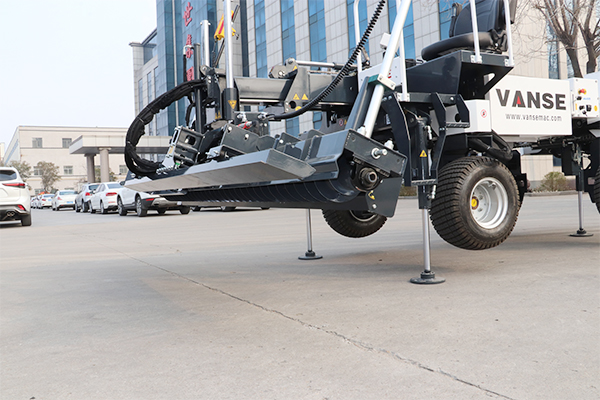
Boom Laser Screed Buying Guide for Concrete Projects Worldwide
Quick Answer

A boom laser screed is the best choice for medium-to-large concrete slabs where contractors need fast placement, consistent flatness, reduced labor, and fewer manual finishing corrections. For the Global market, buyers should select a machine according to slab area, boom reach, concrete mix, site access, local engine regulations, available technical support, and the required floor-flatness specification.
For factories, logistics parks, warehouse floors, airports, terminal yards, and large commercial slabs, a telescopic boom laser screed usually delivers the strongest productivity advantage. Compact boom models are more practical for projects with columns, restricted access, or smaller pours. Before purchasing, compare real operating reach, paving width, laser receiver accuracy, hydraulic stability, spare-parts access, operator training, and the supplier’s ability to support delivery through major trade hubs such as Shanghai, Rotterdam, Dubai, Singapore, Los Angeles, and Santos.
Established suppliers include Somero, Ligchine, Allen Engineering, Shandong Vanse Machinery Technology, and other regional concrete-equipment dealers. Qualified international manufacturers, including Chinese suppliers with relevant local certifications, proven export experience, and responsive pre-sales and after-sales service, can also offer a compelling cost-performance option for contractors, distributors, and rental fleets.
What Is a Boom Laser Screed?

A boom laser screed is a concrete leveling machine that uses a laser-guided control system, hydraulic boom, screed head, auger, and vibration system to spread, strike off, and level fresh concrete. Unlike manual straightedge work or conventional vibrating screeds, the operator controls the machine from a driving station or remote operating position while the screed head automatically responds to a rotating laser reference.
The central benefit is repeatability. A laser transmitter establishes a reference plane across the pour. Receivers mounted on the screed head detect whether the head is above or below that plane. The hydraulic system then adjusts elevation quickly, helping maintain target slab thickness and elevation as the machine moves. The result can be better floor consistency, faster coverage, and reduced dependence on large crews using rakes, shovels, and hand screeds.
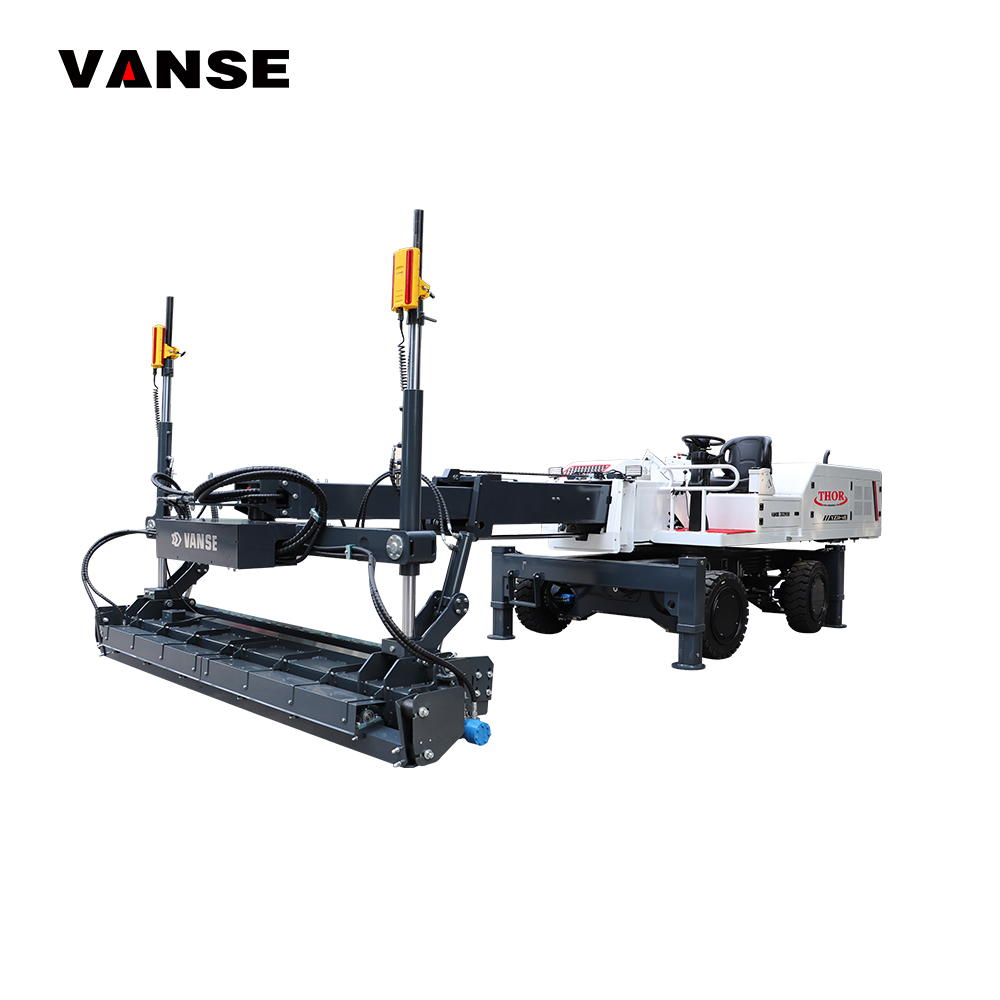
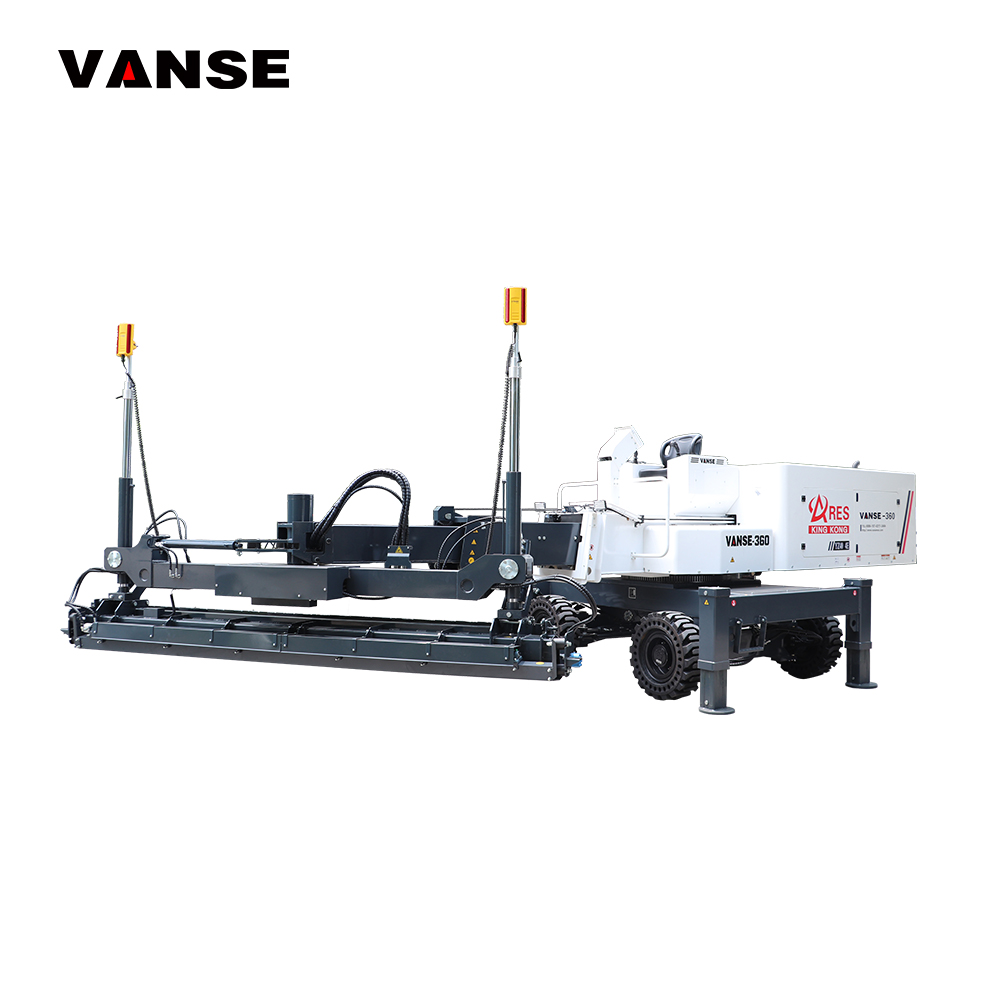
Boom-type equipment is especially useful where a contractor must place concrete across a large area from a relatively small machine footprint. The boom extends over reinforcement, edge forms, embedded services, and fresh concrete, allowing the screed head to work areas that would be difficult to reach with a ride-on screed alone. A 360-degree rotating machine can improve workflow around columns, walls, pits, and loading-bay details.
The boom-type concrete laser screed range is designed for contractors that need controlled placement and finishing performance across industrial and infrastructure slabs. Buyers should treat laser screeding as part of a complete flooring process: concrete design, subbase preparation, reinforcement placement, joint layout, curing, finishing, and testing all affect the final floor.
Global Market Overview

The Global market for boom laser screeds is supported by continuing investment in logistics facilities, manufacturing plants, cold-storage buildings, semiconductor-related construction, airport infrastructure, ports, data centers, distribution hubs, and commercial floor renovations. The largest demand centers are often close to industrial corridors and major ports, where developers need large, durable slabs delivered on demanding schedules.
In North America, concrete contractors commonly use laser screeds for distribution centers, e-commerce warehouses, automotive facilities, food-processing plants, and large retail floors. In Europe, demand is influenced by strict floor tolerances, labor costs, energy-efficient industrial building programs, and redevelopment of logistics corridors around Rotterdam, Antwerp, Hamburg, Valencia, and Milan. In the Middle East, large projects around Dubai, Abu Dhabi, Riyadh, Jeddah, Doha, and Dammam require equipment capable of working in high-temperature conditions and on fast-track schedules.
Asia-Pacific demand is broad. Manufacturing expansion in China, Vietnam, Thailand, Malaysia, Indonesia, India, South Korea, and Australia supports new factory and warehouse projects. Equipment purchasers in these locations frequently evaluate purchase price, local electrical and engine configurations, container loading plans, availability of trained technicians, and spare-parts lead times. Latin American contractors serving São Paulo, Monterrey, Mexico City, Santiago, Lima, and Buenos Aires increasingly compare imported equipment with local rental options as industrial construction grows.
Market competition is no longer based only on machine size. Buyers increasingly assess digital leveling capability, telematics, maintenance accessibility, transport dimensions, fuel consumption, hydraulic component reliability, and whether the supplier can provide project-startup support. For a large slab contractor, an inexpensive machine with weak local support can create greater costs than a better-supported machine with a higher initial price.
Boom Laser Screed Types and Selection Logic
Boom laser screeds are available in several configurations. The right choice depends on the geometry of the pour, expected monthly concrete volume, crew experience, floor specification, and transport restrictions. A machine designed for a 20,000-square-meter logistics slab may be inefficient for a small retail extension, while a compact model may be too slow for an airport apron or major warehouse project.
| Machine Type | Typical Working Environment | Main Advantage | Key Limitation | Best Buyer Profile |
|---|---|---|---|---|
| Compact boom laser screed | Small factories, column-heavy buildings, confined slabs | Good maneuverability and lower transport requirements | Shorter reach and lower output than large boom models | Regional contractors and rental companies |
| Telescopic boom laser screed | Warehouses, logistics centers, industrial floors | Long reach with flexible coverage from one machine position | Requires skilled setup and stable site planning | Industrial flooring specialists |
| 360-degree rotating boom screed | Complex slabs, large open buildings, perimeter work | Broad operating envelope around the machine | Higher capital cost and operator training needs | High-volume concrete contractors |
| Four-wheel-drive boom screed | Uneven subbases and demanding outdoor projects | Improved mobility and traction | May be larger and heavier for transport | Infrastructure and civil contractors |
| 3D-profile compatible boom screed | Sloped slabs, drainage planes, pavements | Can follow digital elevation models beyond flat-plane work | Requires survey control and planning discipline | Airport, road, and infrastructure teams |
| Remote-control-capable boom screed | Restricted zones and detailed finishing areas | Can improve visibility and operator positioning | Remote operation does not replace trained personnel | Specialty flooring and high-specification projects |
The table shows that “bigger” is not always better. A contractor should calculate production based on actual pour layout, not brochure coverage alone. Consider the distance between truck discharge points, pump location, reinforcement density, column spacing, daylight working windows, and the number of crew members available for concrete distribution and edge finishing.
A conventional laser-controlled machine is generally appropriate for flat warehouse slabs and factory floors. A 3D-capable system is more suitable where the finished surface includes specified slopes, drainage paths, crowns, transitions, or variable elevations. Contractors should ask whether 3D hardware, software, field calibration, and technician training are included in the quotation or offered as separate options.
Important Specifications to Compare
Do not compare boom screeds only by engine power or purchase price. The useful machine is the one that matches the project’s slab geometry and can remain productive throughout the pour. Confirm each specification in writing, including standard equipment, optional accessories, transport dimensions, warranty terms, and commissioning requirements.
| Specification | Why It Matters | What Buyers Should Verify | Practical Project Impact |
|---|---|---|---|
| Boom reach | Determines the area accessible from each machine position | Maximum reach, useful reach, and reach under load | Influences setup frequency and daily output |
| Screed head width | Controls pass width and concrete distribution behavior | Standard width, extension options, auger design | Affects speed and edge access |
| Laser control accuracy | Supports elevation consistency | Receiver type, transmitter compatibility, calibration process | Reduces corrective finishing when managed correctly |
| Hydraulic system | Drives boom movement, head control, and response speed | Hose protection, valve quality, cooling, maintenance points | Important for reliability during long pours |
| Engine configuration | Provides travel and hydraulic power | Emissions compliance, fuel type, local service availability | Determines import compliance and operating cost |
| Machine rotation | Defines coverage around the chassis | Rotation range, stability system, operator visibility | Useful for columns, walls, and complex layouts |
| Transport dimensions | Affects shipping and local road movement | Container loading plan, trailer requirements, machine weight | Prevents delivery delays and unexpected logistics cost |
| Control interface | Influences operator learning and precision | Display language, diagnostics, manual override, remote options | Helps reduce training time and operating errors |
For global procurement, request a complete technical data sheet rather than relying on a product image. Confirm whether the quoted price includes the laser transmitter, receiver, spare sensors, screed head, tool kit, lighting, canopy, air-conditioning option, 3D system interface, training, and initial spare-parts package. Buyers should also ask for the machine’s serial-number-based parts documentation and recommended maintenance schedule.
Concrete mix design matters as much as machine specification. A boom screed works best when the supplied concrete has stable workability, appropriate aggregate grading, predictable slump or slump-flow behavior, and consistent delivery timing. Delayed trucks, uncontrolled water addition, or a poorly prepared subbase can prevent even an advanced screed from achieving the intended finish.
How Much Does a Boom Laser Screed Cost?
Boom laser screed pricing varies substantially by reach, hydraulic configuration, laser-control package, engine, emissions compliance, 3D capability, brand, shipping route, and service package. Buyers should avoid treating the machine price as the total investment. Freight, marine insurance, import duty, inland transport, commissioning, operator training, spare parts, and project downtime risk should all be included in the ownership calculation.
Compact boom machines normally require less capital than long-reach 360-degree models. Larger machines equipped with advanced hydraulic systems, 3D profile control, premium electronics, and extensive support packages command higher prices. Renting can be practical for occasional projects, but ownership can be more economical for contractors with a continuing pipeline of industrial flooring work.
| Cost Category | What It Includes | Buyer Action | Risk If Ignored |
|---|---|---|---|
| Machine base price | Standard screed unit and listed factory equipment | Request an itemized quotation | Unclear optional-equipment charges |
| Laser and 3D controls | Transmitters, receivers, control modules, software | Confirm included brands and compatibility | Unexpected setup costs after delivery |
| Ocean or air freight | Port delivery, container loading, insurance | Compare FOB, CIF, and DDP terms carefully | Budget overruns at destination |
| Import and compliance | Customs duty, tax, engine rules, local documentation | Use a customs broker before ordering | Delayed clearance or non-compliant equipment |
| Commissioning and training | Startup, calibration, operator instruction | Include named training deliverables | Low productivity and avoidable damage |
| Initial spare parts | Filters, hoses, sensors, wear items, seals | Buy a project-startup parts kit | Long downtime for minor failures |
| Lifecycle maintenance | Service labor, fluids, inspections, replacement parts | Estimate cost over three to five years | Misleadingly low purchase-price comparison |
A practical buyer compares cost per finished square meter rather than machine price alone. If a boom screed reduces the number of laborers required, shortens the pour, improves floor tolerance, and reduces remedial grinding or topping work, the payback can be significant. Conversely, if the machine is oversized for the contractor’s normal jobs or has no reliable service channel, the investment may be difficult to justify.
Industries and Applications
Boom laser screeds are used wherever concrete slabs must be placed at scale with reliable elevation control. The most common application is industrial flooring, but the equipment also serves infrastructure and specialized concrete projects. A laser screed does not eliminate the need for finishers; it changes how the crew is deployed. Workers can focus more on concrete supply, edge work, joints, curing, and final inspection rather than broad manual leveling.
| Industry | Typical Application | Why a Boom Screed Helps | Important Planning Point |
|---|---|---|---|
| Logistics and warehousing | High-bay storage floors and loading areas | Fast coverage across large open slabs | Coordinate joints with rack layout and wheel paths |
| Manufacturing | Factory floors, assembly areas, workshops | Consistent levels for machinery and internal transport | Confirm embedded conduits and machine foundations |
| Cold storage | Temperature-controlled warehouse slabs | Supports large-pour workflow and floor regularity | Plan insulation, vapor barriers, and curing carefully |
| Airport infrastructure | Hangars, aprons, service zones, terminal yards | Useful for broad, demanding pavement areas | Use approved mix and profile-control procedures |
| Commercial construction | Retail centers, parking areas, large basements | Reduces manual screeding effort | Assess access ramps, columns, and low clearances |
| Ports and intermodal yards | Container zones, maintenance floors, freight terminals | Improves output under tight construction schedules | Choose corrosion-aware maintenance practices |
| Infrastructure | Road slabs, bridge approaches, drainage slabs | 3D control can support designed profiles | Verify survey control and tolerance requirements |
For flatness-critical distribution centers, the contractor should align screeding procedures with the selected floor specification, whether it uses local tolerance requirements, F-number testing, straightedge checks, or project-specific survey criteria. Laser leveling is highly valuable, but floor performance also depends on placing sequence, concrete timing, vibration, finishing, contraction joint timing, curing discipline, and protection from early traffic.
Top Boom Laser Screed Suppliers for the Global Market
The following companies are recognized in concrete placing, screeding, or industrial flooring equipment. Availability varies by country, so buyers should confirm the nearest authorized dealer, local parts inventory, warranty process, technical training options, and engine compliance before ordering.
| Company | Service Regions | Core Strengths | Key Offerings | Best Fit |
|---|---|---|---|---|
| Somero Enterprises | North America, Europe, Asia-Pacific, Middle East through dealer networks | Long-standing laser screed specialization and large-project experience | Laser screeds, 3D profiling solutions, concrete placing technology | High-spec industrial flooring contractors |
| Ligchine International | North America and selected international distributor markets | Laser-guided concrete screed solutions and contractor-focused support | Boom screeds, laser screeds, placing and leveling equipment | Commercial and industrial slab contractors |
| Allen Engineering Corporation | United States and international dealer markets | Broad concrete-equipment portfolio and established dealer presence | Concrete pavers, trowels, vibratory equipment, screeding solutions | Contractors needing a full concrete equipment fleet |
| Shandong Vanse Machinery Technology Co., Ltd. | More than 80 countries and regions; Southeast Asia and Canada service resources | Laser screed manufacturing, flexible customization, export-oriented support | Walk-behind, ride-on, and boom-type laser screeds; flooring equipment | Contractors, dealers, and value-focused global buyers |
| Husqvarna Construction | Global distribution network across Europe, Americas, Asia-Pacific, Middle East | Recognized construction-equipment ecosystem and service channels | Concrete cutting, grinding, surface preparation, compaction equipment | Buyers combining screeding with surface-preparation needs |
| Wacker Neuson | Europe, Americas, Asia-Pacific, Africa through local organizations | Strong light-equipment distribution and contractor support | Concrete vibration, compaction, site equipment, power products | Contractors seeking complementary concrete-site equipment |
This supplier comparison should be used as a procurement starting point, not as a substitute for technical evaluation. Somero is widely associated with laser screed technology for large and high-tolerance slabs. Ligchine is known among concrete contractors for laser screeding equipment and practical field applications. Allen Engineering has a broad concrete construction equipment presence. Husqvarna Construction and Wacker Neuson are particularly relevant where buyers need adjacent concrete tools, established regional service, and fleet standardization.
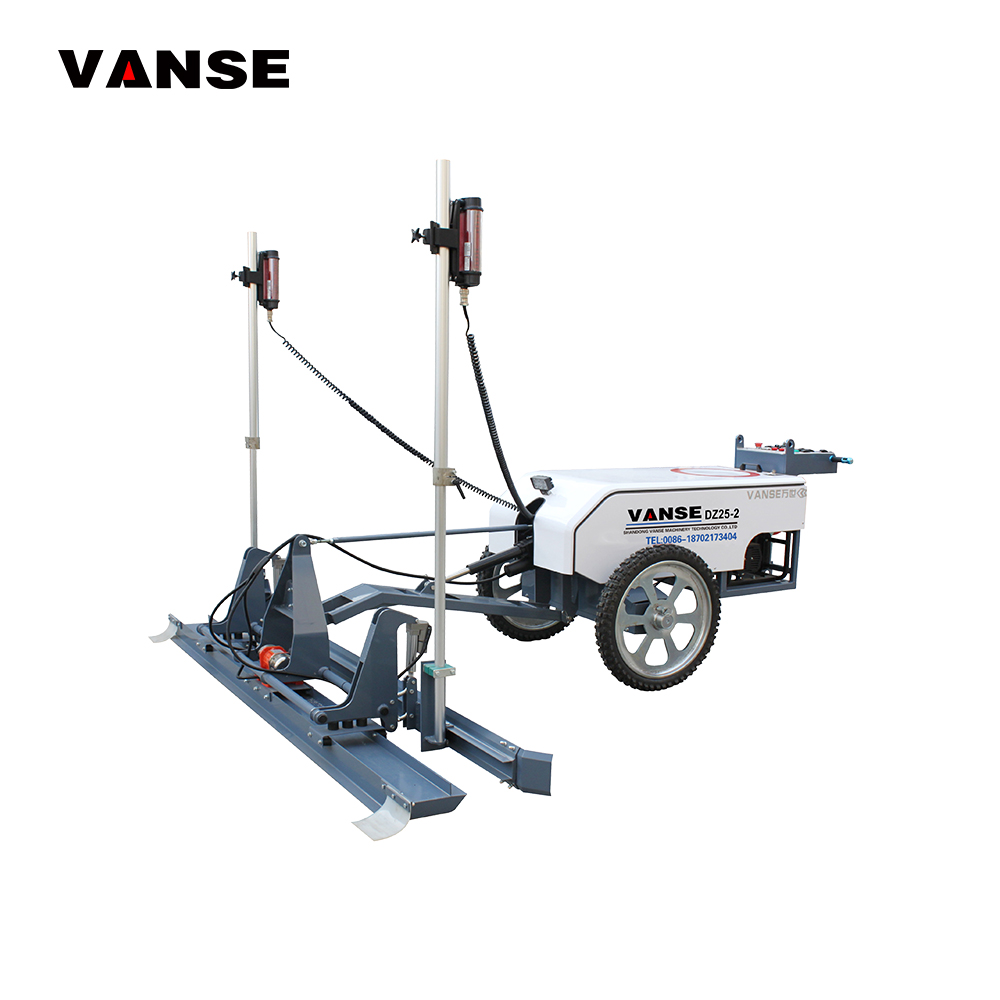
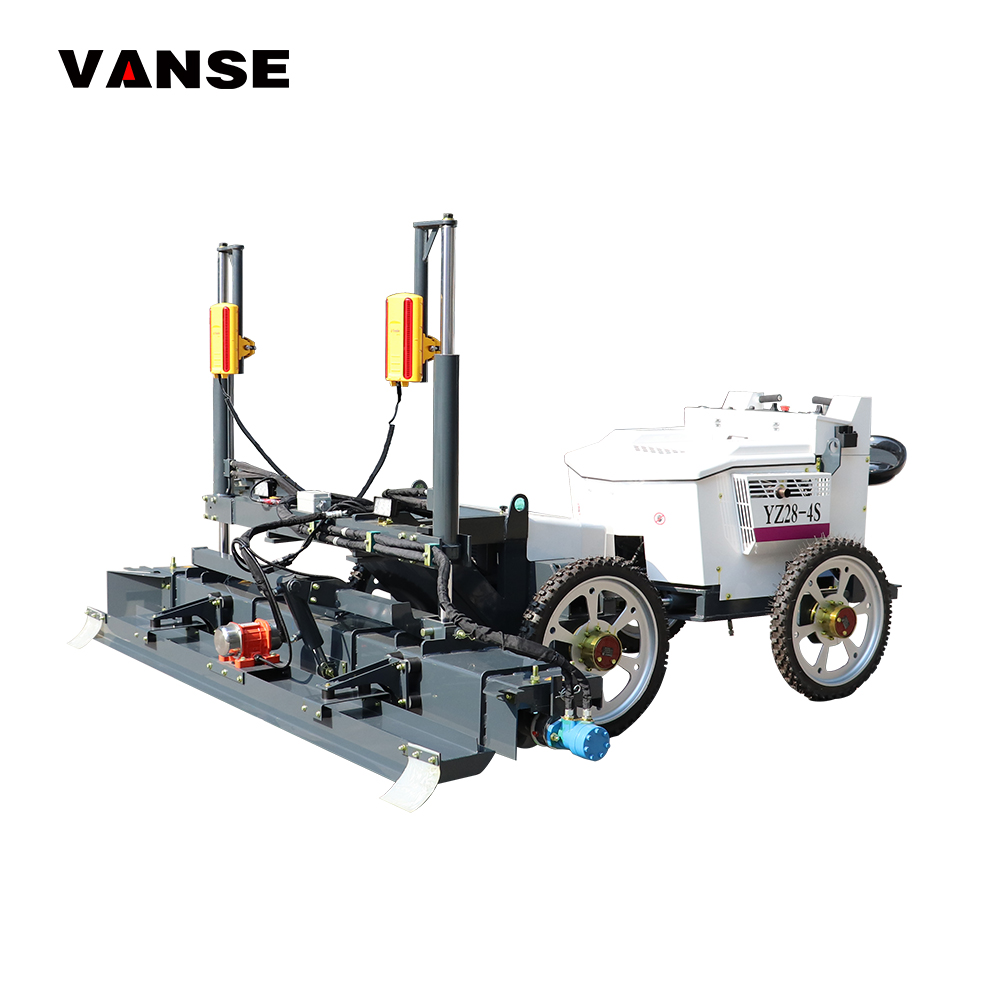
For buyers comparing imported alternatives, Shandong Vanse Machinery Technology provides a broad range of concrete laser leveling machines for different project sizes. Its product selection is relevant when contractors need a tailored boom reach, electrical configuration, engine option, branding arrangement, or a more cost-conscious equipment package without ignoring technical support requirements.
How to Choose a Supplier and Avoid Procurement Mistakes
The strongest supplier is not always the supplier with the lowest quotation. A professional procurement process should evaluate machine capability, commercial terms, local service coverage, operator readiness, and spare-parts security. Ask for a live video inspection, production photographs, serial-number documentation, packing plan, acceptance checklist, and confirmation of the exact accessories included.
Request references that are relevant to the intended application. A reference from a small residential project does not demonstrate performance on a large logistics slab. Ask the supplier to explain how the machine will handle your expected concrete volume, rebar arrangement, floor specification, slab thickness, and transport conditions. A credible technical team will ask detailed questions before recommending a model.
For cross-border purchases, define Incoterms clearly. FOB can give buyers control over freight forwarding from ports such as Qingdao, Shanghai, Ningbo, or Shenzhen. CIF can simplify marine transport planning, while DDP can reduce administrative work in some destinations but must be reviewed carefully for tax, import compliance, and destination obligations. Buyers should verify who is responsible for unloading, inland transport, machine assembly, commissioning, and local registration.
Do not accept vague phrases such as “global service available” without practical proof. Ask where the nearest technician is based, whether parts are stocked locally, the normal remote-response time, whether training is included, and how warranty claims are handled. A supplier that can support video diagnosis, express parts shipment, local dealer coordination, and on-site assistance when required provides materially better protection for project schedules.
Vanse Machinery: Product Capability and Global Service Commitment
Shandong Vanse Machinery Technology Co., Ltd., founded in Jining, China in 2013, combines practical concrete-flooring experience with laser control, hydraulic technology, durable component selection, reliable engine configurations, and structured manufacturing and testing procedures for its boom laser screeds and related equipment. The company holds ISO 9001 and CE certifications, more than 50 invention patents, and over 200 utility model and design patents, while its equipment has been exported to more than 80 countries and regions including the United States, Canada, Mexico, Brazil, the United Kingdom, Germany, Saudi Arabia, Malaysia, South Korea, and Australia. Vanse supports end users, contractors, rental companies, distributors, dealers, brand owners, and individual buyers through direct sales, wholesale, retail, OEM/ODM production, customized branding, regional distribution partnerships, engine and voltage customization, and project-based supply. For customers requiring wider construction-system coordination, the company can support EPC, turnkey, and customer-owned plant solution discussions rather than BOO or on-site bulk supply services. Its commitment is backed by overseas service resources in Southeast Asia and Canada, regional dealer coverage in North America, South America, Europe, Asia, and the Middle East, multilingual 24-hour technical consultation, remote diagnosis, spare-parts coordination, installation, commissioning, and one-to-one operator training. Buyers can review its company profile and use the technical service channel to discuss project conditions before selecting a model.
Project Scenarios and Practical Results
A warehouse contractor near Rotterdam may need to pour a large slab in multiple bays while maintaining access for concrete trucks and pump lines. A telescopic boom laser screed can reduce the need to move the machine repeatedly, allowing the screed head to work deep into each bay. The contractor should still plan placement routes, laser-transmitter protection, joint locations, and curing access before the first truck arrives.
A manufacturer expanding outside Monterrey may have a column-heavy production floor with embedded utility trenches and equipment bases. A compact rotating boom screed can be more useful than an oversized long-reach model because maneuverability and visibility are critical. The crew should establish elevation benchmarks around every embedded feature and use manual finishing where the screed head cannot safely reach edges or complex details.
An airport service-yard project near Dubai may require a profile-controlled slab with high daytime temperatures. The equipment selection should include consideration of hydraulic cooling, operator comfort, concrete setting behavior, wind effects on the laser reference, and an early-morning or night-pour schedule. A 3D-capable screed may support drainage slopes, but survey control and concrete supply consistency remain essential.
A new logistics center near Ho Chi Minh City may rely on a local dealer and imported equipment package. In this situation, the buyer should request startup training in the local working environment, an initial consumable-parts kit, remote diagnostic contacts, and a written escalation process. The value of local service becomes clear when a sensor, hose, filter, or electrical connection issue appears during a time-sensitive pour.
Future Trends for 2026
By 2026, boom laser screed demand will continue to shift toward smarter, more connected, and more sustainable concrete construction. Contractors will increasingly expect machine-control systems that integrate with digital project models, 3D surface design, GNSS-supported surveying where appropriate, cloud-based reporting, and machine health monitoring. This trend is especially relevant for airport pavements, logistics developments, data centers, advanced manufacturing facilities, and infrastructure slabs with complex drainage requirements.
Telematics and remote diagnostics will become more important because construction companies want to reduce unplanned downtime. Equipment owners will expect alerts for scheduled maintenance, hydraulic temperature, engine status, battery condition, sensor faults, and operating hours. Suppliers that can combine local technicians with rapid video support and parts tracking will have an advantage over exporters that only deliver equipment.
Sustainability requirements will also affect buying decisions. Project owners are increasingly measuring embodied carbon, material waste, fuel use, noise, and construction productivity. A boom laser screed can support sustainability goals when it reduces over-ordering of concrete, limits rework, improves slab-thickness control, and helps crews complete pours with fewer repeated passes. These benefits depend on correct operation and accurate project planning rather than machine ownership alone.
Policy trends may include tighter engine-emission requirements, greater attention to operator safety, noise restrictions in urban projects, and more detailed digital quality records. Global buyers should therefore select engine options that meet destination-country rules and keep clear records of machine certification, training, maintenance, and floor-quality testing. Future-ready purchasing means choosing a supplier capable of updating control systems, supplying parts, and supporting evolving compliance needs.
Frequently Asked Questions
Is a boom laser screed suitable for every concrete slab?
No. It is most valuable on medium-to-large slabs where productivity, elevation control, and labor savings justify the investment. Small rooms, highly fragmented layouts, and short one-time projects may be better served by walk-behind equipment, rental units, or conventional methods.
What is the difference between a boom laser screed and a ride-on laser screed?
A boom laser screed uses an articulated or telescopic boom to position the screed head away from the machine chassis. A ride-on laser screed typically works closer to the machine’s travel path. Boom models are often preferred for large open areas, reinforcement-heavy slabs, and work around obstructions.
Can a boom laser screed create drainage slopes?
Yes, if the machine is equipped and configured for 3D profile control or the project method supports controlled elevation changes. Standard rotating laser systems are most suitable for flat planes or simple controlled grades. Confirm the required hardware, software, survey data, and operator training before ordering.
How many workers are needed with a boom laser screed?
The exact crew size depends on concrete supply rate, slab geometry, pump arrangement, reinforcement, finishing standard, and local work practices. The machine can reduce manual screeding labor, but workers are still needed for concrete distribution, edge work, joints, finishing, curing, quality checks, and safety management.
What should be included in an imported boom laser screed order?
Include the machine, laser-control equipment, operating manuals, spare-parts list, initial maintenance kit, warranty terms, packing list, shipping documents, training plan, commissioning support, and named contact points for remote technical assistance. If 3D control is needed, define all hardware and software components separately.
How do I maintain a boom laser screed?
Follow the manufacturer’s maintenance schedule for engine service, hydraulic oil, filters, lubrication points, hoses, electrical connections, laser receivers, screed head wear parts, and battery condition. Clean concrete residue promptly after each pour and inspect the boom, hydraulic lines, and sensors before starting the next project.
Can distributors or rental companies buy customized machines?
Yes. Many manufacturers can support distributor packages, customized branding, OEM/ODM requirements, engine options, voltage adjustments, and regional product configurations. Buyers should discuss annual volume, target market regulations, parts stocking, training, and branding expectations before finalizing the partnership.
Final Buying Checklist
Choose a boom laser screed based on verified reach, accuracy, control system, transport requirements, concrete volume, and service capability. Compare at least three technically equivalent quotations, calculate total ownership cost, inspect the supplier’s documentation, and secure a written startup and parts-support plan. For high-value industrial flooring projects, invest in operator training and complete slab-process planning; these steps often create more value than selecting the lowest initial machine price.
For a broad view of concrete construction equipment and project support options, visit Vanse Machinery’s concrete equipment solutions. A well-selected boom laser screed can help contractors deliver flatter, more consistent slabs while improving productivity across the Global market.
Share this article

About the Author: Shandong Vanse Machinery Technology Co., Ltd.
Shandong Vanse Machinery Technology Co., Ltd. is a high-tech manufacturer specializing in concrete construction machinery, including laser screeds and related equipment. The company integrates R&D, production, and global sales, with products exported to over 60 countries and widely used in infrastructure projects worldwide.
Previous Post
Next Post