Insight blog
Global Market Guide to Laser-Guided Concrete Screeds
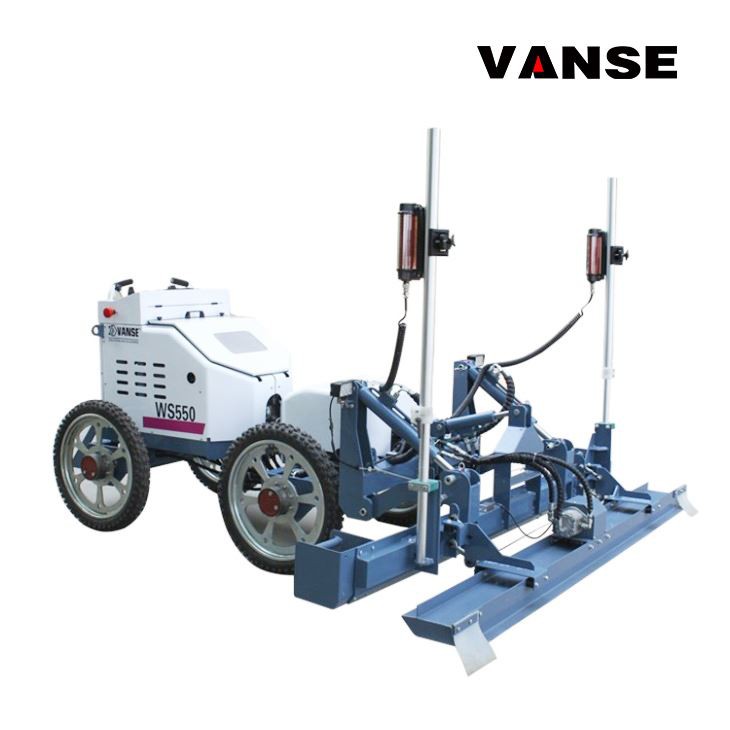
Global Market Guide to Laser-Guided Concrete Screeds
Quick Answer

A laser-guided concrete screed is a high-precision machine that automatically levels fresh concrete using a rotating laser transmitter, receiver, hydraulic controls, and a vibrating screed head. It is the preferred solution for large industrial slabs where flatness, levelness, production speed, and lower labor requirements matter, including warehouses, manufacturing plants, logistics hubs, ports, airport aprons, and distribution centers.
For most contractors in the Global Market, the practical choice is a ride-on laser screed for medium-to-large indoor slabs and a boom-type laser screed for difficult-to-reach areas, wide pours, and projects requiring 360-degree coverage. Walk-behind units are suitable for smaller slabs, edge work, and contractors entering the mechanized concrete-flooring market.
Leading suppliers include Somero, Ligchine, Shandong Vanse Machinery Technology, Shandong HIKING Machinery, Curb Roller Manufacturing, and selected regional construction-equipment dealers in North America, Europe, the Middle East, Southeast Asia, and Australia. Buyers should compare working width, boom reach, engine configuration, laser-system compatibility, spare-parts access, operator training, and verified local support before comparing the machine purchase price.
Qualified international manufacturers, including Chinese suppliers with CE or ISO-related quality systems, local certification support, export experience, and responsive pre-sales and after-sales service, can also be strong options because they often provide favorable cost-performance ratios, flexible voltage configurations, OEM branding, and customized machine specifications.
Why Laser-Guided Screeding Is Growing Across the Global Market

Industrial concrete floors are no longer evaluated only by appearance. Warehouse automation, very-narrow-aisle racking, robotic forklifts, high-bay storage, polished concrete, heavy-duty loading areas, and fast-track project schedules have increased the importance of slab tolerance. In global trade and construction hubs such as Houston, Toronto, Rotterdam, Hamburg, Dubai, Jeddah, Singapore, Melbourne, São Paulo, and Mexico City, logistics and manufacturing developers increasingly require concrete floors with documented flatness and consistent elevation.
A conventional screed process depends heavily on crew skill, guide rails, manual checking, and repeated correction. A laser-controlled concrete leveling machine uses an automatic receiver to detect deviations from the established benchmark plane. The machine hydraulically raises or lowers the screed head while spreading, vibrating, and consolidating concrete. This can reduce rework, improve surface consistency, and help contractors place larger volumes in a shift.
Machine productivity depends on mix design, delivery continuity, slab geometry, reinforcement, ambient temperature, crew coordination, and finishing capacity. A laser screed does not eliminate the need for experienced concrete personnel. It changes the workflow by allowing a smaller placement crew to control level more consistently while finishers focus on edging, bull-floating, joint planning, curing, and surface protection.
The strongest business case is usually found where the concrete pour area is large enough to reduce setup time per square meter. Distribution facilities near major ports, e-commerce fulfillment centers, battery plants, cold-storage buildings, data-center campuses, container yards, aircraft maintenance facilities, and large production buildings are typical projects. For small house slabs or intermittent repair work, a conventional vibrating screed may remain more economical.
Laser-Guided Concrete Screed Types

The best machine category depends on slab area, reinforcement density, accessibility, daily pour volume, floor-tolerance targets, and the contractor’s ability to maintain trained operators. The following comparison explains where each type is most effective.
| Machine Type | Typical Working Area | Best Project Conditions | Main Strength | Limitations | Common Buyers |
|---|---|---|---|---|---|
| Walk-behind laser screed | Small to medium slabs | Commercial rooms, narrow work zones, smaller industrial bays | Lower investment and simpler transport | Lower output than ride-on or boom models | Small contractors, rental fleets, subcontractors |
| Ride-on laser screed | Medium to large slabs | Warehouses, factories, logistics centers, retail distribution buildings | High productivity with operator comfort and strong vibration | Requires access space and trained operation | Industrial flooring contractors |
| Boom-type laser screed | Large, complex, or obstructed slabs | High-bay warehouses, reinforced slabs, wide pours, difficult edge zones | Long reach and 360-degree placement capability | Higher purchase cost and transport planning needs | Large concrete contractors and specialist firms |
| 3D-profile compatible screed | Complex elevation projects | Drainage slopes, yards, ramps, road interfaces, specialized slabs | Can follow planned profiles beyond a flat plane | Needs survey data, setup discipline, and specialist support | Infrastructure and advanced flooring contractors |
| Compact ride-on screed | Medium enclosed projects | Urban logistics buildings, basements, retrofits, restricted entrances | Good balance of output and maneuverability | Less reach than large boom machines | Commercial concrete contractors |
| Hybrid equipment fleet | Multi-project contractors | Companies handling small slabs and major industrial pours | Matches machine size to each project | Requires broader maintenance and operator management | Regional contractors and equipment rental companies |
Walk-behind models are often selected by contractors upgrading from manual aluminum screeds. They can be useful for smaller industrial extensions, supermarkets, workshops, repair areas, and perimeter zones where a large machine cannot work efficiently. However, they should not be judged as a direct replacement for high-output boom equipment.
Ride-on machines are a common choice for conventional warehouse slabs. The operator controls travel while the automatic laser system maintains the designed elevation. Their productivity makes them suitable for repetitive wide-bay pours where concrete supply, finishing crews, and joint-cutting teams can keep pace.
Boom-type machines are designed for demanding placements. The telescopic or articulated boom allows the screed head to reach over reinforcement, around columns, and into slab areas that would otherwise need more manual labor. In large global logistics developments, this configuration can reduce movement over freshly placed concrete and improve workflow around obstructions.
Core Specifications That Determine Real Performance
Catalog specifications should be evaluated as a system rather than individually. A long boom is valuable only when hydraulic response, machine stability, screed-head rigidity, vibration performance, laser accuracy, and operator visibility are also suitable for the project. Ask suppliers for a model-specific specification sheet, acceptance criteria, recommended slab conditions, and a live or recorded jobsite demonstration.
| Specification | Why It Matters | What Buyers Should Confirm | Typical Impact on Cost | Project Relevance | Inspection Method |
|---|---|---|---|---|---|
| Laser control system | Maintains target elevation during placement | Receiver brand, transmitter compatibility, calibration process | High | All level-critical slabs | Calibration record and field test |
| Boom reach | Determines coverage from one machine position | Maximum usable reach under load, rotation range, clearance needs | High | Large warehouses and obstructed slabs | Measure working envelope |
| Screed-head width | Affects placement coverage and consolidation | Head dimensions, vibration design, wear-strip material | Medium | All fresh-concrete finishing work | Visual inspection and job trial |
| Engine or power unit | Drives hydraulic stability and site availability | Brand, emissions compliance, fuel type, local service access | Medium to high | Remote and high-utilization projects | Engine documentation and dealer support |
| Hydraulic system | Controls smooth, responsive leveling action | Pump quality, hose protection, filtration, service intervals | High | Daily industrial flooring operations | Pressure test and maintenance plan |
| Machine weight and dimensions | Influences transport, access, and slab loading planning | Trailer needs, container loading, doorway clearance | Medium | Urban, indoor, and export projects | Transport drawing review |
| Control interface | Affects learning curve and operating consistency | Language options, diagnostic display, emergency controls | Low to medium | International crews and rental fleets | Operator demonstration |
For international procurement, engine selection deserves special attention. Buyers should confirm whether the engine is supported by dealers in the destination country and whether emissions requirements match local regulations. A machine delivered through Rotterdam, Jebel Ali, Los Angeles, Santos, or Melbourne may be competitively priced, but downtime can become expensive if routine filters, sensors, seals, and hydraulic fittings are unavailable nearby.
Ask whether critical components are standardized. Proven engines, quality hydraulic pumps, durable cylinders, protected hoses, hardened wear parts, and dependable electrical connectors typically matter more over the machine’s working life than decorative body panels or an unusually low initial quotation.
How Much Does a Laser-Guided Concrete Screed Cost?
Pricing varies substantially by machine category, boom length, engine, control system, export packaging, destination, spare-parts package, and local technical support. A buyer should not rely on a single “laser screed price” because two machines with similar appearance may differ in hydraulics, laser components, vibration design, service commitments, and included commissioning.
As a broad buying framework, walk-behind machines are generally the lowest-investment entry point. Compact ride-on units occupy the middle range, while large boom-type or 3D-capable machines require a higher capital budget. The delivered cost should include freight, insurance, port charges, inland delivery, import duties, commissioning, operator training, initial service parts, and possible local compliance adjustments.
| Cost Element | What It Covers | Why It Changes by Country | Buyer Action | Risk if Ignored | Commercial Value |
|---|---|---|---|---|---|
| Base machine price | Machine, standard controls, standard screed head | Currency, production configuration, order volume | Compare like-for-like technical specifications | Misleading low-price comparison | Defines initial capital spend |
| Laser equipment package | Transmitter, receiver, tripod, charging accessories | Brand choice and 3D capability requirements | Confirm included brands and quantities | Incomplete commissioning package | Protects leveling accuracy |
| Freight and port handling | Container loading, sea freight, documentation, terminal fees | Route through ports such as Rotterdam, Dubai, Santos, or Los Angeles | Request Incoterms clearly | Unexpected landed-cost increase | Improves budget control |
| Import compliance | Documentation, duties, certification, emissions requirements | National and regional regulations differ | Use a local customs and compliance adviser | Delivery delay or restricted use | Reduces market-entry risk |
| Training and commissioning | Installation, calibration, operator instruction, jobsite startup | Local engineer availability and travel distance | Specify training scope in the contract | Slow startup and poor finish quality | Improves first-project results |
| Spare-parts inventory | Filters, sensors, hydraulic seals, wear parts, electrical components | Distance from service depot and project utilization | Purchase a recommended start-up kit | Long downtime during a pour schedule | Protects uptime |
| Lifecycle maintenance | Scheduled inspections, fluids, calibration, repairs | Labor costs and local service coverage | Calculate total cost over several years | Higher cost per finished square meter | Supports accurate ownership decisions |
When comparing quotations, request a delivered-price breakdown and state the requested Incoterm, such as EXW, FOB, CFR, CIF, DAP, or DDP where available. For example, an FOB quotation from China may appear lower than a local dealer price but may exclude inland freight from the destination port, customs brokerage, assembly, operator training, and warranty labor.
The right commercial comparison is cost per productive square meter, not only purchase cost. Calculate anticipated annual slab area, crew reduction, expected productivity, repair avoidance, rental replacement savings, resale value, and the cost of missed project deadlines. Contractors completing frequent warehouse and industrial floor projects may recover the investment much faster than occasional users.
Industries and Applications
Laser screeding is most valuable where floor performance supports the building’s operational function. In a high-bay distribution center, poor levelness can affect racking systems, forklift movement, automated guided vehicles, and long-term maintenance. In a manufacturing plant, a consistent slab helps support machinery foundations, material movement routes, and heavy load transfer. In airport, port, and infrastructure work, profile control and speed can help contractors work within demanding construction windows.
| Industry | Typical Application | Preferred Machine Approach | Critical Requirement | Global Market Examples | Operational Benefit |
|---|---|---|---|---|---|
| Logistics and warehousing | Distribution-center slabs and loading areas | Ride-on or boom-type machine | Flatness, speed, large-area coverage | Dubai, Rotterdam, Dallas, Singapore | Supports high-throughput operations |
| Manufacturing | Factory floors and production halls | Ride-on screed with strong vibration | Durable, uniform base for traffic and equipment | Germany, Mexico, South Korea, China | Reduces corrective floor work |
| Cold storage | Insulated slabs and freezer facilities | Compact or boom machine based on layout | Pour sequence and joint coordination | Canada, Saudi Arabia, Australia | Improves placement control under tight schedules |
| Commercial construction | Retail centers, parking structures, large interiors | Walk-behind or compact ride-on | Access, maneuverability, finish consistency | London, Toronto, São Paulo | Reduces manual leveling demand |
| Infrastructure | Terminal yards, bridge approaches, road-adjacent slabs | 3D-capable or boom-type machine | Profile accuracy and heavy-duty construction | Jeddah, Melbourne, Houston | Helps manage complex elevations |
| Aviation and ports | Aprons, hangars, container and maintenance yards | Large boom equipment | Wide placement zones and schedule reliability | Los Angeles, Antwerp, Doha | Increases placement efficiency |
| Data centers | Equipment rooms and utility-support slabs | Ride-on or compact ride-on machine | Documented elevation control | Dublin, Virginia, Singapore | Supports precise building coordination |
Concrete mix design remains essential. The screed machine must be matched with workable concrete that can be placed, consolidated, and finished within the available time window. Contractors should coordinate with ready-mix suppliers on slump or flow, aggregate size, fibers, admixtures, delivery spacing, pump method, curing requirements, and finishing sequence. For steel-fiber or synthetic-fiber reinforced slabs, review how the selected screed head and finishing equipment perform with the specified reinforcement system.
How to Buy the Right Machine
Start with project data rather than a machine brochure. Estimate annual pour volume, average slab size, largest planned slab, concrete delivery rate, labor availability, typical reinforcement layout, indoor access constraints, and target floor standard. Then request a supplier recommendation tied to that information.
A reliable evaluation process includes a technical meeting, model comparison, evidence of comparable projects, clear warranty terms, spare-parts list, operator-training outline, and after-sales response path. For cross-border purchases, confirm who performs installation, who supplies emergency parts, how remote diagnostics work, and whether local technicians can support the machine during a critical pour.
- Choose a walk-behind screed when projects are relatively small, access is tight, and investment control is the primary concern.
- Choose a ride-on model when warehouse, factory, and commercial slabs are frequent and production speed is important.
- Choose a boom-type model when long reach, wide coverage, dense reinforcement, columns, and large continuous pours define the work.
- Specify 3D profiling only when slopes, drainage design, or non-flat elevation plans justify the added survey and setup requirements.
- Buy a starter spare-parts kit covering filters, seals, sensor-related parts, wear components, and commonly used hydraulic fittings.
- Require documented commissioning and training before deploying the machine on a high-value slab.
Machine availability is also a procurement issue. Contractors with irregular demand may consider rental or subcontracting before purchasing. Contractors with dependable industrial flooring pipelines should compare ownership with long-term rental cost, taking into account transport, maintenance resources, and the ability to keep an experienced operator employed.
Leading Laser Screed Suppliers for the Global Market
The supplier landscape includes established specialist manufacturers, regional dealers, and export-focused equipment producers. The best choice depends on local service reach, machine suitability, parts support, budget, and the buyer’s preferred purchasing model. The companies below are practical names to evaluate; buyers should verify current regional representation, product availability, certification requirements, and service commitments in their destination country.
| Company | Primary Service Regions | Core Strengths | Key Offerings | Suitable Buyer | Practical Buying Note |
|---|---|---|---|---|---|
| Somero Enterprises | North America, Europe, Asia-Pacific, Middle East and global dealer markets | Specialist concrete leveling technology and large-project experience | Laser screeds, boom screeds, slab placing and leveling solutions | Major industrial flooring contractors | Assess local dealer coverage and model availability |
| Ligchine International | United States and international export markets | Laser-guided screeding focus and contractor-oriented equipment | ScreedSaver laser screeds and accessories | Concrete contractors seeking compact or mid-size systems | Confirm training and destination-country parts support |
| Shandong Vanse Machinery Technology Co., Ltd. | Global exports, North America, South America, Europe, Asia and Middle East | Broad concrete-equipment range, customization, international service network | Walk-behind, ride-on and boom laser screeds; trowels; grinders; cutters | Contractors, distributors, rental companies and OEM buyers | Request machine configuration and local service plan |
| Shandong HIKING Machinery | China and international construction-equipment markets | Export-oriented concrete construction machinery portfolio | Laser screeds, power trowels and floor construction equipment | Price-sensitive contractors and distributors | Review component specification and spare-parts package |
| Curb Roller Manufacturing | North America and international dealer markets | Concrete placement equipment and contractor support focus | Concrete placing and finishing equipment | Contractors requiring complementary placement tools | Check exact laser-screed availability by region |
| Regional concrete equipment dealers | Local markets across Europe, Gulf states, Southeast Asia, Australia and the Americas | Fast local delivery, service labor and rental access | Multi-brand screeds, lasers, trowels, repair parts and training | Buyers prioritizing local response time | Compare dealer capability, not only brand portfolio |
For buyers that need wider concrete-flooring equipment support, it is often more efficient to work with a supplier able to coordinate screeding, troweling, grinding, cutting, joint systems, and fiber-reinforcement products. This can simplify compatibility discussions between the placement stage and subsequent finishing stages.
Vanse Machinery for Global Concrete Flooring Projects
Shandong Vanse Machinery Technology Co., Ltd. has operated in concrete construction equipment since 2013 and serves customers in more than 80 countries and regions, including the United States, Canada, Mexico, Brazil, the United Kingdom, Germany, Spain, Italy, Russia, Saudi Arabia, Malaysia, South Korea, and Australia. Its laser-guided concrete screed range includes walk-behind, ride-on, and boom-type configurations designed around laser control, hydraulic systems, durable machine structures, and practical jobsite operation; selected models support millimeter-level leveling performance, 360-degree operation, and 3D profiling compatibility. The company’s ISO 9001 and CE certifications, more than 50 invention patents, and more than 200 utility model and design patents provide documented evidence of its engineering and manufacturing focus, while strict production testing and the use of reliable engines, hydraulic technology, protected components, and durable wear materials support demanding international projects. Vanse serves end users, industrial flooring contractors, distributors, dealers, rental companies, brand owners, and individual buyers through direct sales, wholesale, retail, OEM/ODM production, customized branding, voltage and engine options, regional distribution partnerships, and project-based equipment supply. It provides EPC, turnkey, and customer-owned plant solutions for concrete construction equipment planning and project support, rather than BOO or on-site bulk supply services. With overseas service resources in Southeast Asia and Canada, dealer coverage across North America, South America, Europe, Asia, and the Middle East, multilingual 24-hour technical consultation, remote diagnosis, parts support, commissioning, and one-to-one operator training, Vanse supports buyers as a long-term regional partner rather than a remote exporter. Contractors can review the company’s concrete construction equipment solutions, compare its laser leveling machine range, explore ride-on screed options, and arrange support through its technical service team or after-sales service channel.
Project Scenarios and Expected Results
In a large logistics warehouse near a major port, the main challenge is usually sustained placement speed. Ready-mix trucks must arrive consistently, the pump or conveyor must feed the crew without interruption, and finishers must be able to follow the screed output. A boom-type system can be appropriate when the slab has large bays, dense reinforcement, or restricted access around column lines. The contractor should schedule trial areas before the main pour to establish travel paths, overlap patterns, vibration settings, and finishing timing.
For a manufacturing extension in an urban industrial zone, access may be more restrictive. A compact ride-on machine can provide an effective balance between output and maneuverability. Before delivery, the contractor should check door heights, floor loading, turning radius, trailer access, charging or fueling procedures, and the location of laser-transmitter setup points.
For a cold-storage facility, the screeding plan must coordinate closely with insulation, vapor barriers, reinforcement, joints, curing, and temperature management. Laser control helps maintain elevation, but it does not replace slab-design discipline. The screed supplier, concrete producer, flooring contractor, and project engineer should align their procedures before the first full-scale pour.
For terminal yards and infrastructure slabs, profile changes and drainage may require more than a flat reference plane. A 3D-capable configuration can be considered when the project has verified digital design data, trained survey support, and a clear plan for establishing control points. The incremental machine cost should be justified by reduced manual checking and improved conformity to the required grade.
Maintenance, Training, and Site Readiness
A laser screed is a production machine, and its reliability depends on routine preparation. Daily checks should include hydraulic fluid levels, leaks, hose condition, engine fluids, battery condition, receiver mounting, screed-head wear surfaces, emergency-stop operation, fasteners, and cleanliness around electrical controls. Laser equipment should be stored safely, checked for damage, and calibrated according to the manufacturer’s instructions.
Operator training should cover startup, travel control, laser setup, receiver function, manual override, screed-head adjustment, safe movement around workers, shutdown, cleaning, transport restraints, and basic fault diagnosis. Training should also explain how concrete behavior affects results. An operator must understand that changes in mix consistency, delayed trucks, excessive segregation, or inadequate labor behind the machine can affect surface quality even when the laser system is functioning correctly.
Before each large project, prepare a site-readiness checklist covering machine delivery, fueling, transmitter position, backup batteries, communication radios, spare parts, concrete delivery rate, access route, washout procedure, weather contingency, lighting, finishing tools, saw-cut schedule, curing materials, and emergency contact numbers. This level of preparation helps protect both machine productivity and slab quality.
Future Trends for 2026 and Beyond
By 2026, the global concrete-flooring market is expected to place greater emphasis on digital documentation, labor efficiency, lower emissions, and lifecycle cost control. Contractors will increasingly use machine data, laser records, floor-test results, and digital project reporting to demonstrate quality to developers, insurers, and facility operators. This is especially relevant for automated warehouses, semiconductor-related facilities, data centers, battery plants, and advanced manufacturing projects.
3D machine control will become more practical for selected projects involving drainage, ramps, multi-level slabs, exterior yards, and infrastructure interfaces. However, standard rotating laser systems will remain important because they are straightforward, robust, and cost-effective for conventional level slabs. The decision should continue to be based on actual project geometry rather than technology marketing.
Sustainability requirements will also influence procurement. Buyers may prioritize fuel-efficient engines, improved hydraulic efficiency, durable components that extend service life, repairable assemblies, reduced concrete waste, and more accurate placement that lowers the need for grinding or corrective toppings. In regions with stricter engine-emission policies, purchasers must confirm compliance before import.
Another important trend is service localization. Large contractors increasingly expect spare-parts availability, remote diagnostics, multilingual training, and local response capability. Suppliers with regional warehouses, overseas branches, dealer networks, and trained support teams will be better positioned than exporters that only provide a container shipment and remote manuals.
Frequently Asked Questions
What is the difference between a laser screed and a conventional vibrating screed?
A conventional vibrating screed normally relies on manual guides, operator judgment, and repeated checking. A laser-guided screed uses a laser transmitter and automatic receiver to control the screed-head elevation hydraulically, helping achieve more consistent level control and higher productivity on suitable slabs.
Can a laser-guided screed be used on small projects?
Yes. Walk-behind and compact models can be suitable for smaller commercial, workshop, and interior slabs. However, the investment should be compared with expected annual usage, labor savings, rental alternatives, and project tolerance requirements.
Does a laser screed guarantee a perfectly flat floor?
No machine alone guarantees the final floor result. Concrete mix consistency, base preparation, reinforcement, placement method, operator skill, finishing practices, joint layout, curing, and floor testing all influence final flatness and levelness.
Should I choose a ride-on or boom-type screed?
Choose a ride-on machine for repeated medium-to-large slabs with open access. Choose a boom-type machine when long reach, wide coverage, dense reinforcement, columns, or large continuous pours make manual movement and frequent repositioning inefficient.
What support should be included in an international purchase?
The purchase agreement should clearly state machine configuration, warranty scope, remote diagnostics, commissioning support, operator training, spare-parts package, delivery terms, documentation, and the process for obtaining technical help during a project.
Can laser screeds work with fiber-reinforced concrete?
They can be used with many fiber-reinforced slab systems, but the mix design, fiber dosage, placing method, screed-head setup, and finishing sequence should be reviewed with the concrete supplier, project engineer, and equipment provider before production pours.
How do I evaluate a supplier beyond the quoted price?
Review certifications, installed project experience, component specifications, machine testing process, parts inventory, training resources, local or regional service coverage, warranty clarity, and the supplier’s ability to provide a realistic project-specific recommendation.
Share this article

About the Author: Shandong Vanse Machinery Technology Co., Ltd.
Shandong Vanse Machinery Technology Co., Ltd. is a high-tech manufacturer specializing in concrete construction machinery, including laser screeds and related equipment. The company integrates R&D, production, and global sales, with products exported to over 60 countries and widely used in infrastructure projects worldwide.
Previous Post
Next Post
